Chef Juliette
Bouillabaisse à la Marseillaise
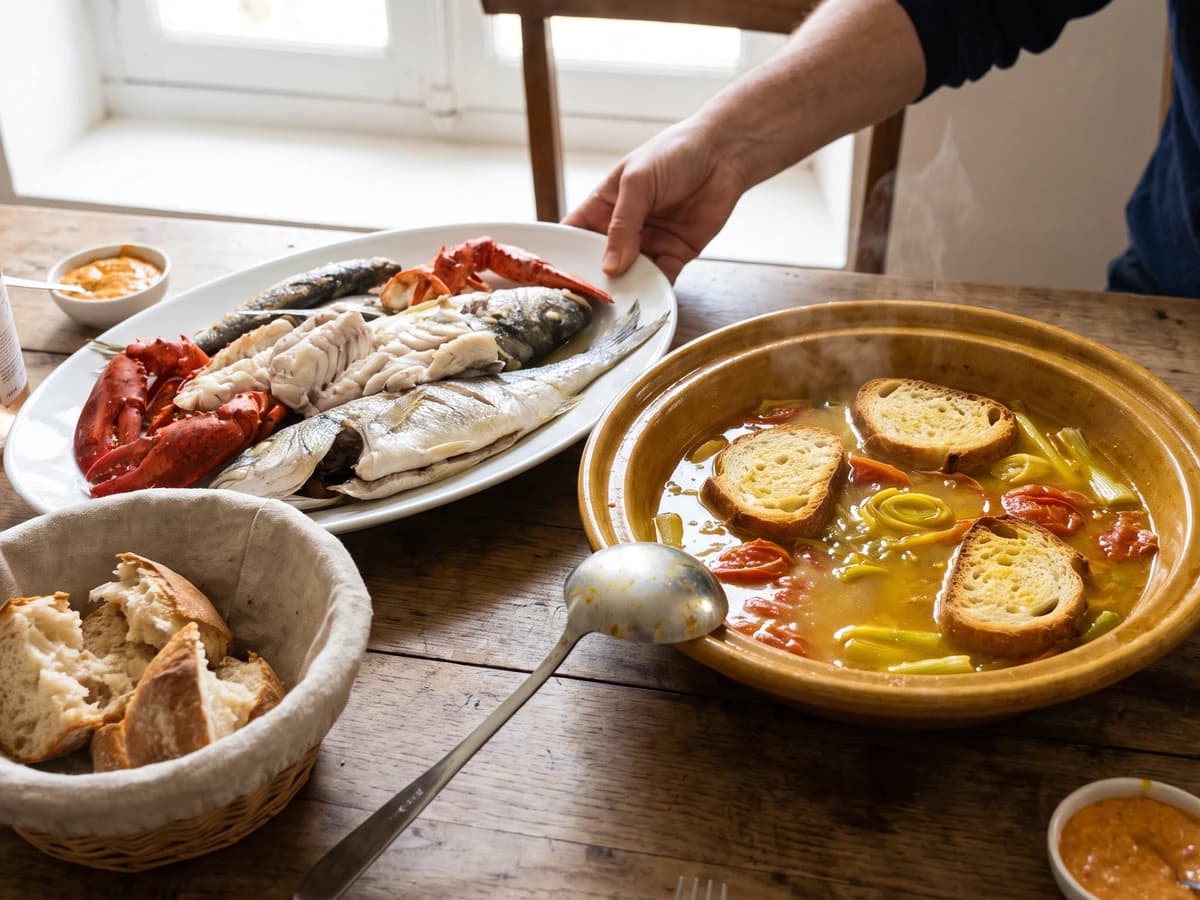
Marseille's great fish stew, saffron-gold and garlic-scented, proves that a hard boil can be the careful choice: it binds olive oil into broth before the whole pot meets bread.
A cooking platform built around craft, culture, and the stories behind what we eat.

Created by Chef Juliette
Based on No. 1350, Irish Stew, from Le Guide Culinaire (1907) by Auguste Escoffier
Mutton, potato, and onion are layered raw, barely moistened, and cooked gently until the meat yields and the potato becomes its own liaison: a plain pot whose discipline lies in proportion and patience.
Ragoût irlandais (Irish stew) teaches a plain and useful truth: when potatoes are both garnish and liaison, the thickener, you must give them enough moisture to soften and little enough that their starch can bind the pot. The meat, onions, and potatoes go in raw. No browning, no stock, no flour. At the end, the mutton yields, the potato edges melt into the liquor, and the onions have nearly disappeared.
This entry is unusually free of brigade scaffolding. It calls for no saucier, no stockpot kept hot, and no salamander; it assumed a deep saucepan exactly filled by two pounds each of meat and potatoes, plus an oven that held gentle heat without explanation. For four servings, every quantity is reduced by one quarter, preserving the one-to-one weight of mutton and potato. A 4-quart lidded pot and a measured 325°F oven are the honest home equivalents. A brief stovetop warm-up is the only procedural addition, so the prescribed hour and a half begins at a true gentle simmer. One cook, one stove, one evening.
The layering is the dish, not scaffolding. Choose a pot just large enough, season the meat as you build, and keep the water modest. The one step that decides everything is leaving those layers undisturbed while the potatoes make their own liaison.
Irish stew belongs to the farmhouse and cottage table of Ireland, where mutton, potatoes, onions, and a little water turned economical cuts into a sustaining one-pot meal. French classical manuals carried it into the canon as Ragoût irlandais with remarkable restraint, adding neither wine nor stock nor preliminary browning and describing the potatoes as both garnish and liaison. The lightly clouded, naturally thickened liquor is therefore the intended sauce, not a failed clear broth.
Quantity
1½ lb (680 g)
cut into 1½-inch (4 cm) pieces
Quantity
1½ lb (680 g)
peeled and sliced ¼ inch (6 mm) thick
Quantity
3 (about 1 lb / 450 g)
finely chopped
Quantity
2⅖ cups (570 ml / 570 g), plus up to ¼ cup (60 ml / 60 g) only if needed
keep the rescue portion boiling and separate
Quantity
2 teaspoons (10 ml / 12 g), plus more if needed
Quantity
¾ teaspoon (4 ml / 2 g)
Quantity
1
4 parsley stems, 2 thyme sprigs, and 1 bay leaf, tied
| Ingredient | Quantity |
|---|---|
| boneless mutton shoulder and breast, in equal partscut into 1½-inch (4 cm) pieces | 1½ lb (680 g) |
| starchy potatoes, such as russetspeeled and sliced ¼ inch (6 mm) thick | 1½ lb (680 g) |
| medium onionsfinely chopped | 3 (about 1 lb / 450 g) |
| waterkeep the rescue portion boiling and separate | 2⅖ cups (570 ml / 570 g), plus up to ¼ cup (60 ml / 60 g) only if needed |
| fine salt | 2 teaspoons (10 ml / 12 g), plus more if needed |
| freshly ground black pepper | ¾ teaspoon (4 ml / 2 g) |
| bouquet garni4 parsley stems, 2 thyme sprigs, and 1 bay leaf, tied | 1 |
Heat the oven to 325°F (165°C). Choose a heavy 4-quart (3.8-litre) ovenproof saucepan or Dutch oven with a snug lid. The fit matters: a broad pot spreads the liquid too thin and exposes too much surface, while this preparation needs close layers and modest evaporation.
Trim hard exterior fat and heavy sinew from the mutton, but leave the soft fat and connective tissue that will enrich the liquor. Cut the shoulder and breast into even 1½-inch (4 cm) pieces. Slice the potatoes uniformly and chop the onions finely; even pieces cook together, which matters when nothing will be stirred or removed separately.
Cover the bottom of the pot with half the mutton and season it evenly with nearly half the salt and pepper. Shingle half the potatoes over the meat, then scatter over half the chopped onions. Set the bouquet garni in the centre. Repeat with the remaining mutton, seasoning, potatoes, and onions, finishing with an even potato layer. Press lightly to settle everything, but do not crush the potatoes.
Pour the 2⅖ cups (570 ml / 570 g) water slowly down the inside wall of the pot so the layers remain intact. The liquid will not cover the ingredients, and it should not. Cover tightly and set the pot over medium heat just until the first quiet bubbles appear at the edge, about 5 minutes, then transfer it immediately to the oven. This short warm-up makes gentle oven cooking predictable without changing the source's proportions.
Cook covered for 1½ hours. Leave the layers undisturbed for the first 1¼ hours, then check once: the mutton should yield when pressed with a fork, the potato edges should be soft and beginning to crumble, and the liquor should look lightly clouded and thickened. If the pot is nearly dry while the meat is still firm, pour up to ¼ cup (60 ml / 60 g) boiling water down the side and cover it again. Ça se rattrape. If the liquor is thin, do not add flour; uncover for the final 10 minutes and press two soft potato slices against the pot wall, then ease them into the liquid without stirring the whole stew. If the mutton remains tough after 1½ hours, cover and continue for 15 minutes. More time, not a harder boil.
Remove the bouquet garni and let the pot stand uncovered for 5 minutes so the liquor settles around the layers. Taste and correct the salt and pepper. The source sends the stew to table in a timbale, but that vessel is service scaffolding, not technique; a warmed deep serving bowl is its honest home equivalent. Spoon down through every layer so each portion receives shoulder, breast, potato, onion, and thickened liquor. Serve very hot. À table!
1 serving (about 520g)
Culinary guides, cultural storytelling, and the editorial depth that makes cooking meaningful.
Discover Culinary ExplorerChef Juliette
Marseille's great fish stew, saffron-gold and garlic-scented, proves that a hard boil can be the careful choice: it binds olive oil into broth before the whole pot meets bread.
Chef Juliette
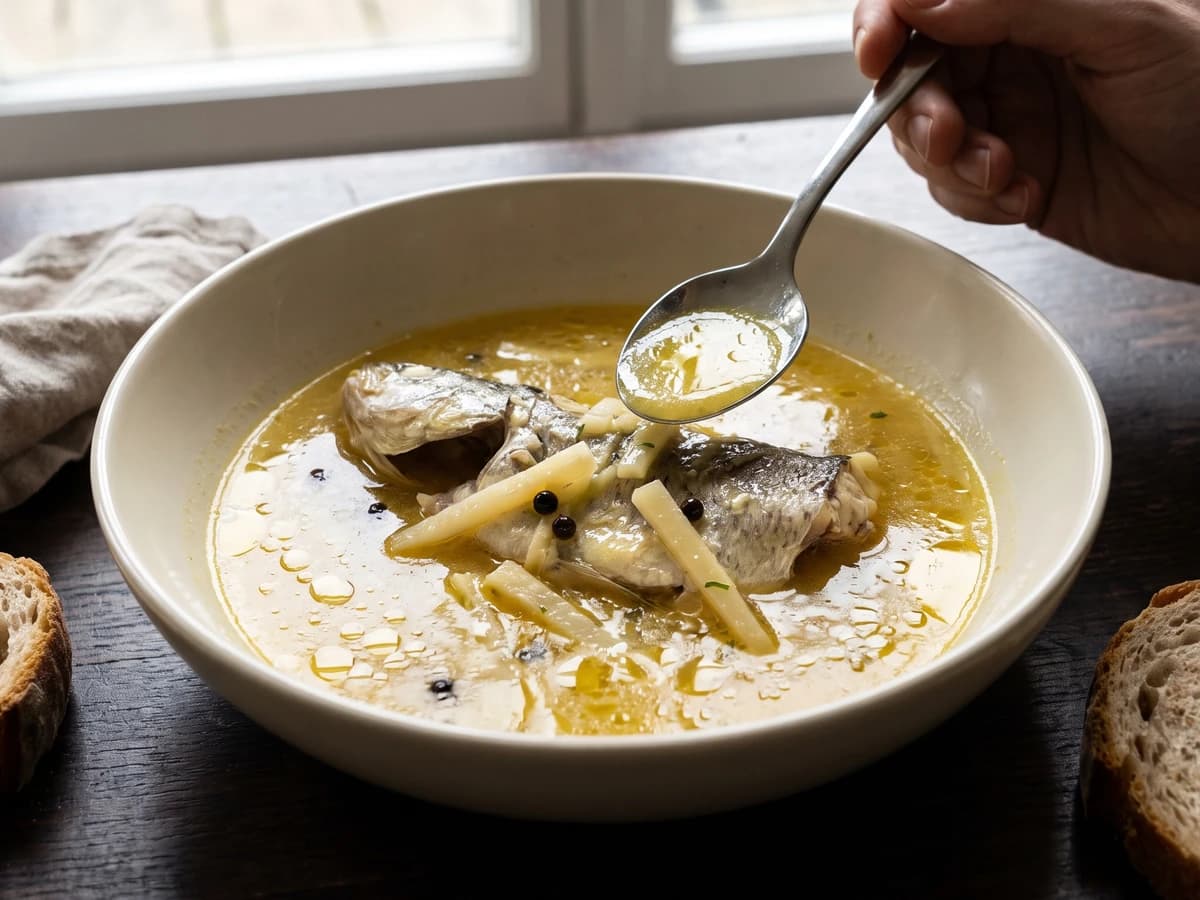
Waterzoi asks fresh, bone-in river fish to thicken its own buttery broth, with parsley root and pepper for company. No flour, no stockpot, just a brisk simmer watched closely.
Chef Juliette
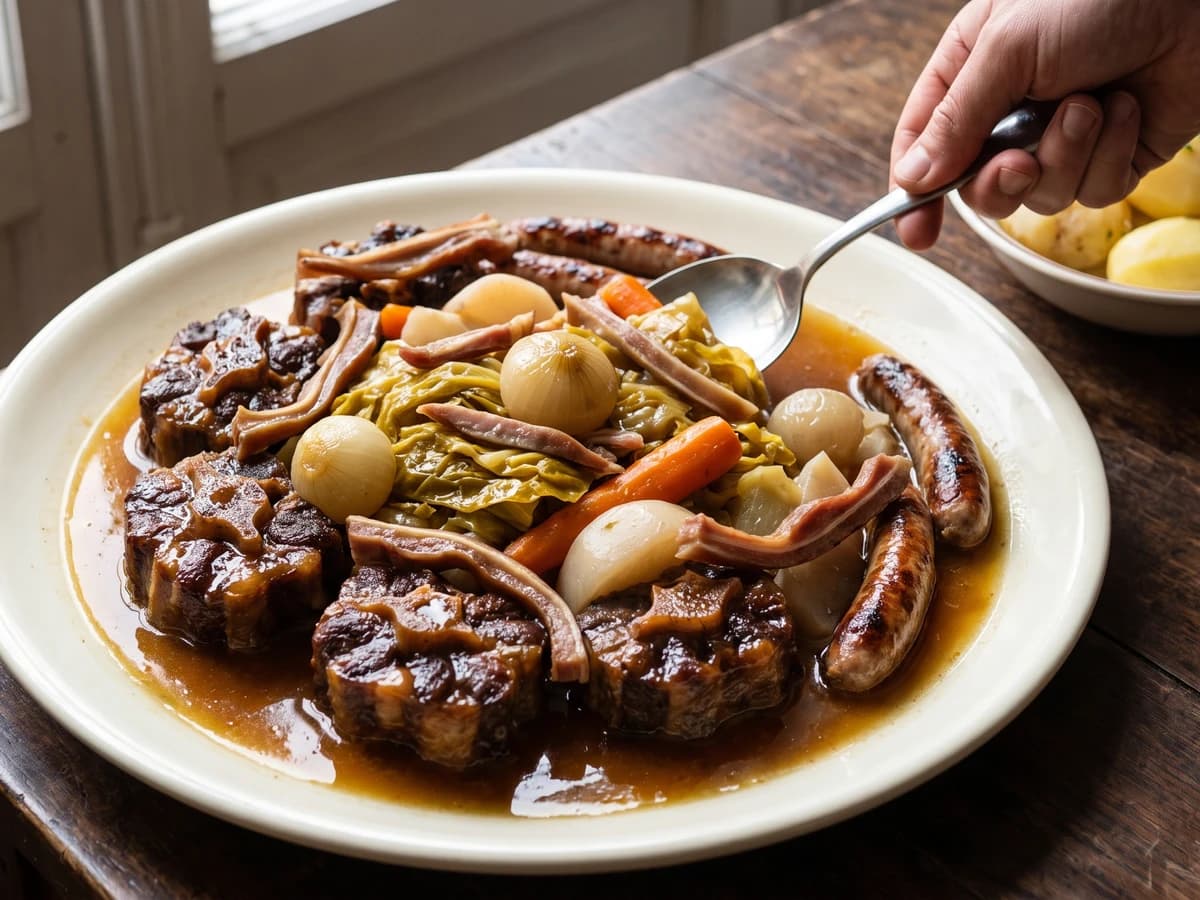
Queue de Bœuf en Hochepot gathers oxtail, pig's trotter and ear, cabbage, roots, and grilled chipolatas around a clear, gelatin-rich broth whose quiet simmer keeps every piece tender and distinct.
Chef Juliette
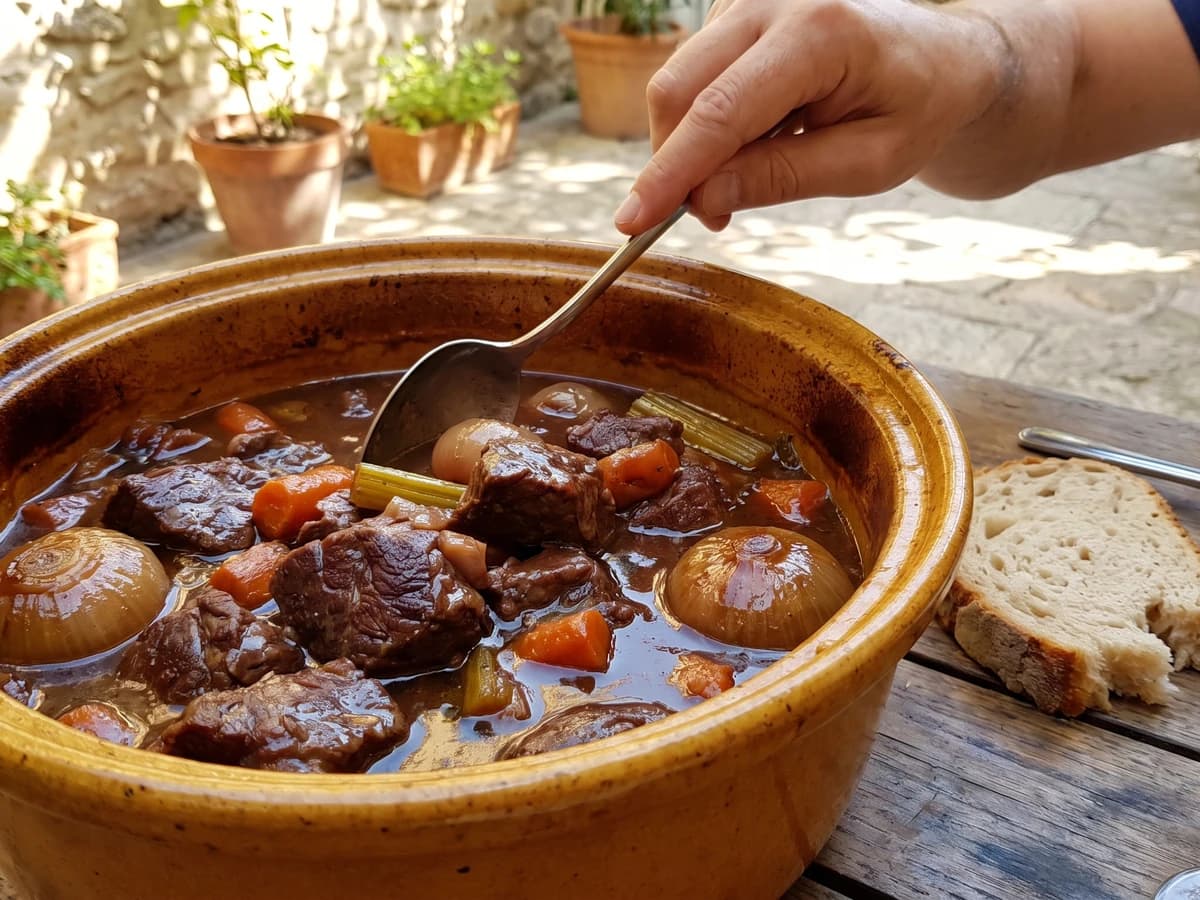
Beef shoulder larded with bacon, sharpened by red wine and vinegar, then sealed with garlic, vegetables, and dry lemon peel until the low oven turns it yielding and the gravy darkly glossy.