Culinary Explorer

A cooking platform built around craft, culture, and the stories behind what we eat.
Discover Culinary Explorer
Daube Froide

Daube Froide

Created by Chef Juliette

Based on No. 1347, Daube Froide, from Le Guide Culinaire (1907) by Auguste Escoffier

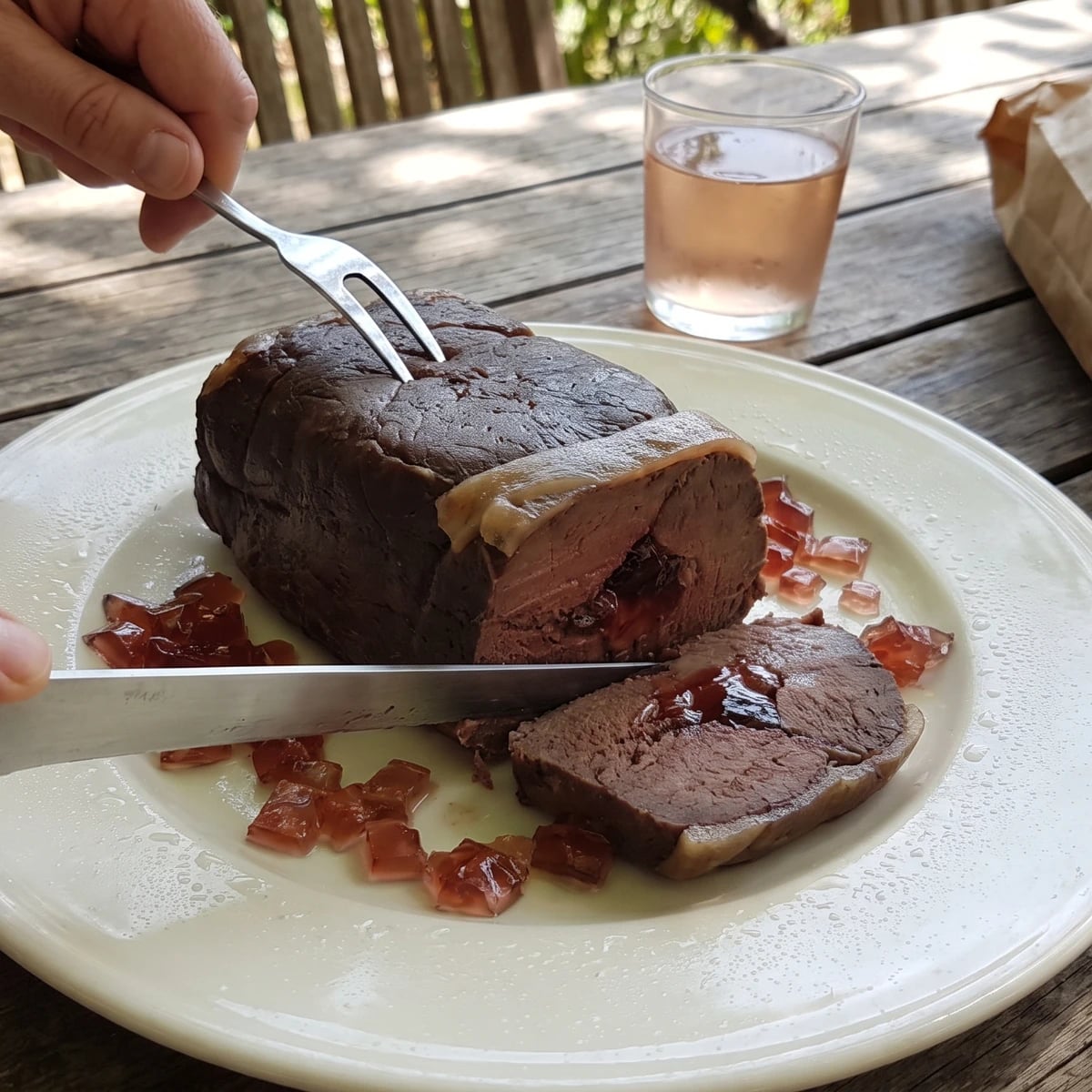
Yesterday’s daube becomes tomorrow’s cold luncheon: collagen-rich beef and pork rind packed into a small mold, set in its own clear jelly, turned out, and carved thin beside a bright ring of chopped jelly.

Main Dishes
French
Make Ahead
Picnic
Budget Friendly
30 min
Active Time
20 min cook8 hr 50 min total
Yield4 servings

Daube froide (cold pressed daube) teaches a truth every charcuterie cook knows: a cold slice is decided while its cooking liquor is still fluid. The pork rind in yesterday’s daube is not a scrap to discard; its collagen is the structure. Keep it, distribute it through the beef, and the loaf will stand cleanly without becoming rubbery.

The original entry assumed a finished daube made with pork rind, a small daubière, the earthenware vessel used for daube, and clear jelly waiting in the larder. At home, a 1 litre loaf tin or pudding basin does the same work, while the braise’s own strained liquor supplies both binder and chopped jelly. A terrine press and a separately prepared aspic are brigade scaffolding, so they go; warming the leftovers gently, packing without air pockets, and chilling them fully are the dish and must stay. That is the honest translation for four servings, one cook, one stove, one evening of work, then lunch tomorrow.

The finished daube froide should be firm but tender, wine-dark at the cut face and surrounded by a delicate, trembling jelly. Test one spoonful of liquor on a cold saucer before filling the mold. If it won’t set softly, reduce it before proceeding; ça se rattrape.

Daube is rooted in Provence and the lower Rhône, where beef cooked slowly with wine in a covered earthenware daubière became a household method as much as a single formula. Daube froide carried that pot to the next day’s luncheon, using pork rind and reduced cooking liquor to preserve and bind the meat for thin carving. It is not a separate braise or a formal forcemeat terrine; its intelligence lies in making yesterday’s daube serve generously again.

The technique, the tradition, and the story behind every dish.

Discover Culinary Explorer

Ingredients

solid pieces from leftover daube, chiefly cooked beef

Quantity

2½ cups (600 ml / 600 g)

bones and spent aromatics removed

soft cooked pork rind from the same daube

Quantity

⅓ cup (80 ml / 75 g)

cut into 1-inch (2.5 cm) strips

cooking liquor from the same daube

Quantity

1 cup (240 ml / 240 g)

chilled, fully defatted, and strained

unflavored powdered gelatin (optional)

Quantity

¾ teaspoon (3.75 ml / 2 g)

use only if the natural gel test fails

cold water (optional)

Quantity

1 tablespoon (15 ml / 15 g)

for blooming the gelatin

fine salt (optional)

Quantity

to taste

Equipment Needed

  • 1 litre (4¼ cup) straight-sided loaf tin, pudding basin, or small daubière
  • Small heavy saucepan
  • Fine-mesh sieve and cheesecloth
  • Shallow 6-inch (15 cm) dish for setting the jelly
  • Round serving platter
  • Long sharp slicing knife

Instructions

  1. 1

    Sort the leftovers

    Lift the solid pieces from the chilled daube. Remove bones, bay leaves, herb stems, and whole spices, but keep every tender garnish that was meant to be eaten. Separate the soft pork rind rather than discarding it, then cut it into short strips so its collagen will be distributed throughout the mold. Remove the solid fat cap from the cooking liquor and strain the liquor through a damp cheesecloth-lined sieve without pressing; this gives the chopped jelly a clean, translucent finish.

    If you have less than the listed quantity, choose a smaller mold. A half-filled large tin spreads the daube too thinly to carve with generosity.
  2. 2

    Test the natural gel

    Warm 1 tablespoon (15 ml / 15 g) of the cooking liquor until fluid, place a teaspoon on a cold saucer, and chill it for 5 minutes. It should tremble, hold a clean trail when pushed, and melt readily on the tongue. If it remains runny, simmer all the liquor gently until reduced by about one-fifth, then test again. If it still will not set, the original daube lacked enough rind: bloom the powdered gelatin in the cold water for 5 minutes and whisk it into the warm liquor off the heat. Ça se rattrape. This is a repair, not the standard binder.

  3. 3

    Warm without recooking

    Reserve one-third of the tested liquor for the chopped jelly. Bring the remaining two-thirds just to a simmer in a small saucepan, then lower the heat and fold in the beef, tender garnish, and strips of pork rind. Heat gently until the old jelly has melted and the meat is hot throughout, about 5 minutes. Do not boil the beef into threads; it has already completed its braise. Cool a drop of liquor on a spoon, taste it, and add salt only if the cold flavor seems dull.

  4. 4

    Pack the daubière

    Rinse the daubière, loaf tin, or pudding basin with cold water and leave it damp. Spoon in a little liquor, then pack the beef and tender garnish in close layers, laying strips of pork rind between them. Press each layer firmly with the back of a spoon to remove air pockets, but do not mash the meat. Pour in enough warm liquor to fill the spaces and barely reach the top, tap the mold twice against a folded towel, and press once more. This close packing is the step that gives you thin, complete slices rather than a heap of chilled stew.

  5. 5

    Set loaf and jelly

    Pour the reserved liquor into a shallow dish to a depth of about ¼ inch (6 mm). Let both dishes stand for no more than 15 minutes, then cover loosely and refrigerate until completely set, at least 8 hours and preferably overnight. Once cold, cover tightly. The separate layer should become a very light jelly, delicate enough to chop rather than stiff enough to bounce.

  6. 6

    Turn out cleanly

    Run a thin knife around the upper rim only. Wrap the outside of the mold in a towel wrung out in warm water for 8 to 10 seconds, place a round platter over it, and invert decisively. Lift the mold straight up. If the surface begins to soften, return the daube froide to the refrigerator for 15 minutes; if a corner cracks, press it gently back into place while cold. The chopped jelly will cover the seam, and no one at the table needs a confession.

  7. 7

    Chop and carve

    Turn the shallow sheet of jelly onto a board and chop it lightly into irregular, sparkling pieces. Arrange the jelly in a generous ring around the daube froide. Dip a long sharp knife in hot water, wipe it dry, and carve the loaf crosswise into slices about ¼ inch (6 mm) thick, cleaning and warming the blade between cuts. Serve immediately while everything is properly cold. À table!

Chef Tips

  • Begin with a daube that was cooked with pork rind. The rind is not decoration and it is not waste; its collagen is what lets yesterday’s sauce become today’s sliceable jelly.
  • Defat the cooking liquor while it is thoroughly cold. The fat lifts away in a solid cap, leaving a clean liquor underneath; warmed fat left in the gel makes the loaf greasy and clouds the chopped jelly.
  • If the cooked rind still feels leathery, simmer it gently in the strained liquor for 10 to 15 minutes before molding. Properly cooked rind should yield under a spoon and nearly melt between the fingers.
  • Carve straight from the refrigerator with a warmed, wiped blade. A room-temperature loaf softens at the edges and drags beneath the knife.
  • Serve with crusty bread, cornichons, and a plainly dressed bitter salad. A lightly chilled young Côtes du Rhône red has enough freshness for the cold beef without bullying the jelly.

Advance Preparation

  • The recipe begins with a finished daube. Chill the braise thoroughly before separating it, because the fat is easiest to remove when solid and the pork rind is easier to identify while cold.
  • Mold the daube froide the evening before serving. Eight hours is the minimum set; an overnight rest gives cleaner slices and a rounder flavor.
  • Keep the molded daube refrigerated and tightly covered for up to 3 days. For a picnic, carry it in an insulated cooler at or below 40°F (4°C), turn it out only when ready to eat, and return leftovers to the cooler within 2 hours.

Frequently Asked Questions

Nutrition Information

1 serving (about 215g)

Calories
480 calories
Total Fat
31 g
Saturated Fat
11 g
Trans Fat
1 g
Unsaturated Fat
18 g
Cholesterol
165 mg
Sodium
560 mg
Total Carbohydrates
1 g
Dietary Fiber
0 g
Sugars
0 g
Protein
50 g

Note: Chef personas and recipes are created with AI assistance. Cook with care: follow safe food-handling practices, check doneness with a thermometer when needed, and adapt for allergies and your kitchen.

Where cooking meets culture.

Culinary guides, cultural storytelling, and the editorial depth that makes cooking meaningful.

Discover Culinary Explorer

More from Relevés and Entrées - MUTTON, GRASS LAMB AND HOUSE LAMB

Browse the full collection