
Chef Juliette
John Dory (St. Pierre)
John Dory has the delicacy of sole and the firmness of turbot. A light flouring, a quick butter sauté, and nut-brown beurre noisette show exactly why looks never mattered.
A cooking platform built around craft, culture, and the stories behind what we eat.
Created by Chef Juliette
Based on No. 1345, Currie à l’Indienne, from Le Guide Culinaire (1907) by Auguste Escoffier
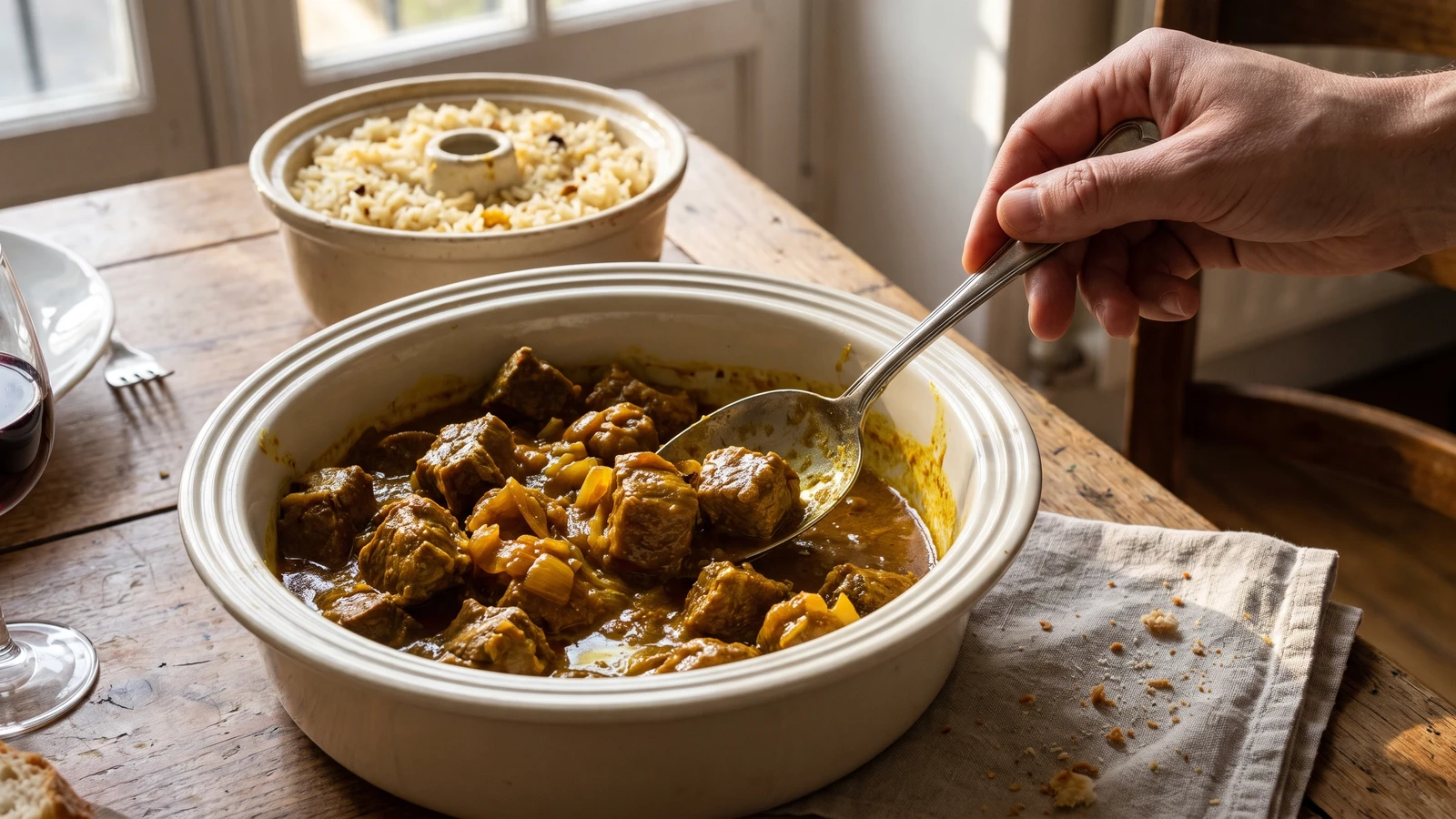
Mutton, onion, curry, and a flour-bound sauce prove the classical lesson: frizzle well, cook the roux, then let gentle heat turn a spare pantry into a generous supper.
Currie à l’Indienne (French mutton curry) teaches one true thing before you touch the pan: frizzling makes the sauce, while the roux, cooked flour and fat, only carries what the browning gives it. Let the mutton and onion take colour before the flour enters. Pale meat under a thick sauce remains pale in character.
The original assumed a saucier on staff, a stock never off the fire, and hands available to stir, skim, and warm two timbales for service. Your honest equivalents are a broad Dutch oven, good light stock, a wooden spoon, and two warmed serving dishes. The book’s quantities become four generous main-course portions at home, rather than smaller portions inside a long menu, so I have kept its two pounds of mutton and its proportions intact. The formal timbales are scaffolding; the generous lard, frizzling, roux, slow oven stew, and Rice à l’Indienne served apart are the dish. One cook, one stove, one evening.
The decisive step is the frizzling. Work in two batches so the cubes actually sizzle beside the onion instead of sitting in released juice. Give them that colour, and the oven has very little left to prove.
Currie à l’Indienne belongs to the French grand kitchen and bourgeois table, especially the cosmopolitan cooking of Paris, rather than to any one provincial larder. French cooks met curry powder through colonial trade and the Anglo-Indian repertoire, then set it inside their own grammar of sautéed meat, roux, stock, and rice served apart. The title does not describe an Indian regional curry; here à l’Indienne names a French adaptation, and the spare pinch of curry in a flour-bound mutton stew makes that distinction plain.
Quantity
2 pounds (907 g)
cut into 1⅓-inch (3.4 cm) cubes
Quantity
6 tablespoons (90 ml / 85 g)
Quantity
1 large (about 1½ cups / 200 g)
chopped
Quantity
1½ teaspoons (7.5 ml / 9 g), plus more if needed
divided
Quantity
1 pinch (about 1/16 teaspoon / 0.1 g)
Quantity
5 tablespoons (75 ml / 38 g)
Quantity
3¼ cups (770 ml / 770 g)
warmed
Quantity
4 servings
prepared separately
| Ingredient | Quantity |
|---|---|
| lean mutton leg or well-trimmed shouldercut into 1⅓-inch (3.4 cm) cubes | 2 pounds (907 g) |
| rendered pork lard | 6 tablespoons (90 ml / 85 g) |
| yellow onionchopped | 1 large (about 1½ cups / 200 g) |
| fine saltdivided | 1½ teaspoons (7.5 ml / 9 g), plus more if needed |
| mild curry powder | 1 pinch (about 1/16 teaspoon / 0.1 g) |
| all-purpose flour | 5 tablespoons (75 ml / 38 g) |
| unsalted light meat stock or waterwarmed | 3¼ cups (770 ml / 770 g) |
| Rice à l’Indienneprepared separately | 4 servings |
Heat the oven to 325°F (160°C). Pat the mutton thoroughly dry; moisture trapped on the surface must boil away before the meat can frizzle. Toss it with the chopped onion, salt, and curry powder, then divide the mixture into two rough batches. Keep the stock warm beside the stove.
Melt half the lard in a wide, heavy Dutch oven over medium-high heat. Add one batch of mutton and onion in a single layer and leave it undisturbed until the undersides take a deep golden colour. Turn and continue frying until the cube edges are bronzed, the onion begins to colour, and the fat sputters cleanly rather than bubbling with water, about 8 to 10 minutes. Transfer the batch to a bowl and repeat with the remaining lard and mutton mixture. If liquid collects in the pot, lift out the meat, boil the liquid away, then return the meat and continue colouring before you reach for the flour.
Return the first batch and its juices to the pot. Lower the heat to medium, sprinkle the flour evenly over the meat, and stir for 3 to 4 minutes, until every cube wears a thin coating and the flour smells lightly biscuit-like rather than raw. Do not take it to a dark roux; the curry is already in the pot and will turn bitter if scorched. Add the warm stock in four additions, stirring firmly and scraping up the fond after each one, then bring the sauce to a full boil while stirring so the roux dissolves. If flour beads form, stop adding liquid and press them against the pot wall with the spoon until smooth. If they persist, lift out the meat, whisk the sauce smooth, and return it. Ça se rattrape.
Cover the pot and place it in the oven for 1½ hours. The sauce should barely tremble around the meat, never boil hard; check after 45 minutes, stir along the bottom, and lower the oven by 25°F (15°C) if the surface is rolling. At the end, a fork should enter the mutton with little resistance while the cubes still hold their shape. If the meat remains firm, give it another 15 minutes and test again. The clock advises, but the mutton decides.
Set the uncovered pot aside for 5 minutes so the lard rises, then skim the surface patiently with a wide spoon until the sauce gleams without a floating slick. If the sauce is thin, lift out the mutton and simmer the sauce gently until it naps the back of the spoon, then return the meat. If it has tightened too far, loosen it with a spoonful of hot water. Taste and correct the salt.
Spoon the currie into a warmed, deep serving dish, keeping the cubes whole and coating them generously with sauce. Bring the Rice à l’Indienne to the table in a separate warmed dish, exactly as the source directs; folding the rice into the stew would blur two distinct preparations. Serve at once. À table!
1 serving (about 580g)
Culinary guides, cultural storytelling, and the editorial depth that makes cooking meaningful.
Discover Culinary ExplorerChef Juliette
John Dory has the delicacy of sole and the firmness of turbot. A light flouring, a quick butter sauté, and nut-brown beurre noisette show exactly why looks never mattered.

Chef Juliette
Fresh haddock proves its delicacy in the meunière pan: a fine flour crust, moist pearly flakes, and beurre noisette sharpened with lemon and parsley, ready from one skillet in half an hour.

Chef Juliette
Éperlans à l’Anglaise turns small fish into a lesson in disciplined coating: boned smelts under a close, crisp crumb, pan-fried in clarified butter and finished with bright, half-melted maître d’hôtel butter.

Chef Juliette
Tiny smelts, shallot, mushrooms, white wine, gratin sauce, and fine bread raspings meet a fierce oven, where the fish must turn tender in the same breath the buttered crust bronzes.