
Chef Juliette
John Dory (St. Pierre)
John Dory has the delicacy of sole and the firmness of turbot. A light flouring, a quick butter sauté, and nut-brown beurre noisette show exactly why looks never mattered.
A cooking platform built around craft, culture, and the stories behind what we eat.
Created by Chef Juliette
Based on No. 1336, Rognons Sautés à l’Indienne, from Le Guide Culinaire (1907) by Auguste Escoffier
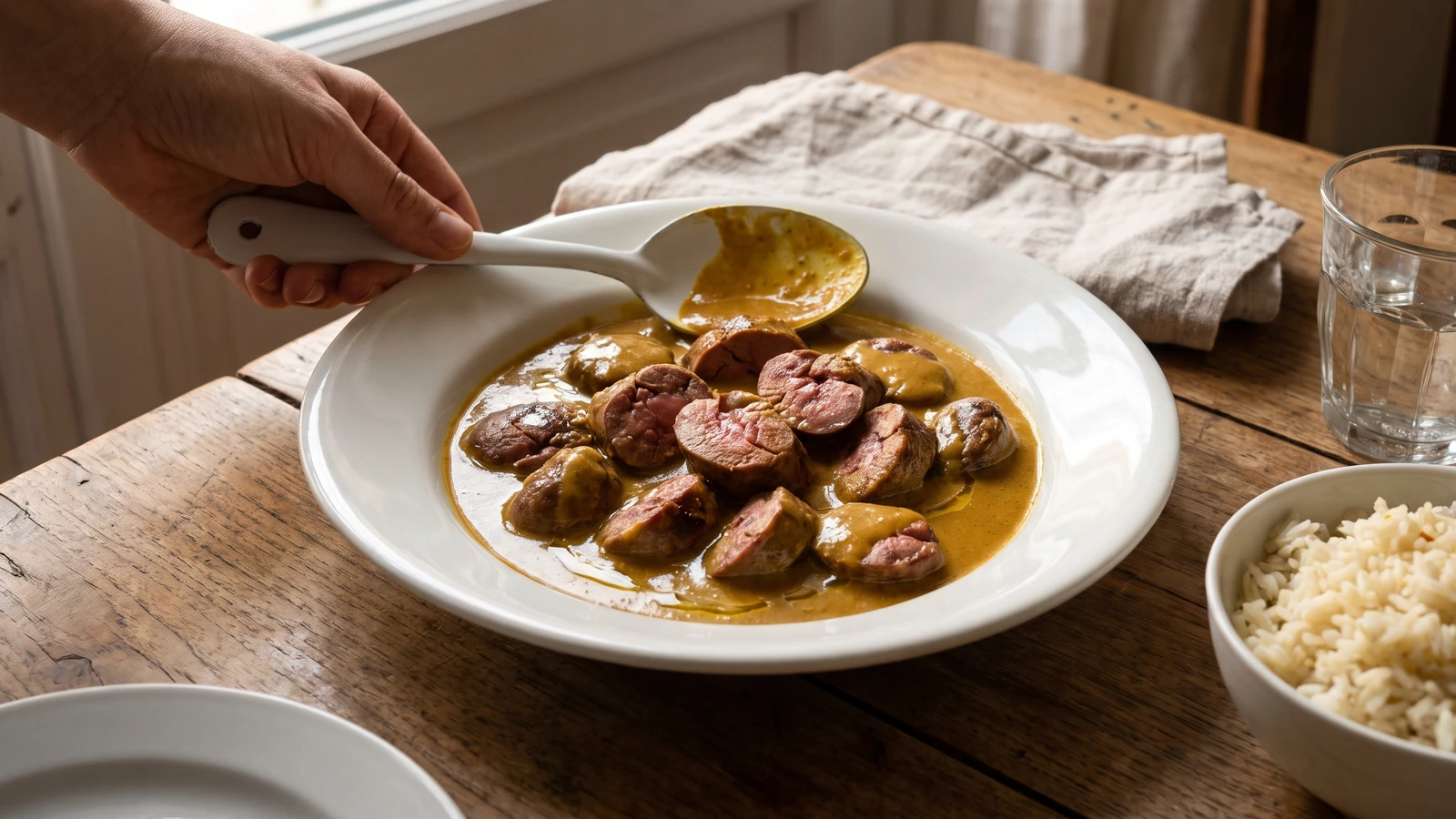
Lamb kidneys seared fast in butter, then folded into a smooth onion-curry velouté and warmed without boiling, with rice à l’Indienne served separately to catch every glossy spoonful.
Rognons Sautés à l’Indienne (sautéed mutton kidneys with curry velouté) teaches a fierce little lesson: the sauce may wait, but the kidneys may not. Have the rice ready, the sauce strained, and the serving dish warm before they touch butter. Once sliced kidneys enter the pan, the whole dish is measured in minutes.
The original formula assumed a saucier with velouté ready beside the stove, a tammy for passing the onion, and mutton kidneys moving through service. At home, prepared light chicken velouté, a fine-mesh sieve, and a wide skillet give the same intent for four generous plates; smaller lamb kidneys replace harder-to-find mutton kidneys by equal weight. The separate sauce station was scaffolding, and it can go. The velouté, the passing, and the fast sauté are the dish, and they stay. One cook, one stove, one evening.
The reward is bronze-edged kidney under a smooth ochre sauce, with loose rice waiting apart to catch it. Dry the slices thoroughly and keep the pan uncrowded. Wet kidneys simmer in their own juices, and no amount of ceremony can brown them afterward.
Rognons sautés belong to the Parisian bistro and the cuisine bourgeoise dining room, where lamb or mutton kidneys are trimmed, sliced, and cooked quickly in a short sauce. In the classical naming system, à l’Indienne means curry powder with rice served separately, a French formula shaped by colonial trade rather than a claim to an Indian regional dish. Passing the onion and curry-enriched velouté through a tammy shows the grand kitchen’s hand: an everyday offal sauté gained a silken sauce without losing its speed.
Quantity
6 mutton kidneys or 8 small lamb kidneys (about 1⅓ lb / 600 g total)
outer membranes and white cores removed
Quantity
1 small (about ¾ cup / 180 ml / 110 g)
finely chopped
Quantity
4 tablespoons (60 ml / 56 g)
divided
Quantity
1 large pinch (about ¼ teaspoon / 1.25 ml / 0.5 g)
Quantity
scant ½ cup (95 ml / 100 g)
warm
Quantity
½ teaspoon (2.5 ml / 3 g)
divided
Quantity
½ teaspoon (2.5 ml / 1 g)
Quantity
3 cups (720 ml / 600 g)
kept separate for serving
| Ingredient | Quantity |
|---|---|
| mutton kidneys, or small lamb kidneys by equal weightouter membranes and white cores removed | 6 mutton kidneys or 8 small lamb kidneys (about 1⅓ lb / 600 g total) |
| yellow onionfinely chopped | 1 small (about ¾ cup / 180 ml / 110 g) |
| unsalted butterdivided | 4 tablespoons (60 ml / 56 g) |
| curry powder | 1 large pinch (about ¼ teaspoon / 1.25 ml / 0.5 g) |
| prepared plain light chicken veloutéwarm | scant ½ cup (95 ml / 100 g) |
| fine sea saltdivided | ½ teaspoon (2.5 ml / 3 g) |
| freshly ground black pepper | ½ teaspoon (2.5 ml / 1 g) |
| prepared Rice à l’Indiennekept separate for serving | 3 cups (720 ml / 600 g) |
Bring the prepared Rice à l’Indienne to serving temperature and keep it covered in its own pan. Warm a shallow serving bowl with hot water, then empty and dry it before serving. Measure the velouté and set a fine-mesh sieve over a clean saucepan. Once the kidneys enter the skillet, nothing else should need attention; the sauce may wait, but the kidneys may not.
Peel away every trace of the thin outer membrane. Split each kidney lengthwise, cut out the firm white core and tubes with the point of a small knife, then slice the lobes crosswise about ½ inch (1.25 cm) thick. Pat the pieces thoroughly dry and keep them cold. Do not season yet, because salt draws moisture to the surface and wet kidneys cannot sauté cleanly.
Melt 1½ tablespoons (22 ml / 21 g) of the butter in a small saucepan over medium-low heat. Add the onion and cook for 5 to 6 minutes, stirring often, until soft and translucent but not browned. Add the curry powder and stir for 30 seconds, just until fragrant. Pour in the prepared plain light chicken velouté and hold it at a bare simmer for 3 minutes, giving the onion time to season the sauce without reducing it heavily.
Rub the sauce through the fine-mesh sieve into the clean saucepan, pressing firmly on the onion with the back of a spoon. This replaces the brigade’s tammy while preserving the point of the step: curry flavour and onion sweetness remain, coarse pieces do not. Return the sauce to the lowest heat. If passing has made it too tight, loosen it with hot water a teaspoon at a time until it coats a spoon in a thin, glossy layer. Taste and use a little of the measured salt only if the velouté needs it.
Season the dry kidney slices with the remaining salt and the pepper. Heat a wide 12-inch (30 cm) skillet over medium-high heat, then add half of the remaining butter. When the foam subsides, lay in half the kidneys with space between them. Sauté for 60 to 90 seconds on the first side and 45 to 60 seconds on the second, until bronze at the edges and just cooked through; repeat with fresh butter and the second batch. The thickest pieces should reach 160°F (71°C). If grey liquid floods the pan, lift the kidneys out immediately, pour away the liquid, wipe and reheat the skillet, then return them briefly in a single layer. Ça se rattrape.
Lift the kidneys from the skillet with a slotted spoon and fold them directly into the warm curried velouté. Turn them gently over the lowest heat for no more than 30 seconds, only long enough to coat and unite them with the sauce. Never let it boil; boiling tightens the kidneys into rubber. If a bubble appears, lift the saucepan from the heat and stir. Transfer at once to the warmed serving bowl and bring the Rice à l’Indienne alongside. À table!
1 serving (about 305g)
Culinary guides, cultural storytelling, and the editorial depth that makes cooking meaningful.
Discover Culinary ExplorerChef Juliette
John Dory has the delicacy of sole and the firmness of turbot. A light flouring, a quick butter sauté, and nut-brown beurre noisette show exactly why looks never mattered.

Chef Juliette
Fresh haddock proves its delicacy in the meunière pan: a fine flour crust, moist pearly flakes, and beurre noisette sharpened with lemon and parsley, ready from one skillet in half an hour.

Chef Juliette
Éperlans à l’Anglaise turns small fish into a lesson in disciplined coating: boned smelts under a close, crisp crumb, pan-fried in clarified butter and finished with bright, half-melted maître d’hôtel butter.

Chef Juliette
Tiny smelts, shallot, mushrooms, white wine, gratin sauce, and fine bread raspings meet a fierce oven, where the fish must turn tender in the same breath the buttered crust bronzes.