
Chef Juliette
John Dory (St. Pierre)
John Dory has the delicacy of sole and the firmness of turbot. A light flouring, a quick butter sauté, and nut-brown beurre noisette show exactly why looks never mattered.
A cooking platform built around craft, culture, and the stories behind what we eat.
Created by Chef Juliette
Based on No. 1332, Rognons Sautés Carvalho, from Le Guide Culinaire (1907) by Auguste Escoffier
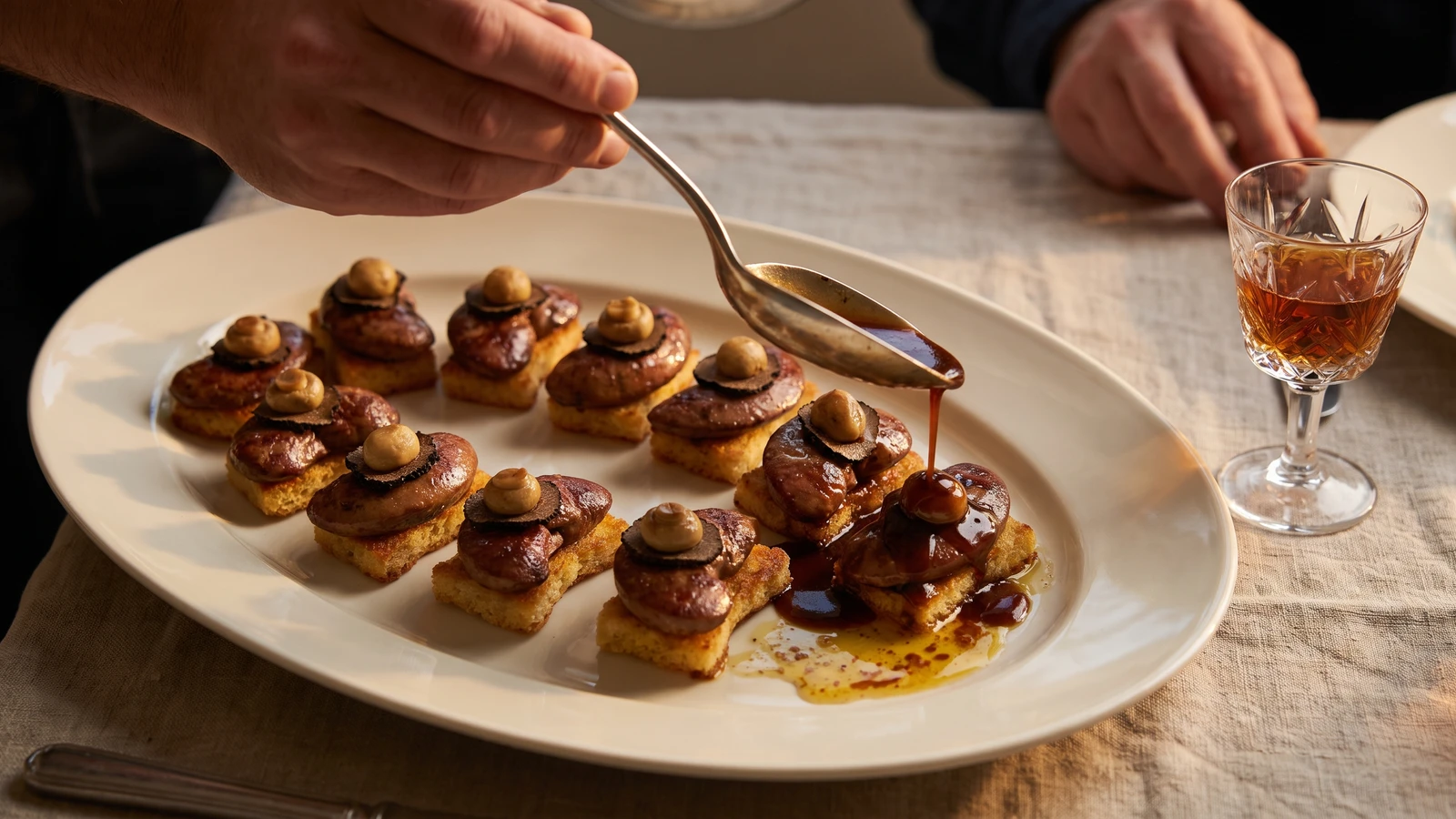
Rognons sautés Carvalho turns a fast kidney sauté into a composed dinner: crisp cockscomb croûtons, mushroom and truffle on every piece, and Madeira demi-glace mounted with butter at the last breath.
Rognons Sautés Carvalho (sautéed mutton kidneys Carvalho-style) teaches the discipline of minute cooking: everything waits for the kidneys, because kidneys wait for nothing. Their surfaces must be dry, the pan properly hot, and the table ready before they touch the butter. Brown outside and tender within, they go from splendid to tough in the time it takes to search for a serving spoon.
The brigade version assumed a saucier with demi-glace always ready, a stockpot never off the fire, a pantry hand shaping Croûtons, and a salamander close by for service. The salamander contributes nothing essential here. At home, one skillet works in sequence, a sound prepared demi-glace replaces the stockpot and saucier, a paring knife shapes the bread, and a low oven warms the plates. I have changed only the scale and logistics: eight small mutton kidneys, or lamb kidneys when mutton cannot be bought, serve four. Separate hands and service hardware were scaffolding; the butter-fried Croûtons, mushroom and truffle crowns, Madeira deglazing, and cold-butter finish are the dish and must stay. One cook, one stove, one evening.
When it is right, each crisp golden Croûton carries a bronzed kidney half, a glossy mushroom, and a dark shaving of truffle, with the Madeira sauce pooling beneath rather than drowning it. Finish every garnish before the kidneys meet the pan. That preparation, followed by a brief uncrowded sauté, is the step that decides the whole plate.
Rognons Sautés Carvalho belongs to the Parisian grand-kitchen repertory of named compositions rather than to a regional farmhouse table. Here, Carvalho identifies the composed garnish: each butter-fried Croûton carries a kidney half, mushroom, and truffle, while Madeira and demi-glace form the sauce. The arrangement passed from brigade service into bourgeois dining rooms through classical recipe manuals, proving that its distinction rests as much on disciplined timing as on truffle.
Quantity
8 (about 1¼ lb / 560 g)
skinned, halved lengthwise, and white cores removed
Quantity
8 slices (about 8 oz / 225 g)
crusts removed
Quantity
16 (about 5½ oz / 160 g)
cleaned, with stems trimmed flush
Quantity
1 small truffle (about ¾ oz / 20 g)
cut into 16 thin slices
Quantity
10 tablespoons (150 ml / 142 g)
divided, with the final 2 tablespoons kept cold
Quantity
½ cup (120 ml / 120 g)
Quantity
¾ cup (180 ml / 180 g)
at pouring consistency
Quantity
1¼ teaspoons (6 ml / 7 g)
divided
Quantity
¾ teaspoon (4 ml / 2 g)
Quantity
1 tablespoon (15 ml / 15 g)
for adjusting or rescuing the sauce
| Ingredient | Quantity |
|---|---|
| small mutton kidneys, or lamb kidneys if mutton is unavailableskinned, halved lengthwise, and white cores removed | 8 (about 1¼ lb / 560 g) |
| day-old pain de mie for Croûtonscrusts removed | 8 slices (about 8 oz / 225 g) |
| small button mushroomscleaned, with stems trimmed flush | 16 (about 5½ oz / 160 g) |
| black truffle, fresh or whole preservedcut into 16 thin slices | 1 small truffle (about ¾ oz / 20 g) |
| unsalted butterdivided, with the final 2 tablespoons kept cold | 10 tablespoons (150 ml / 142 g) |
| medium-dry Madeira | ½ cup (120 ml / 120 g) |
| prepared low-salt veal demi-glace (half-glaze)at pouring consistency | ¾ cup (180 ml / 180 g) |
| fine sea saltdivided | 1¼ teaspoons (6 ml / 7 g) |
| freshly ground black pepper | ¾ teaspoon (4 ml / 2 g) |
| cold water (optional)for adjusting or rescuing the sauce | 1 tablespoon (15 ml / 15 g) |
Pull away any remaining transparent membrane, halve each kidney lengthwise, and cut out the firm white core and tubes with the point of a knife without gouging away good flesh. Pat the 16 halves completely dry and return them uncovered to the cold while you prepare everything else. They should smell fresh and pleasantly mineral; an ammoniac smell is spoilage, not character, and those kidneys must not be cooked. Measure the Madeira and demi-glace, slice the truffle, and set out the serving plates now. Do not season the kidneys yet, because salt left standing draws moisture to the surface.
Cut each slice of pain de mie into two pieces about 2 by 1 inches (5 by 2.5 cm). Round the base of each piece and cut two shallow notches into the opposite long edge to leave three plump points, the simple silhouette of a cock's comb. Croûtons are shaped pieces of bread fried in butter, and no antique cutter is required. Melt 4 tablespoons (60 ml / 57 g) butter over medium heat and fry the Croûtons in batches until evenly golden and crisp, about 1½ to 2 minutes per side. Drain them on a rack, then hold them in a 200°F (95°C) oven. Paper traps butter beneath them and softens the crust, so use the rack.
Wipe the skillet clean and melt 1½ tablespoons (22 ml / 21 g) butter over medium-high heat. Add the mushrooms in one layer, season lightly with salt, and turn them as they cook until tender, glossy, and lightly browned all around, 6 to 8 minutes. Lift them onto a warm plate. They must be fully cooked now, because once the kidneys begin there is no useful pause.
Set four serving plates in the low oven for the final 5 minutes. Heat the skillet over medium-high heat, add 2½ tablespoons (37 ml / 36 g) butter, and wait until it foams briskly and begins to smell nutty without blackening. Season the kidneys with the remaining salt and pepper, then lay them cut-side down with clear space between them. Sauté in one batch if the skillet allows, otherwise use two, giving them about 1½ minutes on the first side and 1 minute on the second. Remove each half as soon as it is deeply browned, just firm, no longer raw or translucent within, and registers 160°F (71°C). If the pan floods because it was crowded, lift the kidneys out immediately, tip away the watery liquid, return the pan to high heat, add a small piece of the allotted butter, and resear them for only 20 to 30 seconds. Ça se rattrape. Do not cover the cooked kidneys tightly, or trapped moisture will soften their browned surfaces.
Transfer the kidneys to a warm plate and pour off any blackened butter while leaving the brown fond attached to the skillet. Take the pan away from the burner before adding the Madeira, then return it to high heat and swill the pan, scraping every browned trace into the wine. Reduce until about one-third remains and the raw alcoholic edge has softened, 2 to 3 minutes. Add the prepared demi-glace and any clear juices released by the kidneys, then simmer until the sauce reaches nappant, thick enough to coat the back of a spoon while still flowing freely. If it is thin, reduce it a little longer; if it tightens too far, loosen it with cold water a teaspoon at a time.
Move the skillet completely away from the heat. Add the final 2 tablespoons (30 ml / 28 g) cold butter a few pieces at a time, swirling or whisking until each disappears before adding the next. This monter au beurre, mounting with butter, gives the sauce its final gloss and body. Do not let it boil afterward. If the butter separates into greasy beads, put 1 teaspoon cold water in a clean bowl and slowly whisk the broken sauce into it by spoonfuls until smooth. Ça se rattrape. Taste, adding salt only if the low-salt demi-glace requires it.
Place four cock's-comb Croûtons on each warmed plate. Set one kidney half on every Croûton, then crown each with one cooked mushroom and one thin slice of truffle, keeping the pointed bread edges visible. Spoon the Madeira demi-glace over the kidneys and let a little pool around the bread without soaking it through. Serve at once. À table!
1 serving (about 270g)
Culinary guides, cultural storytelling, and the editorial depth that makes cooking meaningful.
Discover Culinary ExplorerChef Juliette
John Dory has the delicacy of sole and the firmness of turbot. A light flouring, a quick butter sauté, and nut-brown beurre noisette show exactly why looks never mattered.

Chef Juliette
Fresh haddock proves its delicacy in the meunière pan: a fine flour crust, moist pearly flakes, and beurre noisette sharpened with lemon and parsley, ready from one skillet in half an hour.

Chef Juliette
Éperlans à l’Anglaise turns small fish into a lesson in disciplined coating: boned smelts under a close, crisp crumb, pan-fried in clarified butter and finished with bright, half-melted maître d’hôtel butter.

Chef Juliette
Tiny smelts, shallot, mushrooms, white wine, gratin sauce, and fine bread raspings meet a fierce oven, where the fish must turn tender in the same breath the buttered crust bronzes.