Culinary Explorer

A cooking platform built around craft, culture, and the stories behind what we eat.
Discover Culinary Explorer
Rognons Sautés Bordelaise

Rognons Sautés Bordelaise

Created by Chef Juliette

Based on No. 1331, Rognons Sautés Bordelaise, from Le Guide Culinaire (1907) by Auguste Escoffier

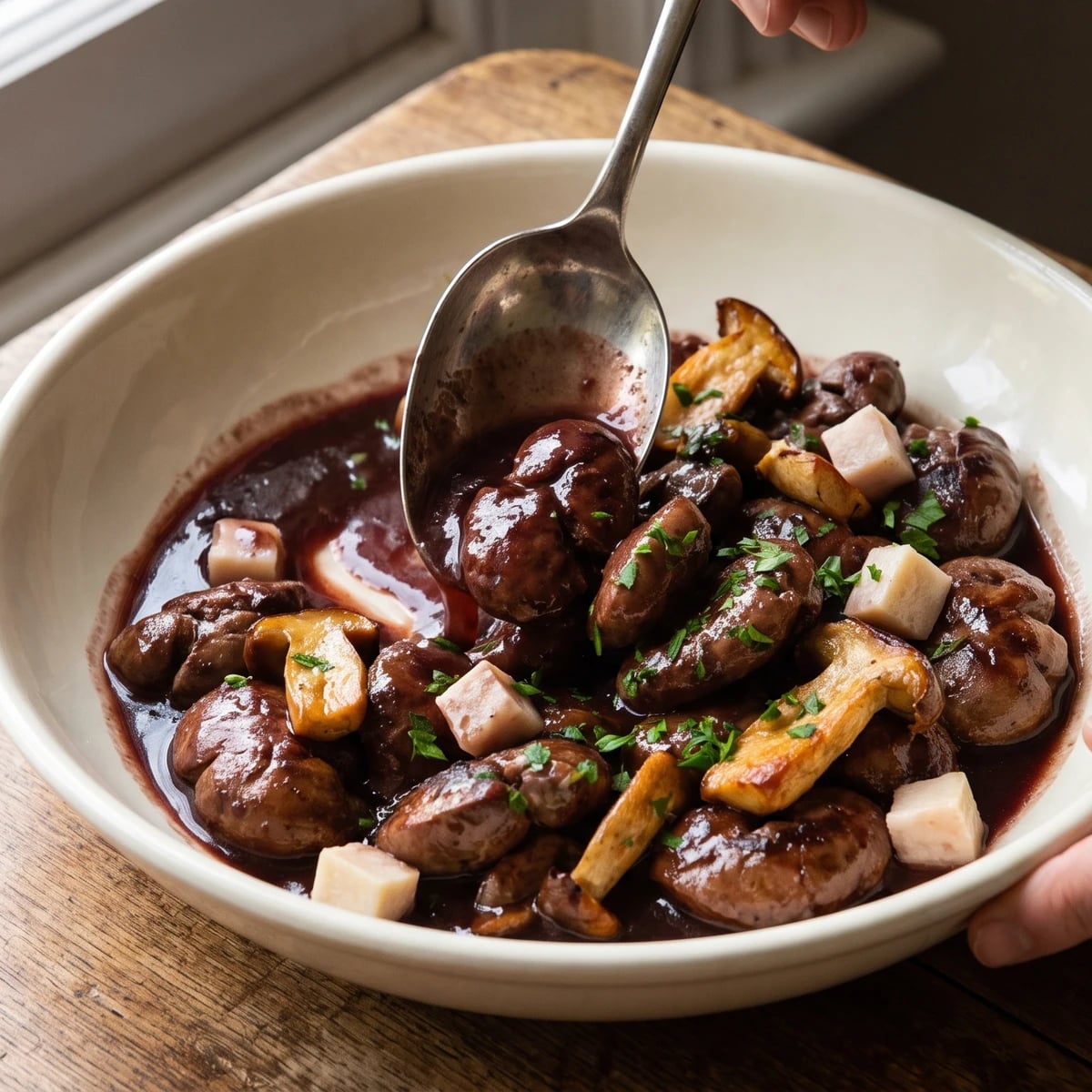
Rognons sautés bordelaise turns a swift, fierce sear into supper: rosy lamb kidneys glazed with wine-dark Sauce Bordelaise, poached marrow, parsley, and cèpes browned in butter.

Main Dishes
French
Dinner Party
Comfort Food
Quick Meal
30 min
Active Time
20 min cook50 min total
Yield4 servings

Rognons sautés bordelaise (quick-seared kidneys in a red-wine Bordelaise sauce) teaches one mercilessly useful rule: kidneys must meet fierce heat briefly, then leave it. Let them simmer in the sauce and they tighten; sauté them hard, drain them, and return them only long enough to take a glossy coat, and they stay tender, rosy, mineral, and rich.

The original entry assumed mutton kidneys, a saucier with Sauce Bordelaise ready, a stockpot never off the fire, and enough hands to cook each garnish separately. At home, lamb kidneys stand in for scarce mutton kidneys, and the finished sauce is made ahead or thawed from your own frozen batch. The separate sauce station is brigade scaffolding and can go; the finished Bordelaise, poached marrow, buttered cèpes, and fry-drain-toss sequence are the dish and stay intact. One cook, one stove, one evening.

Before you touch the pan, trim the kidneys thoroughly and dry them until the paper comes away clean. A wet kidney floods the skillet before it browns. The dry surface and fierce, uncrowded sear decide the plate.

Rognons sautés bordelaise belong to Bordeaux's classical table, where red wine, shallot, and bone marrow give Sauce Bordelaise its dark, glossy identity. The kidneys came into the grand kitchen from the offal cookery practiced across French market and household tables; pairing them with the regional sauce made quick sautéing worthy of formal service without disguising the meat. Bordelaise does not mean any sauce made with Bordeaux wine: in the canon, the marrow and reduced red-wine foundation carry the name, while cèpes place this version firmly in the larder of southwestern France.

The technique, the tradition, and the story behind every dish.

Discover Culinary Explorer

Ingredients

lamb kidneys

Quantity

8 (about 1 lb 5 oz / 600 g)

membranes and white cores removed, cut into 1-inch pieces

prepared Sauce Bordelaise

Quantity

⅓ imperial pint, about ¾ cup (190 ml / about 200 g)

beef bone marrow

Quantity

¼ cup (60 ml / 55 g)

cut into ¼-inch dice

fresh cèpes (porcini mushrooms)

Quantity

3 oz, about 1 packed cup (240 ml / 85 g)

sliced

unsalted butter

Quantity

3 tablespoons (45 ml / 42 g)

divided

neutral oil

Quantity

2 tablespoons (30 ml / 28 g)

divided

flat-leaf parsley

Quantity

1 teaspoon (5 ml / 1 g)

finely chopped

fine salt

Quantity

1¼ teaspoons (6 ml / 7 g)

divided

freshly ground black pepper

Quantity

½ teaspoon (2.5 ml / 1 g)

water

Quantity

2 cups (480 ml / 480 g)

for poaching the marrow

Equipment Needed

  • 30 cm (12-inch) heavy skillet
  • 1 litre (1-quart) saucepan
  • Fine-mesh sieve
  • Slotted spoon
  • Warmed timbale or deep serving bowl

Instructions

  1. 1

    Trim and dry

    Peel away every membrane from the kidneys, split them lengthwise, and cut out the firm white cores without gouging away the surrounding flesh. Cut the lobes into roughly 1-inch pieces, then press them between clean towels until completely dry. Keep them cold and unseasoned while you prepare the garnishes; salt added early draws out moisture and works against the sear.

    A fresh kidney smells clean and faintly mineral. If it smells strongly of ammonia after trimming, don't try to disguise it with milk or wine. Change the plan.
  2. 2

    Poach the marrow

    Bring the water and ¼ teaspoon of the salt to the barest tremble in a small saucepan. Slip in the diced marrow and poach for 60 to 90 seconds, just until the pieces turn opaque at the edges but still hold their shape. Lift them gently with a slotted spoon onto a cool plate. If the edges begin to soften, chill the plate at once; boiling makes the marrow dissolve before it reaches the sauce.

  3. 3

    Brown the cèpes

    Heat 1 tablespoon each of the butter and oil in a heavy skillet over medium-high heat. Add the sliced cèpes in one layer and leave them alone until their undersides bronze, then turn and cook until supple with browned edges, about 4 minutes altogether. Season with a small pinch of salt and drain them well in a sieve, exactly as the source directs; the mushrooms should bring butter and woodland depth to the sauce, not a slick of loose fat.

  4. 4

    Sear the kidneys

    Wipe the skillet clean and heat it over high heat. Season the dry kidneys with the remaining salt and the pepper. Add the remaining oil and, when it glints, add the remaining butter. As soon as the butter's foam subsides, sear the kidneys in two or three uncrowded batches, about 60 to 90 seconds on the first side and 45 seconds after turning. They should be deeply browned outside and rosy rather than raw purple within. Transfer each batch to a sieve set over a bowl and let it drain. If the pan floods, lift the kidneys immediately, discard the liquid, wipe and reheat the skillet, then return only the pale pieces in a smaller batch. Ça se rattrape.

  5. 5

    Assemble the Bordelaise

    Pour the prepared Sauce Bordelaise into the clean skillet or a saucepan and warm it gently. If it is thin, reduce it before adding the garnishes; if it is too tight to flow from a spoon, loosen it with a spoonful of hot water. Once it coats the back of a spoon, fold in the poached marrow, drained cèpes, and chopped parsley. Hold the sauce at a bare tremble so the marrow stays in distinct ivory dice.

  6. 6

    Glaze without boiling

    Add the drained kidneys to the sauce and toss them for 20 to 30 seconds, only until every piece gleams. Never let them boil in the Bordelaise. If the sauce cools too far, lift out the kidneys, reheat the sauce alone, then reunite them off the heat; the sauce can wait another moment, but the kidneys cannot.

  7. 7

    Serve at once

    Spoon the kidneys, cèpes, marrow, and every drop of sauce into a warmed timbale or deep serving bowl. A warm household bowl is the honest equivalent when no timbale lives in the cupboard. Carry it straight to the table with pommes purée or bread ready for the Bordelaise. À table!

Chef Tips

  • Mutton kidneys are the source entry's original choice. Lamb kidneys are the honest home equivalent because they're easier to find and naturally tender enough for this brief sauté; if your butcher has fresh mutton kidneys, use the same weight and cut them slightly smaller.
  • The entry begins with finished Sauce Bordelaise, and this recipe keeps that component whole. Make it separately with real stock, then measure the ⅓ imperial pint the dish requires. Red wine reduced by itself is sharp liquid, not Bordelaise.
  • Fresh cèpes are magnificent when the season gives them. At other times, frozen cèpes picked at their peak are the classical pantry's honest answer; thaw and dry them thoroughly before browning. Dried cèpes bring excellent flavour but not the same fleshy, buttered slices.
  • Ask the butcher for loose beef marrow or split marrow bones. Chill the marrow until firm before dicing, because warm marrow smears under the knife and disappears too quickly in the poaching water.
  • Serve with pommes purée, buttered noodles, or plain bread. A dry red Bordeaux with moderate tannin belongs beside it, not in a reduction made from a bottle too harsh to drink.

Advance Preparation

  • Prepare the Sauce Bordelaise up to three days ahead and chill it without the marrow, cèpes, or parsley. Reheat it gently for the final assembly; it may also be frozen in small portions for several weeks.
  • The marrow can be diced and poached several hours ahead, then kept covered in the cold. Sauté the cèpes up to two hours ahead and hold them separately so they retain their texture.
  • Trim the kidneys up to four hours ahead, arrange them between clean towels, and keep them cold and unseasoned. Once sautéed and sauced, they cannot be held without toughening.

Frequently Asked Questions

Nutrition Information

1 serving (about 200g)

Calories
405 calories
Total Fat
31 g
Saturated Fat
12 g
Trans Fat
1 g
Unsaturated Fat
18 g
Cholesterol
540 mg
Sodium
1150 mg
Total Carbohydrates
4 g
Dietary Fiber
1 g
Sugars
1 g
Protein
27 g

Note: Chef personas and recipes are created with AI assistance. Cook with care: follow safe food-handling practices, check doneness with a thermometer when needed, and adapt for allergies and your kitchen.

Where cooking meets culture.

Culinary guides, cultural storytelling, and the editorial depth that makes cooking meaningful.

Discover Culinary Explorer

More from Relevés and Entrées - MUTTON, GRASS LAMB AND HOUSE LAMB

Browse the full collection