
Chef Juliette
John Dory (St. Pierre)
John Dory has the delicacy of sole and the firmness of turbot. A light flouring, a quick butter sauté, and nut-brown beurre noisette show exactly why looks never mattered.
A cooking platform built around craft, culture, and the stories behind what we eat.
Created by Chef Juliette
Based on No. 1327, Pieds de Mouton Rouennaise, from Le Guide Culinaire (1907) by Auguste Escoffier
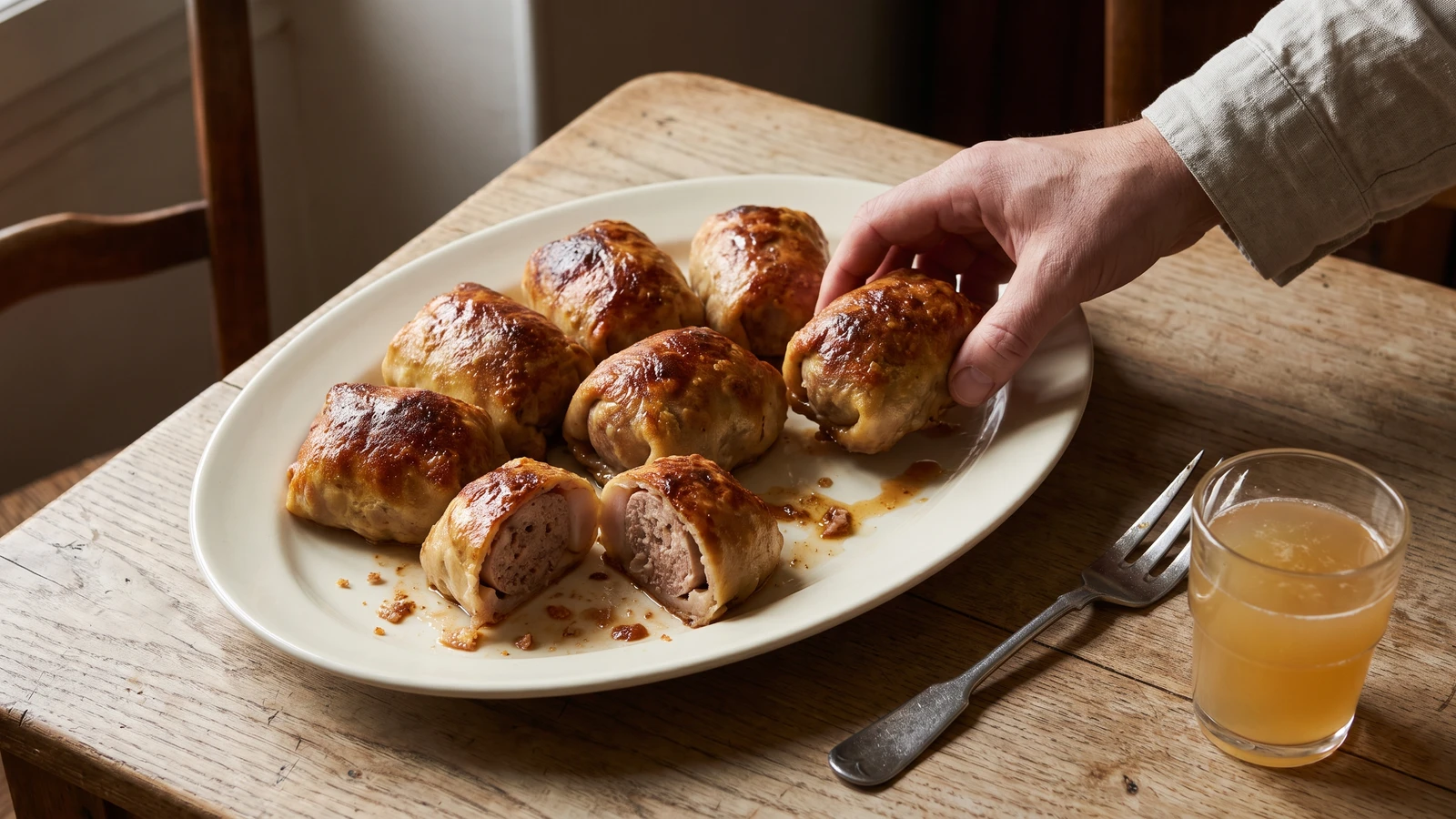
Pieds de mouton à la rouennaise turns humble sheep's trotters into bronzed parcels of yielding tenderness and savory forcemeat, held by caul, glossed with butter, and gently grilled.
Pieds de mouton à la rouennaise (Rouen-style sheep's trotters) teaches the discipline of concentration. The one true thing to know before you touch the pan is this: the braising liquor must become a glaze before it enters the forcemeat. Leave it watery and the filling slumps; reduce it properly and every drop of Madeira, trotter gelatin, and brandy binds the parcel from within.
The original entry assumed ten trotters moving through a brigade, a stockpot never off the fire, a saucier free to watch a reduction, and a salamander giving steady overhead heat. For a table of four, eight split trotters keep the book's proportions and make eight parcels, two per person; unsalted light stock, a small saucepan, and a low home broiler do the same jobs. The brigade's extra hands are scaffolding and can go. The braise, the nearly dry reduction, the sausage forcemeat, the caul, and the gentle grilling are the dish and must stay. One cook, one stove, one evening.
The finished pieds de mouton are deeply bronzed outside, rich and yielding within, with the caul melted into the crumb and the brandied juices caught in the sausage meat. They are generous, a little audacious, and completely at home on a dinner table. Watch the reduction above all: glossy and spoon-coating, not brothy, before it meets the forcemeat.
Pieds de mouton à la rouennaise belongs to Rouen in Normandy, where sheep's feet passed from economical triperie cooking into the classical kitchen through braising, enclosing, and grilling. The Madeira and brandy show the grand-kitchen finish, while sausage meat and pig's caul come directly from charcuterie practice, so the dish moves between butcher's thrift and formal service without losing either. Here pieds de mouton means sheep's trotters, not the hedgehog mushrooms that bear the same French name.
Quantity
8 (about 3½ lb / 1.6 kg total)
singed and split lengthwise by the butcher
Quantity
2 quarts (1.9 L / 1.9 kg), or enough to cover
Quantity
3½ cups (830 ml / 830 g)
Quantity
¼ cup (60 ml / 60 g)
Quantity
1½ teaspoons (7.5 ml / 9 g)
divided
Quantity
½ teaspoon (2.5 ml / 1 g)
divided
Quantity
2⅓ cups (550 ml / 545 g)
finely ground
Quantity
½ cup (120 ml / 70 g)
finely chopped
Quantity
2 tablespoons (30 ml / 28 g)
Quantity
2 tablespoons (30 ml / 8 g)
finely chopped
Quantity
3 tablespoons plus 1 teaspoon (50 ml / 47 g)
Quantity
8 rectangles, each 6 by 4 inches (15 by 10 cm), about 4 oz / 115 g total
Quantity
1 cup (240 ml / 100 g)
Quantity
6 tablespoons (90 ml / 85 g)
melted
| Ingredient | Quantity |
|---|---|
| cleaned sheep's trotterssinged and split lengthwise by the butcher | 8 (about 3½ lb / 1.6 kg total) |
| cold water | 2 quarts (1.9 L / 1.9 kg), or enough to cover |
| unsalted light chicken or veal stock | 3½ cups (830 ml / 830 g) |
| dry Madeira | ¼ cup (60 ml / 60 g) |
| fine sea saltdivided | 1½ teaspoons (7.5 ml / 9 g) |
| freshly ground black pepperdivided | ½ teaspoon (2.5 ml / 1 g) |
| plain fresh pork sausage meatfinely ground | 2⅓ cups (550 ml / 545 g) |
| yellow onionfinely chopped | ½ cup (120 ml / 70 g) |
| unsalted butter | 2 tablespoons (30 ml / 28 g) |
| flat-leaf parsleyfinely chopped | 2 tablespoons (30 ml / 8 g) |
| brandy | 3 tablespoons plus 1 teaspoon (50 ml / 47 g) |
| pig's caul fat | 8 rectangles, each 6 by 4 inches (15 by 10 cm), about 4 oz / 115 g total |
| fine dry breadcrumbs | 1 cup (240 ml / 100 g) |
| unsalted buttermelted | 6 tablespoons (90 ml / 85 g) |
Blanchir, briefly boil, the cleaned trotters before the braise. Put them in a large pot with the cold water, bring slowly to a boil, and cook for 5 minutes. Drain, rinse the trotters well, and wash the pot. This is a cleaning blanch, not a blanc; no flour or acid belongs in the cooking liquid.
Heat the oven to 325°F (160°C). Arrange the trotters snugly in a heavy covered pot and add the stock, Madeira, 1 teaspoon of the salt, and half the pepper. The liquid should reach at least halfway up the trotters; add a little water if your pot is broad. Cover tightly and braise for 2 hours 45 minutes to 3 hours, turning once, until the small bones twist free and the connective tissue yields without resistance. Keep the liquid at a bare tremble. If a trotter splits, save every piece. Ça se rattrape: the caul and forcemeat will hold it later.
Lift the trotters onto a tray and let them cool only until your fingers can manage them. Working while they remain warm, pull and cut away every bone while preserving each trotter as two long halves of skin, tendon, and tender flesh. Strain the braising liquor through a fine sieve into a wide saucepan, then skim away the surface fat.
Boil the strained liquor briskly until only about ½ cup (120 ml) remains and it is nappant, thick enough to coat a spoon in a glossy film. Remove the pan from the heat and place it on a clear heatproof surface, away from anything flammable. Pour the measured brandy from a cup, never from its bottle, and ignite it with a long match while keeping your face and sleeves back. Let the flame die, then return the pan to low heat and reduce again until the liquor coats the spoon. If it goes too far and turns gluey, whisk in 1 tablespoon of water. Ça se rattrape. Cool until fluid but no warmer than your hand.
Melt the 2 tablespoons of butter in a small skillet over low heat. Add the onion and cook for 8 to 10 minutes, stirring often, until completely soft and translucent without coloration. If the edges begin to brown, add a teaspoon of water and lower the heat. Scrape the onion and every drop of butter onto a plate to cool.
Put the cold sausage meat in a bowl and add the cooled onion, parsley, remaining pepper, and reduced braising liquor. Mix until evenly bound but do not beat it warm. Fry a teaspoonful in the onion skillet and taste; add as much of the remaining salt as it needs. If the forcemeat feels too soft to mound, chill it for 20 minutes. Do not stiffen it with breadcrumbs, because the gelatin will set it as it cools.
Rinse the caul in cold water, spread it flat, and pat it dry. Lay out the eight rectangles and divide the forcemeat evenly among them, about 2½ ounces (68 g) for each parcel. Spread roughly a tablespoon beneath each trotter, set the two deboned halves of one trotter together on top, and cover them with the remaining portion of forcemeat. Fold the caul snugly over the filling and set the parcel seam-side down. If the caul tears, overlap a small scrap across the gap. It will melt into the parcel as it cooks.
Set the parcels on a rack over a rimmed baking sheet. Sprinkle the breadcrumbs over every surface, turning the parcels carefully, then spoon the melted butter over them so the crumbs are evenly moistened rather than soaked. Chill uncovered for 20 minutes to firm the shape while the broiler heats.
Set an oven rack about 8 inches (20 cm) below the broiler and use its low setting. Broil the parcels gently, turning every 5 to 6 minutes, until every side is deeply golden and the forcemeat reaches 160°F (71°C), about 18 to 22 minutes total. If the crumbs darken before the centers are ready, lower the rack and finish at 400°F (200°C); ça se rattrape, and the crust will remain crisp. Rest for 5 minutes, then serve two parcels per person while the butter still gleams along the crust. À table!
1 serving (about 370g)
Culinary guides, cultural storytelling, and the editorial depth that makes cooking meaningful.
Discover Culinary ExplorerChef Juliette
John Dory has the delicacy of sole and the firmness of turbot. A light flouring, a quick butter sauté, and nut-brown beurre noisette show exactly why looks never mattered.

Chef Juliette
Fresh haddock proves its delicacy in the meunière pan: a fine flour crust, moist pearly flakes, and beurre noisette sharpened with lemon and parsley, ready from one skillet in half an hour.

Chef Juliette
Éperlans à l’Anglaise turns small fish into a lesson in disciplined coating: boned smelts under a close, crisp crumb, pan-fried in clarified butter and finished with bright, half-melted maître d’hôtel butter.

Chef Juliette
Tiny smelts, shallot, mushrooms, white wine, gratin sauce, and fine bread raspings meet a fierce oven, where the fish must turn tender in the same breath the buttered crust bronzes.