
Chef Juliette
John Dory (St. Pierre)
John Dory has the delicacy of sole and the firmness of turbot. A light flouring, a quick butter sauté, and nut-brown beurre noisette show exactly why looks never mattered.
A cooking platform built around craft, culture, and the stories behind what we eat.
Created by Chef Juliette
Based on No. 1322, Minion Fillets, from Le Guide Culinaire (1907) by Auguste Escoffier
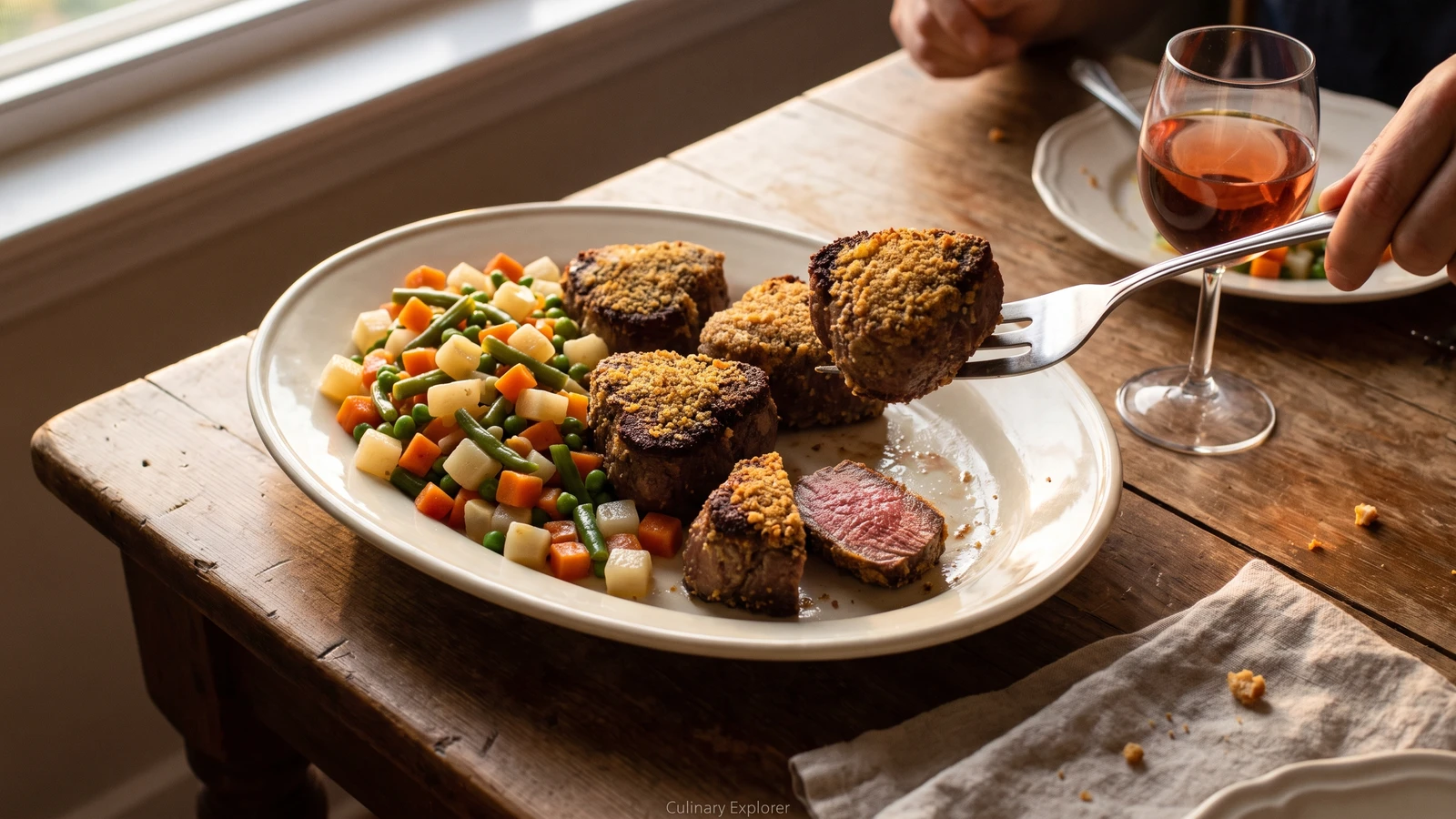
These tender muscles beneath the lamb saddle teach a precise rule: sauté the small ones whole, flatten and gently grill the large, then serve them with a bright, buttered macédoine.
Filets mignons d’agneau teach one exact lesson: size decides technique. Small fillets stay whole and meet the sauté pan; larger ones are cut aslant, flattened into ellipses, dipped in melted butter, covered with fine crumbs, and gently grilled. Ignore that distinction and the little ones dry while the large ones remain raw at the center.
The classical entry assumed whole saddles broken down in-house, fillets sorted at the butcher’s block, a larding needle, a charcoal grill or salamander, and a saucier on staff ready with Béarnaise. At home, ask for lamb tenderloins, use a heavy skillet for the small fillets and the broiler for the large. The larding goes because young market lamb is already tender, while carving away good meat merely to perfect an ellipse was brigade presentation. That is scaffolding. The size-based cooking, real butter, fine crumbs, and careful doneness are the dish. The stockpot can stay quiet because this entry asks for no stock. One cook, one stove, one evening.
Before you touch the pan, sort the fillets by thickness and commit to the proper route. That decision matters more than any flourish added at the table.
Filets mignons belong to the French classical butcher’s and dining-room repertoire, especially the Parisian grand kitchen and the bourgeois table, rather than to one regional larder. In lamb and mutton, the term names the paired tender muscles beneath the saddle; the common assumption that filet mignon can only mean a round beef steak misses its broader butchery usage. Cooks carried the cut from block to table by matching its size to the fire, whole and sautéed when small, flattened and grilled when large, usually beside a vegetable purée or fresh macédoine.
Quantity
8 small or 4 large, about 1½ pounds (680 g) total
silverskin removed
Quantity
6 tablespoons (90 ml / 85 g)
divided
Quantity
½ cup (120 ml / 45 g)
for large fillets only
Quantity
2 teaspoons (10 ml / 12 g)
divided
Quantity
1 teaspoon (5 ml / 2 g)
divided
Quantity
¾ cup (180 ml / 105 g)
cut into a small even dice
Quantity
¾ cup (180 ml / 115 g)
cut into a small even dice
Quantity
¾ cup (180 ml / 90 g)
cut into small even pieces
Quantity
¾ cup (180 ml / 110 g)
| Ingredient | Quantity |
|---|---|
| lamb tenderloinssilverskin removed | 8 small or 4 large, about 1½ pounds (680 g) total |
| unsalted butterdivided | 6 tablespoons (90 ml / 85 g) |
| fine fresh white breadcrumbsfor large fillets only | ½ cup (120 ml / 45 g) |
| fine sea saltdivided | 2 teaspoons (10 ml / 12 g) |
| freshly ground black pepperdivided | 1 teaspoon (5 ml / 2 g) |
| carrotscut into a small even dice | ¾ cup (180 ml / 105 g) |
| turnipscut into a small even dice | ¾ cup (180 ml / 115 g) |
| fine green beanscut into small even pieces | ¾ cup (180 ml / 90 g) |
| fresh or frozen peas | ¾ cup (180 ml / 110 g) |
Melt 4 tablespoons (60 ml / 57 g) of the butter gently in a small saucepan. Skim away the white foam, then pour the clear golden butter into a bowl, leaving the milky sediment behind. This beurre clarifié, clarified butter, tolerates the heat of the sauté pan and broiler without scorching. Keep the remaining 2 tablespoons (30 ml / 28 g) of whole butter for the macédoine.
Pat the lamb completely dry and remove every strip of silverskin without cutting deeply into the meat. If the fillets are small, about 1 inch (2.5 cm) thick or less, leave them whole. If they are large, cut each laterally and on a slight bias into two or three equal portions, then place them between sheets of parchment and tap them gently to an even ½-inch (1.25 cm) thickness. Shape them into loose ellipses with your hands; do not sacrifice good meat for geometric perfection.
Bring a saucepan of water to a lively boil and season it with 1 teaspoon (5 ml / 6 g) of the salt. Add the carrots and turnips and cook for 3 minutes, then add the green beans for 2 minutes more and the peas for the final minute. This macédoine, a mixture of fresh vegetables cut small and evenly, should be tender but still distinct under the teeth. Drain it thoroughly and spread it on a clean towel; water left clinging to the vegetables will thin their butter glaze.
Season the lamb on both sides with the remaining 1 teaspoon (5 ml / 6 g) salt and the pepper. For small whole fillets, stop there. For large flattened fillets, dip each piece lightly in the beurre clarifié, then press both sides into the fine breadcrumbs. Shake off the excess. The coating should be thin enough to brown while the lamb cooks, not a heavy shell that insulates the meat.
For small whole fillets, heat a heavy skillet over medium-high heat and add about half the beurre clarifié. Sauté the lamb without crowding, turning it through its broad sides, for 6 to 8 minutes total, until evenly bronzed and 145°F (63°C) at the center. If the butter darkens before the meat is ready, lift out the lamb, wipe the pan, and continue with the reserved beurre clarifié. Ça se rattrape. For large crumbed fillets, heat the broiler fully and position a rack about 4 inches (10 cm) below it. Arrange the fillets on a wire rack set over a rimmed tray and broil gently for 2 to 3 minutes per side, turning with a broad spatula, until the crumbs are deep butter-gold and the centers reach 145°F (63°C). If the crumbs color too quickly, move the tray farther from the heat and finish the fillets in a 375°F (190°C) oven. Burnt crumbs cannot be reasoned with, but early color can be rescued.
Transfer whole fillets to a warm plate and rest them for 5 minutes; flattened fillets need 3 minutes. While they rest, melt the remaining whole butter over medium heat, add the drained macédoine, and toss until every vegetable carries a bright butter sheen. Taste and correct the seasoning. If the vegetables release water, raise the heat briefly and toss until the liquid evaporates and the glaze returns.
Spoon the macédoine generously onto a warm oval platter. Set the small fillets down whole, or overlap the crumbed ellipses without stacking them so their crust stays crisp. Spoon any clean resting juices over the whole sautéed fillets, but leave the crumbed version untouched. Serve at once. À table!
1 serving (about 260g)
Culinary guides, cultural storytelling, and the editorial depth that makes cooking meaningful.
Discover Culinary ExplorerChef Juliette
John Dory has the delicacy of sole and the firmness of turbot. A light flouring, a quick butter sauté, and nut-brown beurre noisette show exactly why looks never mattered.

Chef Juliette
Fresh haddock proves its delicacy in the meunière pan: a fine flour crust, moist pearly flakes, and beurre noisette sharpened with lemon and parsley, ready from one skillet in half an hour.

Chef Juliette
Éperlans à l’Anglaise turns small fish into a lesson in disciplined coating: boned smelts under a close, crisp crumb, pan-fried in clarified butter and finished with bright, half-melted maître d’hôtel butter.

Chef Juliette
Tiny smelts, shallot, mushrooms, white wine, gratin sauce, and fine bread raspings meet a fierce oven, where the fish must turn tender in the same breath the buttered crust bronzes.