
Chef Juliette
John Dory (St. Pierre)
John Dory has the delicacy of sole and the firmness of turbot. A light flouring, a quick butter sauté, and nut-brown beurre noisette show exactly why looks never mattered.
A cooking platform built around craft, culture, and the stories behind what we eat.
Created by Chef Juliette
Based on No. 1316a, Côtelettes de Mouton à la Reforme, from Le Guide Culinaire (1907) by Auguste Escoffier
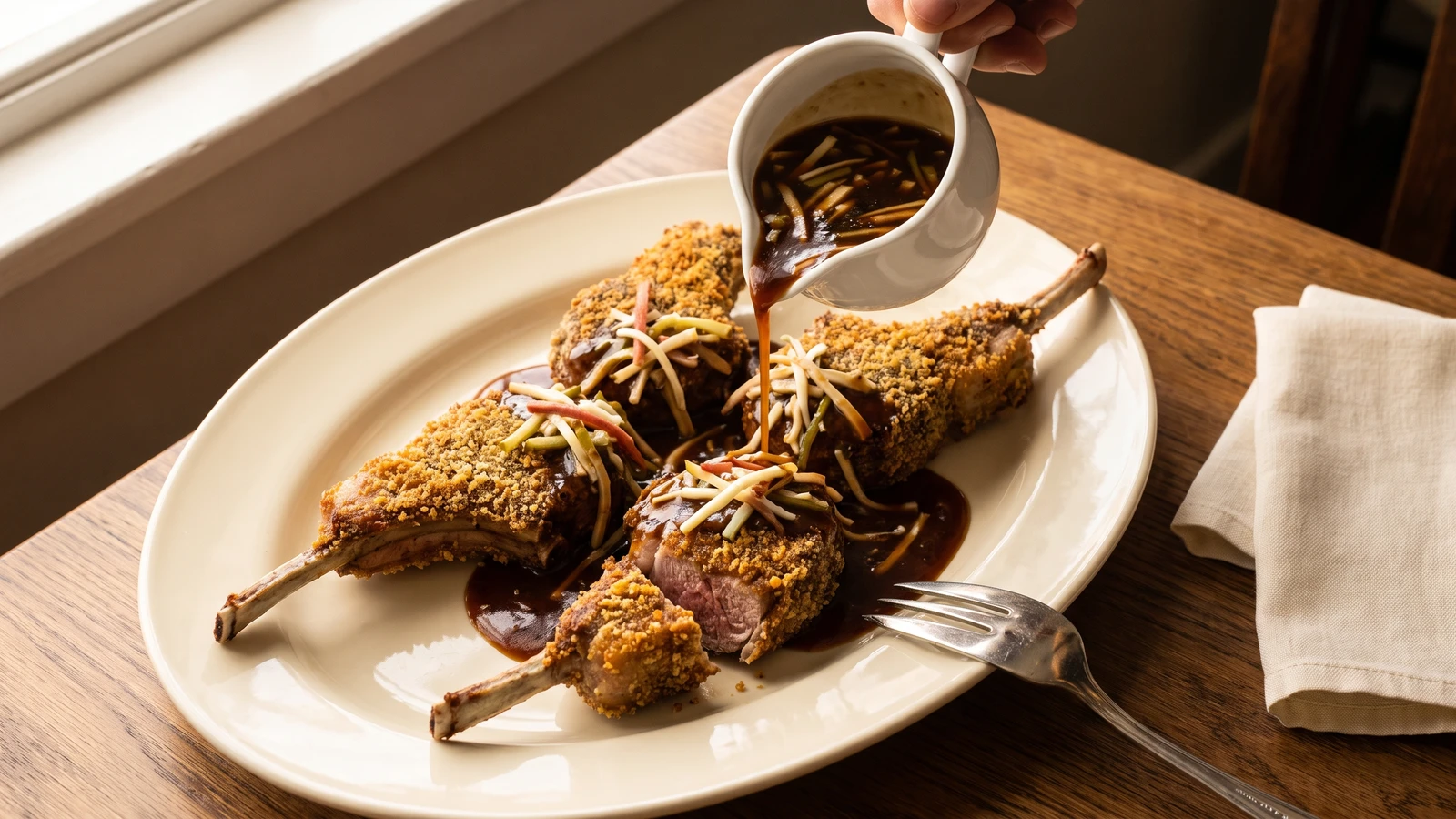
Ham-flecked crumbs, juicy mutton, clarified butter, and a sharp-sweet poivrade half-glaze: a clubland classic whose discipline lies in gentle frying and a julienne cut fine enough to season every spoonful.
Côtelettes de Mouton à la Réforme (mutton cutlets with Reform sauce and garnish) teaches one severe and useful rule: a crumbed cutlet must cook gently enough for its coating and its center to finish together. The ham-flecked crumbs should bronze without scorching while the mutton stays juicy. Rush the pan and the outside is finished before the meat has begun.
The original kitchen assumed six cutlets, a saucier, half-glaze and Sauce Poivrade waiting beside a stock never off the fire, and a hot cupboard for the serving dish. At home, use four cutlets, the two prepared sauces as finished components, one small saucepan, one skillet, and a platter warmed briefly in a low oven. The quantities are reduced by one-third, while the original proportion of one part ham to three parts breadcrumbs remains exact. Making the component sauces during service and maintaining a hot cupboard were brigade scaffolding; the buttered ham crumb, gentle frying, sharp-sweet sauce, and precise little julienne are the dish and must stay. No salamander is wanted, because the crust takes its color entirely in clarified butter.
Done properly, the cutlets arrive deep gold, the sauce gleams darkly beside them, and every spoonful carries a little acidity from gherkin, savor from tongue and mushroom, richness from truffle, and sweetness from red-currant jelly. One cook, one stove, one evening. Before you touch the pan, remember the step that decides everything: keep the clarified butter at a quiet sizzle, never an angry one.
Despite its French title, the dish belongs to the Reform Club in London, where a French-trained club kitchen placed British mutton inside the classical grammar of crumb coating, Sauce Poivrade, half-glaze, and exact garnish. The name honors the club rather than a French region or culinary movement, and the formula traveled from clubland dining into the French-language classical repertoire. Its colored julienne was not decoration alone: egg white, red salted tongue, gherkin, mushroom, and truffle brought softness, savor, acidity, and perfume to an otherwise dense sauce.
Quantity
4 (about 680 g / 1½ lb total)
cut about 2.5 cm / 1 inch thick and trimmed
Quantity
1 teaspoon (5 ml / 6 g)
Quantity
½ teaspoon (2.5 ml / 1 g)
Quantity
2 tablespoons (30 ml / 28 g)
melted
Quantity
¾ cup (180 ml / 60 g)
Quantity
3 tablespoons, loosely packed (45 ml / 20 g)
finely chopped
Quantity
⅓ cup (80 ml / 72 g)
for gentle shallow-frying
Quantity
2 tablespoons (30 ml / 32 g)
Quantity
2 tablespoons (30 ml / 32 g)
Quantity
Scant ¾ teaspoon (3.5 ml / 5 g)
Quantity
Scant ¾ teaspoon (3.5 ml / 2 g)
cut in short fine julienne
Quantity
Scant ¾ teaspoon (3.5 ml / 3 g)
cut in short fine julienne
Quantity
Scant ¾ teaspoon (3.5 ml / 3 g)
cut in short fine julienne
Quantity
Scant ¾ teaspoon (3.5 ml / 2 g)
cut in short fine julienne
Quantity
Scant ¾ teaspoon (3.5 ml / 2 g)
cut in short fine julienne
| Ingredient | Quantity |
|---|---|
| mutton rib or loin cutletscut about 2.5 cm / 1 inch thick and trimmed | 4 (about 680 g / 1½ lb total) |
| fine sea salt | 1 teaspoon (5 ml / 6 g) |
| freshly ground black pepper | ½ teaspoon (2.5 ml / 1 g) |
| unsalted buttermelted | 2 tablespoons (30 ml / 28 g) |
| fine fresh white breadcrumbs | ¾ cup (180 ml / 60 g) |
| cooked hamfinely chopped | 3 tablespoons, loosely packed (45 ml / 20 g) |
| clarified butterfor gentle shallow-frying | ⅓ cup (80 ml / 72 g) |
| prepared half-glaze sauce (demi-glace) | 2 tablespoons (30 ml / 32 g) |
| prepared Sauce Poivrade | 2 tablespoons (30 ml / 32 g) |
| red-currant jelly | Scant ¾ teaspoon (3.5 ml / 5 g) |
| hard-boiled egg whitecut in short fine julienne | Scant ¾ teaspoon (3.5 ml / 2 g) |
| red salted tonguecut in short fine julienne | Scant ¾ teaspoon (3.5 ml / 3 g) |
| gherkincut in short fine julienne | Scant ¾ teaspoon (3.5 ml / 3 g) |
| cooked button mushroomcut in short fine julienne | Scant ¾ teaspoon (3.5 ml / 2 g) |
| preserved black trufflecut in short fine julienne | Scant ¾ teaspoon (3.5 ml / 2 g) |
Set an oven-safe serving platter in a 95°C / 200°F oven to warm. Trim the cutlets neatly, leaving the meat attached to the bone, then pat them completely dry and season both sides with the salt and pepper. Dry meat holds its coating; moisture lets butter and crumbs slide away together.
Cut the egg white, salted tongue, gherkin, mushroom, and truffle julienne-fashion, into matchstick rods about 1 mm thick and 2 cm long. Keep each element distinct as you work, then measure a scant ¾ teaspoon of each. This short, fine cut belongs in every spoonful of sauce; coarse strips turn a composed garnish into a forkful of odds and ends.
Combine the prepared half-glaze sauce and prepared Sauce Poivrade in a small saucepan. Warm them over low heat, whisk in the red-currant jelly, and stop as soon as the jelly has dissolved and the sauce lightly coats the back of a spoon. If it reduces into a sticky glaze, ça se rattrape: whisk in hot water a teaspoon at a time until it flows in a glossy ribbon. Cover and hold it barely warm without letting it boil.
Mix the breadcrumbs and finely chopped ham thoroughly, rubbing any clumps apart with your fingers so the ham is evenly dispersed. Brush or dip each cutlet in the melted butter, then press it firmly into the ham crumbs on both sides and around the edges. Shake away only the loose excess and rest the coated cutlets for 5 minutes. If a patch slips, the meat was probably damp; press fresh crumbs onto that spot and give it another few minutes to settle. Don't add egg or flour, because the melted-butter coating is part of this method.
Heat the clarified butter in a heavy skillet over medium-low heat until a test crumb bubbles quietly without darkening at once, about 155°C / 310°F if you use a thermometer. Lay in two cutlets, leaving space around them, and cook for 4 to 6 minutes per side. Turn each once with a broad spatula, keeping the crust intact, and baste the edges with clarified butter. The coating should deepen gradually to an even burnished gold while the center reaches at least 63°C / 145°F after resting. If the crumbs brown before the meat is ready, lift the pan off the heat, remove any blackened loose crumbs, lower the flame, and continue gently. Ça se rattrape.
Transfer the first cutlets to a rack for 3 minutes while you cook the second pair. Scoop loose crumbs from the butter before the next batch so they don't burn and mark the fresh coating. Keep the cooked cutlets near the warm oven, but don't shut them inside for long or their crust will soften.
Return the sauce to the gentlest heat and fold in the measured julienne of egg white, salted tongue, gherkin, mushroom, and truffle. Warm it only until the garnish is heated through, about 1 minute. A hard simmer muddies the colors, tightens the half-glaze, and steals the gherkin's useful edge.
Remove the warm platter from the oven and arrange the four cutlets in an open circle, bones pointing outward as the original service directs. Pour the sauce into a warm sauceboat and send it to the table beside the cutlets rather than drowning their crust. Spoon the glossy sauce and its fine julienne over each cutlet only as it is served. À table!
1 serving (about 155g)
Culinary guides, cultural storytelling, and the editorial depth that makes cooking meaningful.
Discover Culinary ExplorerChef Juliette
John Dory has the delicacy of sole and the firmness of turbot. A light flouring, a quick butter sauté, and nut-brown beurre noisette show exactly why looks never mattered.

Chef Juliette
Fresh haddock proves its delicacy in the meunière pan: a fine flour crust, moist pearly flakes, and beurre noisette sharpened with lemon and parsley, ready from one skillet in half an hour.

Chef Juliette
Éperlans à l’Anglaise turns small fish into a lesson in disciplined coating: boned smelts under a close, crisp crumb, pan-fried in clarified butter and finished with bright, half-melted maître d’hôtel butter.

Chef Juliette
Tiny smelts, shallot, mushrooms, white wine, gratin sauce, and fine bread raspings meet a fierce oven, where the fish must turn tender in the same breath the buttered crust bronzes.