
Chef Juliette
John Dory (St. Pierre)
John Dory has the delicacy of sole and the firmness of turbot. A light flouring, a quick butter sauté, and nut-brown beurre noisette show exactly why looks never mattered.
A cooking platform built around craft, culture, and the stories behind what we eat.
Created by Chef Juliette
Based on No. 1312, Côtelettes à la Champvallon (10 Cutlets), from Le Guide Culinaire (1907) by Auguste Escoffier
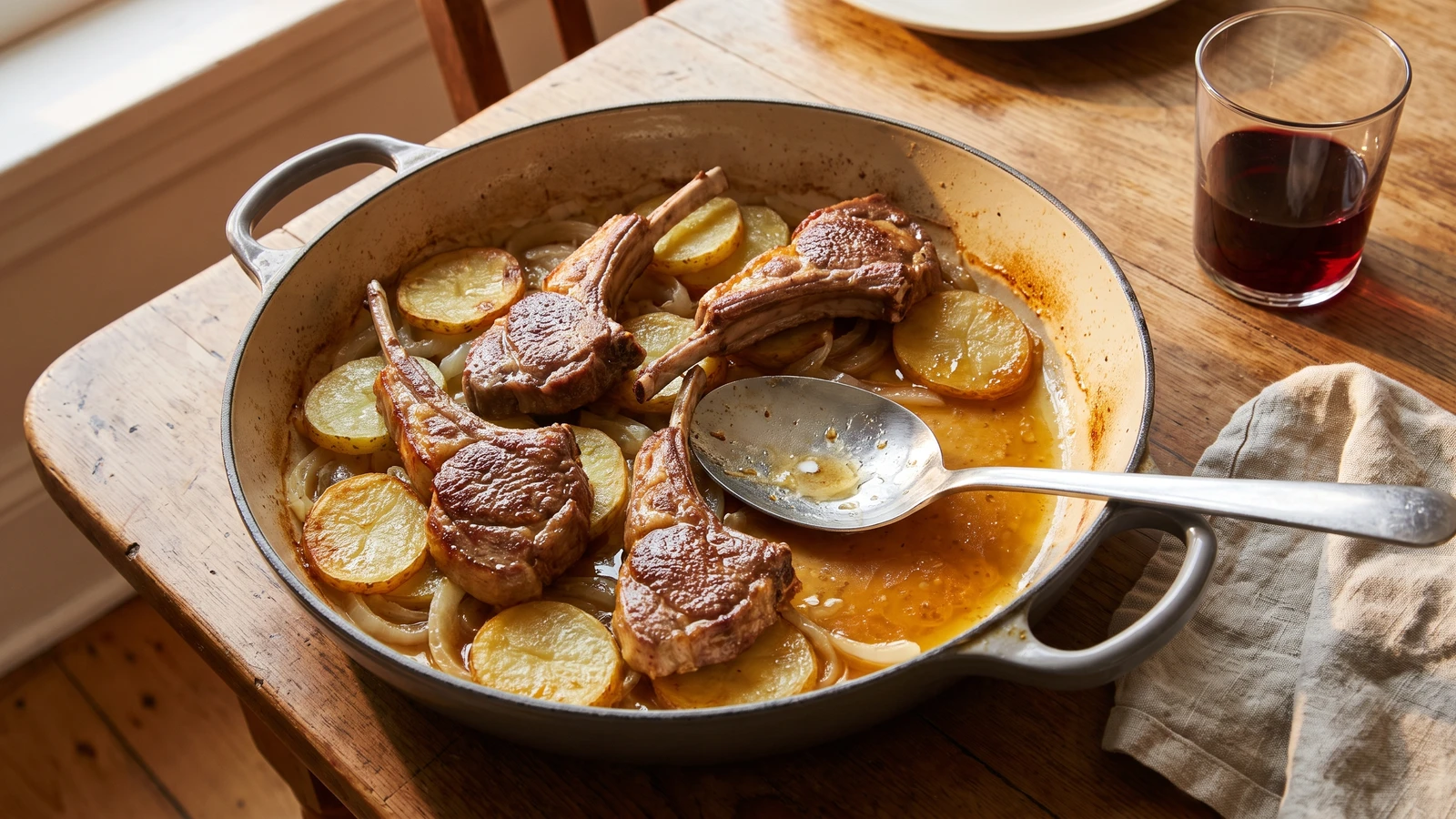
Côtelettes à la Champvallon puts one-pot discipline to work: lamb browned in butter, onions kept pale, and potato roundels basted in white stock until the meat yields and the cooking juices reduce to a glaze.
Côtelettes à la Champvallon (lamb cutlets baked with onions and potato roundels) teaches control through reduction. The one true thing is this: the stock must nearly disappear at the same moment the potatoes soften and the lamb yields. Too much liquid and you have soup; too little, too soon, and the potatoes never finish.
The original entry assumed ten cutlets, white stock never far from the fire, a cook free to baste repeatedly, and a separate pan and earthenware baking dish. Here, the ten cutlets become four, the onions become 90 grams, and the potatoes 270 grams, preserving the book's one-to-three proportion exactly. A good low-sodium white chicken stock stands in for the stockpot, while one shallow ovenproof braiser handles both stove and oven. One cook, one stove, one evening.
Fashioning the potatoes into corks before slicing them was brigade presentation scaffolding, so it can go without harming the dish. Cut even roundels from ordinary peeled potatoes instead. Browning the cutlets in butter, keeping the onions pale, giving the meat its twenty-minute head start, basting the potatoes, and reducing the stock almost away must stay. Those steps are the dish.
When it is right, the potato edges are butter-gold, the onions have melted beneath them, and only a glossy spoonful of cooking juices remains around the bronzed cutlets. Before touching the pan, choose a shallow vessel in which the cutlets fit snugly in one layer. That decision governs the reduction.
Côtelettes à la Champvallon belong to the Parisian classical and bourgeois table, where lamb or mutton cutlets were baked with onions, potatoes, and white stock, then carried to the table in their cooking dish. Grand kitchens formalized this domestic combination by trimming potatoes into cork shapes before slicing them into identical roundels; as the dish moved into home kitchens, the shaping could fall away while the sequence remained. What looks like a gratin is not one: the stock should reduce almost entirely, glazing the meat and potatoes rather than leaving them beneath cream or cheese.
Quantity
4 thick cutlets (about 2 lb / 900 g total)
Quantity
3/4 cup (180 ml / 90 g)
thinly sliced
Quantity
about 2 cups (475 ml / 270 g)
peeled and cut into 1/8-inch (3 mm) roundels
Quantity
3 tablespoons (45 ml / 42 g)
divided
Quantity
2 to 2 1/2 cups (475 to 600 ml / 475 to 600 g)
Quantity
about 1/10 clove (0.3 g)
crushed to a paste
Quantity
1 small bouquet
Quantity
1 1/2 teaspoons (7.5 ml / 9 g)
divided
Quantity
1/2 teaspoon (2.5 ml / 1 g)
divided
| Ingredient | Quantity |
|---|---|
| bone-in lamb shoulder-end cutlets or blade chops | 4 thick cutlets (about 2 lb / 900 g total) |
| yellow onionthinly sliced | 3/4 cup (180 ml / 90 g) |
| waxy yellow potatoespeeled and cut into 1/8-inch (3 mm) roundels | about 2 cups (475 ml / 270 g) |
| unsalted butterdivided | 3 tablespoons (45 ml / 42 g) |
| hot low-sodium white chicken or veal stock | 2 to 2 1/2 cups (475 to 600 ml / 475 to 600 g) |
| garliccrushed to a paste | about 1/10 clove (0.3 g) |
| bouquet garni (herb bundle: parsley, thyme, and bay) | 1 small bouquet |
| fine saltdivided | 1 1/2 teaspoons (7.5 ml / 9 g) |
| freshly ground black pepperdivided | 1/2 teaspoon (2.5 ml / 1 g) |
Heat the oven to 375°F (190°C). Pat the cutlets thoroughly dry, but do not french or scrape the bone ends; the source leaves their meat intact. Season them on both sides with 1 teaspoon of the salt and half the pepper. Slice the onion, tie the bouquet garni, and peel the potatoes, leaving them whole in cold water until their turn comes.
Melt 2 tablespoons (30 ml / 28 g) of the butter in a shallow 12-inch (30 cm) ovenproof braiser over medium-high heat. When the foam subsides, brown the cutlets in batches for 3 to 4 minutes per side, leaving them undisturbed long enough to form a deep butter-bronze crust. Set them aside. Preserve the brown fond on the pan floor; it is the foundation of the finished juices. If the butter solids turn black, wipe out only the burnt fat, add a little of the reserved butter, and continue. Ça se rattrape.
Lower the heat to medium-low and add the remaining 1 tablespoon (15 ml / 14 g) butter. Suer the onions, meaning sweat them gently without browning, for 6 to 8 minutes, stirring until supple and translucent. If they begin to colour, lower the heat and add a spoonful of stock; browned onions would make the dish sweeter and darker than intended. Stir in the tiny scraping of garlic, then add the bouquet garni.
Nestle the cutlets into the onions in one snug layer. Pour in enough hot white stock to almost cover the meat and onions, usually 2 to 2 1/2 cups (475 to 600 ml / 475 to 600 g), depending on the pan. Bring the liquid to a boil on the stove, then immediately transfer the uncovered braiser to the oven for 20 minutes. The brief boil starts the braise evenly; the shallow uncovered vessel begins the reduction.
Slice the potatoes crosswise into even 1/8-inch (3 mm) roundels and pat away their surface water. Season with the remaining salt and pepper, then arrange them over and around the cutlets in loose overlapping layers. Spoon the cooking liquid over every round and return the braiser to the oven, uncovered, for 35 to 45 minutes. Baste every 10 minutes, lifting liquid from the edges and wetting the potatoes without disturbing their layers. They are ready when a knife passes through without resistance and their exposed edges are golden.
Check the cutlets for yielding tenderness and look beneath the potatoes: only a few glossy spoonfuls of liquid should remain. If the meat and potatoes are ready but the pan is still wet, lift them to a warm platter and boil the juices on the stove for 3 to 5 minutes, then return everything to the glaze. If the pan dries before the potatoes soften, add 1/4 cup (60 ml / 60 g) hot stock and continue cooking. Ça se rattrape. Discard the bouquet garni, rest the dish for 5 minutes, and serve directly from the braiser. À table!
1 serving (about 280g)
Culinary guides, cultural storytelling, and the editorial depth that makes cooking meaningful.
Discover Culinary ExplorerChef Juliette
John Dory has the delicacy of sole and the firmness of turbot. A light flouring, a quick butter sauté, and nut-brown beurre noisette show exactly why looks never mattered.

Chef Juliette
Fresh haddock proves its delicacy in the meunière pan: a fine flour crust, moist pearly flakes, and beurre noisette sharpened with lemon and parsley, ready from one skillet in half an hour.

Chef Juliette
Éperlans à l’Anglaise turns small fish into a lesson in disciplined coating: boned smelts under a close, crisp crumb, pan-fried in clarified butter and finished with bright, half-melted maître d’hôtel butter.

Chef Juliette
Tiny smelts, shallot, mushrooms, white wine, gratin sauce, and fine bread raspings meet a fierce oven, where the fish must turn tender in the same breath the buttered crust bronzes.