
Chef Juliette
John Dory (St. Pierre)
John Dory has the delicacy of sole and the firmness of turbot. A light flouring, a quick butter sauté, and nut-brown beurre noisette show exactly why looks never mattered.
A cooking platform built around craft, culture, and the stories behind what we eat.
Created by Chef Juliette
Based on No. 1305, Gigot Bouilli à l’Anglaise, from Le Guide Culinaire (1907) by Auguste Escoffier
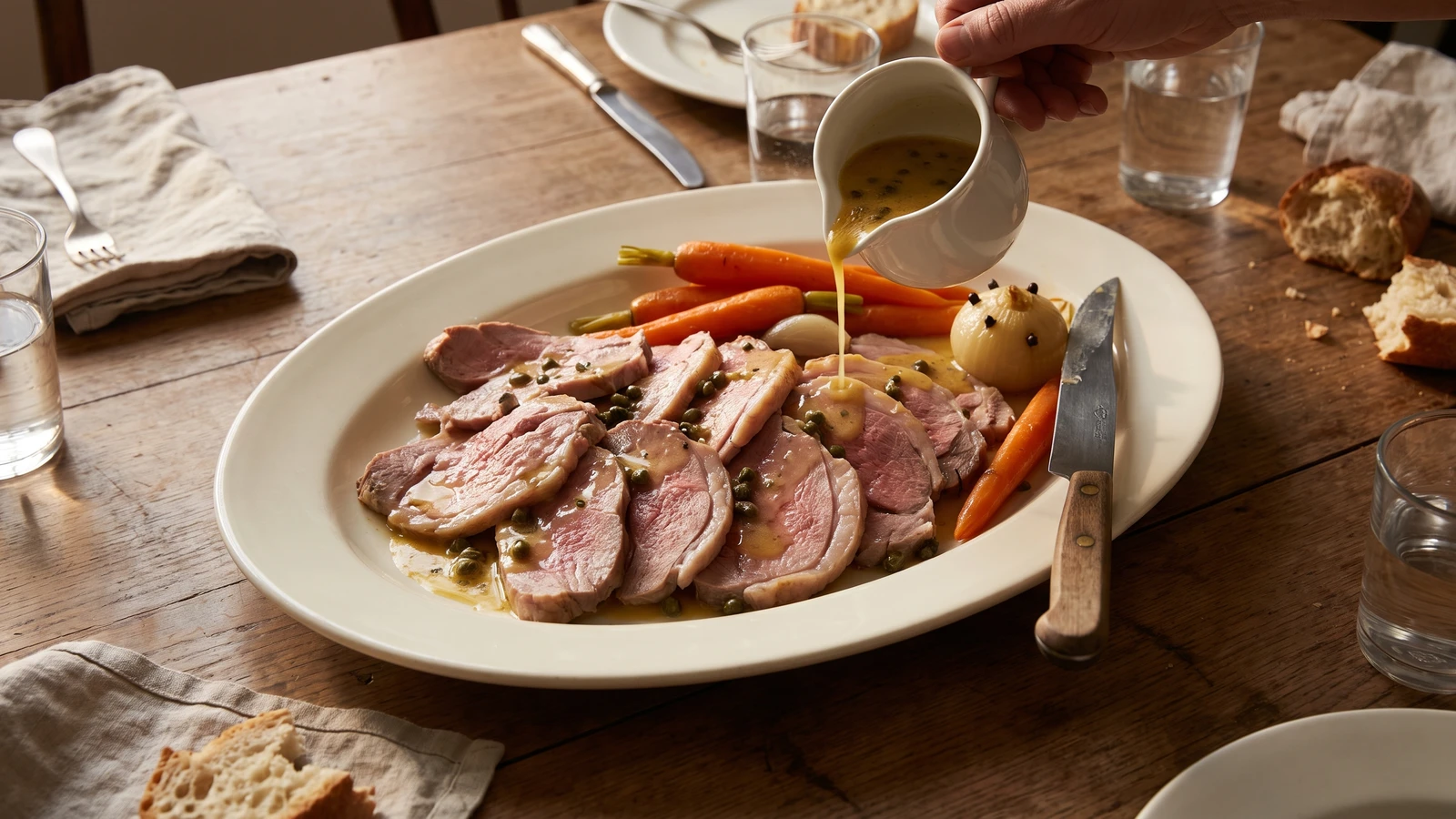
Gigot à l’anglaise proves that plain water can cook with precision: rosy lamb, sweet roots, and caper-bright butter sauce, all decided by one quiet simmer and an honest thermometer.
Gigot Bouilli à l’Anglaise (leg of lamb cooked plainly in water) teaches a severe and useful lesson: boiling is the entrance, not the cooking temperature. The joint goes into properly salted boiling water, then the pot must settle to a bare tremble. Let it roll and the outside tightens before the heart warms; hold it gently and the meat stays rosy, moist, and clean-tasting enough for capers and butter to speak.
The entry assumed a butcher-trimmed full leg with its tibia shortened, a deep stewpan, and a saucier on staff to make the butter sauce while the meat was dressed. A stock never off the fire and a salamander have no work here. For four, a 3½-pound bone-in half leg replaces the brigade-sized joint, and the book’s tied herb faggot becomes a small bouquet garni. The full-sized leg and spare pair of hands are scaffolding and go. The boiling plunge, exact salt ratio, carrots, clove-stuck onion, garlic, herbs, and caper butter sauce are the dish and stay.
The book gives fifteen minutes for each two pounds of meat. Keep that timing as the first moment to check, then let a thermometer supply the judgment once carried by constant repetition. One cook, one stove, one evening. The step that decides everything is lowering the heat the instant the water returns to the boil.
Boiled mutton with caper sauce belongs to the British domestic table, where a joint and its roots formed a generous boiled dinner; French classical kitchens carried it into their own repertoire as Gigot Bouilli à l’Anglaise. In French kitchen vocabulary, à l’anglaise means plainly cooked in water, not covered in an English-style gravy, while the clove-stuck onion and bouquet garni give the cooking liquor a distinctly French discipline. The dish traveled from home table to grand kitchen and back again without losing its essential contrast: mild, rosy meat against sharp capers and rich butter.
Quantity
1, about 3½ pounds (1.6 kg)
trimmed of thick external fat with the protruding shank bone shortened
Quantity
4 quarts (3.8 L / 3.8 kg), or enough to cover by 1 inch (2.5 cm)
Quantity
2 tablespoons (30 ml / 38 g)
Quantity
2 (about 8 ounces / 225 g)
peeled and cut into 2-inch (5 cm) lengths
Quantity
1 (about 6 ounces / 170 g)
peeled
Quantity
1
Quantity
1
Quantity
1
peeled
Quantity
½ cup (120 ml / 113 g)
2 tablespoons for the roux, remaining butter chilled and cubed
Quantity
2 tablespoons (30 ml / 16 g)
Quantity
1½ cups (360 ml / 360 g)
Quantity
3 tablespoons (45 ml / 30 g)
drained and rinsed
Quantity
2 teaspoons (10 ml / 10 g)
Quantity
⅛ teaspoon (0.6 ml / 0.3 g)
| Ingredient | Quantity |
|---|---|
| bone-in shank-end half leg of lambtrimmed of thick external fat with the protruding shank bone shortened | 1, about 3½ pounds (1.6 kg) |
| cold water | 4 quarts (3.8 L / 3.8 kg), or enough to cover by 1 inch (2.5 cm) |
| fine sea salt | 2 tablespoons (30 ml / 38 g) |
| medium carrotspeeled and cut into 2-inch (5 cm) lengths | 2 (about 8 ounces / 225 g) |
| medium yellow onionpeeled | 1 (about 6 ounces / 170 g) |
| whole clove | 1 |
| small bouquet garni containing parsley stems, thyme, and bay | 1 |
| large garlic clovepeeled | 1 |
| unsalted butter2 tablespoons for the roux, remaining butter chilled and cubed | ½ cup (120 ml / 113 g) |
| plain flour | 2 tablespoons (30 ml / 16 g) |
| reserved lamb poaching liquor | 1½ cups (360 ml / 360 g) |
| capers in brinedrained and rinsed | 3 tablespoons (45 ml / 30 g) |
| fresh lemon juice | 2 teaspoons (10 ml / 10 g) |
| ground white pepper | ⅛ teaspoon (0.6 ml / 0.3 g) |
Ask the butcher to shorten the protruding shank bone and remove only the thick, hard external fat. Leave a thin covering to protect the meat. If the half leg is loose or partly boned, tie it at 1½-inch (4 cm) intervals so it cooks as one even joint. Pat it dry, peel the vegetables, and push the whole clove firmly into the onion.
Put the water and salt into an 8-quart (7.5-liter) pot and bring them to a full boil. Lower the lamb carefully into the water with sturdy tongs, moving it away from you to prevent splashing. Add the carrots, clove-stuck onion, bouquet garni, and garlic. Let the water return just to the boil before adjusting the heat.
Immediately lower the heat until the surface barely trembles, with only an occasional lazy bubble, about 180 to 190°F (82 to 88°C). Cover the pot partially and cook gently, turning the lamb once if any part sits above the water. For a 3½-pound joint, begin checking after 26 minutes, following the book’s quarter-hour for each two pounds. Continue until an instant-read thermometer inserted into the thickest meat without touching bone registers 145°F (63°C), usually 30 to 40 minutes. If the pot begins rolling hard, lower the heat at once. Ça se rattrape: even if the outer meat has tightened, a proper rest, thin carving, and generous sauce will keep the platter succulent.
Lift the lamb onto a warm platter and tent it loosely with foil for 15 minutes. Transfer the carrots and onion to a covered dish, discard the bouquet garni and garlic, and reserve at least 2 cups (480 ml) of the poaching liquor. The rest lets the meat settle so its juices stay in the slices rather than escaping across the board.
Melt 2 tablespoons (28 g) of the butter in a small saucepan over gentle heat. Stir in the flour and cook for 2 minutes without allowing it to color, making a roux blanc (white roux). Gradually whisk in 1½ cups (360 ml) of hot poaching liquor, then simmer for 5 to 7 minutes until the sauce reaches nappé, a light coating on the back of a spoon. Take the pan off the heat and monter au beurre, whisking in the remaining cold butter a few cubes at a time. Fold in the capers, lemon juice, and white pepper. If the sauce is too thick, loosen it with reserved liquor; if butter floats at the surface, stop heating and whisk in 1 tablespoon of cool liquor. Ça se rattrape. Never boil the sauce once the finishing butter is in.
Remove any twine and carve the lamb across the grain into thin, generous slices. Arrange them on the warm platter with the carrots and softened onion around the edge. Spoon enough caper butter sauce over the meat to give it a gloss, then send the rest to the table in a warm sauceboat. À table!
1 serving (about 340g)
Culinary guides, cultural storytelling, and the editorial depth that makes cooking meaningful.
Discover Culinary ExplorerChef Juliette
John Dory has the delicacy of sole and the firmness of turbot. A light flouring, a quick butter sauté, and nut-brown beurre noisette show exactly why looks never mattered.

Chef Juliette
Fresh haddock proves its delicacy in the meunière pan: a fine flour crust, moist pearly flakes, and beurre noisette sharpened with lemon and parsley, ready from one skillet in half an hour.

Chef Juliette
Éperlans à l’Anglaise turns small fish into a lesson in disciplined coating: boned smelts under a close, crisp crumb, pan-fried in clarified butter and finished with bright, half-melted maître d’hôtel butter.

Chef Juliette
Tiny smelts, shallot, mushrooms, white wine, gratin sauce, and fine bread raspings meet a fierce oven, where the fish must turn tender in the same breath the buttered crust bronzes.