
Chef Juliette
John Dory (St. Pierre)
John Dory has the delicacy of sole and the firmness of turbot. A light flouring, a quick butter sauté, and nut-brown beurre noisette show exactly why looks never mattered.
A cooking platform built around craft, culture, and the stories behind what we eat.
Created by Chef Juliette
Based on No. 1301, Fillets of Mutton, from Le Guide Culinaire (1907) by Auguste Escoffier
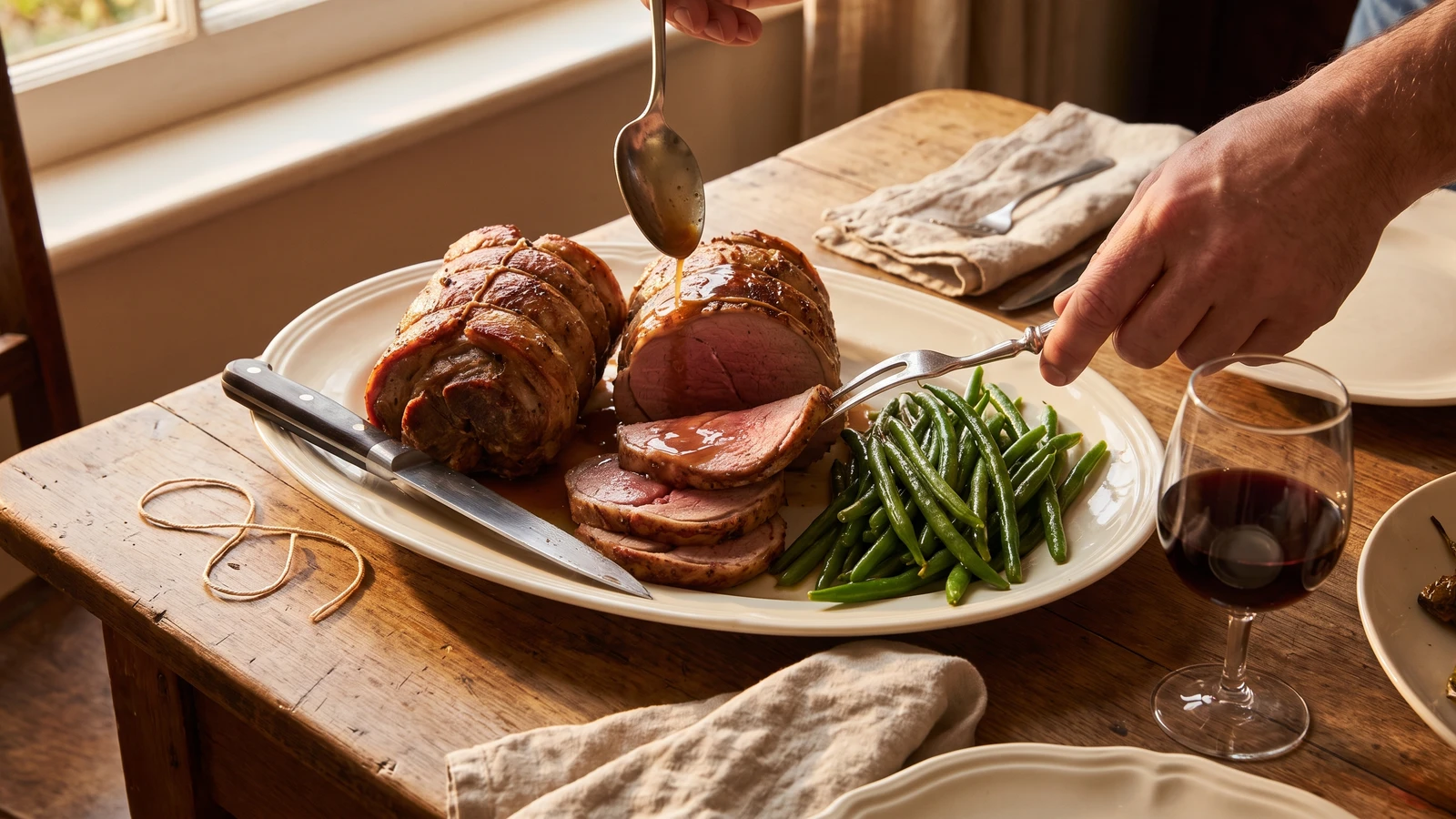
Filets de mouton teach the roast through the knife: saddle halves skinned, rolled tightly around their kernels, tied evenly, then brought to a bronze crust and a rosy, juicy centre.
Filets de Mouton Rôtis teach that the roast is decided before the pan gets hot. The one true thing is the shape: each half saddle must be skinned, relieved of hard excess fat, rolled evenly around its kernel of tender meat, and tied at close intervals. A loose or lopsided filet gives you dry flank at one edge and an underdone knot at the other; a neat cylinder roasts as one piece.
The brigade kitchen assumed a butcher breaking down a whole saddle and enough hands to manage an elaborate garnish beside it. This entry needs neither a saucier on staff, a stock never off the fire, nor a salamander, because sauced garnishes were deliberately judged a poor match. At home, ask a good butcher to bone and split one mutton saddle into its two fillets, then do the final trimming and tying yourself, or have it done while you watch. We replace the brigade's compound display with haricots verts liés au beurre, one of the simple vegetable garnishes the source itself prefers, and make only the natural jus left in the roasting pan. The display is scaffolding. The skinning, centered kernel, close stringing, and rosy roast are the dish.
The finished filets should wear a deep bronze crust, open into moist rosy slices, and leave enough concentrated jus to gloss the meat without burying it. Begin checking early and remove each roll at 140°F / 60°C, then let the rest carry it safely to 145°F / 63°C. Temperature, not the clock, is the step that matters most. One cook, one stove, one evening.
Filets de mouton belong to the French classical relevé table, where a substantial roasted joint was defined as carefully by its butchery as by the garnish placed around it. In this vocabulary, a filet was one lengthwise half of the saddle, divided through the spinal column, not the small tenderloin commonly sold under that name. Boning, skinning, rolling the meat over its kernel, and tying it transformed the large joint into an even roast suited to vegetable or rice garnishes rather than a heavy mantle of sauce.
Quantity
1 small saddle, yielding 2 fillets (about 2 lb 4 oz / 1 kg total after boning)
kernel meat retained with each half
Quantity
1 tablespoon plus 2 teaspoons (25 ml / 30 g)
divided
Quantity
1 teaspoon (5 ml / 2 g)
Quantity
5 tablespoons (75 ml / 70 g)
2 tablespoons softened for the meat, 2 tablespoons for the beans, and 1 tablespoon kept cold for the jus
Quantity
about 6 cups (1.4 L / 500 g)
topped and tailed
Quantity
¾ cup (180 ml / 180 g)
for the jus
Quantity
3 quarts (2.8 L / 2.8 kg)
for blanching the beans
| Ingredient | Quantity |
|---|---|
| mutton saddle, split lengthwise and boned into two half-saddle filletskernel meat retained with each half | 1 small saddle, yielding 2 fillets (about 2 lb 4 oz / 1 kg total after boning) |
| fine sea saltdivided | 1 tablespoon plus 2 teaspoons (25 ml / 30 g) |
| freshly ground black pepper | 1 teaspoon (5 ml / 2 g) |
| unsalted butter2 tablespoons softened for the meat, 2 tablespoons for the beans, and 1 tablespoon kept cold for the jus | 5 tablespoons (75 ml / 70 g) |
| fine green beanstopped and tailed | about 6 cups (1.4 L / 500 g) |
| cold waterfor the jus | ¾ cup (180 ml / 180 g) |
| waterfor blanching the beans | 3 quarts (2.8 L / 2.8 kg) |
Lay each boned half saddle with its outer surface facing up. Peel away the tough overlying fell and shave off any stubborn silverskin; it contracts under heat and will pull the roast out of shape. Turn the meat over and remove knobs of hard underlying fat while leaving the thin, soft fat that will baste the filet. Set the small kernel of tender meat along the centre, draw the flank and loin meat snugly around it, and form an even cylinder. Tie crosswise with kitchen string every 1½ inches / 4 cm, firm enough to hold the roll without cutting deeply into it.
Pat the filets thoroughly dry and season all over with the 2 teaspoons of salt and the black pepper. Leave them for 30 minutes while the oven heats to 375°F / 190°C. Rub the meat with 2 tablespoons of softened butter just before it meets the pan. A dry, evenly buttered surface browns; a wet one sheds liquid and turns grey.
Heat a 12-inch / 30 cm heavy ovenproof skillet over medium-high heat. Add the buttered filets and brown them patiently for 8 to 10 minutes, turning with tongs until every broad surface is Maillard bronze. Finish with the seams underneath. If the butter begins turning black before the meat colours, lift out the filets, wipe away only the burnt fat, lower the heat, and continue with a teaspoon of the reserved butter. Burnt butter cannot improve in the oven, but the roast is still entirely recoverable.
Transfer the skillet to the oven and roast for 18 to 28 minutes, basting once with the pan fat. Begin checking each filet after 15 minutes by inserting an instant-read thermometer into the exact centre from one end. Remove each roll separately when it reaches 140°F / 60°C; two handmade filets rarely finish at precisely the same moment. If the crust darkens too quickly, shield it loosely with foil. Rest the meat for 15 minutes and verify that it reaches at least 145°F / 63°C, which matters because rolling places previously exposed surfaces inside. If it stalls below that point, return it to the oven for 3 to 5 minutes, then rest it again. Ça se rattrape.
While the filets rest, bring the 3 quarts of water to a full boil with the remaining 1 tablespoon of salt. Add the green beans and cook for 5 to 7 minutes, until tender but still lively under the teeth. Drain them thoroughly, return them to the hot empty pot, and toss with 2 tablespoons of butter until the butter and clinging moisture form a fine glaze. These are haricots verts liés au beurre, green beans bound with butter. Cooking well is not cooking fancy.
Spoon excess fat from the roasting skillet, leaving about 1 teaspoon and every brown trace of fond. Set the pan over medium heat, add the ¾ cup of cold water in two additions, and scrape firmly until the fond dissolves. Boil for 3 to 5 minutes, reducing to about ½ cup / 120 ml, until the jus tastes concentrated and lightly coats a spoon without becoming sticky. Remove the pan from the heat and swirl in the final cold tablespoon of butter. If the jus looks greasy, skim it; if the butter separates, whisk in a teaspoon of cold water off the heat. Do not thicken it. This is the roast's own jus, not a sauce garnish.
Snip away every string, then cut the filets crosswise into slices about ¾ inch / 2 cm thick. Arrange them slightly overlapping on a warm oval platter, keeping the rosy cut faces visible, and place the buttered beans alongside. Spoon enough jus over the meat to give it a gloss and serve the rest at the table. Never apologize at your own table. À table!
1 serving (about 360g)
Culinary guides, cultural storytelling, and the editorial depth that makes cooking meaningful.
Discover Culinary ExplorerChef Juliette
John Dory has the delicacy of sole and the firmness of turbot. A light flouring, a quick butter sauté, and nut-brown beurre noisette show exactly why looks never mattered.

Chef Juliette
Fresh haddock proves its delicacy in the meunière pan: a fine flour crust, moist pearly flakes, and beurre noisette sharpened with lemon and parsley, ready from one skillet in half an hour.

Chef Juliette
Éperlans à l’Anglaise turns small fish into a lesson in disciplined coating: boned smelts under a close, crisp crumb, pan-fried in clarified butter and finished with bright, half-melted maître d’hôtel butter.

Chef Juliette
Tiny smelts, shallot, mushrooms, white wine, gratin sauce, and fine bread raspings meet a fierce oven, where the fish must turn tender in the same breath the buttered crust bronzes.