
Chef Juliette
John Dory (St. Pierre)
John Dory has the delicacy of sole and the firmness of turbot. A light flouring, a quick butter sauté, and nut-brown beurre noisette show exactly why looks never mattered.
A cooking platform built around craft, culture, and the stories behind what we eat.
Created by Chef Juliette
Based on No. 1299, Baron or Pair of Hind-quarters of Mutton, from Le Guide Culinaire (1907) by Auguste Escoffier
A true baron keeps saddle and both legs together, then asks for disciplined trimming, tight trussing, and patient roasting before it reaches the table bronzed, juicy, and ringed with buttered vegetables.
Baron d’agneau rôti teaches command of a large roast. The saddle remains joined to both legs, so the one true thing to know before touching the oven is this: shape governs cooking. Clear away superfluous fat, shorten the flanks until they just meet over the fillets, and bind the joint with five or six firm turns of string. A loose baron spreads, cooks unevenly, and loses its magnificent line on the platter.
The original entry assumes a butcher to shape the joint, a roast cook to tend it, a vegetable cook to prepare one of many garnishes, and enough diners to meet a festival portion. It explicitly prefers vegetables to a sauced garnish, so the saucier, the stock never off the fire, and the salamander stay out. For four, order the smallest true baron from a young lamb, use a domestic oven in place of the roasting station, and choose the entry’s simple potatoes, peas, and broad beans instead of its long catalogue of compound garnishes. That catalogue is brigade scaffolding. Trimming, trussing, roasting whole, and presenting the vegetables around the joint are the dish itself. One cook, one stove, one evening.
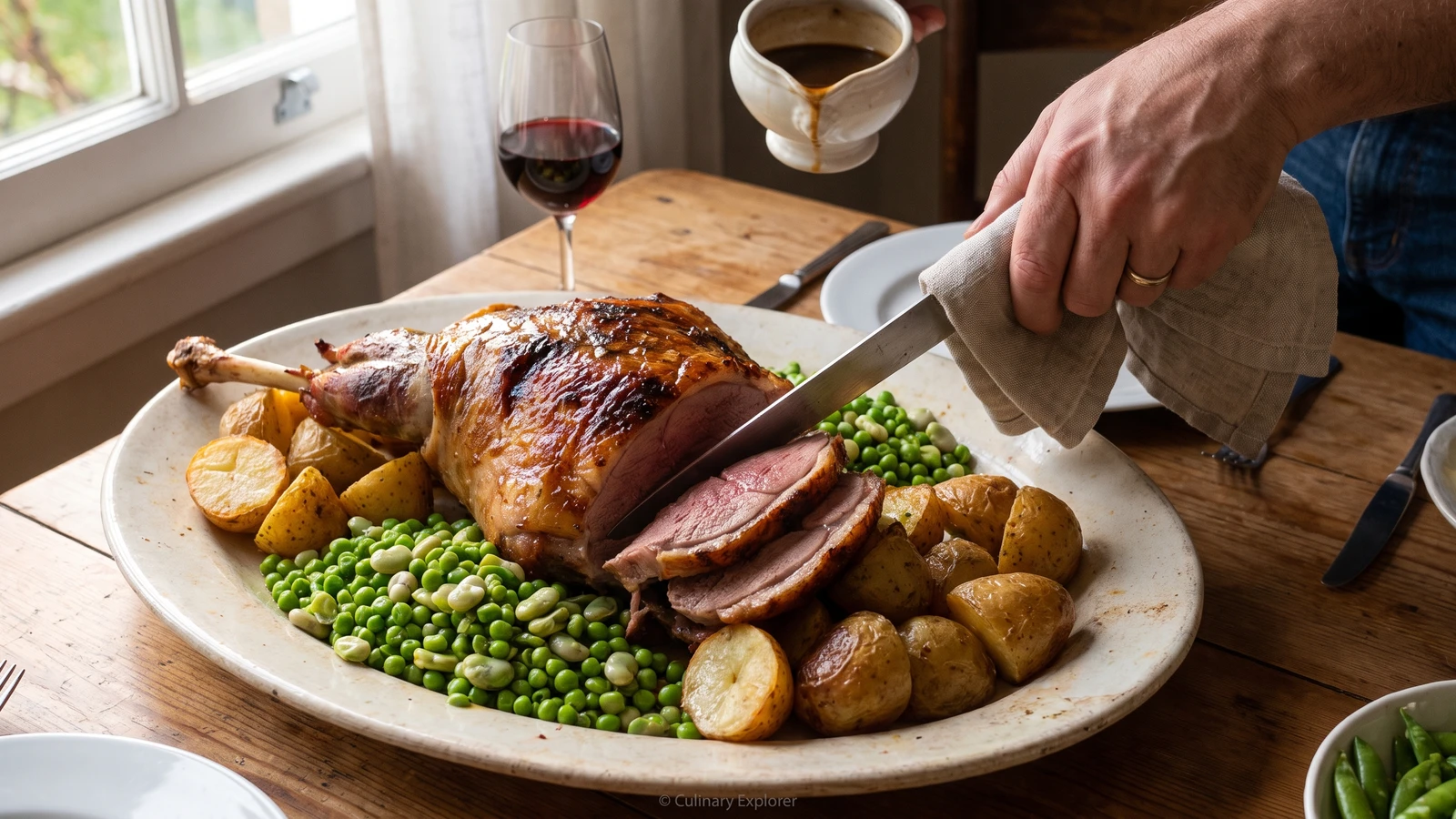
The finished baron should arrive deep bronze, with rosy saddle meat, succulent legs, crisp-edged potatoes, and green vegetables shining with real butter. If the saddle reaches its temperature while the legs still lag, cover only the saddle and keep roasting. Ça se rattrape. Give the trimming and those five or six ties your full attention, because that is the step that decides the dish.
Baron de mouton belongs to the French classical ceremonial table rather than to one province: it was classed among the relevés, substantial joints presented whole and carved before the diners, with vegetables carrying the garnish. Its grand name is precise butcher’s language, not decoration: a baron joins the saddle to both legs, while a double consists of the two unseparated legs without the saddle, and both cuts were usually taken from lamb despite appearing under mutton. Bringing the baron home changes the scale and the oven, never its anatomy or its purpose at the table.
Quantity
1, 6 to 7 lb (2.7 to 3.2 kg)
saddle and both legs intact, outer fell and excess underlying fat removed, flanks trimmed to meet over the fillets
Quantity
2 tablespoons (30 ml / 36 g)
divided
Quantity
2 teaspoons (10 ml / 5 g)
Quantity
10 tablespoons (150 ml / 142 g)
divided, with 1 tablespoon kept cold
Quantity
5 cups (1.2 L / 900 g)
scrubbed
Quantity
2 cups (475 ml / 300 g)
Quantity
2 cups (475 ml / 300 g)
peeled if their skins are tough
Quantity
2 cups (475 ml / 475 g)
divided
| Ingredient | Quantity |
|---|---|
| small baron of lambsaddle and both legs intact, outer fell and excess underlying fat removed, flanks trimmed to meet over the fillets | 1, 6 to 7 lb (2.7 to 3.2 kg) |
| fine sea saltdivided | 2 tablespoons (30 ml / 36 g) |
| freshly ground black pepper | 2 teaspoons (10 ml / 5 g) |
| unsalted butterdivided, with 1 tablespoon kept cold | 10 tablespoons (150 ml / 142 g) |
| small waxy potatoesscrubbed | 5 cups (1.2 L / 900 g) |
| frozen petits pois | 2 cups (475 ml / 300 g) |
| frozen shelled broad beanspeeled if their skins are tough | 2 cups (475 ml / 300 g) |
| hot waterdivided | 2 cups (475 ml / 475 g) |
Set the baron on a large board and inspect the butcher’s work. Remove any loose, thick knobs of fat beneath the saddle, but leave a thin, even outer covering on young lamb. If a papery membrane remains over the saddle, slit it at 1-inch (2.5 cm) intervals without cutting into the meat. Draw the shortened flanks over the fillets so their edges meet without overlapping, then bind the baron firmly in five or six places, spacing the loops about 2 inches (5 cm) apart. Reserve 1 teaspoon of the salt, then season the entire joint with the remaining salt and all the pepper. Leave it uncovered for 45 minutes while you prepare the oven. The meat need not become warm throughout, but its surface must be dry.
Heat the oven to 450°F (230°C), or 425°F (220°C) with convection, with a rack in the lower third. Put the potatoes in cold water with 1/2 teaspoon of the reserved salt, bring them to a boil, and simmer for 8 minutes. Drain thoroughly, shake them in the pan to roughen their surfaces, then coat them with 3 tablespoons (45 ml / 42 g) of the butter. Set a low roasting rack inside a heavy pan large enough to hold the baron without bending either leg.
Rub the baron with 3 tablespoons (45 ml / 42 g) of softened butter and place it on the rack with the legs toward the hotter rear of the oven. Roast for 25 minutes, until the surface begins to take a strong bronze colour. Lower the oven to 350°F (180°C), rotate the pan, and scatter the potatoes beneath and around the rack. Continue roasting for 70 to 90 minutes, basting the meat and turning the potatoes every 25 minutes. If the fond on the pan floor darkens past hazelnut brown, trickle in hot water a tablespoon at a time so it does not burn. Begin checking early: insert the thermometer into the centre of the saddle and the deepest part of each leg without touching bone. If the saddle reaches 135 to 138°F (57 to 59°C) while either leg remains below 140°F (60°C), cover only the saddle with a loose double layer of foil and continue roasting. Ça se rattrape: the shield slows the tender saddle while the legs catch up. Remove the baron when the coolest leg reads 140 to 142°F (60 to 61°C) and the saddle remains below 140°F (60°C).
Transfer the baron to the carving board and cover it loosely with foil. Rest for 35 to 40 minutes; a joint this large needs the full pause for its juices to settle. After 15 minutes, check that the cooler leg has reached 145°F (63°C). If it stalls below that point, shield the saddle again, return the joint to the 350°F (180°C) oven for 8 to 10 minutes, and rest it for another 10 minutes. Meanwhile, test the potatoes. If they are pale, raise the oven to 425°F (220°C) and roast them in the pan for another 10 to 15 minutes, turning once, until deeply golden.
Lift the potatoes from the roasting pan and keep them warm. Pour off the lamb fat, leaving about 1 tablespoon and every brown speck of fond behind. Set the pan across two burners over medium heat, add 1 1/2 cups (355 ml / 355 g) of the hot water, and scrape the pan thoroughly. Simmer until the jus de rôti, the natural roasting juices, reduces to about 3/4 cup (180 ml) and tastes concentrated but not salty. Strain it, then whisk in the final cold tablespoon (15 ml / 14 g) of butter away from the heat. If the jus looks greasy, skim it first and whisk in a spoonful of cold water until it comes together. This is a light spoonful for the meat, not a heavy sauce laid over the vegetable garnish.
Bring a wide pan of water to a boil. Add the broad beans and cook for 3 minutes, then add the petits pois and cook for another 2 minutes, just until both are tender and vividly green. Drain them very well and return them to the dry pan with the remaining 3 tablespoons (45 ml / 42 g) of butter and the last 1/2 teaspoon of reserved salt. Toss over gentle heat until the vegetables are liés au beurre, bound with butter into a glossy, cohesive garnish. If water pools beneath them, raise the heat briefly and keep tossing until it evaporates.
Remove every piece of string and place the baron whole on a large warm oval platter. Ring it generously with the bronzed potatoes, then spoon the buttered peas and broad beans into the spaces between them. Present the joint before carving, because its whole shape is part of the occasion. Move it back to the board, release each leg through its natural hip joint, and carve the leg meat across the grain. Run the knife down each side of the saddle backbone to lift the loins, then slice them crosswise. Cut only what the table will eat so the remaining meat stays juicy. Pass the jus separately. À table!
1 serving (about 850g)
Culinary guides, cultural storytelling, and the editorial depth that makes cooking meaningful.
Discover Culinary ExplorerChef Juliette
John Dory has the delicacy of sole and the firmness of turbot. A light flouring, a quick butter sauté, and nut-brown beurre noisette show exactly why looks never mattered.

Chef Juliette
Fresh haddock proves its delicacy in the meunière pan: a fine flour crust, moist pearly flakes, and beurre noisette sharpened with lemon and parsley, ready from one skillet in half an hour.

Chef Juliette
Éperlans à l’Anglaise turns small fish into a lesson in disciplined coating: boned smelts under a close, crisp crumb, pan-fried in clarified butter and finished with bright, half-melted maître d’hôtel butter.

Chef Juliette
Tiny smelts, shallot, mushrooms, white wine, gratin sauce, and fine bread raspings meet a fierce oven, where the fish must turn tender in the same breath the buttered crust bronzes.