
Chef Juliette
John Dory (St. Pierre)
John Dory has the delicacy of sole and the firmness of turbot. A light flouring, a quick butter sauté, and nut-brown beurre noisette show exactly why looks never mattered.
A cooking platform built around craft, culture, and the stories behind what we eat.
Created by Chef Juliette
Based on No. 1298, Saddle of Mutton, from Le Guide Culinaire (1907) by Auguste Escoffier
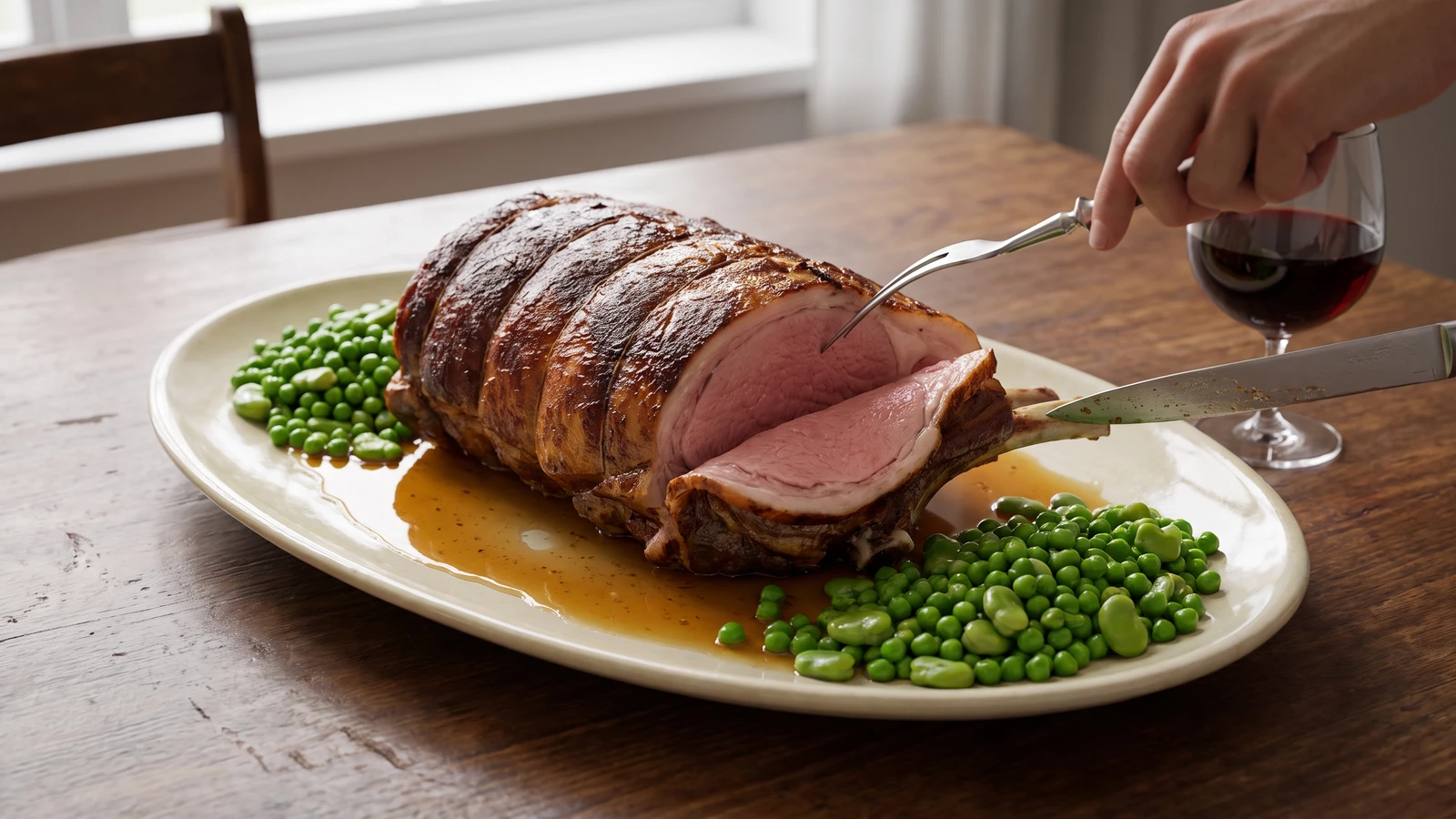
Selle de mouton rôtie teaches that the roast is decided before the oven: trim cleanly, fold the flanks close, tie firmly, then carve rosy slices beside vegetables glossed with real butter.
Selle de mouton rôtie teaches a severe and useful lesson: a roast this grand is decided on the cutting board. Clear away the soft underlying fat, remove the tough overlying skin, shorten the flanks until they meet rather than overlap, and bind the saddle into one compact, even shape. Do that well and the two loins roast rosy together. Neglect it and no amount of oven fussing will restore the shape.
The original entry assumes the service surrounding a relevé, the substantial roast course: a butcher preparing the joint, separate hands tending its vegetables, a saucier with stock never off the fire, and a salamander available to correct pale colour. Your honest equivalents are a helpful butcher, kitchen twine, a thermometer, a fierce opening oven, and the resting interval in which you butter the vegetables and draw a clear jus from the pan fond. The long parade of compound garnishes is brigade scaffolding at this scale, so it goes. The trimmed, tightly strung saddle and the vegetable garnish stay, because they are the dish. One cook, one stove, one evening.
The platter arrives generously: a deep bronze crust, rosy slices from both sides of the backbone, bright peas and broad beans carrying a proper sheen of butter, and just enough clear jus to moisten the plate without burying the meat. Before you heat the oven, make all five or six ties equally firm. That even pressure is the step that matters most.
Selle de mouton belongs to the French table of large relevés, substantial joints presented whole and accompanied more naturally by vegetables or rice than by a heavy sauce. Classical butchery distinguishes the cuts precisely: the saddle extends from the haunch bone to the floating ribs; joined to both legs it becomes a baron, while a double consists of the two unseparated legs without the saddle. Its journey from whole-animal butchery to formal service preserved a practical truth, careful trimming and tying protect the loins and make the joint roast and carve evenly.
Quantity
1 saddle, 4 to 4½ pounds (1.8 to 2 kg)
outer skin removed, underlying fat cleared, flank flaps left intact
Quantity
1 tablespoon (15 ml / 18 g)
divided
Quantity
1½ teaspoons (7.5 ml / 3 g)
divided
Quantity
1½ cups (360 ml / 360 g)
divided
Quantity
2 cups (475 ml / 280 g)
Quantity
2 cups (475 ml / 300 g)
Quantity
4 tablespoons (60 ml / 57 g)
cubed and divided
| Ingredient | Quantity |
|---|---|
| small bone-in saddle of muttonouter skin removed, underlying fat cleared, flank flaps left intact | 1 saddle, 4 to 4½ pounds (1.8 to 2 kg) |
| fine sea saltdivided | 1 tablespoon (15 ml / 18 g) |
| freshly ground black pepperdivided | 1½ teaspoons (7.5 ml / 3 g) |
| waterdivided | 1½ cups (360 ml / 360 g) |
| frozen petits pois (small peas) | 2 cups (475 ml / 280 g) |
| frozen shelled broad beans | 2 cups (475 ml / 300 g) |
| cold unsalted buttercubed and divided | 4 tablespoons (60 ml / 57 g) |
Work with the saddle cold and set it underside up. Remove the tough outer fell if the butcher has left any behind, then cut away the thick pads of soft underlying fat without gouging the lean meat. Leave a thin, even exterior covering of firm fat for protection and browning. Draw the two flank flaps inward and shorten them only enough that their edges just meet over the underside; an overlap makes a thick seam that cooks more slowly than the loins.
Fold the trimmed flanks over the underside and turn the saddle seam-side down. Tie it firmly with kitchen twine in five or six places, spacing the loops evenly from one end to the other. Each tie should hold the joint compactly without cutting into the flesh. Season all over with about 2½ teaspoons of the salt and 1 teaspoon of the pepper, then leave it at cool room temperature for 40 to 45 minutes. The ties are not decoration: equal pressure gives the two loins the same thickness and the same chance in the oven.
Heat a conventional oven to 450°F (230°C), or 410°F (210°C) with a fan, with a rack in the lower third. Set the saddle seam-side down in a heavy roasting tin so the backbone supports it and the exterior fat faces upward. Roast for 20 minutes to establish a deep bronze surface, then lower the oven to 350°F (180°C), or 325°F (165°C) with a fan. Continue roasting for 35 to 55 minutes, spooning the rendered fat over the joint once halfway through. If the pan fond threatens to turn black, add 2 tablespoons of the measured water around the meat. Mahogany is flavour; black is bitterness.
Begin checking both loin muscles after 35 minutes at the lower heat, sliding the thermometer horizontally into the thickest meat without touching bone. Rotate the pan if one side runs warmer. Remove the saddle when both sides register about 140°F (60°C); during a 25-minute rest they should climb to 145°F (63°C), leaving the meat rosy and succulent. If the crust darkens before the centre is ready, cover it loosely with foil and reduce the oven to 325°F (165°C). If it has gone beyond 145°F (63°C), rest it uncovered, carve thicker slices, and serve every portion with jus. Ça se rattrape.
Transfer the saddle to a warm platter and cover it loosely with foil for 25 minutes. Do not wrap it tightly, or the crust softens. Confirm that the centre has reached 145°F (63°C); if it has stalled below that point, return the joint to the 350°F (180°C) oven in 5-minute intervals. Resting is part of roasting, not idle time. The juices settle into the meat while you finish everything else.
Bring ½ cup of the measured water to a brisk simmer in a wide saucepan with 1 tablespoon of the butter and a pinch of the reserved salt. Add the broad beans and cook for 3 minutes, then add the petits pois and cook until both are tender but still bright, about 3 minutes more. Pour off any liquid beyond 2 tablespoons, lower the heat, and swirl in the remaining 3 tablespoons of cold butter a few cubes at a time. This beurre monté, a butter emulsion, should cling as a shining coat rather than collect as oil underneath. If it separates, take the pan off the heat, add 1 tablespoon cold water, and shake it firmly until the butter gathers again. Ça se rattrape.
Pour the fat from the roasting tin, leaving the brown fond behind. Add the remaining 1 cup water and set the tin over medium heat, scraping up every mahogany deposit while leaving any truly black patch untouched. Boil until reduced to ½ to ¾ cup, about 6 to 8 minutes, then strain and skim away the surface fat. Taste and season with the remaining salt and pepper. If it is thin, reduce it further; if it is too concentrated, add water by the spoonful. Keep it clear and light. The source prefers vegetables to a sauce-laden garnish, and it is right.
Present the saddle whole, then move it to a carving board and snip away every string. Run a sharp carving knife beside one edge of the backbone, keeping the blade against the bone, then sweep outward over the ribs to release the first loin in one piece; repeat on the other side. Slice the loins crosswise about ½ inch (1.25 cm) thick. Turn the saddle, open the flanks, and remove and slice the two smaller inside fillets. Arrange the meat on the warm platter with the petits pois and broad beans at either end. Spoon the jus around the slices, never over the browned surface. À table!
1 serving (about 415g)
Culinary guides, cultural storytelling, and the editorial depth that makes cooking meaningful.
Discover Culinary ExplorerChef Juliette
John Dory has the delicacy of sole and the firmness of turbot. A light flouring, a quick butter sauté, and nut-brown beurre noisette show exactly why looks never mattered.

Chef Juliette
Fresh haddock proves its delicacy in the meunière pan: a fine flour crust, moist pearly flakes, and beurre noisette sharpened with lemon and parsley, ready from one skillet in half an hour.

Chef Juliette
Éperlans à l’Anglaise turns small fish into a lesson in disciplined coating: boned smelts under a close, crisp crumb, pan-fried in clarified butter and finished with bright, half-melted maître d’hôtel butter.

Chef Juliette
Tiny smelts, shallot, mushrooms, white wine, gratin sauce, and fine bread raspings meet a fierce oven, where the fish must turn tender in the same breath the buttered crust bronzes.