
Chef Juliette
John Dory (St. Pierre)
John Dory has the delicacy of sole and the firmness of turbot. A light flouring, a quick butter sauté, and nut-brown beurre noisette show exactly why looks never mattered.
A cooking platform built around craft, culture, and the stories behind what we eat.
Created by Chef Juliette
Based on No. 1296, Vol au Vent de Cervelle, from Le Guide Culinaire (1907) by Auguste Escoffier
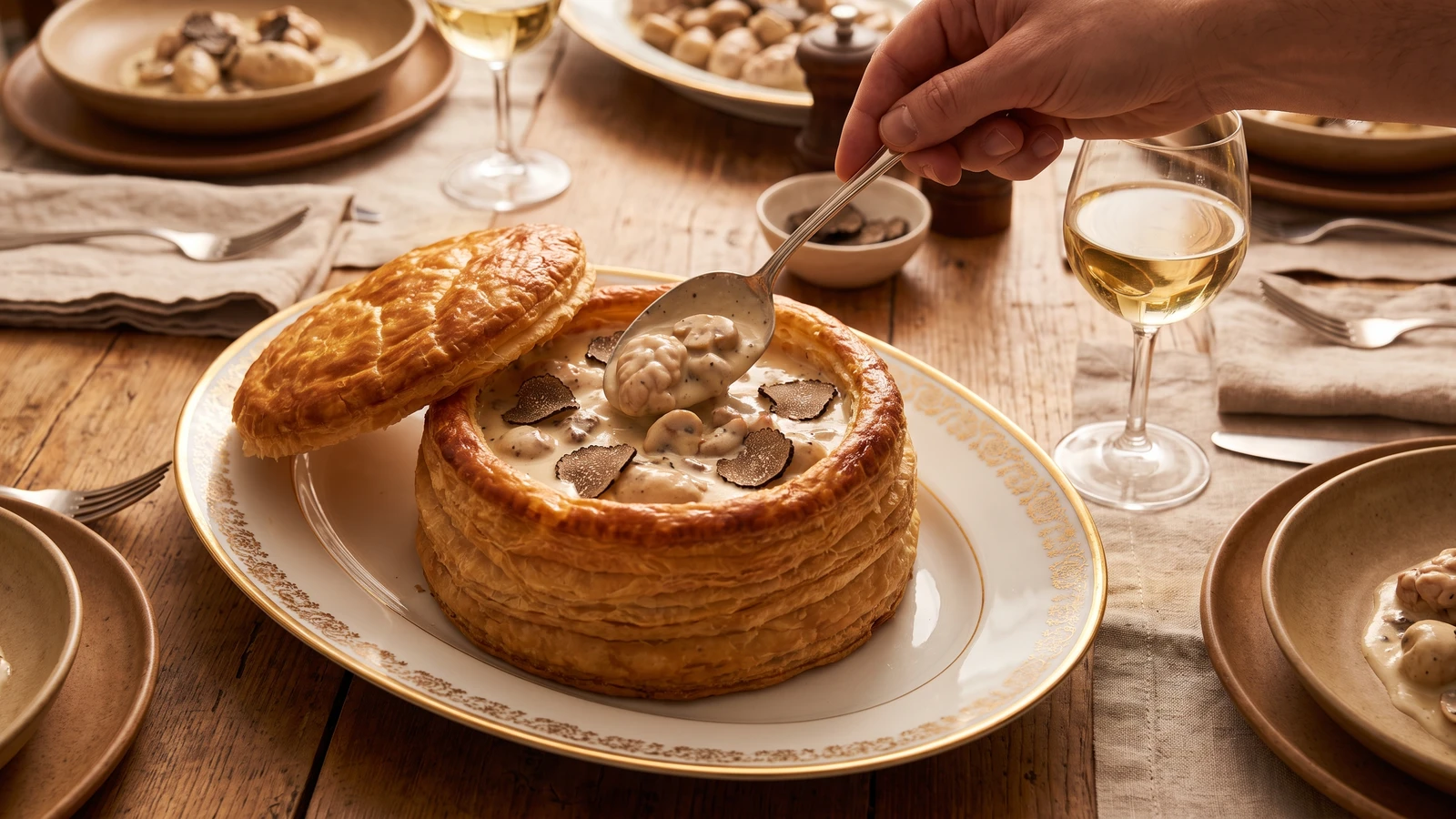
Vol-au-Vent de Cervelle keeps the grand garnish pale and tender: calf brain, twelve veal quenelles, mushrooms, and truffle folded through glossy Allemande and spooned into a crisp pastry case.
Vol-au-Vent de Cervelle (puff-pastry case filled with calf brain) teaches the discipline of keeping a rich garnish pale. The one true thing to know before touching a pan is this: colour is not always flavour. Browning would muddy the delicate brain, mushrooms, and Sauce Allemande (a velouté finished with yolks and cream), so gentleness carries the dish.
The book assumed a pâtissier's ready crust, a saucier on staff, a stockpot never off the fire, a hand shaping quenelles at service, and a salamander to refresh the pastry. At home, one baked Vol-au-Vent Crust (No. 2390), a pale small-batch stock, a food processor instead of mortar and sieve, and a hot oven do the same honest work for four. The silver dish on a folded napkin and the brigade handoffs are scaffolding, so they go. The crisp case, twelve freshly poached quenelles (small veal dumplings), four ounces of cooked mushrooms, one ounce of truffle, and the half-pint of Allemande are the dish, so they stay. One cook, one stove, one evening.
When it is right, pale slices of brain and ivory quenelles sit in glossy sauce beneath the black punctuation of truffle, all held by pastry that flakes beneath the serving spoon. The decisive step is the liaison: bring the Allemande to coating consistency without letting it boil, then warm the fragile garnish with a folding motion, never a vigorous stir.
Vol-au-vent belongs to Parisian pâtisserie and grand-kitchen service, where a tall, hollow puff-paste case carried delicate garnishes bound in velouté-family sauces. Cervelle entered that repertoire because calf brain offered the pale tenderness these fillings prized, while mushrooms and black truffle marked a formal table rather than a regional larder. A vol-au-vent is properly the large case brought whole and portioned at table; the little individual shells often given the same name belong closer to bouchées.
Quantity
1 large, about 1 pound (450 g)
Quantity
12 cups (2.8 L / 2.8 kg)
divided
Quantity
1/4 cup (60 ml / 60 g)
divided
Quantity
1 medium, about 3 ounces (85 g)
thinly sliced
Quantity
1 small, about 4 ounces (115 g)
thinly sliced
Quantity
1
Quantity
1 tablespoon plus 2 teaspoons (25 ml / 30 g)
divided
Quantity
4 ounces (115 g)
diced and thoroughly chilled
Quantity
1/4 cup (60 ml / 20 g)
divided
Quantity
2 tablespoons (30 ml / 30 g)
Quantity
4 1/2 tablespoons (68 ml / 64 g)
divided
Quantity
3
divided
Quantity
1/16 teaspoon (0.3 ml / 0.1 g)
Quantity
1/4 teaspoon (1.25 ml / 0.6 g)
divided
Quantity
5 ounces (140 g), yielding 4 ounces (115 g) cooked
trimmed
Quantity
1 tablespoon (15 ml / 15 g)
divided
Quantity
2 tablespoons (30 ml / 16 g)
Quantity
1 1/4 cups (300 ml / 300 g)
Quantity
5 tablespoons (75 ml / 75 g)
divided
Quantity
1 ounce (28 g)
thinly sliced, with 6 slices reserved
| Ingredient | Quantity |
|---|---|
| Vol-au-Vent Crustlid reserved | 1 baked 8-inch (20 cm) Vol-au-Vent Crust (No. 2390) |
| calf brain | 1 large, about 1 pound (450 g) |
| cold waterdivided | 12 cups (2.8 L / 2.8 kg) |
| white wine vinegardivided | 1/4 cup (60 ml / 60 g) |
| carrotthinly sliced | 1 medium, about 3 ounces (85 g) |
| onionthinly sliced | 1 small, about 4 ounces (115 g) |
| bouquet garni of parsley stems, thyme, and bay | 1 |
| fine sea saltdivided | 1 tablespoon plus 2 teaspoons (25 ml / 30 g) |
| lean vealdiced and thoroughly chilled | 4 ounces (115 g) |
| fine fresh white breadcrumbsdivided | 1/4 cup (60 ml / 20 g) |
| whole milk | 2 tablespoons (30 ml / 30 g) |
| unsalted butterdivided | 4 1/2 tablespoons (68 ml / 64 g) |
| large egg yolksdivided | 3 |
| freshly grated nutmeg | 1/16 teaspoon (0.3 ml / 0.1 g) |
| ground white pepperdivided | 1/4 teaspoon (1.25 ml / 0.6 g) |
| very small button mushroomstrimmed | 5 ounces (140 g), yielding 4 ounces (115 g) cooked |
| fresh lemon juicedivided | 1 tablespoon (15 ml / 15 g) |
| plain flour | 2 tablespoons (30 ml / 16 g) |
| pale veal stock or unsalted chicken stock | 1 1/4 cups (300 ml / 300 g) |
| heavy creamdivided | 5 tablespoons (75 ml / 75 g) |
| fresh or preserved black trufflethinly sliced, with 6 slices reserved | 1 ounce (28 g) |
Set the calf brain in a nonreactive bowl with 3 cups (710 ml) of the cold water and 1 tablespoon (15 ml) of the vinegar. Refrigerate for 30 minutes, drain, and repeat with another 3 cups (710 ml) water and 1 tablespoon (15 ml) vinegar. Working in a bowl of clean cold water, slip away the thin outer membrane and any dark blood vessels with your fingertips and the tip of a small knife. Keep the lobes as whole as you can, but do not worry over a small tear; gentle poaching will firm everything enough to slice.
Combine 3 cups (710 ml) of the remaining water with the remaining 2 tablespoons (30 ml) vinegar, the carrot, onion, bouquet garni, and 2 teaspoons (12 g) salt. Simmer for 10 minutes to make a light court-bouillon, then lower in the brain. Cover it with a round of baking parchment and hold the liquid at the barest tremble for 15 to 20 minutes, never a boil, until the centre reaches 160°F (71°C). Lift the brain into a shallow dish, strain enough court-bouillon over it to cover, and cool for about 20 minutes. Drain and cut across the lobes into 1/2-inch (1.25 cm) slices.
Put the cold veal, 3 tablespoons (15 g) breadcrumbs, milk, 1 1/2 tablespoons (21 g) butter, 1 egg yolk, nutmeg, 1/8 teaspoon white pepper, and 1/2 teaspoon salt into a chilled food processor. Pulse until the mixture becomes smooth, sticky, and able to hold a ridge from a spoon, stopping before the bowl grows warm. Scrape it into a cold bowl, cover, and refrigerate for 20 minutes. The processor replaces the mortar and sieve, but the cold remains essential; warm forcemeat leaks fat and gives heavy quenelles.
Melt 1 tablespoon (14 g) butter in a small covered pan with 2 tablespoons (30 ml) water, 1 teaspoon (5 ml) lemon juice, and a pinch of salt. Add the mushrooms and cook them à blanc (without browning) over gentle heat for 5 to 7 minutes, shaking the covered pan once or twice. Uncover and cook only until tender. Drain them, reserve their liquor, and weigh 4 ounces (115 g) for the filling. Keep them whole if they are truly small; halve any larger ones.
Measure the reserved mushroom liquor and enough pale stock together to make 1 1/4 cups (300 ml). Melt 2 tablespoons (28 g) butter in a small saucepan, stir in the flour, and cook this roux blanc (white roux) for 2 minutes without letting it colour. Whisk in the measured liquid gradually, scraping well into the corners, then simmer gently for 8 to 10 minutes until reduced to about 3/4 cup plus 1 tablespoon (195 ml) and thick enough to coat a spoon. Whisk 2 egg yolks with 4 tablespoons (60 ml) cream, temper them with several spoonfuls of hot sauce, then return everything to the pan over low heat. Whisk until the Sauce Allemande reaches 160°F (71°C), looks glossy, and coats the spoon cleanly. Never let it boil. Add the remaining 2 teaspoons (10 ml) lemon juice, the remaining white pepper, and salt to taste, then pass it through a fine sieve. You need 1 cup plus 3 tablespoons (285 ml), the book's half-pint at the home table. If the liaison turns grainy, take it off the heat immediately and whisk in the reserved tablespoon of cold cream before straining. Ça se rattrape.
Heat the oven to 375°F (190°C). Set the Vol-au-Vent Crust (No. 2390) and its lid on a baking sheet and warm them for 6 to 8 minutes, until the pastry feels crisp and light again. Meanwhile, bring the remaining 3 cups (710 ml) water and 2 teaspoons salt to 175°F to 185°F (80°C to 85°C), with movement below the surface but no rolling bubbles. Dip two teaspoons in the water and shape the cold forcemeat into 12 small oval quenelles. Poach one first. If it frays, stop, mix the reserved breadcrumbs into the forcemeat, and chill it for 10 minutes before continuing. Poach all 12 for 6 to 8 minutes, turning once, until their centres reach 160°F (71°C), then lift them onto a clean towel to drain.
Return the Sauce Allemande to the lowest heat. Add the sliced brain, all 12 quenelles, exactly 4 ounces (115 g) cooked mushrooms, and all but the 6 reserved truffle slices. Fold with a broad spoon for 3 to 5 minutes, just until the garnish is hot, keeping the sauce below a simmer. If the Allemande tightens, loosen it with pale stock a tablespoon at a time; if a brain slice breaks, stop stirring and guide the filling with the spoon instead. Set the crisp case on its platter, pour and guide the filling into it, then arrange the reserved truffle slices over the surface. Rest the pastry lid at an angle against the rim and serve at once. À table!
1 serving (about 360g)
Culinary guides, cultural storytelling, and the editorial depth that makes cooking meaningful.
Discover Culinary ExplorerChef Juliette
John Dory has the delicacy of sole and the firmness of turbot. A light flouring, a quick butter sauté, and nut-brown beurre noisette show exactly why looks never mattered.

Chef Juliette
Fresh haddock proves its delicacy in the meunière pan: a fine flour crust, moist pearly flakes, and beurre noisette sharpened with lemon and parsley, ready from one skillet in half an hour.

Chef Juliette
Éperlans à l’Anglaise turns small fish into a lesson in disciplined coating: boned smelts under a close, crisp crumb, pan-fried in clarified butter and finished with bright, half-melted maître d’hôtel butter.

Chef Juliette
Tiny smelts, shallot, mushrooms, white wine, gratin sauce, and fine bread raspings meet a fierce oven, where the fish must turn tender in the same breath the buttered crust bronzes.