
Chef Juliette
Selle de Veau (Relevé)
A half saddle of veal, bacon-barded and braised by short moistening, emerges bronze and succulent, with the concentrated veal glaze that makes this grand relevé worthy of the home table.
A cooking platform built around craft, culture, and the stories behind what we eat.
Created by Chef Juliette
Based on No. 1286, Calf’s Feet, from Le Guide Culinaire (1907) by Auguste Escoffier
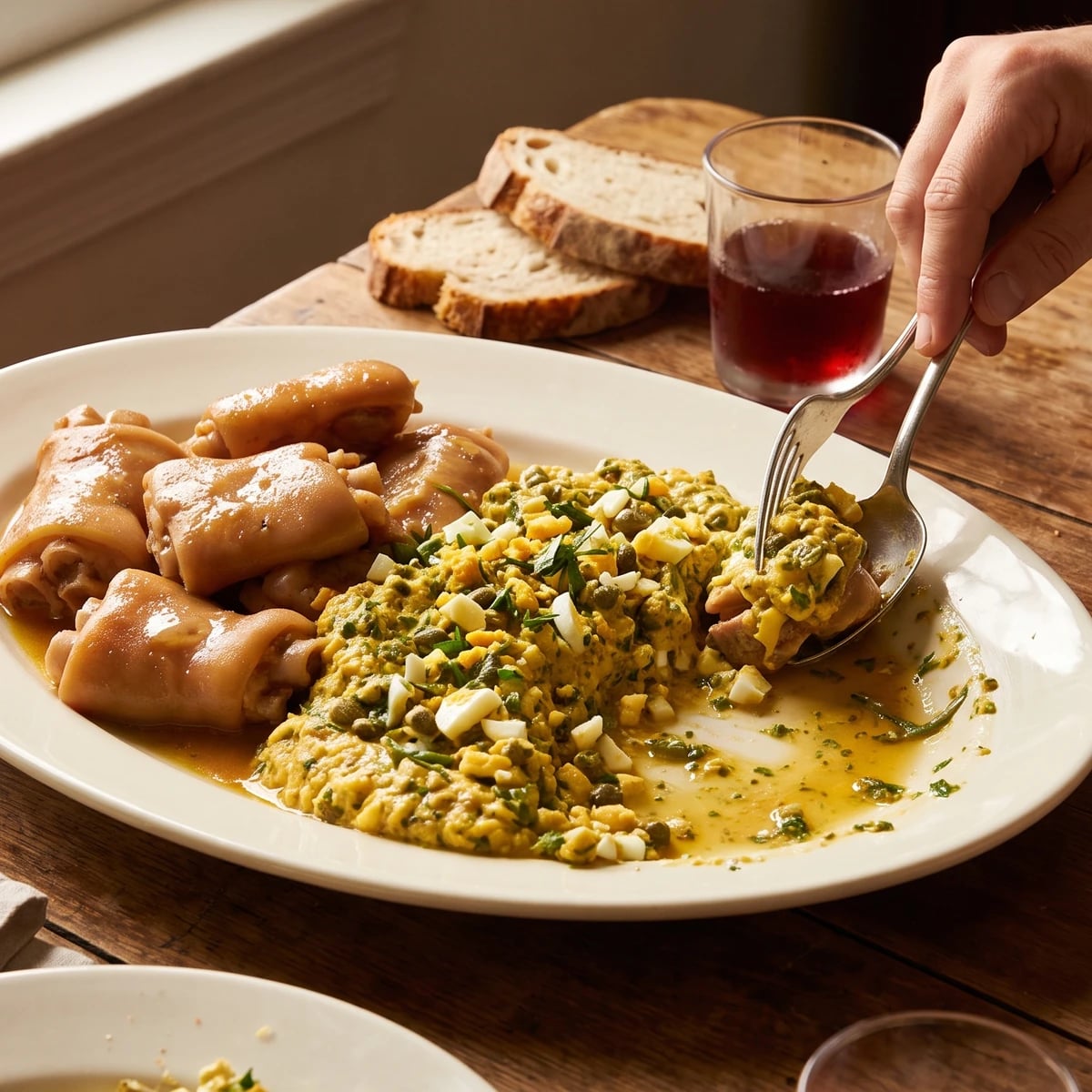
Pieds de veau turn patient poaching into two rewards: tender, trembling morsels with sauce gribiche tonight, and gelatin-rich liquor that gives tomorrow’s braise its body.
Pieds de veau à la gribiche (calf’s feet with egg-and-herb sauce) teach the honest purpose of slow poaching. The feet contain little conventional meat and an abundance of skin, tendon, and cartilage; given gentle heat, these become supple and remarkably rich. The one true thing is this: the blanc, an acidulated flour poaching liquor, must barely tremble. Boiling tears the feet apart before you can bone and serve them.
The original entry is pantry intelligence rather than a complete plated formula. It chiefly sends calf’s feet toward aspics and braising stock, then directs any special service to the calf’s-head family. That assumed a stockpot never off the fire and spare hands to bone the feet while warm. Here the cross-reference becomes a complete home dish: four butcher-prepared feet, one heavy pot, and the sharp sauce gribiche traditionally at home beside tête de veau. The quantity is scaled for four because the entry supplied no table portion of its own.
The standing stockpot and spare hands were brigade scaffolding, so they can go. The long blanc and warm boning are the dish, and they must stay. Hold that poach at the barest tremble, and the rest is patient work for one cook, one stove, one evening.
Pieds de veau belong to the French classical pantry and the bourgeois table, where cooks valued the feet as much for their gelatine as for the portion that reached the plate. In professional kitchens they quietly supplied the setting power for aspics and the body for braising liquor, exactly the practical role that made them indispensable. When served as a dish, they followed the poaching and sharp-sauce grammar of tête de veau, with mustard, vinegar, capers, cornichons, and herbs cutting through their generous texture.
Quantity
4 (3½ to 4 pounds / 1.6 to 1.8 kg total)
hoof casings removed
Quantity
6 quarts (5.7 liters / 5.7 kg)
divided
Quantity
¼ cup (60 ml / 30 g)
Quantity
½ cup (120 ml / 120 g)
Quantity
1 medium (about 7 ounces / 200 g)
peeled and quartered
Quantity
2 medium (about 7 ounces / 200 g)
cut into thick rounds
Quantity
1 small (about 5 ounces / 140 g)
washed and cut into three pieces
Quantity
1
Quantity
2 tablespoons plus ½ teaspoon (32.5 ml / 39 g)
divided
Quantity
10 (about ½ teaspoon / 1 g)
Quantity
2
Quantity
1 tablespoon (15 ml / 15 g)
Quantity
2 tablespoons (30 ml / 30 g)
Quantity
½ cup (120 ml / 110 g)
Quantity
¼ cup (60 ml / 40 g)
well drained and finely chopped
Quantity
2 tablespoons (30 ml / 20 g)
drained and finely chopped
Quantity
¼ cup (60 ml / 15 g)
finely chopped
Quantity
1 tablespoon (15 ml / 3 g)
finely chopped
Quantity
¼ teaspoon (1.25 ml / 0.6 g)
| Ingredient | Quantity |
|---|---|
| butcher-cleaned, split calf’s feethoof casings removed | 4 (3½ to 4 pounds / 1.6 to 1.8 kg total) |
| cold waterdivided | 6 quarts (5.7 liters / 5.7 kg) |
| all-purpose flour | ¼ cup (60 ml / 30 g) |
| white wine vinegar | ½ cup (120 ml / 120 g) |
| onionpeeled and quartered | 1 medium (about 7 ounces / 200 g) |
| carrotscut into thick rounds | 2 medium (about 7 ounces / 200 g) |
| leekwashed and cut into three pieces | 1 small (about 5 ounces / 140 g) |
| bouquet garni of parsley stems, thyme, and bay leaf | 1 |
| fine sea saltdivided | 2 tablespoons plus ½ teaspoon (32.5 ml / 39 g) |
| black peppercorns | 10 (about ½ teaspoon / 1 g) |
| large eggs | 2 |
| Dijon mustard | 1 tablespoon (15 ml / 15 g) |
| red wine vinegar | 2 tablespoons (30 ml / 30 g) |
| grapeseed or another neutral oil | ½ cup (120 ml / 110 g) |
| cornichonswell drained and finely chopped | ¼ cup (60 ml / 40 g) |
| capersdrained and finely chopped | 2 tablespoons (30 ml / 20 g) |
| flat-leaf parsleyfinely chopped | ¼ cup (60 ml / 15 g) |
| tarragon leavesfinely chopped | 1 tablespoon (15 ml / 3 g) |
| freshly ground black pepper | ¼ teaspoon (1.25 ml / 0.6 g) |
Examine the prepared feet and remove any stray bristles with clean tweezers, then rinse them well. Put them in a heavy pot with 2 quarts of the cold water and bring it to a full boil. Boil for 5 minutes, drain, and rinse the feet under cool water while rubbing away any grey foam. Wash the pot before continuing. This blanching is scaffolding worth keeping: it removes blood and impurities that would give the blanc a muddy taste.
Whisk the flour with the white wine vinegar and 1 cup of the remaining cold water until perfectly smooth. Pour it into the clean pot, whisk in the rest of the water, then add the onion, carrots, leek, bouquet garni, 2 tablespoons of the salt, and the peppercorns. Settle in the blanched feet. Lay a parchment cartouche directly over the liquid and use a small heatproof plate to keep the feet submerged if necessary. Bring the blanc slowly toward a simmer.
Lower the heat as soon as the first bubbles rise. Poach the feet partially covered for 3 to 3½ hours, keeping the blanc between 185 and 195°F (85 and 90°C), with only an occasional bubble breaking the surface. Add hot water if the feet become exposed. They are ready when a skewer enters the thick pad without resistance and a large bone twists free cleanly. If a foot begins separating because the liquid boiled, lift it onto a square of cheesecloth, tie a loose parcel, and return it to gentler heat. Ça se rattrape.
While the feet poach, cover the eggs with water in a small saucepan, simmer them for 9 minutes, then cool and peel them. Separate the yolks from the whites and chop the whites coarsely. Mash the yolks with 2 teaspoons of the Dijon mustard, 1 tablespoon of the red wine vinegar, and the remaining ½ teaspoon salt. Whisk in the oil drop by drop at first, then in a thin stream, until the sauce is thick but loose. Fold in the chopped whites, cornichons, capers, parsley, tarragon, black pepper, and enough of the remaining vinegar to make the sauce properly sharp. Keep it at cool room temperature.
Lift one foot at a time onto a rimmed tray, leaving the others in the warm blanc. As soon as it is cool enough to handle, pull out every bone, including the small toe bones, and discard any rough or discolored skin. Keep the tender skin, cartilage, and tendon together, then cut them into generous 1½-inch pieces. If a foot cools and sets before you finish, return it to the warm liquor for 5 minutes rather than forcing the bones out. Strain the blanc through a fine sieve and keep 2 cups with the boned portions for reheating.
Return the boned pieds de veau and the reserved 2 cups of blanc to the pot. Warm them for about 5 minutes at the barest simmer, then lift them out with a slotted spoon and drain well. Arrange them on a warmed platter and spoon some sauce gribiche generously over the center, leaving the rest in a bowl for the table. The feet should be supple, glossy, and yielding, with the mustard and vinegar cutting cleanly through their richness. À table!
Strain the remaining cooking liquor once more, cool it promptly over an ice bath, and refrigerate it within 2 hours. It will set firmly when cold. Lift away the fat and freeze the gel in small portions for bodying braises and sauces. Because this special-dish method uses a flour blanc, the liquor is meant for an opaque braise rather than a crystal-clear aspic.
1 serving (about 230g)
Culinary guides, cultural storytelling, and the editorial depth that makes cooking meaningful.
Discover Culinary Explorer
Chef Juliette
A half saddle of veal, bacon-barded and braised by short moistening, emerges bronze and succulent, with the concentrated veal glaze that makes this grand relevé worthy of the home table.

Chef Juliette
A bronzed saddle of veal between two patterned vegetable domes, with clear, glossy braising jus passed at the table: classical structure translated for four, patient enough for a celebration and possible on one stove.

Chef Juliette
A veal saddle braised until tender, its fillets cut into collops and rebuilt with paprika Béchamel and truffle, then flashed beneath fierce heat until the ivory sauce glazes.

Chef Juliette
A veal saddle becomes edible architecture: Soubise and ham tucked into the carved loin, truffled Parmesan soufflé rising above it, and reduced braising liquor served alongside.