Culinary Explorer

A cooking platform built around craft, culture, and the stories behind what we eat.
Discover Culinary Explorer
Sauté de Veau Printanier

Sauté de Veau Printanier

Created by Chef Juliette

Based on No. 1282, Sauté de Veau Printanier, from Le Guide Culinaire (1907) by Auguste Escoffier

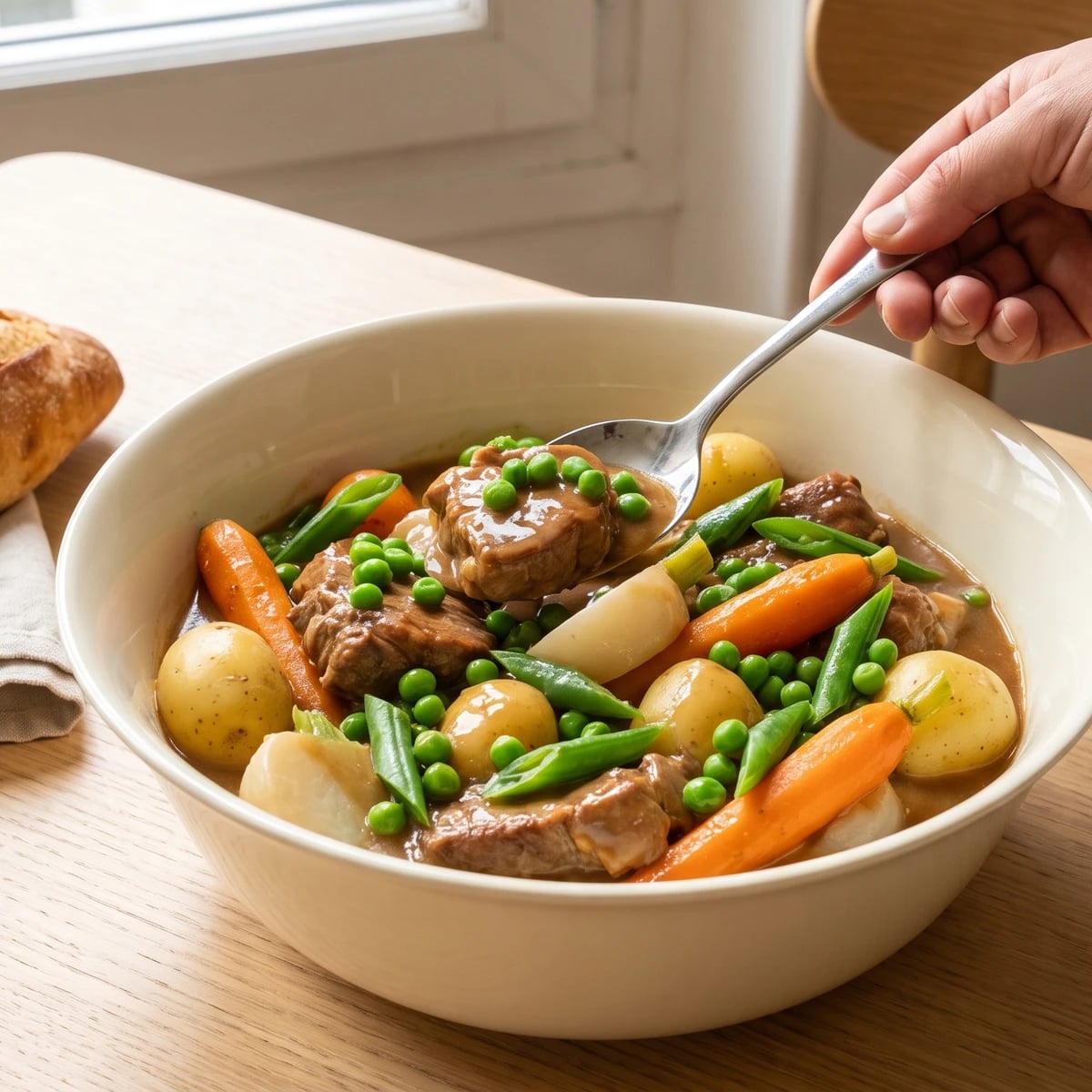
Veal browned in butter, braised gently in brown stock and demi-glace, then reunited with tender new roots, peas, and diamond-cut beans: spring in one pot, built in careful stages.

Soups & Stews
French
Comfort Food
Make Ahead
35 min
Active Time
2 hr 10 min cook2 hr 45 min total
Yield4 servings

Sauté de veau printanier teaches staged cooking. Here sauté carries its classical meaning: pieces browned in butter, moistened with stock, and cooked gently, not hurried around a skillet. The one true thing is timing. The veal needs a long, quiet braise, while the green vegetables need only minutes; force them into the pot together and spring turns grey.

The source assumed a saucier on staff, a brown stockpot never off the fire, prepared demi-glace, and another clean saucepan waiting for the transfer. At home, good unsalted brown veal stock, prepared demi-glace, a fine sieve, and one heavy cocotte do the work. The quantity is reduced to four generous portions, and the wiped cocotte replaces the second saucepan. That extra pan was brigade scaffolding. The browning, the first braise, the strained sauce, and the peas and beans cooked à l'anglaise (plainly in water) are the dish itself, so they stay.

When it is right, the veal yields beneath the fork, the new roots hold their shape, and the brown sauce gleams around bright peas and diamond-cut beans. One cook, one stove, one evening. Before you touch the pan, dry the veal thoroughly and make room to brown it in batches. That first colour decides the sauce.

Sauté de veau printanier belongs to the Parisian classical table, where printanier names a garnish of young spring vegetables rather than a regional mixture of herbs. Grand kitchens organized the dish in stages, braising browned veal in brown stock and demi-glace before straining the sauce and cooking each vegetable according to its needs; bourgeois home kitchens kept the same logic with fewer pans. The peas and French beans cooked à l'anglaise are not decoration but the fresh final counterpoint to the brown sauce, which is why they are distributed over the stew only at service.

The technique, the tradition, and the story behind every dish.

Discover Culinary Explorer

Ingredients

boneless veal shoulder

Quantity

1¾ pounds (800 g)

cut into 1½-inch (4 cm) pieces

fine sea salt

Quantity

1 teaspoon (5 ml / 6 g)

freshly ground black pepper

Quantity

½ teaspoon (2.5 ml / 1 g)

unsalted butter

Quantity

3 tablespoons (45 ml / 42 g)

divided

unsalted brown veal stock

Quantity

1⅔ cups (400 ml / 400 g)

prepared demi-glace (half-glaze)

Quantity

¼ cup (60 ml / 65 g)

bouquet garni

Quantity

1

2 parsley stems, 2 thyme sprigs, and 1 bay leaf, tied securely

slender new carrots

Quantity

8 (about 7 ounces / 200 g)

scrubbed and trimmed

small new turnips

Quantity

4 (about 7 ounces / 200 g)

peeled and halved if larger than a walnut

small new potatoes

Quantity

12 (about 1 pound / 450 g)

scrubbed

shelled fresh or frozen peas

Quantity

¾ cup (180 ml / 100 g)

slender French beans

Quantity

1 cup (240 ml / 115 g)

trimmed and cut diagonally into ¾-inch (2 cm) lozenges

water

Quantity

2 quarts (1.9 liters / 1.9 kg)

for cooking the peas and beans

fine sea salt

Quantity

1 tablespoon (15 ml / 18 g)

for the cooking water

Equipment Needed

  • Heavy 5-quart (4.7-liter) cocotte or Dutch oven with lid
  • Fine-mesh sieve
  • 3-quart (2.8-liter) saucepan
  • Tongs or slotted spoon
  • Deep warmed serving bowl

Instructions

  1. 1

    Prepare the vegetables

    Heat the oven to 325°F (165°C). Keep the carrots, turnips, and potatoes together, but hold the peas and diamond-cut French beans separately; they enter at different stages because their cooking times are entirely different. Pat the veal dry with clean towels, then season it evenly with the salt and pepper.

    Choose roots of similar size so they finish together. Leave truly small new carrots and potatoes whole; halve larger pieces rather than cutting everything into anonymous cubes.
  2. 2

    Brown the veal

    Melt 2 tablespoons of the butter in a heavy cocotte over medium-high heat. When the foam subsides, brown the veal in three batches, leaving space around every piece and turning only when the underside releases with a deep golden crust. Add the remaining butter as the pan needs it. If the pan fills with liquid, lift out the meat and boil that liquid down until the butter and browned fond show again, then continue. The colour is delayed, not lost.

    Butter, not oil. Keep the heat lively enough to brown the meat but lower it if the milk solids turn black or smell acrid; a hazelnut-brown butter is welcome, a burnt one poisons the sauce.
  3. 3

    Begin the braise

    Return all the veal to the cocotte. Moisten with the brown veal stock and demi-glace, scraping every bronze speck of fond from the bottom, then add the bouquet garni. Bring the liquid to a full boil once, as the source directs, immediately reduce it to a bare simmer, cover, and transfer the cocotte to the oven. Cook gently for 1 hour. The liquid should barely move around the meat; a hard boil tightens veal before its connective tissue has time to soften.

  4. 4

    Strain and add roots

    Lift the veal into a bowl. Strain the sauce through a fine sieve, pressing lightly on the bouquet garni before discarding it, then wipe the cocotte clean. Return the veal to the same cocotte with the carrots, turnips, and potatoes, and strain the sauce over everything. Cover and cook in the oven for about 45 minutes, beginning to check after 35, until the veal yields to a fork and the roots are tender but intact. If one vegetable softens before the meat, lift it out and keep it covered, then return it at the finish. Ça se rattrape.

  5. 5

    Cook greens à l'anglaise

    During the final 10 minutes of the braise, bring the water and its salt to a brisk boil. Cook the diamond-cut French beans until bright green and just tender, 3 to 4 minutes, then lift them out and drain thoroughly. Cook the peas in the same water until tender, about 1 minute for frozen peas or 2 minutes for fresh. Drain them at once. Do not leave either vegetable sitting in water; their fresh colour and distinct texture are the reason they were cooked separately.

  6. 6

    Finish and serve

    Lift the veal and root vegetables into a warmed, deep serving bowl. If the sauce runs thin, simmer it uncovered until it coats a spoon in a glossy veil; if it has tightened too far, loosen it with plain hot water, 1 tablespoon at a time. Taste before adding any more salt because the demi-glace has concentrated during cooking. Return the veal and roots briefly to the sauce, then arrange them in the serving bowl, spoon the sauce over, and distribute the peas and diamond-cut beans across the top. This deep bowl is the honest home equivalent of the source's timbale. À table!

Chef Tips

  • Buy veal shoulder, neck, or another braising cut with visible seams of connective tissue. Veal scallops and lean leg meat belong to quicker preparations; nearly two hours of gentle cooking would leave them dry.
  • The brown foundation matters. Use unsalted brown veal stock and a prepared demi-glace with enough gelatin to set softly when chilled. A salty stock cube cannot replace both without making the finished sauce harsh.
  • Fresh peas are lovely when their season is honest, but frozen peas picked young are the classical pantry's sensible answer at other times. Add them straight from frozen to the boiling water and give them only a minute.
  • Serve with bread for the sauce and pour a light red Beaujolais or a dry white Mâcon. The stew already contains its vegetables and potatoes, so it needs no parade of side dishes.

Advance Preparation

  • For the cleanest make-ahead schedule, complete the first 1-hour braise, strain the sauce, and cool the veal in the sauce within 2 hours. Refrigerate, covered, for up to 2 days. Reheat to a bare simmer, add the root vegetables, and continue with their 45-minute cooking stage.
  • The carrots, turnips, potatoes, and French beans can be prepared earlier the same day and kept covered in the refrigerator. Cook the peas and beans à l'anglaise shortly before serving so their colour and texture stay lively.
  • Leftovers keep for up to 3 days under refrigeration. Reheat over low heat without boiling, adding a spoonful of water if the gelatin-rich sauce has set too firmly.

Frequently Asked Questions

Nutrition Information

1 serving (about 480g)

Calories
535 calories
Total Fat
24 g
Saturated Fat
12 g
Trans Fat
1 g
Unsaturated Fat
11 g
Cholesterol
200 mg
Sodium
950 mg
Total Carbohydrates
35 g
Dietary Fiber
7 g
Sugars
8 g
Protein
47 g

Note: Chef personas and recipes are created with AI assistance. Cook with care: follow safe food-handling practices, check doneness with a thermometer when needed, and adapt for allergies and your kitchen.

Where cooking meets culture.

Culinary guides, cultural storytelling, and the editorial depth that makes cooking meaningful.

Discover Culinary Explorer

More from Relevés and Entrées - VEAL

Browse the full collection