
Chef Juliette
John Dory (St. Pierre)
John Dory has the delicacy of sole and the firmness of turbot. A light flouring, a quick butter sauté, and nut-brown beurre noisette show exactly why looks never mattered.
A cooking platform built around craft, culture, and the stories behind what we eat.
Created by Chef Juliette
Based on No. 1271, Rognon de Veau à la Robert, from Le Guide Culinaire (1907) by Auguste Escoffier
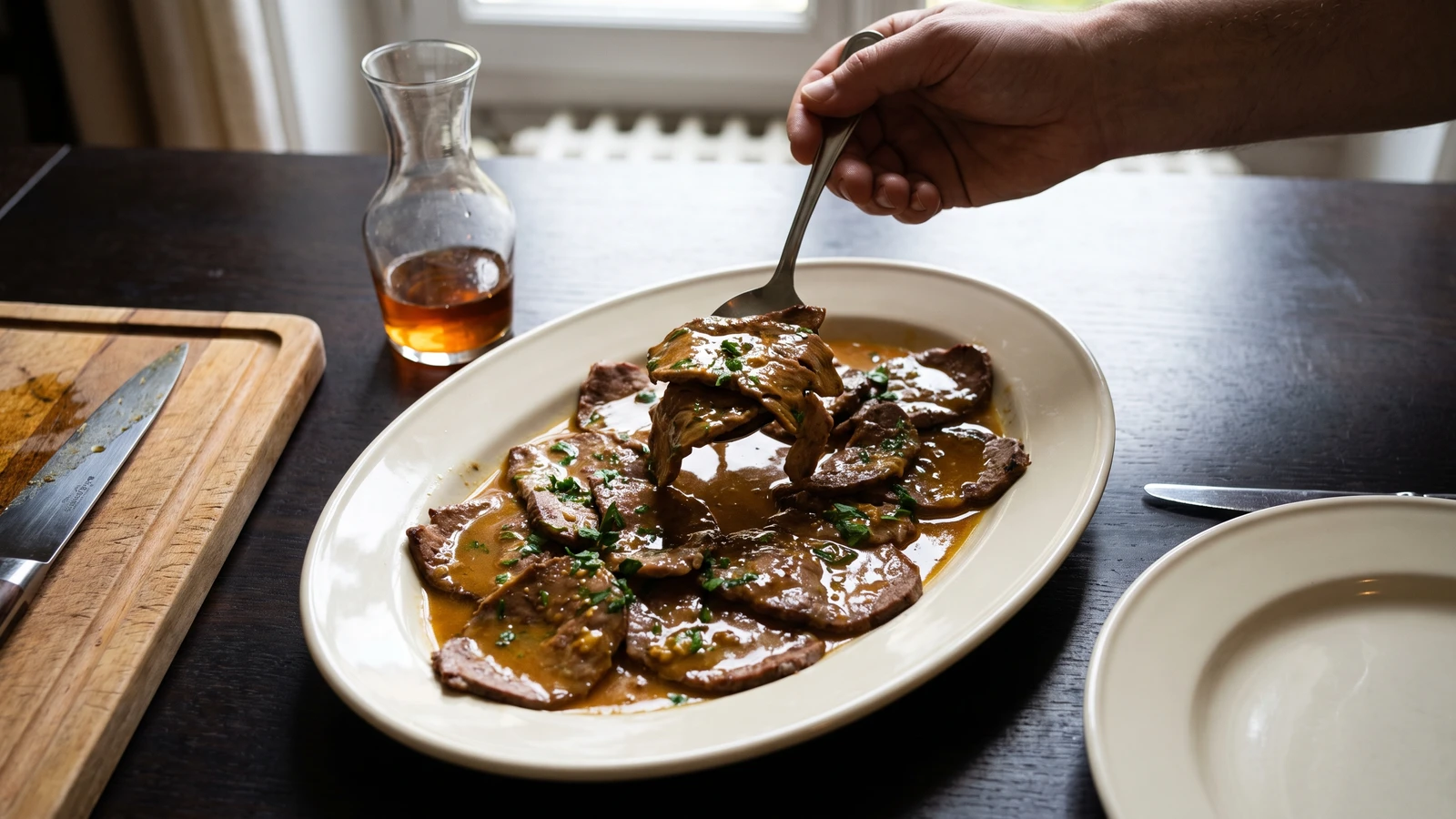
A whole veal kidney browned briskly, roasted, sliced whisper-thin, and warmed in a Cognac, mustard, lemon, parsley, and butter liaison: rich, sharp, glossy, and governed by one rule, never let the sauce boil.
Rognon de Veau à la Robert (veal kidney with Cognac mustard-butter) teaches the liaison (butter binding): the moment a reduction becomes a sauce because cold butter is worked into it without boiling. Know this before touching a pan: the kidney can wait under a warm plate for a few minutes, but the liaison cannot survive a boil. Hold that boundary and the dish is generous, glossy, sharp with mustard and lemon, and far less formidable than its table-side ceremony suggests.
The original assumed a small cocotte moved from oven to spirit lamp and two practiced hands, one reducing the brandy while another sliced the kidney at the table. It needed neither a stockpot nor a salamander; its hidden brigade luxury was simultaneous service. For one cook, we keep the ovenproof pan and warm plates, lose the spirit lamp, and work safely at the stove in sequence. The source ratio is written for one kidney, so two kidneys and every accompaniment doubled in the same proportion make four servings. The synchronized table service was scaffolding; brisk browning, extremely thin slicing, reducing the Cognac by half, and making the mustard-butter liaison are the dish and stay.
Take the pan off the heat before the finishing butter goes in, then return it only to the gentlest heat. If the sauce turns oily, ça se rattrape: a teaspoon of cold water and steady whisking will rebuild it. The step that decides the whole dish is simple, heat the sliced kidney thoroughly, but never let the sauce boil.
Rognons de veau belong to the Parisian bistro and bourgeois dining-room repertoire, where a whole kidney could be roasted, carved, and sauced before the guests. In this preparation, à la Robert does not mean ladling on the usual onion-based Sauce Robert; the sauce is built directly in the cocotte from reduced Cognac, mustard, lemon, parsley, and butter. Despite common flambé retellings, the source calls for the brandy to be reduced rather than ignited.
Quantity
2 (about 2 lb / 900 g total)
outer membrane, hard fat, and white central cores removed while keeping the lobes together
Quantity
1 teaspoon (5 ml / 6 g)
Quantity
1/2 teaspoon (2.5 ml / 1 g)
Quantity
8 tablespoons (120 ml / 113 g)
divided, with 4 tablespoons chilled and cut into small pieces
Quantity
1/2 cup (120 ml / 114 g)
Quantity
2 teaspoons (10 ml / 10 g)
Quantity
2 tablespoons (30 ml / 30 g)
Quantity
2 teaspoons (10 ml / 3 g)
finely chopped
Quantity
1 tablespoon (15 ml / 15 g)
only if needed to rescue the liaison
| Ingredient | Quantity |
|---|---|
| whole veal kidneysouter membrane, hard fat, and white central cores removed while keeping the lobes together | 2 (about 2 lb / 900 g total) |
| fine sea salt | 1 teaspoon (5 ml / 6 g) |
| freshly ground black pepper | 1/2 teaspoon (2.5 ml / 1 g) |
| unsalted butterdivided, with 4 tablespoons chilled and cut into small pieces | 8 tablespoons (120 ml / 113 g) |
| excellent Cognac or French grape brandy | 1/2 cup (120 ml / 114 g) |
| Dijon mustard | 2 teaspoons (10 ml / 10 g) |
| fresh lemon juice | 2 tablespoons (30 ml / 30 g) |
| flat-leaf parsleyfinely chopped | 2 teaspoons (10 ml / 3 g) |
| cold water (optional)only if needed to rescue the liaison | 1 tablespoon (15 ml / 15 g) |
Heat the oven to 450°F (230°C). Open each kidney along its inner curve without separating all the lobes, then cut away every firm white tube, the central core, and any hard fat; these parts stay chewy however carefully you cook them. Fold the kidney back into its natural shape and secure it with kitchen twine at 1-inch (2.5 cm) intervals. Pat it thoroughly dry, then season with the salt and pepper just before it meets the pan. A wet kidney simmers in its own moisture; a dry one takes the brisk browning the sauce needs.
Melt 4 tablespoons (60 ml / 56 g) of the butter in a 12-inch (30 cm) ovenproof skillet or shallow cocotte over medium-high heat. When the foam subsides, add the kidneys and brown them briskly on every broad surface, about 2 minutes per side; work one at a time if the pan crowds, because colour matters more than speed. Return both kidneys to the pan and roast for 10 to 15 minutes, checking early if they are small, until the thickest part reaches about 150°F (66°C). The final warming in the sauce will carry the thin slices to 160°F (71°C) without subjecting the liaison to a boil.
Transfer the kidneys to a warm plate or cutting board and leave the browned butter and fond in the cocotte. Take the pan completely off the heat before adding the Cognac, and turn off a gas burner while you pour; alcohol fumes need respect, not theater. Return the pan to medium heat and scrape the bottom thoroughly as the Cognac bubbles. Reduce it by half, to about 1/4 cup (60 ml), until its raw alcoholic sting has softened and the fond has dissolved into a fragrant amber reduction. Do not ignite it. The source asks for reduction, and reduction gives the sauce its concentration.
Take the reduced Cognac off the heat. Remove the twine and slice the kidneys across the lobes as thinly as your knife permits, about 1/8 inch (3 mm), collecting every drop of juice. Cover the slices with an inverted warm plate while you finish the sauce. This extremely thin slicing is not decoration; it keeps the kidney tender and gives every piece a full coating of liaison. Fill the serving platter and dinner plates with very hot water now, then drain and dry them just before serving.
Whisk the Dijon mustard, lemon juice, and parsley into the warm Cognac reduction. With the pan off the heat, add the remaining 4 tablespoons (60 ml / 56 g) of cold butter a few pieces at a time, whisking each addition into the sauce before adding more. The liaison is ready when it looks glossy and lightly coats a spoon, not when it becomes thick like gravy. If it turns oily or separates, stop. Ça se rattrape: place 1 teaspoon of the cold water in a clean warm bowl, then whisk in the broken sauce one spoonful at a time until it comes together; add another teaspoon of water only if needed.
Set the pan over the lowest heat and slide in the sliced kidney with all its collected juices. Fold the slices through the liaison for 1 to 3 minutes, just until thoroughly heated and several of the thickest pieces register 160°F (71°C). The sauce may quiver, but it must not bubble. If bubbles appear at the edge, lift the pan off the heat immediately and keep folding; if the liaison begins to separate, use the cold-water rescue from the previous step. Spoon the kidney and every drop of sauce onto the drained, very hot platter, then serve at once on the warmed plates. À table!
1 serving (about 190g)
Culinary guides, cultural storytelling, and the editorial depth that makes cooking meaningful.
Discover Culinary ExplorerChef Juliette
John Dory has the delicacy of sole and the firmness of turbot. A light flouring, a quick butter sauté, and nut-brown beurre noisette show exactly why looks never mattered.

Chef Juliette
Fresh haddock proves its delicacy in the meunière pan: a fine flour crust, moist pearly flakes, and beurre noisette sharpened with lemon and parsley, ready from one skillet in half an hour.

Chef Juliette
Éperlans à l’Anglaise turns small fish into a lesson in disciplined coating: boned smelts under a close, crisp crumb, pan-fried in clarified butter and finished with bright, half-melted maître d’hôtel butter.

Chef Juliette
Tiny smelts, shallot, mushrooms, white wine, gratin sauce, and fine bread raspings meet a fierce oven, where the fish must turn tender in the same breath the buttered crust bronzes.