
Chef Juliette
Selle de Veau (Relevé)
A half saddle of veal, bacon-barded and braised by short moistening, emerges bronze and succulent, with the concentrated veal glaze that makes this grand relevé worthy of the home table.
A cooking platform built around craft, culture, and the stories behind what we eat.
Created by Chef Juliette
Based on No. 1267, Rognon de Veau Grillé, from Le Guide Culinaire (1907) by Auguste Escoffier
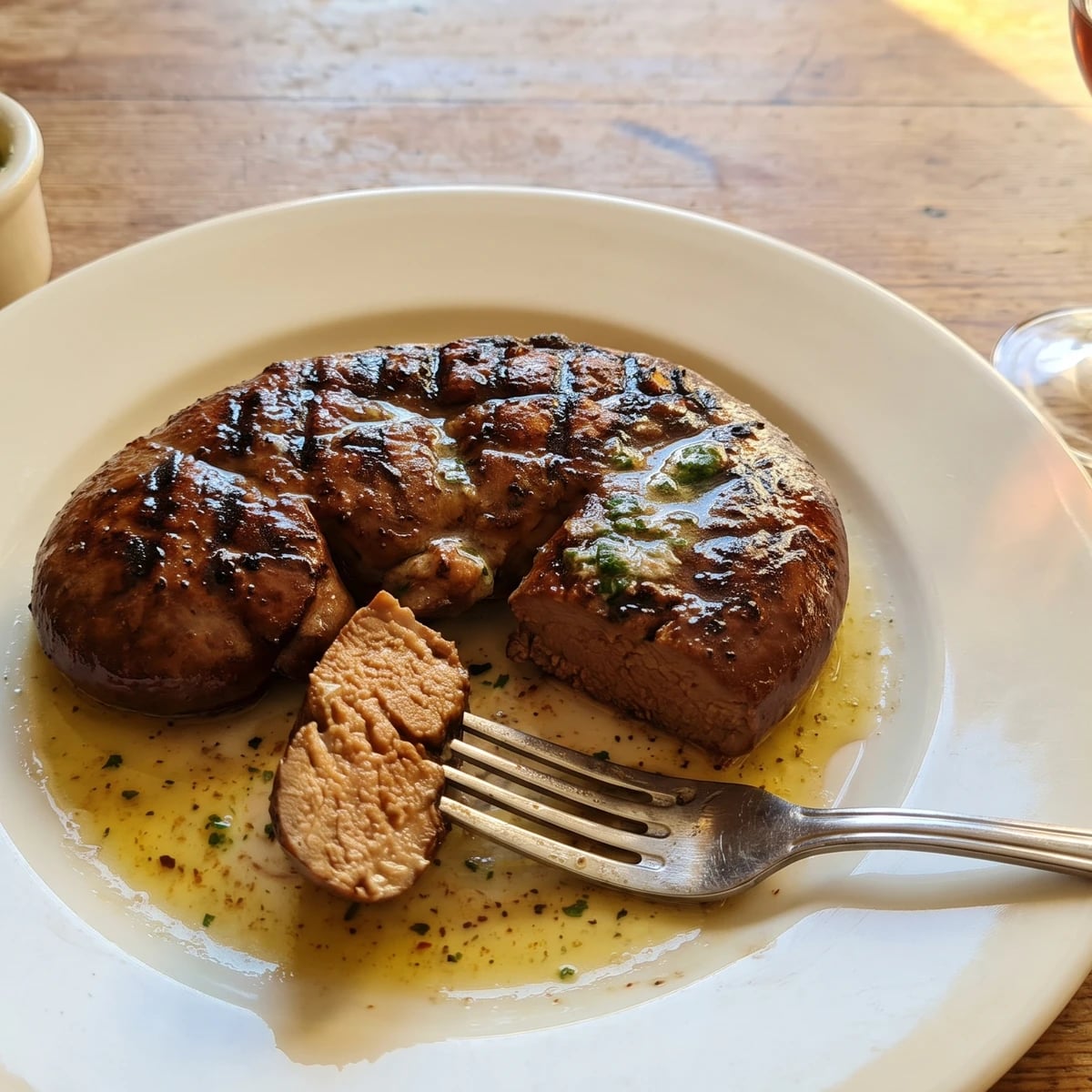
A veal kidney split but kept hinged, skewered flat, and grilled over moderate heat with frequent butter basting, then served with maître-d'hôtel butter: the quick grill that rewards nerve and attention.
Rognon de veau grillé (butter-basted grilled veal kidney) teaches control over fire. Kidney must cook through without surrendering its moisture, so the one true thing to know before touching the pan is this: moderate heat and frequent basting matter more than a furious sear. Done properly, the lobed surface turns deep bronze beneath a glossy veil of butter while the interior stays succulent.
Unlike much of the classical canon, this entry assumed neither a saucier on staff, a stockpot never off the fire, nor a salamander. It assumed a grill cook tending steady coals and several compound butters already prepared for service. A heavy cast-iron grill pan supplies the steady heat at home, and this version chooses beurre maître-d'hôtel (parsley-and-lemon compound butter) from the entry's own alternatives, making only enough for four. One cook, one stove, one evening.
The brigade's selection of prepared butters is scaffolding and can be reduced. Trimming a thin jacket of fat, leaving the kidney hinged, skewering it flat, grilling gently, and basting often are the dish, so every one stays. Watch the butter when the kidney first meets the iron: it should foam and gild, never blacken.
Veal kidney moved easily between the bourgeois home table, Parisian brasseries, and the classical French grill station, where its delicacy called for quick cooking rather than a long stew. The small skewer was practical, holding the butterflied lobes flat over the fire while a thin jacket of the kidney's own fat protected them. Serving a compound butter separately placed the dish firmly in the grill repertoire, adding richness without disguising the kidney beneath a sauce.
Quantity
4 (about 1½ lb / 680 g total)
chilled with their outer fat intact
Quantity
4 tablespoons (60 ml / 56 g)
melted
Quantity
1 teaspoon (5 ml / 6 g)
Quantity
½ teaspoon (2.5 ml / 1.2 g)
Quantity
4 tablespoons (60 ml / 56 g)
softened
Quantity
2 tablespoons (30 ml / 8 g)
very finely chopped
Quantity
2 teaspoons (10 ml / 10 g)
Quantity
⅛ teaspoon (0.6 ml / 0.75 g)
Quantity
⅛ teaspoon (0.6 ml / 0.3 g)
| Ingredient | Quantity |
|---|---|
| veal kidneyschilled with their outer fat intact | 4 (about 1½ lb / 680 g total) |
| unsalted butter for bastingmelted | 4 tablespoons (60 ml / 56 g) |
| fine sea salt | 1 teaspoon (5 ml / 6 g) |
| freshly ground black pepper | ½ teaspoon (2.5 ml / 1.2 g) |
| unsalted butter for the beurre maître-d'hôtelsoftened | 4 tablespoons (60 ml / 56 g) |
| flat-leaf parsleyvery finely chopped | 2 tablespoons (30 ml / 8 g) |
| fresh lemon juice | 2 teaspoons (10 ml / 10 g) |
| fine sea salt for the beurre maître-d'hôtel | ⅛ teaspoon (0.6 ml / 0.75 g) |
| freshly ground black pepper for the beurre maître-d'hôtel | ⅛ teaspoon (0.6 ml / 0.3 g) |
Beat the softened butter with the parsley, lemon juice, salt, and pepper until evenly flecked and smooth. Pack the beurre maître-d'hôtel into a small serving crock and hold it in a cool place while you cook. It should be firm enough to sit proudly but soft enough to yield when a hot piece of kidney touches it.
Pull away the tough outer membrane from each chilled kidney, then pare the surrounding fat down to an even layer about ⅛ inch (3 mm) thick. Leave that slight jacket all around, as the source directs; it protects the kidney and bastes it from within. Cut lengthwise through the rounded side without separating the halves, leaving a sturdy hinge, then open the kidney like a book. Remove the hard white core and any thick tubes with small V-shaped cuts, taking care not to sever the hinge. Pat every surface thoroughly dry.
Open each kidney flat and run a short metal skewer across its width through both halves so it cannot fold shut on the grill. Season both sides evenly with the salt and pepper immediately before cooking. This skewer is not decoration; it gives every lobe equal contact with the heat, which is why the original method insists upon it.
Heat a heavy cast-iron grill pan over medium heat for about four minutes. Brush the cut faces lightly with melted butter and lay the kidneys cut-side down without crowding. Grill for three minutes, turn, and spoon over more melted butter; continue turning every two minutes and basting frequently until the surfaces are bronzed, the lobes feel just firm, and the thickest part reaches at least 160°F (71°C), usually eight to twelve minutes in all. If the butter blackens or smells acrid, lift out the kidneys, take the pan off the heat, wipe it carefully with folded paper held in tongs, and resume over gentler heat with fresh melted butter. Ça se rattrape. A hard fire burns the butter before the kidney cooks; a moderate one lets them finish together.
Transfer the kidneys to warm plates and rest them for three minutes, then draw out the skewers. Serve one kidney per person with the beurre maître-d'hôtel passed separately, exactly as the entry intends, so each diner can add it as the butter-softened surface asks. Don't pour the dark residue from the grill pan over the meat; the clean compound butter is the finish. À table!
1 serving (about 135g)
Culinary guides, cultural storytelling, and the editorial depth that makes cooking meaningful.
Discover Culinary Explorer
Chef Juliette
A half saddle of veal, bacon-barded and braised by short moistening, emerges bronze and succulent, with the concentrated veal glaze that makes this grand relevé worthy of the home table.

Chef Juliette
A bronzed saddle of veal between two patterned vegetable domes, with clear, glossy braising jus passed at the table: classical structure translated for four, patient enough for a celebration and possible on one stove.

Chef Juliette
A veal saddle braised until tender, its fillets cut into collops and rebuilt with paprika Béchamel and truffle, then flashed beneath fierce heat until the ivory sauce glazes.

Chef Juliette
A veal saddle becomes edible architecture: Soubise and ham tucked into the carved loin, truffled Parmesan soufflé rising above it, and reduced braising liquor served alongside.