Culinary Explorer

A cooking platform built around craft, culture, and the stories behind what we eat.
Discover Culinary Explorer
Rognon de Veau

Rognon de Veau

Created by Chef Juliette

Based on No. 1264, Rognon de Veau, from Le Guide Culinaire (1907) by Auguste Escoffier

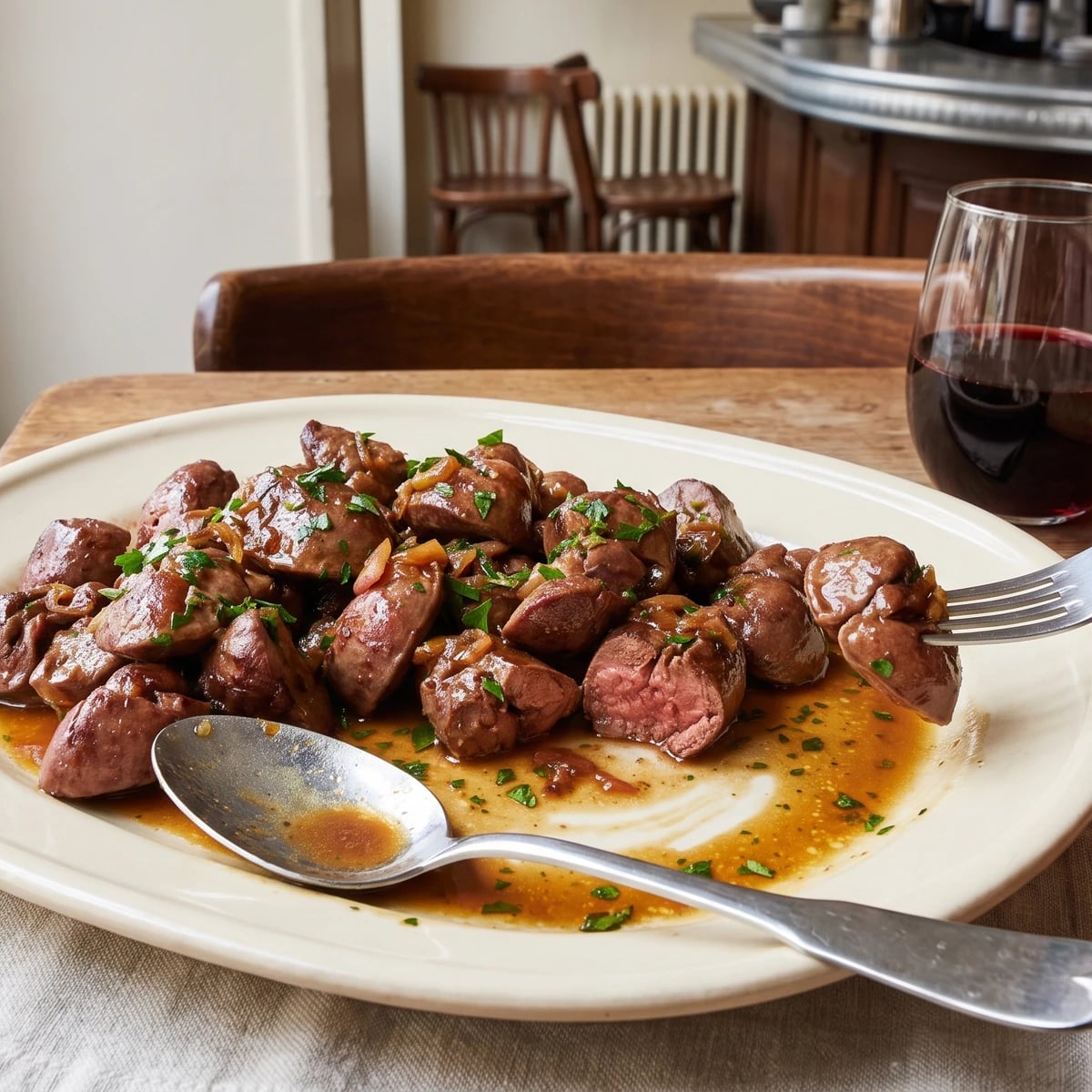
Rognon de veau asks for nerve, not time: a dry kidney, fierce heat, and a swift pan jus give you bronze edges, a rosy centre, and butter-bright sauce before the meat can toughen.

Main Dishes
French
Weeknight
Comfort Food
30 min
Active Time
15 min cook45 min total
Yield4 servings

Rognon de veau sauté teaches speed. The one true thing to know before touching the pan is this: kidney must meet fierce heat while bone-dry, in batches small enough that its surface browns before its centre turns grey. Hesitate over trimming if you must. Once the pan is hot, move with conviction.

The book's entry is a doorway rather than a derivative recipe. It sends the cook to the glossary term sauté and says veal kidney accepts the same sautéed preparations as sheep's kidney. Many grand-kitchen formulas assumed a saucier on staff, stock never off the fire, or a salamander; this one assumes none of them, only trained hands and enough pans to prevent crowding. For one cook, one stove, one evening, a 12-inch skillet used in two batches is the honest equivalent. This home-scale version serves four and adds only a short shallot, white-wine, and butter jus because the entry specifies no derivative sauce. The brigade scaffolding goes; the sauté stays.

Done properly, the lobes arrive mahogany-bronzed at their edges, tender and rosy inside, with a sharp little jus that gleams rather than blankets. The step that decides everything is the first minute in the pan: high heat, open space, and no hesitation.

Rognon de veau belongs to the cuisine bourgeoise of Paris and the offal-loving bouchon tables of Lyon, where calf kidney moved naturally from the household pan to the bistro as a quick, last-minute dish. Classical manuals often treat the name as an ingredient heading rather than one fixed sauce, sending the sautéed kidney through a family of preparations, exactly as this source entry does. Its larger, milder lobes distinguish it from sheep's kidney, but they do not make it forgiving: cooks may debate mustard, Madère, or a simple jus, while swift cooking is not debated.

The technique, the tradition, and the story behind every dish.

Discover Culinary Explorer

Ingredients

whole veal kidneys

Quantity

2 whole (about 2 lb / 900 g before trimming)

fine sea salt

Quantity

1¼ teaspoons (6 ml / 7 g)

divided

freshly ground black pepper

Quantity

¾ teaspoon (4 ml / 2 g)

clarified butter

Quantity

2 tablespoons (30 ml / 28 g)

divided

small shallots

Quantity

2 small (about ⅓ cup / 50 g)

finely minced

dry white wine

Quantity

½ cup (120 ml / 120 g)

cold water

Quantity

⅓ cup (80 ml / 80 g)

fresh lemon juice

Quantity

2 teaspoons (10 ml / 10 g)

cold unsalted butter

Quantity

3 tablespoons (45 ml / 42 g)

cut into small cubes

flat-leaf parsley

Quantity

2 tablespoons (30 ml / 8 g)

finely chopped

Equipment Needed

  • 30 cm (12-inch) stainless-steel or carbon-steel skillet
  • Small sharp boning or paring knife
  • Fine-mesh sieve set over a bowl
  • Small whisk
  • Instant-read thermometer for diners requiring fully cooked offal

Instructions

  1. 1

    Trim the kidneys

    Chill the kidneys for ten minutes so the fat firms, then peel away the thin outer membrane. Separate the lobes along their natural seams and cut out every scrap of the hard white central fat, connective tissue, and visible duct. Sacrifice a little meat rather than leave a chewy core. Cut the larger lobes into pieces about 1¼ inches (3 cm) across, leaving small lobes whole. Fresh veal kidney should smell clean and faintly mineral; an ammoniac smell is spoilage, not something soaking can mend. Pat the pieces until the paper comes away completely dry.

  2. 2

    Ready the stove

    Set a fine-mesh sieve over a bowl and warm a serving platter. Measure the wine, water, lemon juice, butter, shallots, and parsley before cooking begins, because the kidney cannot wait while you search for them. Season the dry pieces just before they meet the pan with 1 teaspoon of the salt and all the pepper. Heat a wide skillet over high heat until a drop of water skitters away at once.

  3. 3

    Sauté in batches

    Add 1 tablespoon of clarified butter, swirl it across the pan, and lay in half the kidney with space between every piece. Leave it untouched for about 45 seconds, then toss or turn it briskly for another 1½ to 2 minutes, until the faces are deeply bronzed and the centres remain rosy and resilient. Transfer the batch to the sieve and repeat with the remaining clarified butter and kidney. If liquid floods the pan and the sizzle dies, lift the pieces out immediately, pour away the liquid, dry and reheat the pan, then continue in smaller batches. The pieces can still brown while their centres are underdone; leave them sitting in that liquid and they turn grey.

  4. 4

    Reduce the pan jus

    Lower the heat to medium and add the shallots to the brown fond left in the skillet. Stir for 30 seconds, just until fragrant, then pour in the wine and scrape up every brown speck. Reduce au sec, nearly dry, until about 2 tablespoons remain. Add the cold water and reduce again until the liquid is lightly syrupy and measures roughly ¼ cup. Discard the strong juices collected beneath the kidney rather than muddying the clean pan jus with them.

  5. 5

    Monter au beurre

    Take the skillet completely off the heat and stir in the lemon juice. Monter au beurre, finish the sauce by whisking in the cold butter a few cubes at a time, adding each only after the last has disappeared. The jus should become glossy and lightly thickened without turning oily. If the butter separates, the pan was too hot. Ça se rattrape: whisk in 1 teaspoon of cold water off the heat, then continue with the remaining butter more slowly.

  6. 6

    Gloss and serve

    Return the kidney and parsley to the skillet and turn the pieces through the sauce for 20 to 30 seconds off the heat. Do not bring the sauce back to a simmer; the residual warmth is enough, and another minute would undo the careful sauté. Taste the jus, add the remaining salt only if it needs it, and spoon everything onto the warm platter at once. À table!

Chef Tips

  • Buy whole kidney so you can judge it before trimming. The surface should be moist but not slimy, the colour a clear rosy brown, and the smell clean and mineral. Ammonia means the kidney is past its moment; change the plan, not the standard.
  • Fresh veal kidney needs no bath in milk. A long soak waterlogs the surface, and a wet surface will not brown. Careful trimming and thorough drying matter far more.
  • The classical serving point is rosy at the centre, which keeps a quick sauté tender. For pregnant, immunocompromised, elderly, or very young diners, cook offal to 160°F (71°C); the texture will be firmer, so a moist braised kidney preparation is the kinder choice.
  • Serve the rognon with pommes purée, pommes sautées, or simply good bread to gather the butter jus. A young Beaujolais has enough fruit and acidity for the mineral richness without overpowering it.
  • Cooked kidney does not improve overnight. Refrigerate leftovers within two hours and eat them the following day, reheated only until warm; repeated heating turns the lobes firm.

Advance Preparation

  • The kidneys may be trimmed and cut up to 6 hours ahead. Dry them well, arrange them in one layer on a paper-lined tray, cover, and refrigerate at 40°F (4°C) or colder. Do not salt until the pan is ready.
  • The shallots may be minced and the sauce ingredients measured earlier in the day. Keep the butter cold so it emulsifies cleanly at the finish.
  • Do not sauté the kidney in advance or hold the completed dish. This is last-minute cooking by nature, but once the trimming is done, the pan work takes only fifteen minutes.

Frequently Asked Questions

Nutrition Information

1 serving (about 190g)

Calories
320 calories
Total Fat
21 g
Saturated Fat
12 g
Trans Fat
0 g
Unsaturated Fat
9 g
Cholesterol
1300 mg
Sodium
900 mg
Total Carbohydrates
3 g
Dietary Fiber
1 g
Sugars
1 g
Protein
28 g

Note: Chef personas and recipes are created with AI assistance. Cook with care: follow safe food-handling practices, check doneness with a thermometer when needed, and adapt for allergies and your kitchen.

Where cooking meets culture.

Culinary guides, cultural storytelling, and the editorial depth that makes cooking meaningful.

Discover Culinary Explorer

More from Relevés and Entrées - VEAL

Browse the full collection