
Chef Juliette
Selle de Veau (Relevé)
A half saddle of veal, bacon-barded and braised by short moistening, emerges bronze and succulent, with the concentrated veal glaze that makes this grand relevé worthy of the home table.
A cooking platform built around craft, culture, and the stories behind what we eat.
Created by Chef Juliette
Based on No. 1260, Côte de Veau Pojarski, from Le Guide Culinaire (1907) by Auguste Escoffier
Veal, chopped with half its weight in cold butter, rebuilt around the rib bone, and fried to a bronze crust: Côte de Veau Pojarski teaches that temperature and a gentle turn can hold richness in shape.
Côte de Veau Pojarski (veal cutlet chopped with butter and re-formed on its bone) teaches one severe little lesson: cold is structure. The meat contains no egg, flour, or breadcrumbs. It holds because the veal is chopped finely with exactly half its weight in cold butter, pressed firmly around the cleaned rib bone, chilled, and turned with care. Let that butter soften before the cutlet reaches the pan and the shape begins to slide.
The book's brief instruction assumes a commis to strip and chop the cutlets, clarified butter ready by the stove, and another station to send the garnish. It calls for no saucier, stock, or salamander, so we won't invent any. At home, a chilled tray, a sharp knife, a refrigerator, and one broad skillet do the same work for four. The short chill is the honest equivalent of the cold working conditions the old kitchen took for granted. One cook, one stove, one evening.
The internal butter ratio and hand chopping are the dish, and they must stay. Brigade handling is scaffolding and can go: portion by scale, chill everything on one tray, and fry two cutlets at a time. When the Pojarski is right, its surface is an even Maillard bronze and the interior is delicate, juicy, and nearly mousse-like without becoming paste. Before you touch the pan, settle this: turn each cutlet once, with two broad spatulas supporting its full length.
Côte de Veau Pojarski belongs to the Franco-Russian branch of the classical French table. The Pozharsky name is tied to Torzhok, a Russian posting town whose inn became known across generations for chopped cutlets enriched with butter, most often made from poultry, though stories disagree over who first fixed the form. French kitchens carried the method into veal and rebuilt the mince on the cleaned rib bone; breadcrumb-coated versions are close cousins, but this entry deliberately uses none.
Quantity
4 chops, about 8 oz (225 g) each
about 1 inch (2.5 cm) thick; trimmed to yield about 1 lb 5 oz (600 g) meat, bones reserved
Quantity
1⅓ cups (315 ml / 300 g), or exactly half the trimmed veal weight
cut into ¼-inch (6 mm) dice
Quantity
¾ cup (180 ml / 165 g)
divided, for frying
Quantity
1½ teaspoons (7.5 ml / 9 g)
Quantity
¾ teaspoon (3.75 ml / 1.5 g)
Quantity
2 loosely packed cups (475 ml / 60 g)
tough stems removed
| Ingredient | Quantity |
|---|---|
| bone-in veal rib chopsabout 1 inch (2.5 cm) thick; trimmed to yield about 1 lb 5 oz (600 g) meat, bones reserved | 4 chops, about 8 oz (225 g) each |
| very cold unsalted buttercut into ¼-inch (6 mm) dice | 1⅓ cups (315 ml / 300 g), or exactly half the trimmed veal weight |
| clarified butterdivided, for frying | ¾ cup (180 ml / 165 g) |
| fine sea salt | 1½ teaspoons (7.5 ml / 9 g) |
| freshly ground black pepper | ¾ teaspoon (3.75 ml / 1.5 g) |
| watercress (optional)tough stems removed | 2 loosely packed cups (475 ml / 60 g) |
Chill a rimmed tray and mixing bowl for 15 minutes. Cut every scrap of meat away from each rib bone, then remove the skin, silver membrane, sinew, and gristle from the veal. Scrape the bones clean and reserve them. Weigh the fully trimmed meat now, not before trimming, because that number governs the butter: for 600 g veal, use exactly 300 g butter. Cut the meat into ½-inch (1.25 cm) pieces, spread it on the cold tray, and chill it for 10 minutes.
Put the cold veal on a chilled board and scatter over the diced butter, salt, and pepper. Chop through everything with a heavy chef's knife, repeatedly gathering and turning the mixture with a bench scraper, until the veal is finely cut, the butter resembles tiny rice grains, and a squeezed handful holds together. Keep texture in it; this is a hand-chopped cutlet, not a smooth forcemeat. If the butter begins to streak or smear across the board, stop immediately, scrape everything into the cold bowl, and refrigerate it for 10 minutes before continuing. Ça se rattrape.
Divide the mixture into four equal portions by weight. With cold, dry hands, press each portion firmly against the thick end of a cleaned rib bone, shaping it into the oval outline of the original chop and leaving the rest of the bone exposed as a handle. Keep each cutlet about 1 inch (2.5 cm) thick, seal every crack with a pinch of cold mince, and smooth the edges without compressing the center into rubber. Set the cutlets on the chilled tray and refrigerate them uncovered for 20 minutes. If one slumps, chill it until the butter firms, then shape it again; don't add crumbs or egg.
Heat the oven to 225°F (110°C) and set a wire rack over a tray inside for holding the first batch. Pour half the clarified butter into a broad, heavy skillet and heat it over medium heat to about 325°F (165°C). A fleck of veal should sizzle promptly without scorching. Clarified butter matters here: ordinary butter's milk solids would burn during the long frying before the centers were safely cooked.
Slide two cutlets into the clarified butter with a broad spatula, keeping space between them. Fry without moving them for 5 to 6 minutes, adjusting the heat so the butter bubbles steadily while remaining clear and golden. Spoon a little clarified butter over the edges as they cook. The underside is ready when it is evenly bronzed and firm enough to release cleanly; trying to turn it while pale is how the cutlet comes apart.
Support the meat with one broad spatula and the bone end with another, then turn the cutlet once, gently and decisively. Fry the second side for 5 to 6 minutes, until equally bronzed and the center reaches 160°F (71°C) when tested through the side away from the bone. If a cutlet begins to split, stop moving it, press the opening together with the two spatulas, and spoon clarified butter over the seam until the proteins set. Ça se rattrape. Transfer the first batch to the warm rack for no more than 10 minutes, replenish the pan with the remaining clarified butter, restore the heat, and cook the second batch the same way.
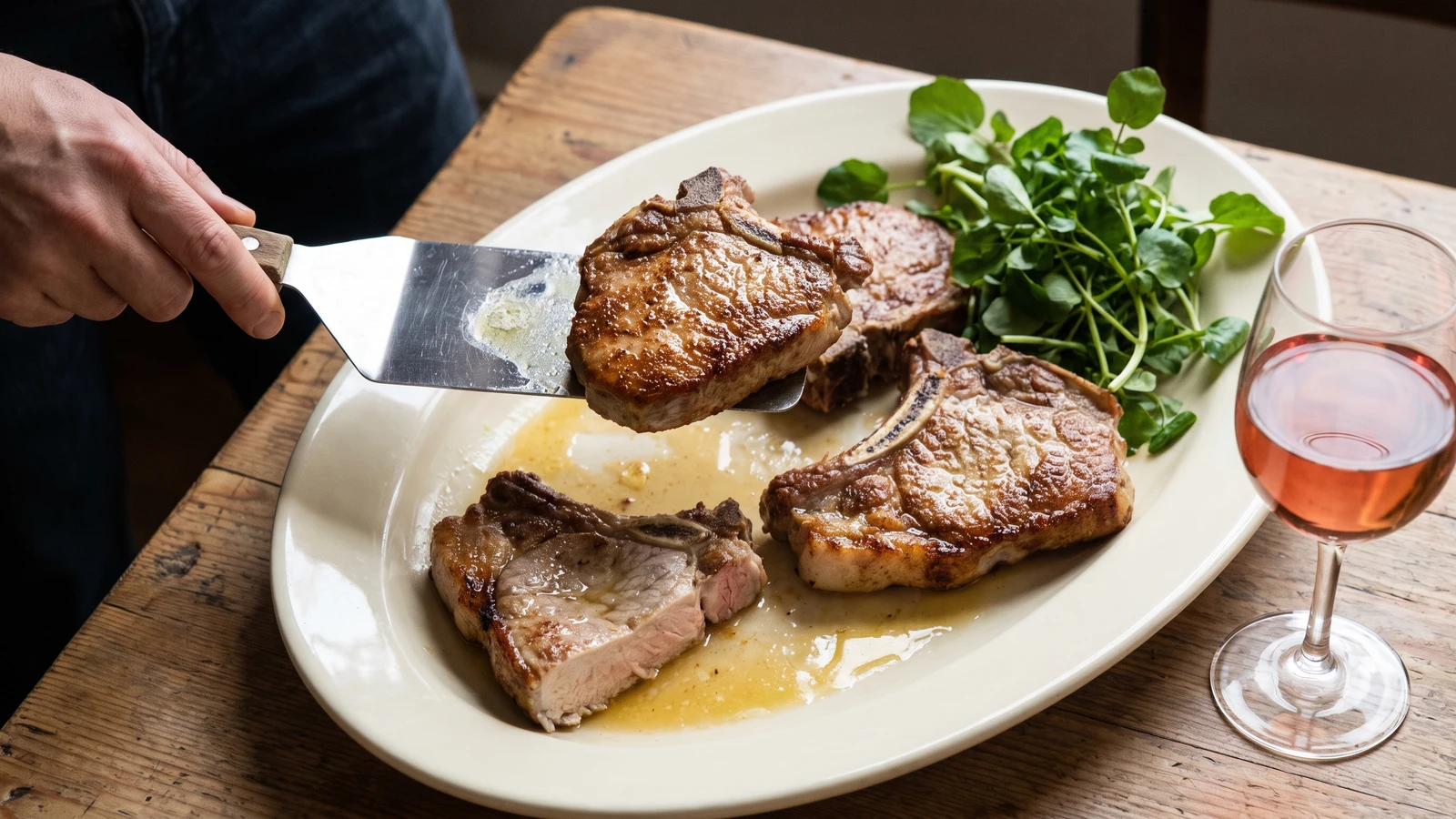
Let the Pojarski rest on the rack for 3 minutes so the butter settles inside rather than flooding the first cut. Arrange the four cutlets on a warm platter, bones pointing outward, and tuck the watercress beside them as the suitable garnish called for by the original entry. Serve immediately, while the unbreaded crust is bronze and the center remains tender. À table!
1 serving (about 205g)
Culinary guides, cultural storytelling, and the editorial depth that makes cooking meaningful.
Discover Culinary ExplorerChef Juliette
A half saddle of veal, bacon-barded and braised by short moistening, emerges bronze and succulent, with the concentrated veal glaze that makes this grand relevé worthy of the home table.

Chef Juliette
A bronzed saddle of veal between two patterned vegetable domes, with clear, glossy braising jus passed at the table: classical structure translated for four, patient enough for a celebration and possible on one stove.

Chef Juliette
A veal saddle braised until tender, its fillets cut into collops and rebuilt with paprika Béchamel and truffle, then flashed beneath fierce heat until the ivory sauce glazes.

Chef Juliette
A veal saddle becomes edible architecture: Soubise and ham tucked into the carved loin, truffled Parmesan soufflé rising above it, and reduced braising liquor served alongside.