
Chef Juliette
John Dory (St. Pierre)
John Dory has the delicacy of sole and the firmness of turbot. A light flouring, a quick butter sauté, and nut-brown beurre noisette show exactly why looks never mattered.
A cooking platform built around craft, culture, and the stories behind what we eat.
Created by Chef Juliette
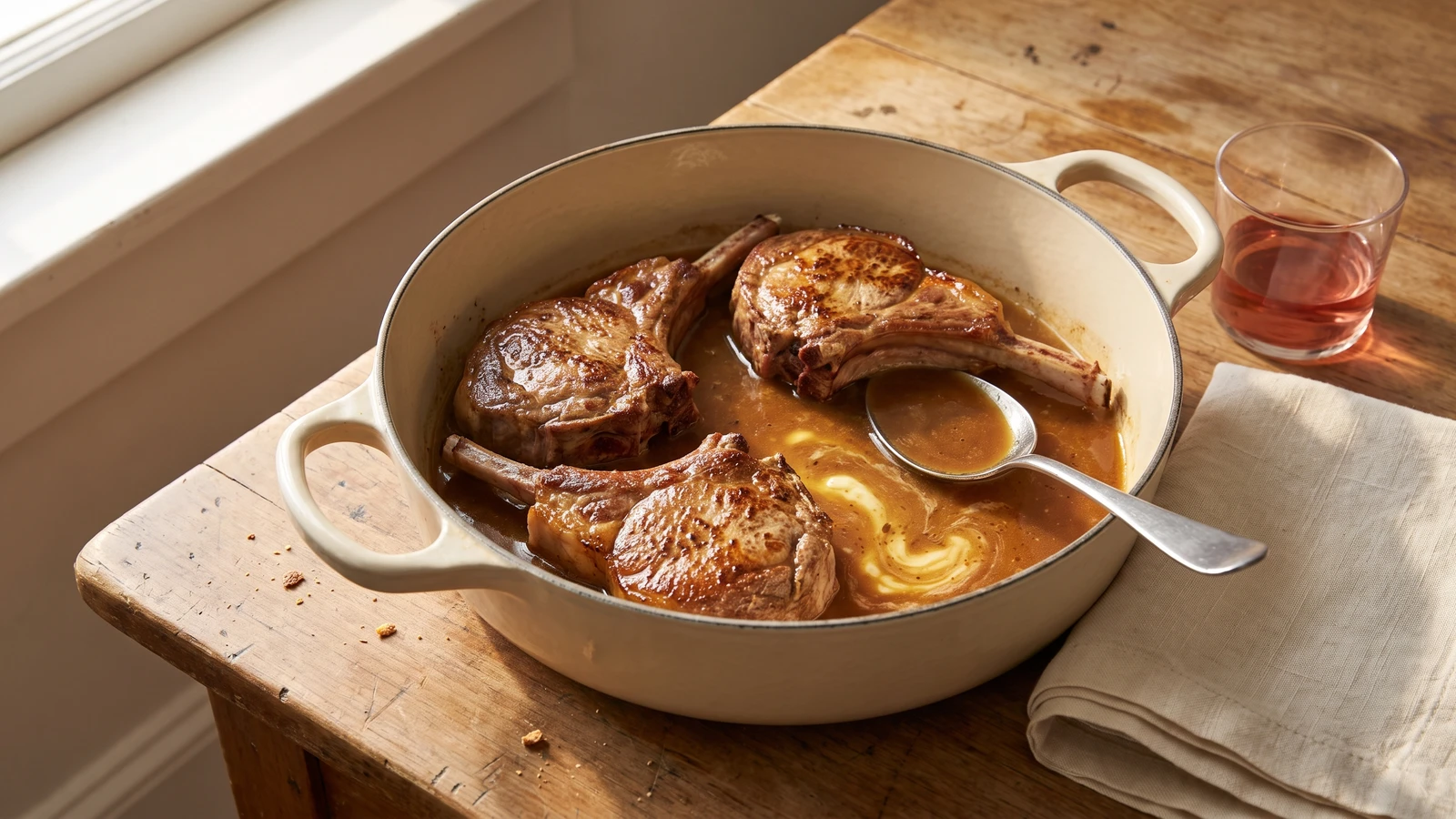
Based on No. 1255, Côte de Veau en Casserole, from Le Guide Culinaire (1907) by Auguste Escoffier
Côte de veau at its most disciplined: thick rib chops turned patiently in quiet butter, finished with one spoonful of veal gravy, and served from the casserole that cooked them.
Côte de Veau en Casserole (veal rib chops gently cooked in butter in a casserole) teaches heat control without disguise. The one true thing to know before touching the pan is this: the butter must whisper, never rage. Turn the chops often and they cook evenly in butter-gold fat; let the pan run hot and the outside toughens before the meat beside the bone is ready.
The old entry assumes one chop cooked to order in flameproof earthenware, a saucier at hand, and a veal stockpot never cold. At home, a broad enameled braiser gives four chops the same gentle contact, while good unsalted prepared veal jus supplies the final spoonful. The source's proportion stays exact, one ounce of butter and one tablespoon of gravy per chop, but the individual service pan becomes one table-sized casserole. That little pan was brigade scaffolding. The quiet cooking and last-moment gravy are the dish. One cook, one stove, one evening.
Nothing else belongs in the pot. No wine, herbs, flour, or cream. The decisive step is the repeated turning: keep the butter pale and the chops moving until they are evenly golden and just cooked beside the bone.
Côte de veau en casserole belongs to cuisine bourgeoise, the well-kept French household table where a good chop and a little veal gravy made a complete main course. The method passed easily into classical à la carte service because each chop could be cooked and presented in its own earthenware vessel, but en casserole names the pot and the service, not a long braise. Its spareness is deliberate: the veal gravy enters only at the end, leaving the meat to taste clearly of veal and butter.
Quantity
4, about 6 ounces (170 g) each and 3/4 inch (2 cm) thick
Quantity
1/2 cup (120 ml / 113 g)
Quantity
1 teaspoon (5 ml / 6 g)
Quantity
1/2 teaspoon (2.5 ml / 1 g)
Quantity
1/4 cup (60 ml / 60 g)
warmed; if using concentrated veal demi-glace, dilute it to a light gravy consistency
| Ingredient | Quantity |
|---|---|
| bone-in veal rib chops | 4, about 6 ounces (170 g) each and 3/4 inch (2 cm) thick |
| unsalted butter | 1/2 cup (120 ml / 113 g) |
| fine sea salt | 1 teaspoon (5 ml / 6 g) |
| freshly ground white pepper | 1/2 teaspoon (2.5 ml / 1 g) |
| excellent veal gravy or unsalted prepared veal juswarmed; if using concentrated veal demi-glace, dilute it to a light gravy consistency | 1/4 cup (60 ml / 60 g) |
Set the chops out for 15 minutes so the deep chill leaves them, then blot every surface dry. Season both sides and the edges evenly with the measured salt and white pepper. A wet chop cools the butter and cooks patchily; a dry one takes on a quiet golden surface.
Melt the butter in a wide flameproof casserole over low heat. When it is fully melted and covered with fine white foam, but shows no brown flecks, lay in the chops in one layer. They may sit close, but they must not overlap. We don't apologize for butter, and we don't scorch it.
Cook uncovered over low to medium-low heat for 14 to 18 minutes, turning the chops with tongs every 2 minutes so both faces and the fatty edges meet the butter. The sound should remain a quiet, steady sizzle, and the meat should color gradually to butter-gold with a few deeper bronze patches. If the butter begins darkening quickly, lift the casserole from the burner, keep turning for 30 seconds, then return it over lower heat; the residual heat continues the cooking while the butter calms. Check the thickest part beside the bone with an instant-read thermometer, which must register 145°F (63°C).
Lower the heat to its minimum and pour 3 tablespoons of the warm veal gravy around the chops. Turn them once, then rock the casserole gently for 30 seconds. Take the pot off the heat, add the remaining tablespoon of gravy, and rock it again until the butter and gravy gather into a loose, glossy finish. Do not boil it. If the sauce beads into separate fat, keep it off the heat and stir at the edge while rocking the casserole; ça se rattrape. The finish should pool and spoon, never reduce to a sticky glaze.
Leave the chops in the casserole off the heat for 3 minutes, satisfying their resting time without losing the butter or gravy beneath them. Spoon the pan liquor over each chop and carry the casserole directly to the table. Serve at once. À table!
1 serving (about 140g)
Culinary guides, cultural storytelling, and the editorial depth that makes cooking meaningful.
Discover Culinary ExplorerChef Juliette
John Dory has the delicacy of sole and the firmness of turbot. A light flouring, a quick butter sauté, and nut-brown beurre noisette show exactly why looks never mattered.

Chef Juliette
Fresh haddock proves its delicacy in the meunière pan: a fine flour crust, moist pearly flakes, and beurre noisette sharpened with lemon and parsley, ready from one skillet in half an hour.

Chef Juliette
Éperlans à l’Anglaise turns small fish into a lesson in disciplined coating: boned smelts under a close, crisp crumb, pan-fried in clarified butter and finished with bright, half-melted maître d’hôtel butter.

Chef Juliette
Tiny smelts, shallot, mushrooms, white wine, gratin sauce, and fine bread raspings meet a fierce oven, where the fish must turn tender in the same breath the buttered crust bronzes.