
Chef Juliette
John Dory (St. Pierre)
John Dory has the delicacy of sole and the firmness of turbot. A light flouring, a quick butter sauté, and nut-brown beurre noisette show exactly why looks never mattered.
A cooking platform built around craft, culture, and the stories behind what we eat.
Created by Chef Juliette
Based on No. 1254, Côte de Veau à la Bonne Femme, from Le Guide Culinaire (1907) by Auguste Escoffier
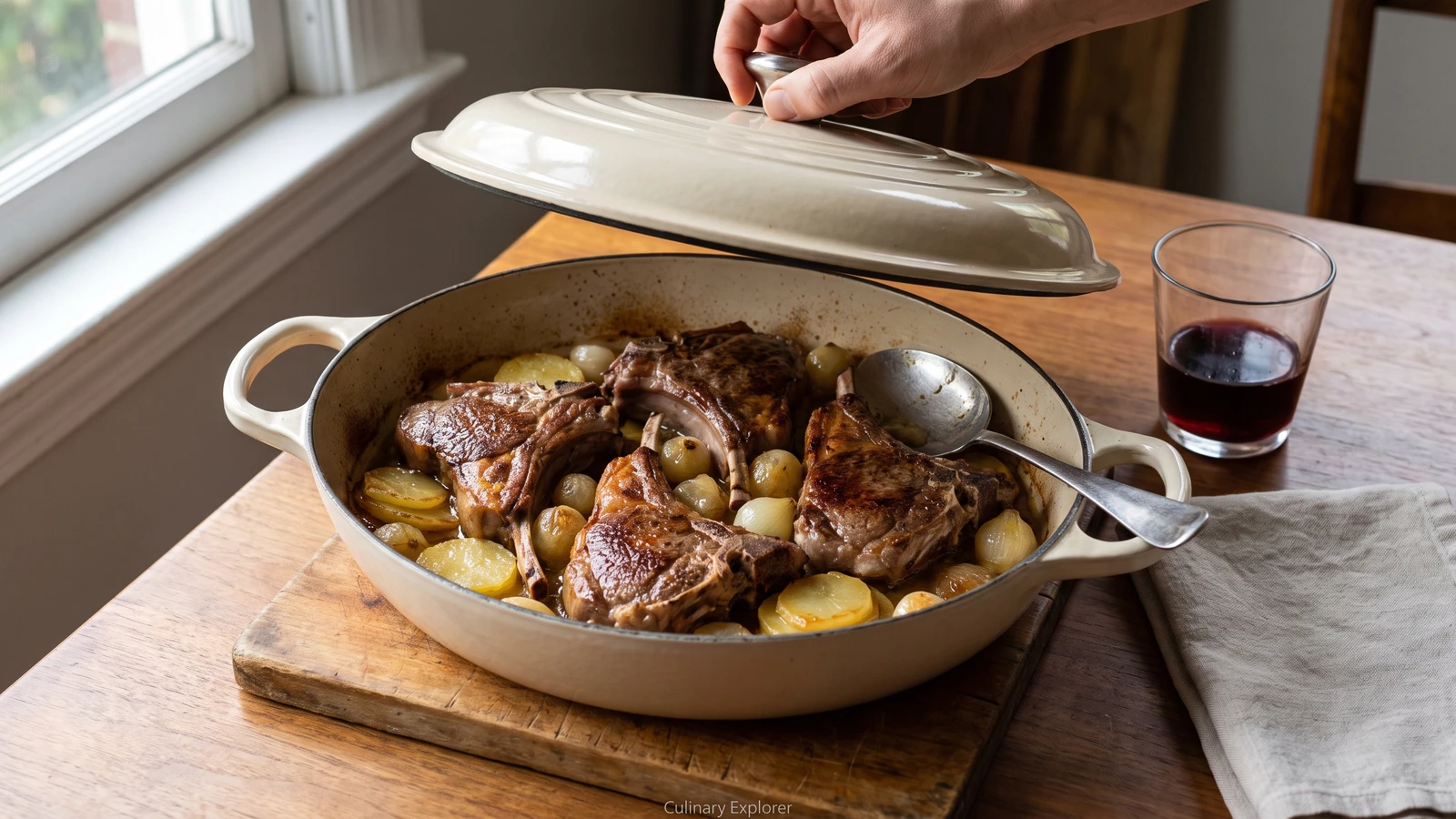
Four veal chops, browned deeply in butter and covered with pearl onions and potato roundels, finish gently in one pot, where their juices make the only sauce this generous bonne femme supper needs.
Côte de Veau à la Bonne Femme (veal chop in the home cook's style) teaches one plain truth: brown the veal completely before the lid goes on. Once covered, the oven can cook the meat gently and marry its juices with butter, onions, and potatoes, but it cannot give a pale chop the bronze crust that makes this spare dish taste full.
The original entry calls on no saucier, no stock kept perpetually at the fire, and no salamander. Its assumptions are simpler: a flameproof earthenware saucepan, a separate pan for the onions, and one chop cooked to order. A lidded braiser is the safe home equivalent, and cooking the onions in it before the veal removes the extra pan without changing the sequence. The book gives each chop 1½ ounces / 42 grams of butter, six small onions, and 3 ounces / 85 grams of potato; those measures are multiplied exactly by four here. The separate onion pan was brigade scaffolding. The butter browning and covered oven finish are the dish, and they stay. One cook, one stove, one evening.
When the bonne femme is right, the chops sit deep gold in their serving pot, the onions are lacquered at their edges, and the potato rondelles have taken up the butter and veal juices beneath them. If the potatoes lag behind the meat, lift out the chops and give the vegetables five more covered minutes. Ça se rattrape. Before anything meets the pan, dry the chops thoroughly; their browning is the step that decides the dish.
Côte de veau à la bonne femme belongs to cuisine bourgeoise, the French middle-class household table codified by Parisian kitchens, rather than to one province's larder. Bonne femme was never one universal sauce or garnish: it signaled a plain, household-minded treatment that changed with the principal ingredient, and in this veal preparation the identity is small onions, potato rondelles, butter, and earthenware service. Grand kitchens absorbed the formula without disguising it, preserving the practical virtue that the cooking vessel goes straight to the table.
Quantity
24 (about 2 cups / 475 ml / 300 g)
peeled
Quantity
2 tablespoons (30 ml / 28 g)
Quantity
4 (about 2 lb / 900 g total)
each about 1¼ inches / 3 cm thick
Quantity
¾ cup (180 ml / 170 g)
divided
Quantity
2¼ cups (540 ml / 340 g)
scrubbed and cut into ⅛-inch / 3-mm rondelles
Quantity
1¼ teaspoons (6 ml / 7 g)
divided
Quantity
½ teaspoon (2.5 ml / 1 g)
| Ingredient | Quantity |
|---|---|
| small pearl onionspeeled | 24 (about 2 cups / 475 ml / 300 g) |
| unsalted butter for the onions | 2 tablespoons (30 ml / 28 g) |
| bone-in veal rib chopseach about 1¼ inches / 3 cm thick | 4 (about 2 lb / 900 g total) |
| unsalted butter for the vealdivided | ¾ cup (180 ml / 170 g) |
| small waxy potatoesscrubbed and cut into ⅛-inch / 3-mm rondelles | 2¼ cups (540 ml / 340 g) |
| fine sea saltdivided | 1¼ teaspoons (6 ml / 7 g) |
| freshly ground white pepper | ½ teaspoon (2.5 ml / 1 g) |
Heat the oven to 325°F / 165°C with a rack in the middle. Cut the potatoes into rondelles, thin rounds, as evenly as possible so they finish with the veal. Pat the chops completely dry, including around the bones, then season them with 1 teaspoon of the salt and all the white pepper. Leave the remaining salt for the vegetables.
Melt the 2 tablespoons of butter in a 5-quart shallow braiser over medium-low heat. Add the onions and a pinch of the remaining salt, cover, and cook for 5 minutes. Uncover and continue cooking for 5 to 7 minutes, rolling them often, until almost tender and pale gold in patches. Transfer the onions to a bowl, leaving their butter in the braiser.
Raise the heat to medium and add half the veal butter. When it foams and the foam begins to subside, add two chops without crowding them. Brown for 3 to 4 minutes per side, including the fatty edges, until a deep golden crust forms. Move the first batch and its still-golden butter to a bowl, add the remaining butter, and brown the other chops. The fond, the brown film on the pot floor, is the foundation of the dish, so give it colour without burning it. If the milk solids begin turning black, pull the pot from the heat, save the chops and any golden butter, wipe away the bitter specks, and continue with the measured butter still held back. Ça se rattrape.
Lift the browned chops out briefly. Spread the potato rondelles across the bottom of the braiser in loose overlapping layers and season them with the remaining salt. Set the chops over the potatoes, tuck the buttered onions around them, and pour every collected drop of golden butter and veal juice back into the pot. Do not add stock or water. The lid will hold enough moisture to loosen the fond into the butter and cooking juices.
Cover the braiser tightly and place it in the oven for 18 to 25 minutes. Begin checking early: the veal is ready when the thickest part, clear of the bone, reaches 145°F / 63°C, and the potato rondelles should yield easily to a knife. If a chop reaches temperature before the potatoes soften, lift it to a warm plate and cover it loosely, then return the covered vegetables to the oven for 5 to 10 minutes. Put the chop back on top when the potatoes are ready.
Let the veal rest in the covered braiser for 3 minutes. Tip the vessel gently so the butter and juices gather, then spoon them over the chops, potatoes, and onions. Taste one potato for seasoning and bring the preparation to the table exactly as it stands, with no separate sauce and no decorative garnish. À table!
1 serving (about 330g)
Culinary guides, cultural storytelling, and the editorial depth that makes cooking meaningful.
Discover Culinary ExplorerChef Juliette
John Dory has the delicacy of sole and the firmness of turbot. A light flouring, a quick butter sauté, and nut-brown beurre noisette show exactly why looks never mattered.

Chef Juliette
Fresh haddock proves its delicacy in the meunière pan: a fine flour crust, moist pearly flakes, and beurre noisette sharpened with lemon and parsley, ready from one skillet in half an hour.

Chef Juliette
Éperlans à l’Anglaise turns small fish into a lesson in disciplined coating: boned smelts under a close, crisp crumb, pan-fried in clarified butter and finished with bright, half-melted maître d’hôtel butter.

Chef Juliette
Tiny smelts, shallot, mushrooms, white wine, gratin sauce, and fine bread raspings meet a fierce oven, where the fish must turn tender in the same breath the buttered crust bronzes.