
Chef Juliette
John Dory (St. Pierre)
John Dory has the delicacy of sole and the firmness of turbot. A light flouring, a quick butter sauté, and nut-brown beurre noisette show exactly why looks never mattered.
A cooking platform built around craft, culture, and the stories behind what we eat.
Created by Chef Juliette
Based on No. 1251, Foie de Veau Sauté aux Fines Herbes, from Le Guide Culinaire (1907) by Auguste Escoffier
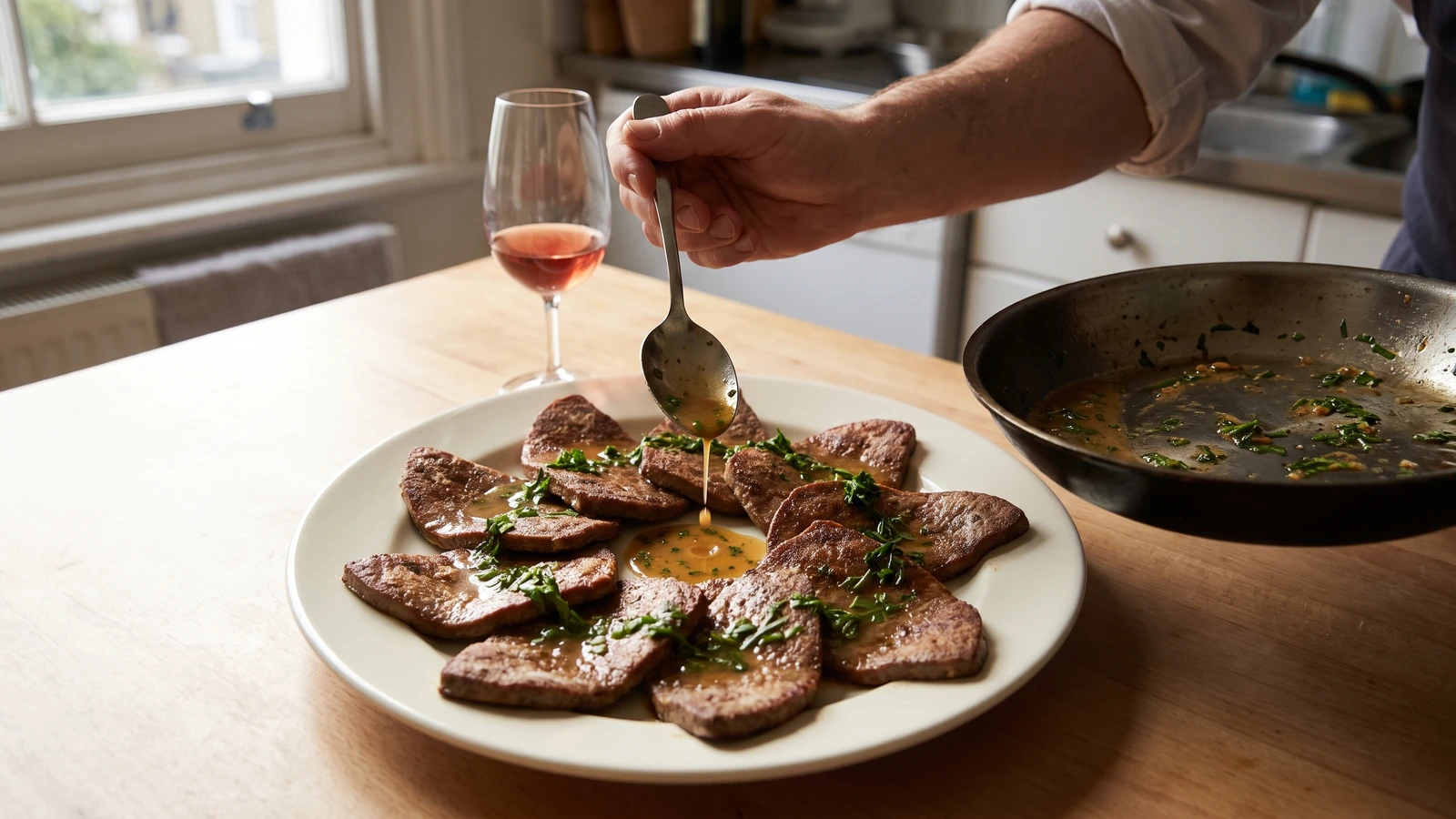
Foie de veau at its best: tender, butter-gilded slices in a glossy sauce aux fines herbes, with quick heat doing the work and one pan carrying every browned flavor to the table.
Foie de Veau Sauté aux Fines Herbes (calf's liver sautéed with fine herbs) teaches one severe little truth: quick heat is everything. Liver wants a thin coat of flour, foaming butter, and barely enough time to bronze. Keep it waiting in the pan and tenderness turns to chalk. The sauce should gleam around the slices, fragrant with parsley, chervil, chives, and tarragon, while the liver stays supple beneath its fine crust.
The original entry could simply call for sauce aux fines herbes because a professional kitchen had a saucier on staff and a stockpot never off the fire. For one cook, one stove, one evening, the honest equivalent is to make a reduction in the same skillet from the fond, the browned deposits left by the liver, then monter au beurre (finish by whisking in cold butter off the heat). The separate sauce station was brigade scaffolding and can go; a salamander has no work here. The flour dusting, butter sauté, quick cooking, fines herbes, and circular service are the dish and stay, scaled to eight slices for four.
Have the herbs chopped, the wine and stock measured, and the platter warming before the liver meets the butter. The sauté decides the dish: work in batches, watch the color, and stop the instant the thickest slice reaches 160°F (71°C). Everything else can be adjusted. Overcooked liver cannot.
Foie de veau sauté belongs to the cuisine bourgeoise of Paris and other French town tables, later becoming bistro fare because a complete supper could be cooked à la minute in one pan. Calf's liver was prized above mature beef liver for its finer grain and gentler mineral flavor, which is why quick sautéing, rather than long braising, became its classical treatment. Fines herbes is not a loose label or a claim of luxury: it names the delicate family led by parsley, chervil, chives, and tarragon, added late so their fragrance survives.
Quantity
1½ pounds (680 g)
membrane and firm tubes removed; cut across the grain into 8 even ⅜-inch (1 cm) slices
Quantity
⅓ cup (80 ml / 40 g)
Quantity
1 teaspoon (5 ml / 6 g)
Quantity
½ teaspoon (2.5 ml / 1 g)
Quantity
6 tablespoons (90 ml / 85 g)
divided, with 2 tablespoons chilled and cubed
Quantity
1 small (30 g)
very finely minced
Quantity
⅓ cup (80 ml / 80 g)
Quantity
½ cup (120 ml / 120 g)
Quantity
1 teaspoon (5 ml / 5 g)
Quantity
2 tablespoons (30 ml / 8 g)
finely chopped
Quantity
1 tablespoon (15 ml / 2 g)
finely chopped
Quantity
1 tablespoon (15 ml / 3 g)
finely sliced
Quantity
1 teaspoon (5 ml / 1 g)
finely chopped
| Ingredient | Quantity |
|---|---|
| calf's livermembrane and firm tubes removed; cut across the grain into 8 even ⅜-inch (1 cm) slices | 1½ pounds (680 g) |
| all-purpose flour | ⅓ cup (80 ml / 40 g) |
| fine sea salt | 1 teaspoon (5 ml / 6 g) |
| freshly ground black pepper | ½ teaspoon (2.5 ml / 1 g) |
| unsalted butterdivided, with 2 tablespoons chilled and cubed | 6 tablespoons (90 ml / 85 g) |
| shallotvery finely minced | 1 small (30 g) |
| dry white wine | ⅓ cup (80 ml / 80 g) |
| unsalted veal stock or unsalted chicken stock | ½ cup (120 ml / 120 g) |
| fresh lemon juice | 1 teaspoon (5 ml / 5 g) |
| fresh flat-leaf parsleyfinely chopped | 2 tablespoons (30 ml / 8 g) |
| fresh chervilfinely chopped | 1 tablespoon (15 ml / 2 g) |
| fresh chivesfinely sliced | 1 tablespoon (15 ml / 3 g) |
| fresh tarragon leavesfinely chopped | 1 teaspoon (5 ml / 1 g) |
Run your fingers over the liver and remove the thin outer membrane, any visible veins, and every firm white tube with a small sharp knife. Cut across the grain into 8 even slices, each about ⅜ inch (1 cm) thick, then pat them thoroughly dry. Uneven slices finish at different moments, and a wet surface turns the flour gummy. Keep the liver chilled while you prepare everything else.
Combine the parsley, chervil, chives, and tarragon in a small bowl. Measure the wine, set aside 2 tablespoons of the stock for adjusting the sauce, and keep the remaining stock beside the stove. Fill a round serving platter with hot water to warm it, then empty and dry it just before the liver is ready. Once the sauté begins, there is no useful pause.
Mix the salt and pepper and season both sides of the liver. Spread the flour on a shallow plate, dredge each slice, then shake it firmly so only a fine veil remains. Do this immediately before cooking. A heavy coat absorbs butter, turns pasty, and muffles the liver rather than protecting it.
Heat a 12-inch (30 cm) heavy skillet over medium-high heat, then add 2 tablespoons of the butter. When the foam subsides and the butter smells nutty, lay in 4 liver slices without crowding. Cook without moving them for 1½ to 2 minutes, until the undersides are chestnut-brown, then turn and cook for another 1 to 1½ minutes. Check the thickest slice by inserting an instant-read thermometer sideways into its center; lift it out as soon as it reaches 160°F (71°C). Repeat with 2 more tablespoons of butter and the remaining liver. If the butter turns black or smells acrid, pour it off and wipe out the scorched flecks before continuing. Browned butter belongs here. Burned butter does not.
Arrange the cooked slices immediately in an overlapping circle on the warmed round platter, leaving the center open as the original service directs. Keep the overlap slight so the crust remains exposed, and leave the platter uncovered in a draft-free place while you make the sauce. The sauce takes only a few minutes, which is all the liver should be asked to wait.
Pour off excess fat from the skillet, leaving a thin sheen and the chestnut-colored fond. Add the shallot over medium heat and stir for about 30 seconds, just until fragrant. Pour in the wine and scrape the skillet thoroughly with a wooden spoon, then boil until about 2 tablespoons remain. Add all but the reserved 2 tablespoons of stock and reduce until the bubbles grow glossy and a spoon drawn across the pan leaves a trail that closes slowly, about 2 to 3 minutes. If flour residue thickens the sauce too quickly, loosen it with a spoonful of the reserved stock.
Take the skillet off the heat. Whisk in the 2 tablespoons of chilled butter a few cubes at a time, waiting until each addition disappears before adding more. Stir in the lemon juice and the fines herbes, then taste for seasoning. Do not boil the sauce after the butter and herbs enter. If it separates into greasy streaks, whisk in 1 teaspoon of cold reserved stock away from the heat. Ça se rattrape. The finished sauce should be glossy, fluid, and bright with fresh herbs.
Spoon the sauce lightly over and around the ring of liver, allowing a little to gather in the center without drowning the flour crust. The source also permits serving the sauce separately, so pass it in a warmed sauceboat if your table prefers each slice sauced at the last moment. Serve immediately. À table!
1 serving (about 180g)
Culinary guides, cultural storytelling, and the editorial depth that makes cooking meaningful.
Discover Culinary ExplorerChef Juliette
John Dory has the delicacy of sole and the firmness of turbot. A light flouring, a quick butter sauté, and nut-brown beurre noisette show exactly why looks never mattered.

Chef Juliette
Fresh haddock proves its delicacy in the meunière pan: a fine flour crust, moist pearly flakes, and beurre noisette sharpened with lemon and parsley, ready from one skillet in half an hour.

Chef Juliette
Éperlans à l’Anglaise turns small fish into a lesson in disciplined coating: boned smelts under a close, crisp crumb, pan-fried in clarified butter and finished with bright, half-melted maître d’hôtel butter.

Chef Juliette
Tiny smelts, shallot, mushrooms, white wine, gratin sauce, and fine bread raspings meet a fierce oven, where the fish must turn tender in the same breath the buttered crust bronzes.