
Chef Juliette
John Dory (St. Pierre)
John Dory has the delicacy of sole and the firmness of turbot. A light flouring, a quick butter sauté, and nut-brown beurre noisette show exactly why looks never mattered.
A cooking platform built around craft, culture, and the stories behind what we eat.
Created by Chef Juliette
Based on No. 1250, Foie de Veau à l’Espagnole, from Le Guide Culinaire (1907) by Auguste Escoffier
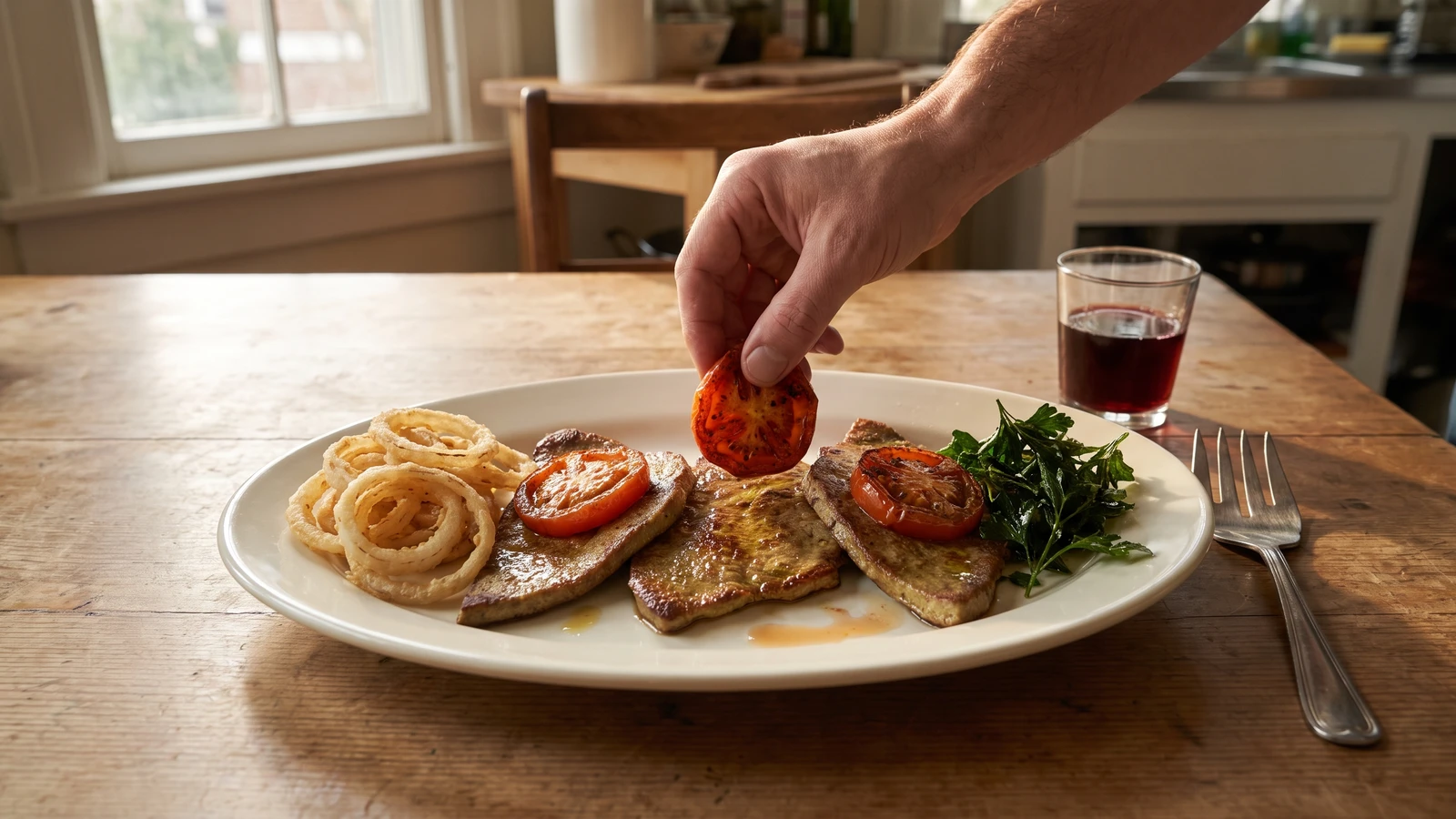
Calf’s liver stays tender beneath a fine flour crust, with grilled tomatoes, crisp onion roundels, and fried parsley beside it. Oil, quick heat, and an orderly stove make this generous old plate entirely at home.
Foie de Veau à l’Espagnole teaches timing before it teaches anything else: every garnish must be ready before the liver touches heat. Calf’s liver is tender when it cooks quickly and goes from silken to chalky while you look away, so the plate waits for the liver, never the reverse.
The original entry assumes a grill station and hot oil working at the same moment, with one hand tending the liver while another grills tomatoes and fries onions and parsley. At home, the broiler is the honest salamander, a shallow skillet replaces the fryer, and the garnishes are cooked first while four exact three-and-a-half-ounce slices wait in the cold. I changed the order, not the intent: brigade simultaneity is scaffolding; oil, flour, restrained grilling, tomatoes, onion roundels, and fried parsley are the dish. One cook, one stove, one evening.
There is no hidden sauce and no butter to add on instinct. The tomato juices and olive oil dress the liver at the table, keeping the plate bright and sun-warm. The last step decides everything: dry, season, dredge, oil, and grill the liver only when everyone is ready to eat.
This precise arrangement belongs to the French classical grill-room and bourgeois table rather than to a named Spanish region. In this preparation, à l’Espagnole identifies the company kept by the liver, grilled tomato, onion roundels fried in oil, and fried parsley, not a spooning sauce. It passed readily to the home stove because it needs no stockpot or saucier, only several small preparations brought together at the last moment.
Quantity
4 slices, 3½ oz (100 g) each; 14 oz (400 g) total
trimmed of membrane and cut about ⅜ inch (1 cm) thick
Quantity
2 medium (14 oz / 400 g)
halved crosswise
Quantity
2 medium (12 oz / 340 g)
peeled and sliced into ⅛-inch (3 mm) roundels
Quantity
¾ cup (90 g)
divided
Quantity
1 cup (240 ml / 220 g)
divided
Quantity
1 packed cup (30 g)
washed and completely dried
Quantity
1½ teaspoons (7.5 ml / 9 g)
divided
Quantity
¾ teaspoon (3.75 ml / 1.5 g)
divided
| Ingredient | Quantity |
|---|---|
| calf’s livertrimmed of membrane and cut about ⅜ inch (1 cm) thick | 4 slices, 3½ oz (100 g) each; 14 oz (400 g) total |
| ripe, firm tomatoeshalved crosswise | 2 medium (14 oz / 400 g) |
| yellow onionspeeled and sliced into ⅛-inch (3 mm) roundels | 2 medium (12 oz / 340 g) |
| all-purpose flourdivided | ¾ cup (90 g) |
| mild olive oildivided | 1 cup (240 ml / 220 g) |
| flat-leaf parsley sprigswashed and completely dried | 1 packed cup (30 g) |
| fine sea saltdivided | 1½ teaspoons (7.5 ml / 9 g) |
| freshly ground black pepperdivided | ¾ teaspoon (3.75 ml / 1.5 g) |
Place an oven rack about 6 inches (15 cm) below the broiler and heat it. Set a wire rack over a tray for the fried garnishes, and put an oval serving platter nearby. Separate the onion slices into intact roundels, pat the liver dry, and return the liver to the cold. Divide the flour between two shallow dishes, one for the onions and one for the raw liver, so the onion flour stays clean. Keep roughly half the measured salt and pepper for the liver. Mise en place is the first technique here: once the liver meets the pan, nothing else may ask for your attention.
Set the tomato halves cut side up on a small rimmed sheet pan. Sprinkle them with 1 tablespoon (15 ml / 14 g) of the olive oil and season lightly with salt and pepper. Broil until their shoulders brown, their cut faces gleam, and the flesh softens without collapsing, 5 to 7 minutes. The broiler is the home equivalent of the salamander that handled this garnish in a classical kitchen. Lower the oven to 200°F (95°C) and hold the tomatoes cut side up for no more than 20 minutes.
Pour ¾ cup (180 ml / 165 g) of the olive oil into a deep 10-inch (25 cm) skillet and heat it to about 350°F (175°C). Check once more that the parsley is completely dry, then lower it into the oil in small handfuls with long tongs. Fry for 10 to 15 seconds, just until the leaves turn crisp and deep green, then lift them to the wire rack and season with a pinch of salt. If the oil spits hard, slide the pan off the heat and shield it with a splatter screen; water on the parsley is the culprit, so dry the remaining sprigs before continuing.
Bring the oil back to about 340°F (170°C). Season the onion roundels lightly, dredge them in their separate dish of flour, and shake away every loose veil of flour. Fry in uncrowded batches, turning once, until pale gold and crisp at the edges, 2 to 3 minutes per batch. Drain them on the wire rack. If they brown before they crisp, the oil is too fierce; lower the heat and let the centres finish gently. Hold them uncovered in the low oven only while the liver cooks.
Heat a large ridged cast-iron grill pan over medium heat until thoroughly hot but not smoking. Season the liver with the remaining salt and pepper, dredge each slice in the reserved clean flour, and shake it well. Sprinkle both sides with the remaining 3 tablespoons (45 ml / 41 g) olive oil. Grill gently without pressing, about 2 minutes on the first side and 1½ to 2 minutes on the second, until the flour coating is bronze, the liver is just firm, and the centre reaches 160°F (71°C). Work in two batches if the pan crowds, holding the first briefly on the warm platter. If the flour darkens before the centre is ready, move the slice to a cooler edge and lower the heat. If one goes a shade too far, ça se rattrape: rest it, slice it thinly across the grain, and let the tomato juices moisten it at the table. Do not put it back in the pan.
Arrange the four liver slices in a line along the centre of the warm oval platter, exactly as the preparation intends. Place one grilled tomato half upon each slice, heap the crisp onion roundels on one side, and set the fried parsley on the other. Spoon any juices from the tomato pan over the tomatoes, not over the onions. There is no added sauce and none is missing. Carry the platter straight to the table. À table!
1 serving (about 250g)
Culinary guides, cultural storytelling, and the editorial depth that makes cooking meaningful.
Discover Culinary ExplorerChef Juliette
John Dory has the delicacy of sole and the firmness of turbot. A light flouring, a quick butter sauté, and nut-brown beurre noisette show exactly why looks never mattered.

Chef Juliette
Fresh haddock proves its delicacy in the meunière pan: a fine flour crust, moist pearly flakes, and beurre noisette sharpened with lemon and parsley, ready from one skillet in half an hour.

Chef Juliette
Éperlans à l’Anglaise turns small fish into a lesson in disciplined coating: boned smelts under a close, crisp crumb, pan-fried in clarified butter and finished with bright, half-melted maître d’hôtel butter.

Chef Juliette
Tiny smelts, shallot, mushrooms, white wine, gratin sauce, and fine bread raspings meet a fierce oven, where the fish must turn tender in the same breath the buttered crust bronzes.