
Chef Juliette
John Dory (St. Pierre)
John Dory has the delicacy of sole and the firmness of turbot. A light flouring, a quick butter sauté, and nut-brown beurre noisette show exactly why looks never mattered.
A cooking platform built around craft, culture, and the stories behind what we eat.
Created by Chef Juliette
Based on No. 1247, Foie de Veau Braisé à la Bourgeoise, from Le Guide Culinaire (1907) by Auguste Escoffier
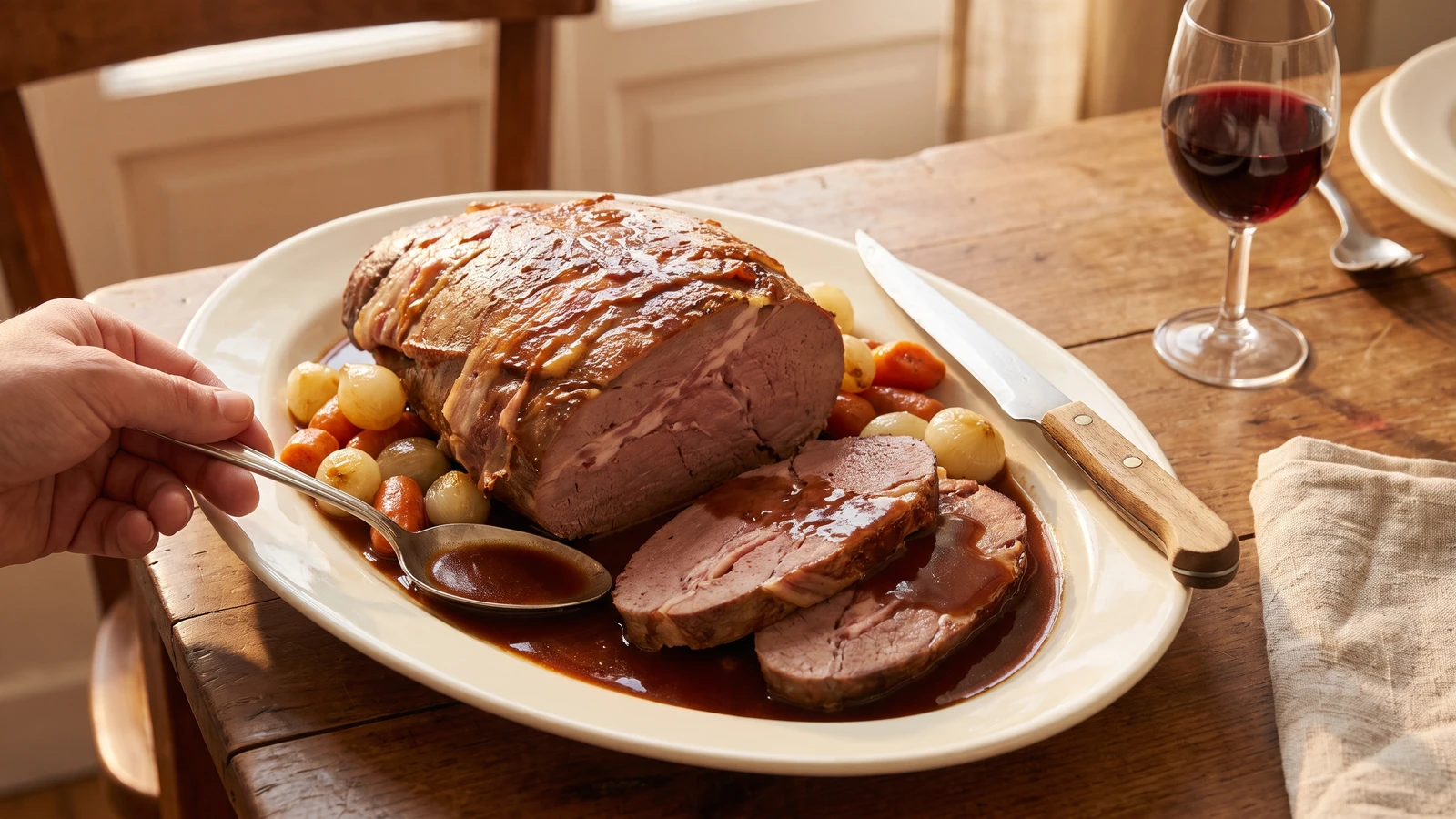
A whole calf's liver larded with seasoned bacon, gently braised in white wine, brown stock, and Espagnole, then ringed plainly with carrots and onions: cuisine bourgeoise with discipline, not display.
Foie de Veau Braisé à la Bourgeoise (bourgeois-style braised calf's liver) teaches that braising is not always about tenderness won through hours. Calf's liver has little connective tissue to forgive excess heat, so the larding supplies richness while the short, gentle braise builds the sauce around it. The one true thing to know before touching a pan is simple: brown lightly, simmer barely, and stop cooking the moment the center is done.
The original formula assumed a large piece of liver, a special larding needle, a saucier on staff, brown stock never off the fire, finished Espagnole, and enough clean saucepans to transfer the liver without thought. For four people, a trimmed 2-pound lobe fits a snug four-quart cocotte. Chilled bacon batons, a narrow knife, and a rounded chopstick replace the larding needle, while measured stock and prepared Espagnole replace the perpetual stockpots. One cook, one stove, one evening.
A second clean saucepan and repeated straining through muslin are brigade scaffolding, so the home method lifts the liver to a tray, strains the sauce, wipes the same cocotte, and carries on. The larding, complete reduction of the white wine, exact two-to-one proportion of brown stock to Espagnole, half-depth moistening, and clean second braise are the dish, so they stay. Guard the temperature during that second braise; everything else can be adjusted, but an overcooked liver cannot be made tender again.
Foie de veau à la bourgeoise belongs not to one province but to cuisine bourgeoise, the well-supplied household cooking of Paris and France's large provincial towns. It carries the grand-kitchen practices of larding, braising, and Espagnole into a family dish, while the loose ring of carrots and onions declares its domestic register: the garnish is deliberately plain rather than symmetrical. That simplicity is not carelessness; it separates generous table food from display.
Quantity
1 lobe, about 2 lb (900 g)
membrane and large ducts removed
Quantity
about 1¼ cups loosely packed (300 ml / 6 oz / 170 g)
cut into long ⅓-inch (8 mm) batons
Quantity
2 tablespoons (30 ml / 28 g)
Quantity
2 tablespoons (30 ml / 8 g)
finely chopped
Quantity
¾ teaspoon (3.75 ml / 1.5 g)
divided
Quantity
⅛ teaspoon (0.6 ml / 0.25 g)
Quantity
⅛ teaspoon (0.6 ml / 0.25 g)
Quantity
1½ teaspoons (7.5 ml / 9 g)
divided
Quantity
1 home-scale batch of Ordinary Braisings (No. 247), sized for a 2 lb (900 g) liver
Quantity
1 tablespoon (15 ml / 14 g)
Quantity
1¼ cups (300 ml / 300 g)
Quantity
1½ cups (360 ml / 360 g)
Quantity
¾ cup (180 ml / 190 g)
Quantity
3, about 2 cups (480 ml / 300 g)
shaped into elongated olives
Quantity
2 cups (480 ml / 480 g)
Quantity
16, about 1½ cups (360 ml / 250 g)
peeled
Quantity
2 tablespoons (30 ml / 28 g)
Quantity
up to ½ cup (120 ml / 120 g)
| Ingredient | Quantity |
|---|---|
| trimmed calf's liver lobemembrane and large ducts removed | 1 lobe, about 2 lb (900 g) |
| unsmoked fatty slab bacon or fatbackcut into long ⅓-inch (8 mm) batons | about 1¼ cups loosely packed (300 ml / 6 oz / 170 g) |
| Cognac or brandy | 2 tablespoons (30 ml / 28 g) |
| flat-leaf parsleyfinely chopped | 2 tablespoons (30 ml / 8 g) |
| freshly ground black pepperdivided | ¾ teaspoon (3.75 ml / 1.5 g) |
| freshly grated nutmeg | ⅛ teaspoon (0.6 ml / 0.25 g) |
| quatre-épices | ⅛ teaspoon (0.6 ml / 0.25 g) |
| fine saltdivided | 1½ teaspoons (7.5 ml / 9 g) |
| prepared aromatic braising base | 1 home-scale batch of Ordinary Braisings (No. 247), sized for a 2 lb (900 g) liver |
| clarified butter | 1 tablespoon (15 ml / 14 g) |
| dry white wine | 1¼ cups (300 ml / 300 g) |
| brown stock | 1½ cups (360 ml / 360 g) |
| Sauce Espagnole | ¾ cup (180 ml / 190 g) |
| large carrotsshaped into elongated olives | 3, about 2 cups (480 ml / 300 g) |
| consommé | 2 cups (480 ml / 480 g) |
| small pearl onionspeeled | 16, about 1½ cups (360 ml / 250 g) |
| unsalted butter | 2 tablespoons (30 ml / 28 g) |
| additional brown stock (optional) | up to ½ cup (120 ml / 120 g) |
Toss the bacon batons with the Cognac, parsley, ¼ teaspoon of the pepper, nutmeg, and quatre-épices. Cover and chill for 2 hours, turning once so the seasoning reaches every surface. Drain the batons and keep them cold; chilled fat is firm enough to pass through the liver, while warm fat buckles and tears it.
Pat the liver thoroughly dry. To larder, meaning to thread seasoned fat through the flesh, make evenly spaced channels lengthwise with a narrow boning knife, working from both ends if necessary. Push the chilled bacon through each channel with a rounded chopstick or slim skewer, distributing it through the thick and thin portions. Season the outside with 1 teaspoon of the salt and the remaining pepper, then tie the liver loosely with kitchen twine so it holds an even shape.
Heat the oven to 425°F (220°C). Brush the liver with the clarified butter, set it in a shallow roasting tin, and brown it in the oven for 10 to 12 minutes, turning once. Look for a light bronze surface, not the dark crust wanted on beef; hard browning drives too much heat into the outside before the braise begins. Lower the oven to 325°F (165°C).
Prepare the aromatic braising base from Ordinary Braisings (No. 247) through its prescribed base stage in a snug 4-quart cocotte. Set the browned liver on the base, pour the white wine around it, and reduce uncovered over medium heat until no free wine remains and the liquid clings like syrup around the aromatics, about 12 to 18 minutes. This complete reduction removes the wine's raw edge and concentrates its acidity. If the base begins catching before the wine is gone, pull the pot from the heat, add 1 tablespoon of the additional stock, scrape gently, and continue over lower heat. Ça se rattrape, provided the aromatics have browned rather than blackened.
Whisk the brown stock and Sauce Espagnole together, then pour them around the liver. In a properly snug cocotte, the sauce will rise a little above the middle of the piece; if it sits lower, use a smaller vessel rather than flooding the dish with more liquid. Bring the sauce only to a bare simmer, cover, and place the cocotte in the 325°F (165°C) oven. Braise for 25 to 35 minutes, turning once and basting every 10 minutes, until the center reaches about 130°F (54°C). If the sauce boils vigorously, lower the oven to 300°F (150°C); a hard boil tightens liver and muddies the sauce.
While the liver completes its first braising phase, put the carrot olives in a small saucepan with the consommé and ¼ teaspoon of the salt. Simmer gently for 8 to 10 minutes, until a knife enters the outer flesh but meets resistance at the center, then drain. Melt the unsalted butter in a skillet, add the pearl onions and the remaining ¼ teaspoon salt, and cook gently for 7 to 9 minutes, rolling them often, until lightly golden and half-tender. Neither vegetable should be fully cooked yet; both finish in the sauce.
Lift the liver onto a rimmed tray. Strain the braising sauce through a fine-mesh sieve, discard the spent base, and wipe the cocotte clean. Return the liver to the same pot, surround it loosely with the carrots and onions, and pour the strained sauce over everything. Cover and braise for another 15 to 25 minutes, basting twice, until the sauce barely trembles and the thickest part of the liver reaches 154°F (68°C). Begin checking after 12 minutes. If the sauce tightens at the edge, take the pot out, loosen it with a spoonful of additional stock, and lower the oven before continuing. Rest the liver, loosely covered, for 10 minutes so its temperature carries to 160°F (71°C).
Transfer the liver and vegetables to a warmed oval platter and remove the twine. Skim excess fat from the sauce, then reduce it over medium heat only if it fails to nap the back of a spoon. If it becomes too thick or salty, whisk in additional brown stock a tablespoon at a time; if it remains thin, keep reducing rather than adding another thickener. Taste for seasoning. Arrange the carrots and onions loosely around the liver, with no symmetry and no fuss, then spoon the glossy sauce over the garnish. Carve the liver into generous slices at the table. À table!
1 serving (about 450g)
Culinary guides, cultural storytelling, and the editorial depth that makes cooking meaningful.
Discover Culinary ExplorerChef Juliette
John Dory has the delicacy of sole and the firmness of turbot. A light flouring, a quick butter sauté, and nut-brown beurre noisette show exactly why looks never mattered.

Chef Juliette
Fresh haddock proves its delicacy in the meunière pan: a fine flour crust, moist pearly flakes, and beurre noisette sharpened with lemon and parsley, ready from one skillet in half an hour.

Chef Juliette
Éperlans à l’Anglaise turns small fish into a lesson in disciplined coating: boned smelts under a close, crisp crumb, pan-fried in clarified butter and finished with bright, half-melted maître d’hôtel butter.

Chef Juliette
Tiny smelts, shallot, mushrooms, white wine, gratin sauce, and fine bread raspings meet a fierce oven, where the fish must turn tender in the same breath the buttered crust bronzes.