
Chef Juliette
John Dory (St. Pierre)
John Dory has the delicacy of sole and the firmness of turbot. A light flouring, a quick butter sauté, and nut-brown beurre noisette show exactly why looks never mattered.
A cooking platform built around craft, culture, and the stories behind what we eat.
Created by Chef Juliette
Based on No. 1246, Palets de Ris de Veau à l’Écarlate, from Le Guide Culinaire (1907) by Auguste Escoffier
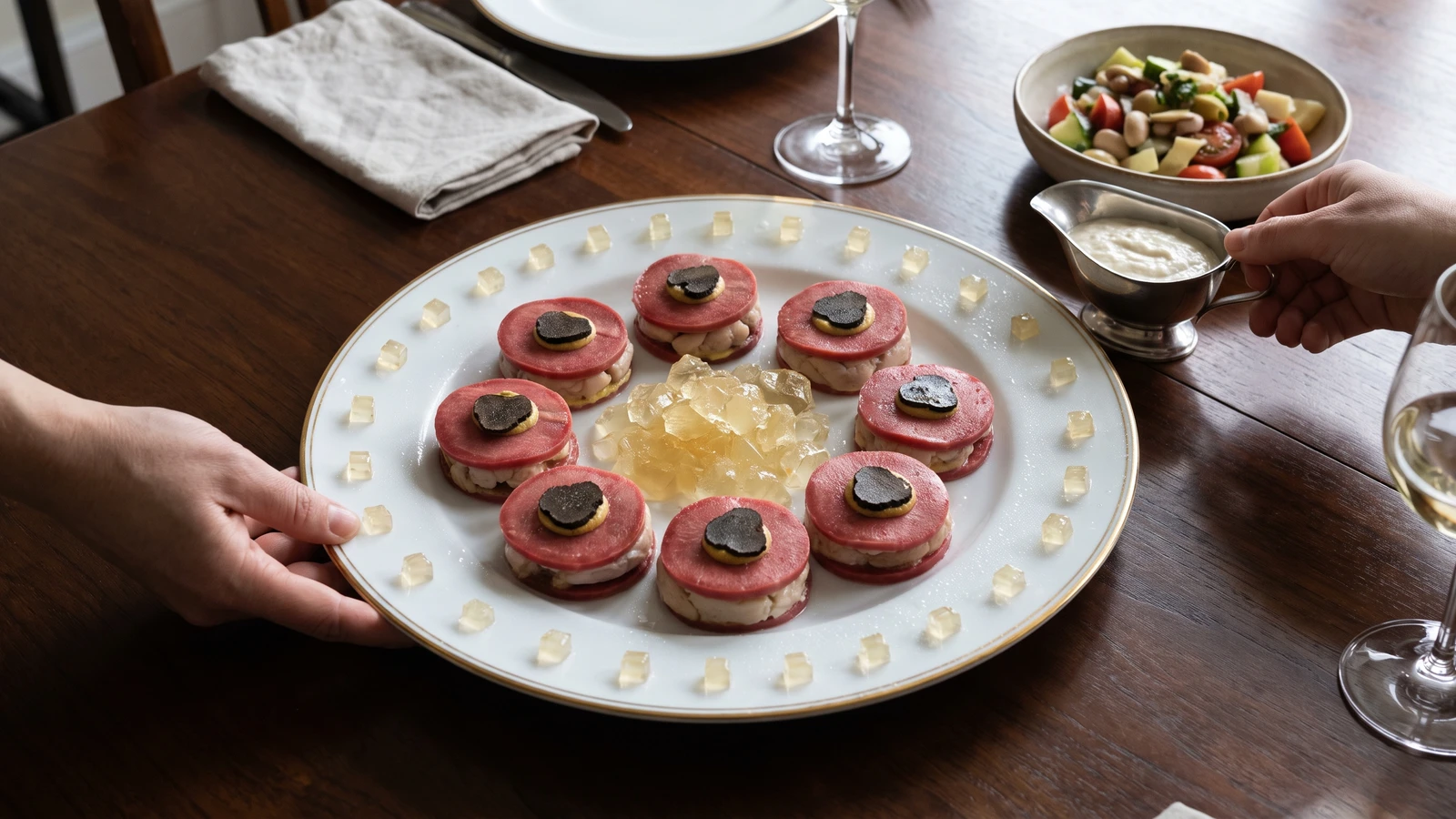
Cold palets of pressed sweetbread, mustard butter, scarlet tongue and truffle under clear aspic, arranged with geometric calm and served beside horseradish cream and Salade Italienne.
Palets de Ris de Veau à l’Écarlate (cold sweetbread quoits with scarlet tongue) teach the discipline of cuisine froide, the classical cold kitchen: temperature creates structure, and structure makes elegance possible. Know one thing before touching a pan. The sweetbreads must be pressed while still pliable, then chilled until thoroughly firm; without that pressing, no cutter will give you the clean, even palets the dish demands.
The original service assumed a garde-manger, the cold-kitchen cook, to stamp every round, a saucier to supply clear meat jelly from a stockpot never off the fire, and a larger brigade around them, though a salamander has no role in this cold dish. At home, one round cutter replaces the garde-manger's practiced knife, good clear stock reinforced with gelatin replaces the perpetual jelly pot, and the refrigerator does the setting. Ready-cooked salted tongue replaces curing a whole tongue, which is brigade scaffolding. What remains is the dish itself: sweetbread sliced half an inch thick, two tongue roundels for every palet, mustard butter on both faces, clear aspic and a coin of truffle.
Finished properly, each palet shows a pale sweetbread heart between scarlet slices of tongue, a thin ochre seam of mustard butter, a black truffle round and a glass-clear coat of aspic. Horseradish cream cuts through the richness, while Salade Italienne brings acid, vegetables and salt. One cook, one stove, one evening of assembly, with the cold doing most of the work. Press the sweetbreads firmly and let them become completely cold before you cut.
Palets de Ris de Veau à l’Écarlate belong to the Parisian cuisine froide tradition, where cold entrées were cut, glazed and arranged for formal service by the garde-manger. À l’écarlate does not name a pepper sauce or a regional preparation; the scarlet is salted tongue, whose red roundels frame the pale sweetbread while aspic preserves the geometry and gloss. The dish traveled from grand cold tables to bourgeois special-occasion service because every element could be completed ahead and brought to the table intact.
Quantity
2 large (about 1½ pounds / 680 g)
Quantity
16 cups (3.8 L / 3.8 kg), plus more as needed
divided
Quantity
2 tablespoons (30 ml / 30 g)
Quantity
1 tablespoon (15 ml / 18 g), plus more to taste
divided
Quantity
3 cups (720 ml / 720 g)
Quantity
⅓ cup (80 ml / 80 g)
Quantity
5 teaspoons (25 ml / 15 g)
Quantity
6 tablespoons (90 ml / 85 g)
softened
Quantity
2 tablespoons plus 2 teaspoons (40 ml / 40 g)
divided
Quantity
¼ teaspoon (1.25 ml / 0.6 g)
divided
Quantity
8 ounces (225 g)
chilled and sliced ⅛ inch (3 mm) thick
Quantity
1 small (about 1 ounce / 25 g)
drained and thinly sliced
Quantity
½ cup (120 ml / 120 g)
Quantity
3 tablespoons (45 ml / 30 g)
finely grated
Quantity
2 tablespoons (30 ml / 30 g)
Quantity
6 ounces (170 g)
peeled and cut into ¼-inch (6 mm) dice
Quantity
4 ounces (115 g)
peeled and cut into ¼-inch (6 mm) dice
Quantity
4 ounces (115 g)
peeled and cut into ¼-inch (6 mm) dice
Quantity
4 ounces (115 g)
trimmed and cut into ½-inch (1 cm) pieces
Quantity
½ cup (120 ml / 75 g)
Quantity
¼ cup (60 ml / 40 g)
quartered
Quantity
4 fillets (about ¾ ounce / 20 g)
drained and chopped
Quantity
1 tablespoon (15 ml / 9 g)
drained
Quantity
3 tablespoons (45 ml / 41 g)
Quantity
1 tablespoon (15 ml / 15 g)
| Ingredient | Quantity |
|---|---|
| veal heart sweetbreads | 2 large (about 1½ pounds / 680 g) |
| cold waterdivided | 16 cups (3.8 L / 3.8 kg), plus more as needed |
| white wine vinegar | 2 tablespoons (30 ml / 30 g) |
| fine sea saltdivided | 1 tablespoon (15 ml / 18 g), plus more to taste |
| clear low-sodium beef or veal stock | 3 cups (720 ml / 720 g) |
| cold water for blooming | ⅓ cup (80 ml / 80 g) |
| unflavored powdered gelatin | 5 teaspoons (25 ml / 15 g) |
| unsalted buttersoftened | 6 tablespoons (90 ml / 85 g) |
| Dijon mustarddivided | 2 tablespoons plus 2 teaspoons (40 ml / 40 g) |
| ground white pepperdivided | ¼ teaspoon (1.25 ml / 0.6 g) |
| ready-cooked salted beef tonguechilled and sliced ⅛ inch (3 mm) thick | 8 ounces (225 g) |
| preserved Périgord black truffledrained and thinly sliced | 1 small (about 1 ounce / 25 g) |
| crème fraîche | ½ cup (120 ml / 120 g) |
| fresh horseradishfinely grated | 3 tablespoons (45 ml / 30 g) |
| heavy cream | 2 tablespoons (30 ml / 30 g) |
| waxy potatoespeeled and cut into ¼-inch (6 mm) dice | 6 ounces (170 g) |
| carrotpeeled and cut into ¼-inch (6 mm) dice | 4 ounces (115 g) |
| turnippeeled and cut into ¼-inch (6 mm) dice | 4 ounces (115 g) |
| green beanstrimmed and cut into ½-inch (1 cm) pieces | 4 ounces (115 g) |
| frozen green peas | ½ cup (120 ml / 75 g) |
| pitted oil-cured black olivesquartered | ¼ cup (60 ml / 40 g) |
| oil-packed anchovy filletsdrained and chopped | 4 fillets (about ¾ ounce / 20 g) |
| capersdrained | 1 tablespoon (15 ml / 9 g) |
| grapeseed or sunflower oil | 3 tablespoons (45 ml / 41 g) |
| red wine vinegar | 1 tablespoon (15 ml / 15 g) |
Sprinkle the gelatin evenly over the ⅓ cup (80 ml) cold water and leave it for 10 minutes, until every grain is swollen. Warm the clear stock until hot but not boiling, remove it from the heat and whisk in the bloomed gelatin until completely dissolved. Season lightly with salt; cold dulls seasoning, but the tongue and anchovies will bring plenty later. Strain through a fine sieve. Pour 2 cups (480 ml) into a 9-inch (23 cm) square pan to form the jelly for chopping and dicing, then place the remainder in a small bowl for glazing. Chill both for 2 to 3 hours, until firmly set.
Rinse the sweetbreads, place them in a nonreactive bowl and cover with 8 cups (1.9 L) cold water. Refrigerate for 2 hours, replacing the water once halfway through. This dégorgement, a cold soak that draws out blood, keeps the flesh pale and its flavor delicate. Drain and rinse before poaching.
Place the soaked sweetbreads in a saucepan with enough fresh cold water to cover, the white wine vinegar and 2 teaspoons of the salt. Bring the liquid slowly to a bare simmer, then poach gently for 15 to 20 minutes, without boiling, until the thickest part reaches 160°F (71°C). Transfer them to cold water for 3 minutes, just until they can be handled, then pull away the tough outer membrane and any obvious tubes while the flesh is still warm. Set the sweetbreads between two parchment-lined trays, place a flat 4-pound (1.8 kg) weight on top and refrigerate for at least 2 hours. If a lobe splits, nest the pieces closely before pressing and cut slightly smaller rounds from the firm sections later. Ça se rattrape.
Bring a saucepan of salted water to a gentle boil. Add the carrot and turnip; after 2 minutes add the potato, after another 4 minutes add the green beans, then add the peas for the final minute. Drain when every vegetable is tender but still holds a clean edge, refresh briefly in cold water and spread on a towel until thoroughly dry. Whisk the red wine vinegar with 1 teaspoon Dijon mustard and a pinch of salt, then stream in the oil while whisking to make a light vinaigrette. Fold it through the vegetables with the olives, anchovies and capers. Chill in a covered bowl. If the salad sheds water, drain it, dry the vegetables again and add a fresh spoonful of vinaigrette; the flavor and texture both return.
Whisk the crème fraîche with the freshly grated horseradish, heavy cream, 1 teaspoon Dijon mustard, a pinch of salt and half the white pepper. The sauce should hold a soft spoonful while remaining loose enough to pass at the table. If it becomes too stiff in the cold, whisk in another teaspoon of cream. Cover and refrigerate.
Unweight the cold sweetbreads and blot away any moisture. Slice them across into ½-inch (1.25 cm) collops, then use a 2-inch (5 cm) round cutter to stamp 8 even palets. With the same cutter, stamp 16 roundels from the sliced salted tongue. Keep the tongue at ⅛ inch (3 mm), exactly one quarter the thickness of the sweetbread; two scarlet roundels for every pale palet is the architecture given by the original dish.
Beat the softened butter with the remaining 2 tablespoons Dijon mustard and remaining white pepper until smooth and uniform. It should be soft enough to spread but firm enough to hold a ridge. If it looks glossy or greasy, it is too warm; chill it for 5 minutes and beat again. Spread a thin, complete layer of mustard butter over both flat faces of every sweetbread palet, then press a tongue roundel onto each face. Set the assembled palets on a cold tray and refrigerate for 20 to 30 minutes, until the butter is hard.
Melt the reserved glazing aspic over the gentlest heat, then cool it until barely fluid and slightly syrupy, about 68 to 72°F (20 to 22°C). Set the cold palets on a rack over a tray and spoon or brush a thin coat over their tops and sides. Chill for 8 minutes, turn them carefully to brush the bases, then return them upright. Apply a second thin coat and set one fine truffle slice in the middle of each palet while the aspic is tacky; seal it with one last brush of jelly. If the glaze slides off, either it or the palets are too warm. Chill both, remelt only enough aspic to make it flow, and begin again. Ça se rattrape.
Unmold the square of set aspic. Cut enough into regular ¼-inch (6 mm) dice to border the platter, then chop the remainder into glittering, irregular pieces. Arrange the 8 palets in a circle on a chilled round serving dish, mound the chopped aspic in the center and place the even jelly dice around the rim. Keep the horseradish sauce and Salade Italienne in separate bowls, exactly as the source directs. Refrigerate until 10 minutes before serving, then bring everything to the table together. À table!
1 serving (about 500g)
Culinary guides, cultural storytelling, and the editorial depth that makes cooking meaningful.
Discover Culinary ExplorerChef Juliette
John Dory has the delicacy of sole and the firmness of turbot. A light flouring, a quick butter sauté, and nut-brown beurre noisette show exactly why looks never mattered.

Chef Juliette
Fresh haddock proves its delicacy in the meunière pan: a fine flour crust, moist pearly flakes, and beurre noisette sharpened with lemon and parsley, ready from one skillet in half an hour.

Chef Juliette
Éperlans à l’Anglaise turns small fish into a lesson in disciplined coating: boned smelts under a close, crisp crumb, pan-fried in clarified butter and finished with bright, half-melted maître d’hôtel butter.

Chef Juliette
Tiny smelts, shallot, mushrooms, white wine, gratin sauce, and fine bread raspings meet a fierce oven, where the fish must turn tender in the same breath the buttered crust bronzes.