
Chef Juliette
Selle de Veau (Relevé)
A half saddle of veal, bacon-barded and braised by short moistening, emerges bronze and succulent, with the concentrated veal glaze that makes this grand relevé worthy of the home table.
A cooking platform built around craft, culture, and the stories behind what we eat.
Created by Chef Juliette
Based on No. 1244, Ris de Veau à la Richelieu, from Le Guide Culinaire (1907) by Auguste Escoffier
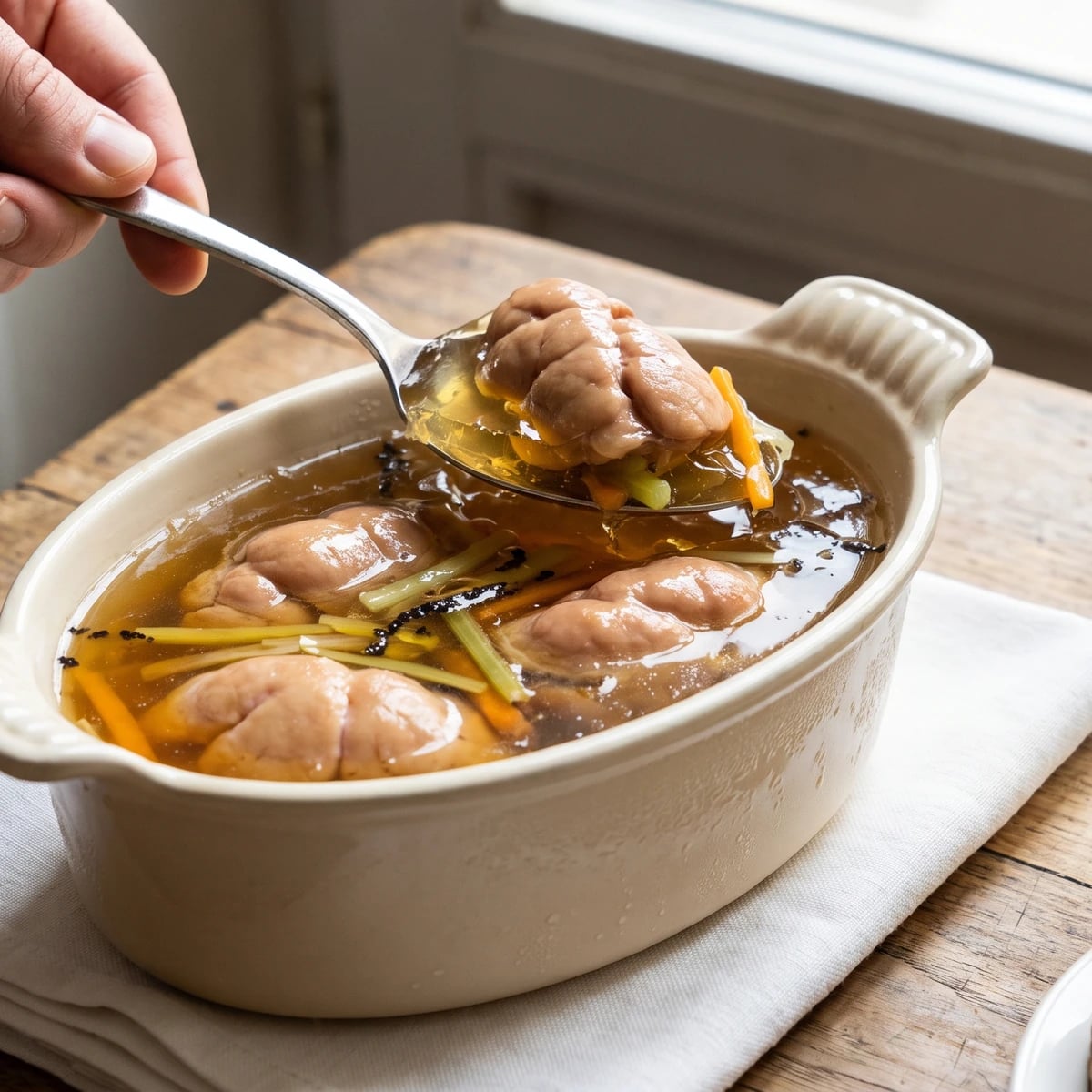
Ris de Veau à la Richelieu turns a careful Bonne-Maman braise into a cold truffled cocotte, with tender sweetbreads and vegetable julienne suspended beneath clear, savory jelly.
Ris de Veau à la Richelieu (veal sweetbreads in truffled braising jelly) teaches the discipline of a cold braise. The liquor must taste finished while warm, remain plentiful enough to cover the meat, and set clearly around it. The one true thing to know before touching a pan is this: if your stock won't gel, the dish cannot become itself. Test it, then correct it before chilling.
The original sends the cook to a Bonne-Maman braise and assumes a saucier on staff, a stockpot never allowed to go cold, and enough pans to strain, reduce, and hold everything separately. A salamander has no job here because this is a cold cocotte, not a hot glazed service. At home, one small cocotte, rich veal stock, a fine sieve, and a measured little gelatin when the stock needs help do the same work. The extra holding pans were brigade scaffolding and can go. Blanching and pressing the sweetbreads, braising them gently, adding the vegetable and truffle julienne, and covering everything completely with liquor are the dish and must stay. One cook, one stove, one evening of work, then the cold does its part.
Done properly, the pale, tender lobes sit beneath clear amber jelly, threaded with dark truffle and bright vegetables, with every trace of risen fat skimmed away. Before pouring the liquor into the cocotte, set one spoonful on a cold saucer. That small test decides the whole preparation.
The title à la Richelieu belongs to the Parisian classical table, where truffle marked a preparation intended for formal service and named dishes traveled readily into cuisine bourgeoise. This entry is a quiet surprise: the sweetbreads are not presented hot beneath a glaze, but braised Bonne-Maman style, covered with their strained liquor, and served cold from the cocotte after the risen fat is removed. The folded napkin beneath the pot belongs to its service, but the real refinement is practical, a clear jelly carrying the truffle through every helping.
Quantity
4 (about 2 lb / 900 g total)
Quantity
10 cups (2.4 L / 2.4 kg), plus more for soaking
Quantity
3 tablespoons (45 ml / 45 g)
divided
Quantity
1 tablespoon (15 ml / 18 g), plus more to finish
divided
Quantity
4 tablespoons (60 ml / 57 g)
divided
Quantity
1 small (about 4 oz / 115 g)
thinly sliced
Quantity
2 medium (about 7 oz / 200 g total)
one thinly sliced and one cut into fine julienne
Quantity
1 medium (about 5 oz / 140 g)
half sliced and half cut into fine julienne
Quantity
2 medium (about 4 oz / 110 g total)
one sliced and one cut into fine julienne
Quantity
1 cup (240 ml / 240 g)
Quantity
5 cups (1.2 L / 1.2 kg), plus more as needed to cover
preferably naturally gelatinous
Quantity
1
Quantity
1 teaspoon (5 ml / 2 g)
lightly crushed
Quantity
1 medium (about 1½ oz / 40 g)
drained and cut into fine julienne
Quantity
2 tablespoons (30 ml / 30 g)
Quantity
2¼ teaspoons (11 ml / 7 g)
| Ingredient | Quantity |
|---|---|
| veal heart sweetbreads | 4 (about 2 lb / 900 g total) |
| cold water | 10 cups (2.4 L / 2.4 kg), plus more for soaking |
| white wine vinegardivided | 3 tablespoons (45 ml / 45 g) |
| fine sea saltdivided | 1 tablespoon (15 ml / 18 g), plus more to finish |
| unsalted butterdivided | 4 tablespoons (60 ml / 57 g) |
| yellow onionthinly sliced | 1 small (about 4 oz / 115 g) |
| carrotsone thinly sliced and one cut into fine julienne | 2 medium (about 7 oz / 200 g total) |
| leek, white and pale green parts onlyhalf sliced and half cut into fine julienne | 1 medium (about 5 oz / 140 g) |
| celery stalksone sliced and one cut into fine julienne | 2 medium (about 4 oz / 110 g total) |
| dry white wine | 1 cup (240 ml / 240 g) |
| rich unsalted veal stockpreferably naturally gelatinous | 5 cups (1.2 L / 1.2 kg), plus more as needed to cover |
| bouquet garni of parsley stalks, thyme, and bay leaf | 1 |
| black peppercornslightly crushed | 1 teaspoon (5 ml / 2 g) |
| whole black truffle, fresh or preserveddrained and cut into fine julienne | 1 medium (about 1½ oz / 40 g) |
| reserved truffle juice (optional) | 2 tablespoons (30 ml / 30 g) |
| unflavored powdered gelatin (optional) | 2¼ teaspoons (11 ml / 7 g) |
Place the sweetbreads in a nonreactive bowl, cover generously with very cold water, and add 1 tablespoon of the vinegar. Refrigerate for 2 hours, changing the water twice, until the lobes look pale and the water remains nearly clear. Keeping them cold draws out blood without softening their texture.
Put the sweetbreads in the cocotte with the 10 cups of fresh cold water, the remaining 2 tablespoons vinegar, and 2 teaspoons of the salt. Bring slowly to a bare simmer, then cook for 5 minutes. Transfer them immediately to ice water. While they are still slightly warm, pull away the thick outer membrane, loose fat, and visible tubes, keeping each lobe as whole as possible. If a membrane clings, dip that lobe back into warm water for 30 seconds. Ça se rattrape. Do not gouge the tender flesh simply to chase every fine thread.
Lay the trimmed sweetbreads on a shallow tray, cover them with parchment, and set a second tray or small board on top. Weight it evenly with about 4 lb / 1.8 kg and refrigerate for 1 hour. Pressing compacts the lobes so they braise evenly and remain neat beneath the jelly; this is part of the dish, not ceremony.
Heat the oven to 325°F / 165°C. Dry the pressed sweetbreads and season them with the remaining teaspoon of measured salt. Melt 2 tablespoons of the butter in the cocotte over medium heat, then color the lobes gently on both broad sides until light gold, about 2 minutes per side. Lift them out. Add 1 tablespoon butter with the onion, sliced carrot, sliced leek, and sliced celery; cook for 6 to 8 minutes until softened but not deeply browned. Pour in the wine and scrape up the pale fond from the pot floor, then reduce the wine by half. Add the veal stock, bouquet garni, and peppercorns. Return the sweetbreads and add enough extra hot stock to cover them by about ½ inch / 1 cm.
Lay a parchment cartouche directly over the liquid, cover the cocotte, and braise in the oven for 35 to 45 minutes. The liquor should barely tremble, never boil. Check halfway through and add hot stock if the sweetbreads are no longer covered. They are ready when a thin skewer enters without springy resistance and the center reaches 160°F / 71°C. A hard boil emulsifies the fat into the liquor and clouds the finished jelly, so lower the heat at once if the surface grows lively.
Lift the sweetbreads carefully onto a plate. Strain the braising liquor through a damp, fine sieve into a heatproof bowl without pressing the spent vegetables, then discard them and the bouquet garni. Wipe the cocotte, return the liquor to it, and add the reserved truffle juice if using. You need enough liquor to cover the sweetbreads completely after assembly. If it is short, add hot stock; if there is a great excess and it tastes weak, reduce only that excess at a gentle simmer. Season a shade more firmly than you would for a hot sauce because cold mutes salt. Put 1 tablespoon of liquor on a chilled saucer and refrigerate it for 5 minutes. It should form a soft jelly that trembles when tilted. If it remains liquid, cool 2 tablespoons of the liquor completely, sprinkle the gelatin over it, and leave it for 5 minutes. Whisk this bloom into the hot liquor until dissolved, but do not boil it. Ça se rattrape, and the measured gelatin is the honest home equivalent of a stockpot rich enough to set by itself.
Pour the adjusted liquor back into the heatproof bowl and wipe the cocotte once more. Melt the final tablespoon of butter over gentle heat. Add the carrot julienne and cook for 2 minutes, then add the leek and celery julienne and cook for another 3 to 4 minutes. They should become tender and flexible without losing their color. Nestle the sweetbreads into the vegetables and distribute the truffle julienne over and around them. Pour the warm braising liquor through the clean sieve over the whole, using enough to cover every sweetbread completely. This full cover is essential; exposed meat darkens and dries in the cold.
Set the uncovered cocotte in a shallow ice bath until the liquor is cool, about 30 minutes, taking care that no water enters the pot. Transfer it to the refrigerator and chill until the liquor is fully set, at least 6 hours and preferably overnight, then cover it. Once the jelly is firm, slide a thin spoon beneath the opaque layer of fat that has risen to the surface and lift it away in sheets. If the fat is too soft to remove cleanly, return the cocotte to the cold for 30 minutes rather than digging into the jelly.
Take the cocotte from the refrigerator 10 minutes before serving so the jelly loses its deepest chill without softening. Set the cocotte on a folded napkin, as the original service directs, and bring it whole to the table. Serve one sweetbread per person with its clear jelly, vegetable julienne, and truffle, with good bread alongside for every last savory spoonful. À table!
1 serving (about 350g)
Culinary guides, cultural storytelling, and the editorial depth that makes cooking meaningful.
Discover Culinary Explorer
Chef Juliette
A half saddle of veal, bacon-barded and braised by short moistening, emerges bronze and succulent, with the concentrated veal glaze that makes this grand relevé worthy of the home table.

Chef Juliette
A bronzed saddle of veal between two patterned vegetable domes, with clear, glossy braising jus passed at the table: classical structure translated for four, patient enough for a celebration and possible on one stove.

Chef Juliette
A veal saddle braised until tender, its fillets cut into collops and rebuilt with paprika Béchamel and truffle, then flashed beneath fierce heat until the ivory sauce glazes.

Chef Juliette
A veal saddle becomes edible architecture: Soubise and ham tucked into the carved loin, truffled Parmesan soufflé rising above it, and reduced braising liquor served alongside.