
Chef Juliette
John Dory (St. Pierre)
John Dory has the delicacy of sole and the firmness of turbot. A light flouring, a quick butter sauté, and nut-brown beurre noisette show exactly why looks never mattered.
A cooking platform built around craft, culture, and the stories behind what we eat.
Created by Chef Juliette
Based on No. 1236, Ris de Veau aux Queues d’Écrevisses, from Le Guide Culinaire (1907) by Auguste Escoffier
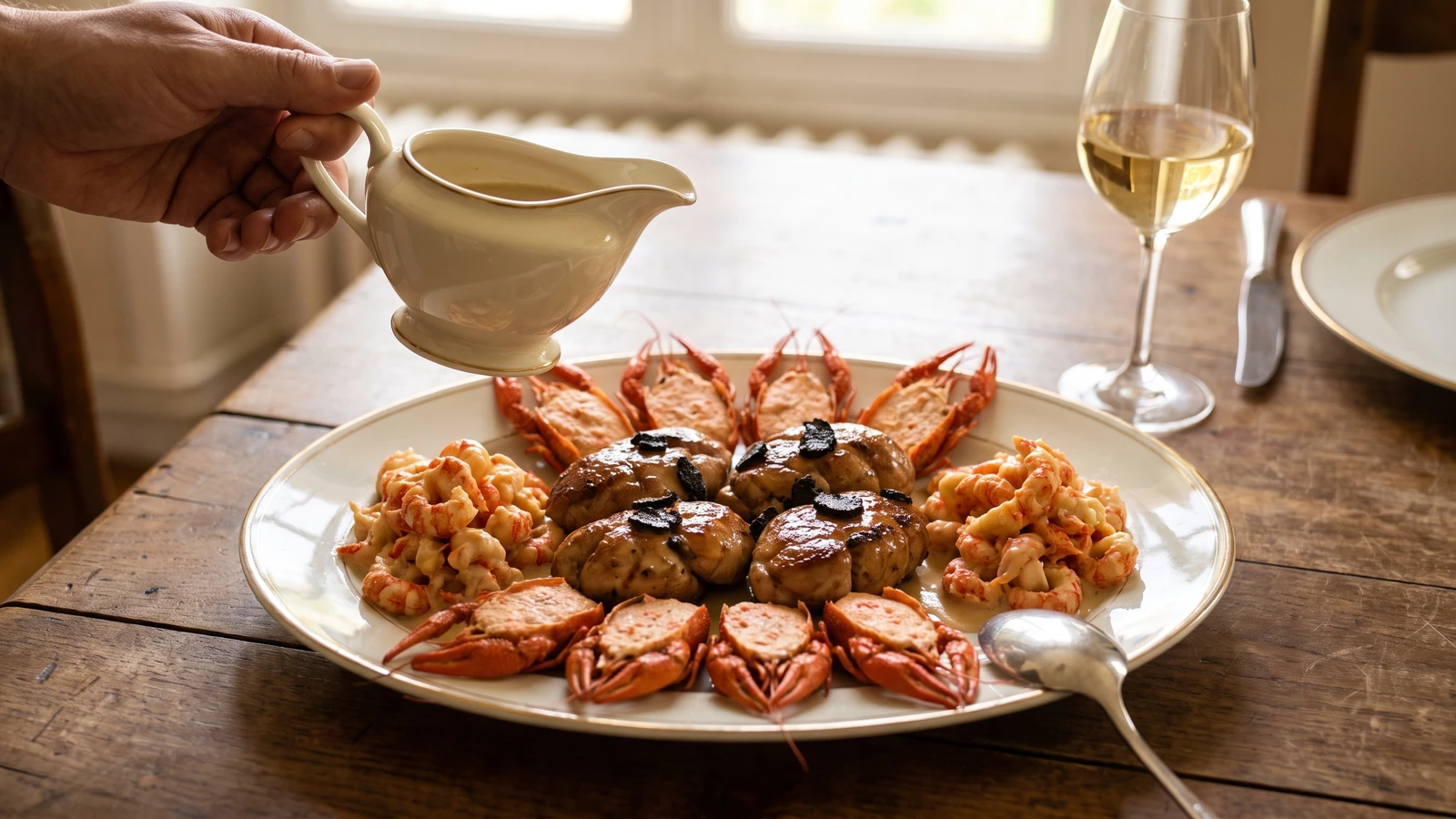
Sweetbreads braised without colour, truffle tucked inside, crayfish tails bound in cream, and filled carapaces at the ends: a generous formal platter whose deepest flavour comes from the shells.
Ris de Veau aux Queues d’Écrevisses (veal sweetbreads with crayfish tails) teaches that delicacy is built, not achieved by timid cooking. The sweetbreads braise without colour, yet the platter tastes deeply of shellfish because the crayfish shells are worked into butter, then carried through the chicken forcemeat and Sauce Allemande, a velouté enriched with yolk and cream. The one true thing to know before touching a pan is simple: save the shells. The shellfish makes it.
The book assumed a saucier minding the Allemande, a stockpot never off the fire, a larding needle for the truffle, brigade quantities, and a salamander standing ready, though this pale dish asks no browning from it. Your kitchen gets honest equivalents: braising liquor becomes the sauce foundation, a slender paring knife replaces the needle, a food processor makes the forcemeat, and the covered oven supplies steady heat. Passing every paste through a drum sieve is brigade scaffolding and can go. Pressing the sweetbreads, extracting the crayfish butter, keeping the forcemeat cold, and protecting the egg-bound sauce from a boil are the dish and must stay.
For four, the book's proportion becomes four sweetbreads, sixteen tails, four per person, and eight filled carapaces, two for each sweetbread. The finished platter is ivory, coral, and black with truffle, generous enough to silence a table for a moment. One cook, one stove, one evening. Work the shells into vivid crayfish butter before you build the sauce; that extraction decides whether the dish tastes merely creamy or unmistakably of écrevisse.
Ris de veau aux queues d’écrevisses belongs to the grand Parisian dining-room canon, where pale-braised sweetbreads, filled shellfish cases, and a sauce sent separately displayed the coordinated work of several kitchen stations. Crayfish butter has a powerful regional life around Lyon and Nantua, whose freshwater cookery made écrevisse sauces famous, but this composition is not Sauce Nantua: its prescribed finish is Sauce Allemande enriched with crayfish butter. As the formula moved onto bourgeois tables, the presentation remained formal while the work could be gathered into one sequence, shells to butter, braising liquor to sauce, platter to table.
Quantity
4, about 1½ lb (680 g) total
Quantity
6 qt (5.7 L / 5.7 kg)
divided, for soaking and blanching
Quantity
2 tsp (10 ml / 12 g)
divided
Quantity
1 small, about ¾ oz (20 g)
cut into 20 slim batons
Quantity
16, about 2½ lb (1.1 kg)
chilled
Quantity
½ cup (120 ml / 113 g)
Quantity
1 cup (240 ml / 240 g)
Quantity
¾ cup (180 ml / 100 g)
diced and kept very cold
Quantity
1 (2 tbsp / 30 ml / 30 g)
very cold
Quantity
¼ cup (60 ml / 60 g)
very cold
Quantity
½ tsp (2.5 ml / 1 g)
divided
Quantity
3 tbsp (45 ml / 42 g)
Quantity
¾ cup (180 ml / 75 g)
thinly sliced
Quantity
½ cup (120 ml / 55 g)
thinly sliced
Quantity
1 cup (240 ml / 70 g)
thinly sliced
Quantity
½ cup (120 ml / 120 g)
Quantity
5 cups (1.2 L / 1.2 kg)
divided
Quantity
2¼ tsp (11 ml / 7 g)
use only if the stock lacks body
Quantity
1
parsley stems, thyme, and bay
Quantity
2 tbsp (30 ml / 28 g)
Quantity
2 tbsp (30 ml / 16 g)
Quantity
2 (2 tbsp / 30 ml / 34 g)
Quantity
½ cup (120 ml / 120 g)
Quantity
1 tbsp (15 ml / 15 g)
Quantity
½ cup (120 ml / 120 g)
| Ingredient | Quantity |
|---|---|
| veal heart sweetbread lobes | 4, about 1½ lb (680 g) total |
| cold waterdivided, for soaking and blanching | 6 qt (5.7 L / 5.7 kg) |
| fine sea saltdivided | 2 tsp (10 ml / 12 g) |
| whole black trufflecut into 20 slim batons | 1 small, about ¾ oz (20 g) |
| whole cooked freshwater crayfishchilled | 16, about 2½ lb (1.1 kg) |
| unsalted butter for crayfish butter | ½ cup (120 ml / 113 g) |
| water for extracting crayfish butter | 1 cup (240 ml / 240 g) |
| skinless chicken breastdiced and kept very cold | ¾ cup (180 ml / 100 g) |
| large egg whitevery cold | 1 (2 tbsp / 30 ml / 30 g) |
| heavy cream for the chicken forcemeatvery cold | ¼ cup (60 ml / 60 g) |
| finely ground white pepperdivided | ½ tsp (2.5 ml / 1 g) |
| unsalted butter for the pale braise | 3 tbsp (45 ml / 42 g) |
| leek whitethinly sliced | ¾ cup (180 ml / 75 g) |
| celerythinly sliced | ½ cup (120 ml / 55 g) |
| white button mushroomsthinly sliced | 1 cup (240 ml / 70 g) |
| dry white wine | ½ cup (120 ml / 120 g) |
| unsalted white veal stock or chicken stockdivided | 5 cups (1.2 L / 1.2 kg) |
| unflavored gelatin (optional)use only if the stock lacks body | 2¼ tsp (11 ml / 7 g) |
| bouquet garniparsley stems, thyme, and bay | 1 |
| unsalted butter for the roux | 2 tbsp (30 ml / 28 g) |
| all-purpose flour | 2 tbsp (30 ml / 16 g) |
| large egg yolks | 2 (2 tbsp / 30 ml / 34 g) |
| heavy cream for Sauce Allemande | ½ cup (120 ml / 120 g) |
| fresh lemon juice | 1 tbsp (15 ml / 15 g) |
| heavy cream for binding the crayfish tails | ½ cup (120 ml / 120 g) |
Cover the sweetbreads with 2 qt (1.9 L / 1.9 kg) of the cold water and refrigerate for 1 hour. Drain, cover with another 2 qt (1.9 L / 1.9 kg), and soak for 1 hour more; the water should finish nearly clear. Put the remaining 2 qt (1.9 L / 1.9 kg) water and 1 tsp (5 ml / 6 g) salt in a saucepan with the sweetbreads. Bring slowly from cold to the first bare simmer, hold for 3 minutes, then transfer the lobes to ice water. Once cool, peel away the tough outer membrane and pull out thick cords without tearing into the tender flesh. Set the sweetbreads between two towel-lined trays, weight them with 2 to 3 lb (900 g to 1.4 kg), and refrigerate for 1 hour. Pressing gives them the close, even shape that will hold the truffle and slice cleanly.
Twist the tail from each crayfish, peel away the shell, and remove the dark intestinal thread without splitting the meat. Refrigerate all 16 tails. Choose the eight largest, least damaged body carapaces, pull out the gills and interior sacs with a teaspoon, rinse them briefly, and dry them well. Pick any useful claw meat for another meal, then crush the remaining eight body shells and all the emptied claws and legs with a rolling pin. Keep every fragment; it is the foundation of the crayfish butter.
Melt the ½ cup (120 ml / 113 g) butter over low heat in a small heavy saucepan. Add the crushed shells and cook for 8 to 10 minutes, pressing and turning them until the butter becomes coral and smells distinctly of crayfish, but never letting the milk solids brown. Add the 1 cup (240 ml / 240 g) water and hold at a bare simmer for 10 minutes. Strain through a fine sieve into a metal bowl, pressing the shells firmly, then set the bowl over ice until the coloured butter firms above the liquid. Lift it off and scrape away any watery residue underneath. You need at least 4 tbsp (60 ml / 56 g). If the butter is pale, remelt it with the shells for 5 minutes and strain again; the flavour can still be drawn out.
Chill the food processor bowl and blade for 15 minutes. Process the chicken with ¼ tsp (1.25 ml / 1.5 g) salt and ⅛ tsp (0.6 ml / 0.25 g) white pepper until smooth and tacky. Add the egg white and process only until absorbed. Reserve 1 tbsp (15 ml / 15 g) of the cold cream, then add the rest in a thin stream while pulsing. Work in 1 tbsp (15 ml / 14 g) crayfish butter. The forcemeat must remain cold and glossy; if it turns grainy or leaks fat, stop, chill it for 10 minutes, then pulse in the reserved cream. Poach a teaspoonful in barely simmering water until it reaches 165°F (74°C), taste, and correct the seasoning. Fill the eight cleaned carapaces generously with the forcemeat, smoothing the tops with a spoon, and refrigerate them.
Unwrap the pressed sweetbreads and pat them dry. With the tip of a narrow paring knife or a clean metal skewer, make five slim tunnels through each lobe, following its length. Slide one truffle baton into every tunnel so the ends sit flush with the surface. Keep the openings narrow; large pockets make the sweetbreads split during braising. If a lobe needs help holding its shape, tie one loose loop of kitchen string around its middle.
Heat the oven to 325°F (165°C). If using boxed stock, bloom the gelatin in ¼ cup (60 ml / 60 g) cold stock for 5 minutes, then warm it into the remaining stock. Melt the 3 tbsp (45 ml / 42 g) butter in a shallow lidded braiser over low heat. Add the leek, celery, mushrooms, ¼ tsp (1.25 ml / 1.5 g) salt, and ⅛ tsp (0.6 ml / 0.25 g) white pepper. Sweat for 8 minutes until tender but still pale. If an edge begins to colour, add 2 tbsp (30 ml / 30 g) stock at once and lower the heat. Set the sweetbreads on the vegetables, add the wine, 3 cups (720 ml / 720 g) stock, and the bouquet garni, then bring only to a bare simmer. Cover the surface with parchment, put on the lid, and braise in the oven for 25 to 35 minutes, turning once, until the lobes feel tender but resilient and reach 160°F (71°C). This is braisage à blanc, braising without colour. Lift the sweetbreads into a clean covered pan with a splash of liquor. Strain the remaining braising liquid, discard the vegetables and bouquet garni, and reduce or supplement the liquid to obtain exactly 2 cups (480 ml / 480 g) for the sauce.
Arrange the eight filled carapaces stuffing-side up in a shallow pan. Pour 1½ cups (360 ml / 360 g) of the remaining stock around them, coming halfway up the shells without washing over the forcemeat. Cover and poach at the barest tremble for 12 to 15 minutes, until the forcemeat is set, smooth, and reaches 165°F (74°C). If the liquid begins bubbling hard and the filling swells, pull the pan from the heat for 1 minute, then finish over lower heat. Keep the carapaces covered in their poaching liquid while you make the sauce.
Melt the 2 tbsp (30 ml / 28 g) butter in a saucepan, stir in the flour, and cook for 2 minutes without colouring. This roux blanc, a pale butter-flour base, must lose its raw smell while remaining ivory. Gradually whisk in the 2 cups (480 ml / 480 g) hot strained braising liquid. Simmer gently for 12 minutes, skimming the surface, until the velouté lightly coats a spoon. Reserve 1 tbsp (15 ml / 15 g) cream, then whisk the yolks with the rest. Temper them with a ladle of hot velouté, take the saucepan off the heat, and whisk the liaison back into it. Return to the lowest heat and stir until the Sauce Allemande reaches 160°F (71°C) and nappe, coats the back of a spoon. Never boil it. If the yolks begin to grain, strain the sauce immediately into a cold bowl and whisk in the reserved cream. Ça se rattrape. When smooth, whisk in 3 tbsp (45 ml / 42 g) crayfish butter a little at a time, then the lemon juice and enough of the remaining salt and white pepper to sharpen the flavour. Hold the sauce warm, not hot, in a sauceboat.
Pour the final ½ cup (120 ml / 120 g) cream into a wide sauté pan and simmer gently until reduced by about one-third and thick enough to cling to a spoon. Add the 16 crayfish tails and turn them through the cream for 60 to 90 seconds, only until warmed. They are already cooked, so boiling makes them tight. If the cream becomes thin after the tails go in, lift them out, reduce the cream alone, and return them; if it tightens too far, loosen it with a spoonful of reserved stock.
Remove any string from the sweetbreads and arrange the four lobes in a central row on a warmed long platter. Set eight cream-bound crayfish tails in a generous heap along each side, preserving the book's four-tails-per-person proportion. Drain the filled carapaces and place four at either end, giving two carapaces for every sweetbread. Carry the Sauce Allemande separately so each guest can spoon it over the sweetbread without drowning the careful arrangement. No parsley confetti. The coral shells, ivory sauce, and black truffle have already done the work. À table!
1 serving (about 410g)
Culinary guides, cultural storytelling, and the editorial depth that makes cooking meaningful.
Discover Culinary ExplorerChef Juliette
John Dory has the delicacy of sole and the firmness of turbot. A light flouring, a quick butter sauté, and nut-brown beurre noisette show exactly why looks never mattered.

Chef Juliette
Fresh haddock proves its delicacy in the meunière pan: a fine flour crust, moist pearly flakes, and beurre noisette sharpened with lemon and parsley, ready from one skillet in half an hour.

Chef Juliette
Éperlans à l’Anglaise turns small fish into a lesson in disciplined coating: boned smelts under a close, crisp crumb, pan-fried in clarified butter and finished with bright, half-melted maître d’hôtel butter.

Chef Juliette
Tiny smelts, shallot, mushrooms, white wine, gratin sauce, and fine bread raspings meet a fierce oven, where the fish must turn tender in the same breath the buttered crust bronzes.