
Chef Juliette
Selle de Veau (Relevé)
A half saddle of veal, bacon-barded and braised by short moistening, emerges bronze and succulent, with the concentrated veal glaze that makes this grand relevé worthy of the home table.
A cooking platform built around craft, culture, and the stories behind what we eat.
Created by Chef Juliette
Based on No. 1225, Escalopes de Ris de Veau Bérengère, from Le Guide Culinaire (1907) by Auguste Escoffier
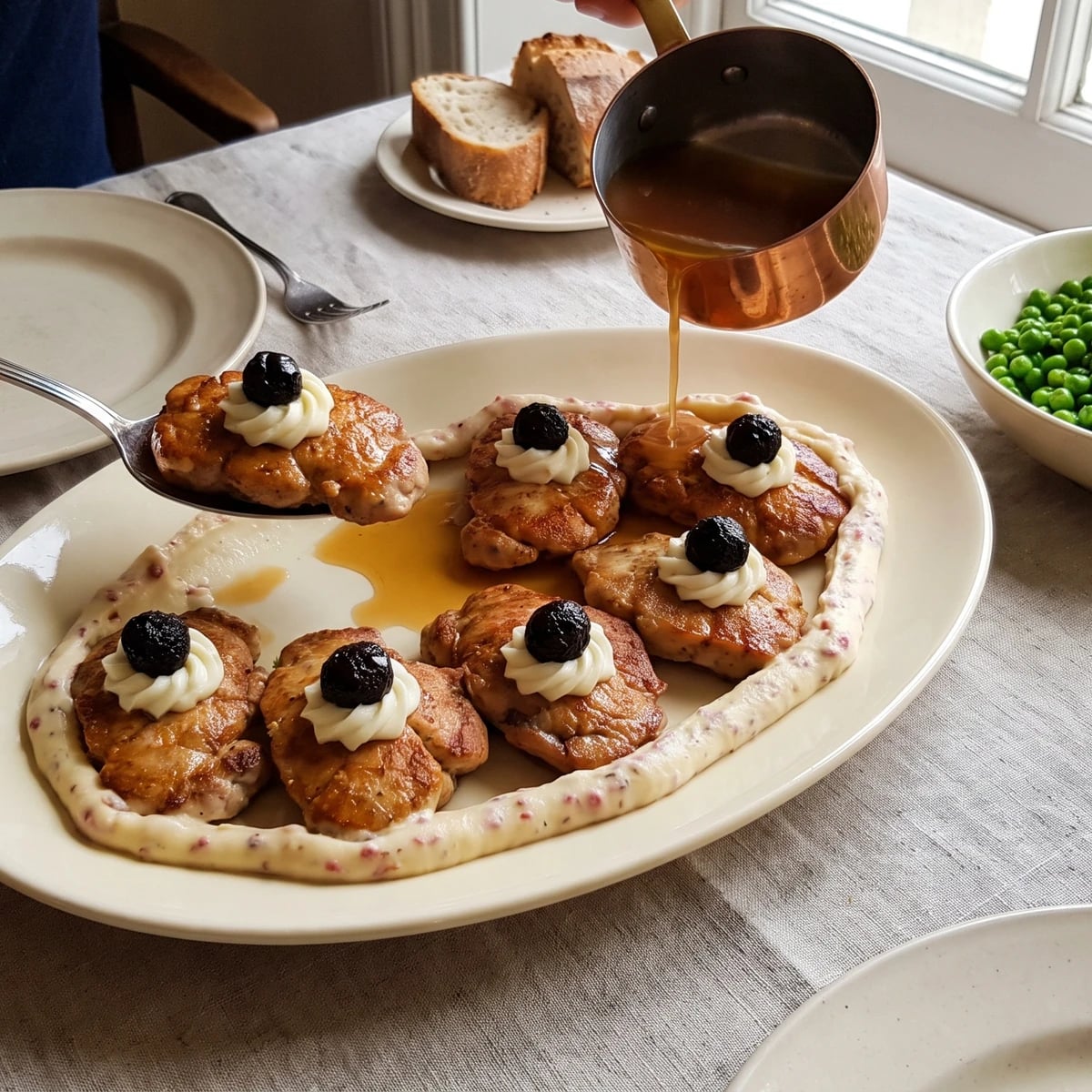
Eight braised sweetbread ovals, each edged with tongue mousseline, crowned with white Soubise and black truffle, then set on a butter-crisp croûton with glossy braising liquor and peas served apart.
Escalopes de Ris de Veau Bérengère (braised veal sweetbread slices with tongue mousseline, Soubise, and truffle) teaches temperature discipline. The sweetbreads must be tender yet firm enough to cut cleanly, the Soubise warm and supple, and the mousseline ice-cold until it enters the oven. Remember that last point before touching a pan. Warm forcemeat loses its emulsion and its neat border.
The original assumed a saucier tending the braising liquor and Soubise, a stockpot never off the fire, another pair of hands filling piping bags, matched fancy-cutters, and a salamander or hot cupboard bridging the final minutes of service. Your equivalents are gelatin-rich stock, a food processor and fine sieve, a card oval used twice, and a household oven set to a true moderate heat. The brigade tray becomes eight slices for four people. One cook, one stove, one evening.
The extra hands and special cutter were scaffolding, so they can go. The sequence cannot: braise, slice, pipe the tongue mousseline, poach it, crown it with very white Soubise and black truffle, then place each escalope on a Croûton fried in butter. The glossy liquor and bright peas remain apart so the bread stays crisp and each guest sauces the plate. The step that decides the dish is the mousseline: keep it cold until piped, then poach it only until set.
Escalopes de Ris de Veau Bérengère belongs to the Parisian grand-kitchen repertory of named compositions, where a title promised a precise arrangement rather than a loose regional seasoning. Sweetbreads moved easily between formal service and the prosperous bourgeois table because their delicacy rewarded the patient household cook as readily as the brigade. Here escalope means a trimmed oval slice, not a sautéed cutlet, and the architecture of mousseline, Soubise, truffle, and Croûton is the identity of the dish.
Quantity
2 large, about 1½ lb (680 g)
Quantity
2 tbsp (30 ml / 30 g)
Quantity
2½ tsp (12.5 ml / 15 g)
divided
Quantity
½ tsp (2.5 ml / 1 g)
divided
Quantity
10 tbsp (150 ml / 142 g)
divided
Quantity
1 medium, about ½ cup (120 ml / 60 g)
finely diced
Quantity
1 small, about ¾ cup (180 ml / 100 g)
finely diced
Quantity
1 stalk, about ½ cup (120 ml / 50 g)
finely diced
Quantity
1
Quantity
2 cups (480 ml / 480 g)
Quantity
4 oz (115 g)
cubed and thoroughly chilled
Quantity
1 large (30 g)
thoroughly chilled
Quantity
⅓ cup (80 ml / 80 g)
thoroughly chilled
Quantity
¼ cup (60 ml / 50 g)
chilled and very finely chopped
Quantity
2 medium, about 2 cups (480 ml / 300 g)
thinly sliced
Quantity
1 tbsp (15 ml / 12 g)
Quantity
½ cup (120 ml / 120 g)
Quantity
¼ cup (60 ml / 60 g)
Quantity
8 slices, about 8 oz (225 g)
cut ½ inch (1.25 cm) thick
Quantity
1 small, about ¾ oz (20 g)
cut into eight small balls
Quantity
3 cups (720 ml / 430 g)
Quantity
¼ cup (60 ml / 60 g)
| Ingredient | Quantity |
|---|---|
| veal heart sweetbreads | 2 large, about 1½ lb (680 g) |
| white wine vinegar | 2 tbsp (30 ml / 30 g) |
| fine sea saltdivided | 2½ tsp (12.5 ml / 15 g) |
| ground white pepperdivided | ½ tsp (2.5 ml / 1 g) |
| unsalted butterdivided | 10 tbsp (150 ml / 142 g) |
| carrotfinely diced | 1 medium, about ½ cup (120 ml / 60 g) |
| yellow onion for braisingfinely diced | 1 small, about ¾ cup (180 ml / 100 g) |
| celeryfinely diced | 1 stalk, about ½ cup (120 ml / 50 g) |
| bouquet garni of parsley stems, thyme, and bay | 1 |
| unsalted gelatin-rich veal stock | 2 cups (480 ml / 480 g) |
| skinless chicken breastcubed and thoroughly chilled | 4 oz (115 g) |
| egg whitethoroughly chilled | 1 large (30 g) |
| heavy cream for the mousselinethoroughly chilled | ⅓ cup (80 ml / 80 g) |
| cooked salted beef tonguechilled and very finely chopped | ¼ cup (60 ml / 50 g) |
| white or yellow onions for the Soubisethinly sliced | 2 medium, about 2 cups (480 ml / 300 g) |
| white rice | 1 tbsp (15 ml / 12 g) |
| pale unsalted chicken stock | ½ cup (120 ml / 120 g) |
| heavy cream for the Soubise | ¼ cup (60 ml / 60 g) |
| pain de mie or close-textured white sandwich bread for the Croûtonscut ½ inch (1.25 cm) thick | 8 slices, about 8 oz (225 g) |
| black trufflecut into eight small balls | 1 small, about ¾ oz (20 g) |
| shelled fresh peas or frozen petits pois | 3 cups (720 ml / 430 g) |
| water | ¼ cup (60 ml / 60 g) |
Put the sweetbreads in a bowl of very cold water and soak them for 2 hours, changing the water every 30 minutes, until the water stays nearly clear. Transfer them to a saucepan, cover generously with fresh cold water, and add the vinegar. Bring the water slowly to a bare simmer, never a rolling boil, and blanch for 5 minutes. Lift the sweetbreads immediately into ice water. The soaking clears them; the brief blanch firms the outside so you can remove the membrane without tearing the delicate lobes.
When the sweetbreads are cold, peel away the thick outer membrane and pull out any obvious tubes, blood spots, and hard pieces of fat with your fingers and a small knife. Preserve the rounded lobes rather than chasing every fine thread. Set them between two parchment-lined trays, weight the upper tray with about 2 lb (900 g), and refrigerate for 45 minutes. Pressing gives the sweetbreads an even thickness and the clean oval slices this dish requires.
Heat the oven to 325°F (165°C). Season the pressed sweetbreads with about ¾ tsp of the measured salt and a little white pepper. Melt 2 tbsp (30 ml / 28 g) of the butter in a snug ovenproof sauté pan, add the carrot, diced onion, and celery, and cook gently for 6 minutes without deep browning. Set the sweetbreads on the vegetables, turn them once in the butter, add the bouquet garni and veal stock, and bring the liquid just to a simmer. Cover with a round of parchment and the lid, then braise for 25 to 30 minutes, until the lobes feel firm yet springy and reach 160°F (71°C) at the center. Lift them onto a tray and let them settle for 10 minutes. Strain the braising liquor into a small saucepan and reserve it.
While the sweetbreads braise, melt 2 tbsp (30 ml / 28 g) of the butter in a small heavy saucepan. Add the sliced onions and about ½ tsp salt, cover them with a parchment round, and cook over the gentlest heat for 15 minutes. They must soften without taking color, because this Soubise should be fine and very white. Stir in the rice and pale chicken stock, cover, and simmer gently for 20 to 25 minutes, until both rice and onions collapse under a spoon. Purée until smooth, press through a fine sieve, then return it to the pan with the cream. Cook gently until it holds a clean groove when stirred. If it becomes too stiff to pipe, loosen it with a spoonful of stock; if it slumps, reduce it for another minute. Ça se rattrape. Cover its surface directly and keep it warm.
Chill the food-processor bowl and blade for 10 minutes. Process the cold chicken with ½ tsp salt and a pinch of white pepper until it forms a smooth, sticky paste. Add the cold egg white and process just until absorbed. With the machine pulsing, add all but 1 tbsp (15 ml / 15 g) of the cold cream in three additions, stopping as soon as the mousseline is smooth and satiny. Press it through a fine sieve, then fold in the finely chopped salted tongue. Poach a teaspoonful in barely simmering water until cooked through and taste it. If it is rubbery, fold in the reserved cream. If the mixture looks greasy, stop immediately. Ça se rattrape: spread it thinly on a cold metal tray, chill for 15 minutes, then process it only long enough to come smooth again. Keep the finished mousseline over ice.
Cut each braised sweetbread crosswise into four medium slices, about ½ inch (1.25 cm) thick, giving eight slices in all. Use a 3-inch by 2-inch (7.5 by 5 cm) oval cutter, or a stiff card template and a sharp knife, to trim each slice evenly. Use that same shape to cut eight bread ovals. The matched cutter was brigade convenience; one reusable template gives the home cook the same clean result.
Arrange the sweetbread ovals on a parchment-lined tray. Fit a piping bag with a plain ⅙-inch (4 mm) tip, fill it with the cold tongue mousseline, and pipe a generous, even border around the edge of every slice, leaving the center open for the Soubise. Hold the tip close to the surface and squeeze steadily so the forcemeat adheres. If a border slumps before baking, scrape it back into the bag and chill it for 15 minutes. Bake at 325°F (165°C) for 8 to 11 minutes, until the mousseline looks matte, springs lightly under a fingertip, and reaches 165°F (74°C). Do not brown it.
Melt 4 tbsp (60 ml / 57 g) of the butter in a broad skillet over medium heat. Fry the bread ovals in batches until they are evenly golden and crisp on both sides, adding no more heat than the butter can bear. If the butter darkens before the bread crisps, lower the heat and wipe out any burnt milk solids before continuing. Drain the Croûtons briefly on a rack so their undersides remain crisp.
Let the strained braising liquor stand for a minute, then skim every visible bead of fat from the surface. Reduce it at a lively simmer to about ¾ cup (180 ml / 180 g), until glossy and full-flavored but still pourable. If it turns too salty, add a spoonful of water or unsalted stock; if it remains thin, reduce it further. For the peas, combine them with the remaining 2 tbsp (30 ml / 28 g) butter, the measured water, ½ tsp salt, and a pinch of white pepper. Cover and cook just until bright and tender, about 3 minutes for frozen petits pois or 5 to 8 minutes for fresh peas. Transfer them to a warmed bowl and keep them separate.
Fit a second piping bag with a ½-inch (12 mm) fluted tip and fill it with the warm Soubise. Pipe a full rosette into the open center of each escalope, then place one black truffle ball in the middle. Set every finished slice on its matching butter-fried Croûton and arrange them on a warm platter. Pour the completely degreased braising liquor into a sauceboat and bring it to the table beside the separate bowl of peas. Sauce each serving only after it reaches the plate so the Croûton keeps its crisp edge. À table!
1 serving (about 500g)
Culinary guides, cultural storytelling, and the editorial depth that makes cooking meaningful.
Discover Culinary Explorer
Chef Juliette
A half saddle of veal, bacon-barded and braised by short moistening, emerges bronze and succulent, with the concentrated veal glaze that makes this grand relevé worthy of the home table.

Chef Juliette
A bronzed saddle of veal between two patterned vegetable domes, with clear, glossy braising jus passed at the table: classical structure translated for four, patient enough for a celebration and possible on one stove.

Chef Juliette
A veal saddle braised until tender, its fillets cut into collops and rebuilt with paprika Béchamel and truffle, then flashed beneath fierce heat until the ivory sauce glazes.

Chef Juliette
A veal saddle becomes edible architecture: Soubise and ham tucked into the carved loin, truffled Parmesan soufflé rising above it, and reduced braising liquor served alongside.