
Chef Juliette
John Dory (St. Pierre)
John Dory has the delicacy of sole and the firmness of turbot. A light flouring, a quick butter sauté, and nut-brown beurre noisette show exactly why looks never mattered.
A cooking platform built around craft, culture, and the stories behind what we eat.
Created by Chef Juliette
Based on No. 1224, Ris de Veau Demidoff, from Le Guide Culinaire (1907) by Auguste Escoffier
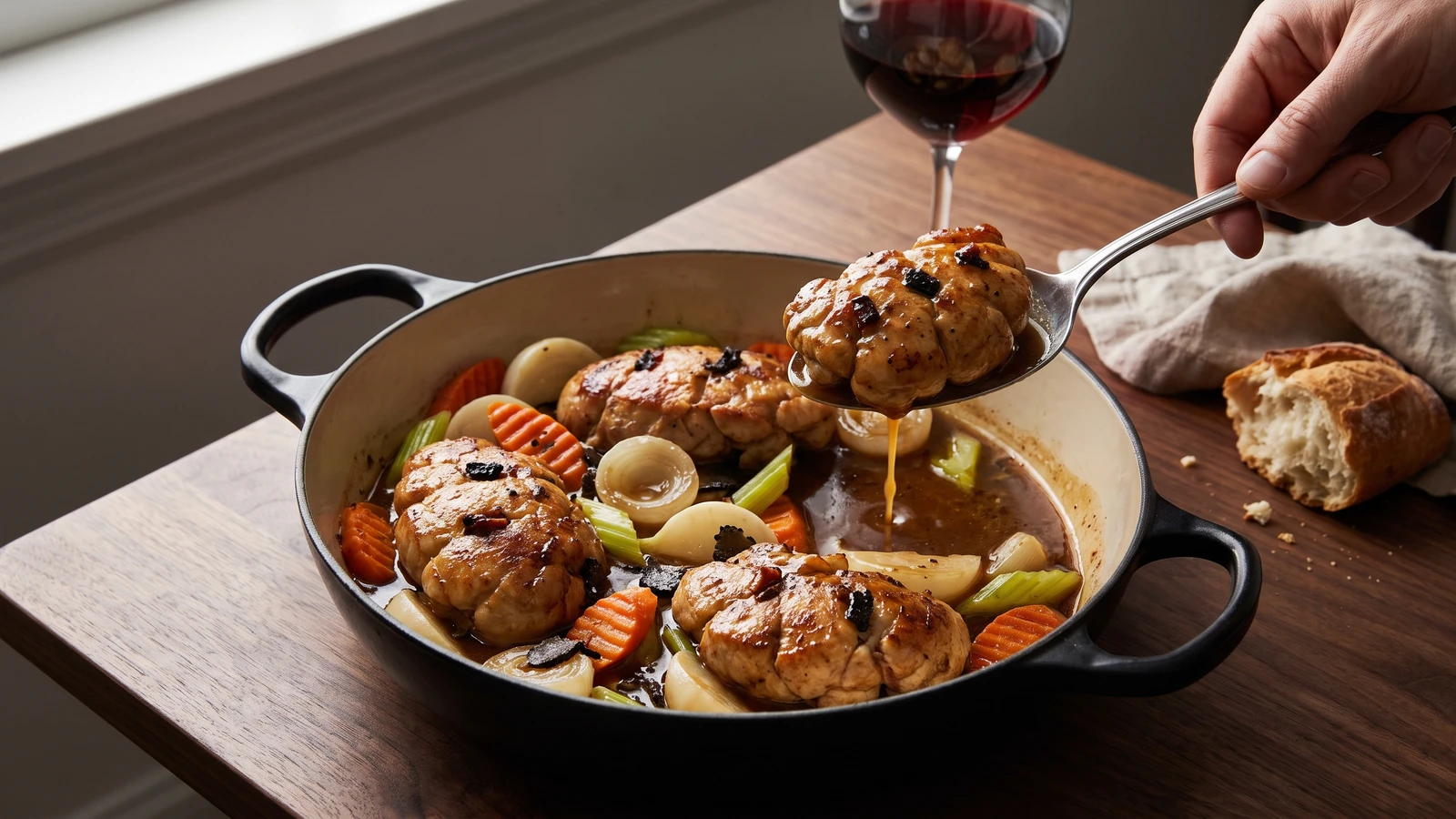
Ris de veau Demidoff teaches the disciplined braise: lard tender veal sweetbreads with bacon and truffle, stop the first cooking halfway, then finish them among precisely cut vegetables in a glossy cocotte jus.
Ris de veau Demidoff (veal sweetbreads threaded with bacon and truffle) teaches one true thing: the first braise must stop halfway. The sweetbreads finish with their garnish and braising liquor, so cooking them through before assembly gives you firm meat by the time the vegetables are tender. Divided cooking is the structure of the dish, not an inconvenience.
The original formula assumed a larding needle, a stock never off the fire, brigade hands to groove ounces of vegetables, and a saucier to mind the braising liquor. A salamander contributes nothing here because the cocotte is the finish. At home, a paring knife makes the larding channels, good unsalted veal stock replaces the perpetual stockpot, and one shallow cocotte handles the browning, butter-stewing, and final braise for four. Separate sauce pans are brigade scaffolding and can go. The larding, the deliberate half-cook, the book's precise vegetable cuts, and the minced truffle must stay. One cook, one stove, one evening.
Done properly, the sweetbreads are compact and yielding beneath a Maillard-bronze surface, the vegetables keep their distinct shapes, and the truffled jus clings without leaving grease on the tongue. Watch the first braise above all: stop while the centers are still underdone, however much your instincts urge another few minutes.
Ris de veau Demidoff belongs to the Parisian grand-kitchen repertoire, where dishes bearing the Demidoff name joined French technique to the truffle-rich taste associated with the Russian princely household that patronized French cooks. In the canon, Demidoff describes a manner of cooking more than a French region: carefully larded sweetbreads, precisely cut buttered vegetables, and truffle carried through a brown braising liquor. The noble name can distract from the real luxury, which is disciplined timing rather than ornament.
Quantity
4, about 1½ pounds (680 g) total
Quantity
¼ cup (60 ml / 55 g)
cut into fine batons
Quantity
1 small truffle, 1½ ounces (42 g)
divide into ½ ounce (14 g) fine batons and 1 ounce (28 g) minced
Quantity
5 tablespoons (75 ml / 70 g)
divided
Quantity
2 cups (475 ml / 475 g)
divided
Quantity
½ cup (120 ml / 55 g)
peeled and cut into grooved crescents
Quantity
½ cup (120 ml / 55 g)
peeled and cut into grooved crescents
Quantity
½ cup (120 ml / 55 g)
peeled and cut into thick roundels
Quantity
⅓ cup (80 ml / 40 g)
cut paysanne-fashion into thin triangles
Quantity
1 teaspoon (5 ml / 6 g)
divided
Quantity
½ teaspoon (2.5 ml / 1 g)
| Ingredient | Quantity |
|---|---|
| veal heart sweetbreads | 4, about 1½ pounds (680 g) total |
| thick-cut unsmoked baconcut into fine batons | ¼ cup (60 ml / 55 g) |
| fresh or whole preserved black truffledivide into ½ ounce (14 g) fine batons and 1 ounce (28 g) minced | 1 small truffle, 1½ ounces (42 g) |
| unsalted butterdivided | 5 tablespoons (75 ml / 70 g) |
| unsalted veal stockdivided | 2 cups (475 ml / 475 g) |
| carrotpeeled and cut into grooved crescents | ½ cup (120 ml / 55 g) |
| turnippeeled and cut into grooved crescents | ½ cup (120 ml / 55 g) |
| small onionspeeled and cut into thick roundels | ½ cup (120 ml / 55 g) |
| celerycut paysanne-fashion into thin triangles | ⅓ cup (80 ml / 40 g) |
| fine sea saltdivided | 1 teaspoon (5 ml / 6 g) |
| freshly ground white pepper | ½ teaspoon (2.5 ml / 1 g) |
Put the sweetbreads in a large bowl and cover them generously with very cold water. Soak for 1 hour, changing the water twice, until the water stays nearly clear and the flesh looks pale. This purging removes blood that would otherwise cloud the braising liquor and give the sweetbreads a grey cast.
Transfer the sweetbreads to a saucepan, cover with fresh cold water, and bring slowly to a bare simmer. Hold them there for 5 minutes, never at a hard boil, then move them into cold water. While they are still slightly warm, pull away the loose membrane and any obvious cords without breaking the lobes apart. Set them between two parchment-lined trays, place about 2 pounds (900 g) of weight on top, and refrigerate for 45 minutes. Pressing gives the sweetbreads an even thickness, so they brown and finish at the same pace.
While the sweetbreads press, run a channel knife lengthwise down the carrot and turnip to make shallow grooves, then halve them lengthwise and cut them crosswise into ¼-inch (6 mm) crescents. Cut the small onions crosswise into broad ⅜-inch (1 cm) roundels. Cut the celery paysanne-fashion, meaning thin triangles here, about ¾ inch (2 cm) across. Keep the shapes even because they must finish together, but do not fuss them into decorations; the grooves are there to catch the truffled liquor.
Chill the bacon and truffle batons until firm. Dry the pressed sweetbreads thoroughly, then use a narrow paring knife or metal skewer to make several lengthwise channels through each lobe. Tuck alternating bacon and truffle batons into the channels, pushing them just beneath the surface. Work gently and keep the lobes compact. If one splits, bind it once around the middle with kitchen twine; it will hold during the braise and the twine comes off before serving. Season with half the salt and pepper.
Heat the oven to 325°F (165°C). Melt 2 tablespoons (30 ml / 28 g) of the butter in a shallow cocotte over medium heat. When the foam subsides, brown the sweetbreads on both broad sides, working in batches if necessary, until deeply golden but not scorched. Return them all to the cocotte, pour in 1½ cups (355 ml / 355 g) of the veal stock, and scrape the fond from the bottom. Bring the liquor only to a tremble, cover, and braise in the oven for 10 to 12 minutes. Remove the sweetbreads while their centers are still distinctly underdone. This deliberate half-cook is the principle that decides the dish.
Transfer the sweetbreads to a plate and strain the braising liquor into a jug. Wipe the cocotte clean, return it to low heat, and add the remaining 3 tablespoons (45 ml / 42 g) butter. Add the carrot and turnip, cover, and stew gently for 4 minutes. Add the onion roundels and celery triangles, season with the remaining salt and pepper, then cover and cook for another 4 to 5 minutes. Turn the vegetables carefully so their shapes remain clear. They should be glossy and barely tender without taking color. If the butter begins to brown, lower the heat and add a tablespoon of reserved stock.
Set the half-cooked sweetbreads in the center of the cocotte and arrange the butter-stewed vegetables around them. Add the strained braising liquor and the 1 ounce (28 g) minced truffle; the liquid should reach roughly halfway up the sweetbreads, so add some of the reserved stock if needed. Cover and return the cocotte to the oven for 12 to 18 minutes, until the liquor barely trembles and the thickest sweetbread reaches 160°F (71°C). If the liquid begins boiling hard, take the cocotte out, uncover it for 2 minutes, and lower the oven to 300°F (150°C) before continuing. Boiling tightens sweetbreads; gentle heat keeps them yielding.
Remove any twine, then tilt the cocotte and skim every visible bead of fat from the surface with a shallow spoon. If the liquor is thin, lift the sweetbreads and vegetables out briefly and reduce it for 2 to 4 minutes until glossy enough to coat a spoon. If it tightens too far, loosen it with reserved stock, one tablespoon at a time. Ça se rattrape. Return everything to the cocotte, spoon the truffled liquor over the sweetbreads, and serve directly from the vessel. À table!
1 serving (about 275g)
Culinary guides, cultural storytelling, and the editorial depth that makes cooking meaningful.
Discover Culinary ExplorerChef Juliette
John Dory has the delicacy of sole and the firmness of turbot. A light flouring, a quick butter sauté, and nut-brown beurre noisette show exactly why looks never mattered.

Chef Juliette
Fresh haddock proves its delicacy in the meunière pan: a fine flour crust, moist pearly flakes, and beurre noisette sharpened with lemon and parsley, ready from one skillet in half an hour.

Chef Juliette
Éperlans à l’Anglaise turns small fish into a lesson in disciplined coating: boned smelts under a close, crisp crumb, pan-fried in clarified butter and finished with bright, half-melted maître d’hôtel butter.

Chef Juliette
Tiny smelts, shallot, mushrooms, white wine, gratin sauce, and fine bread raspings meet a fierce oven, where the fish must turn tender in the same breath the buttered crust bronzes.