Culinary Explorer

A cooking platform built around craft, culture, and the stories behind what we eat.
Discover Culinary Explorer
Crépinette de Ris de Veau

Crépinette de Ris de Veau

Created by Chef Juliette

Based on No. 1222, Crépinette de Ris de Veau, from Le Guide Culinaire (1907) by Auguste Escoffier

Crépinette de ris de veau teaches the discipline of forcemeat: equal parts sweetbread and calf’s udder, rich with truffle, held in caul, crumbed, grilled gently, and carried by Périgueux sauce.

Main Dishes
French
Comfort Food
Dinner Party
1 hr 25 min
Active Time
30 min cook2 hr total
Yield4 servings

Crépinette de Ris de Veau (caul-wrapped sweetbread patties) teaches one precise lesson: caul fat is structure that must disappear. Keep the mince cold while you shape it, then give it gentle heat, and the caul melts inward, basting the offal while holding everything together. Blast it with fierce heat and the crumbs burn before the raw udder cooks through.

The original entry assumed white sweetbreads already prepared, a butcher supplying calf’s udder and very soft caul, a saucier with Périgueux sauce ready beside a stockpot never off the fire, and a salamander for gentle grilling. At home, you blanch and press one small throat sweetbread, reheat the finished sauce from its own preparation, weigh four three-ounce portions, and use a low broiler. That division of labor and obsolete equipment were brigade scaffolding, so they can go. Equal weights of sweetbread and udder, the generous truffle and egg ratios, the caul, butter, crumbs, and gentle grilling are the dish itself, so every one stays.

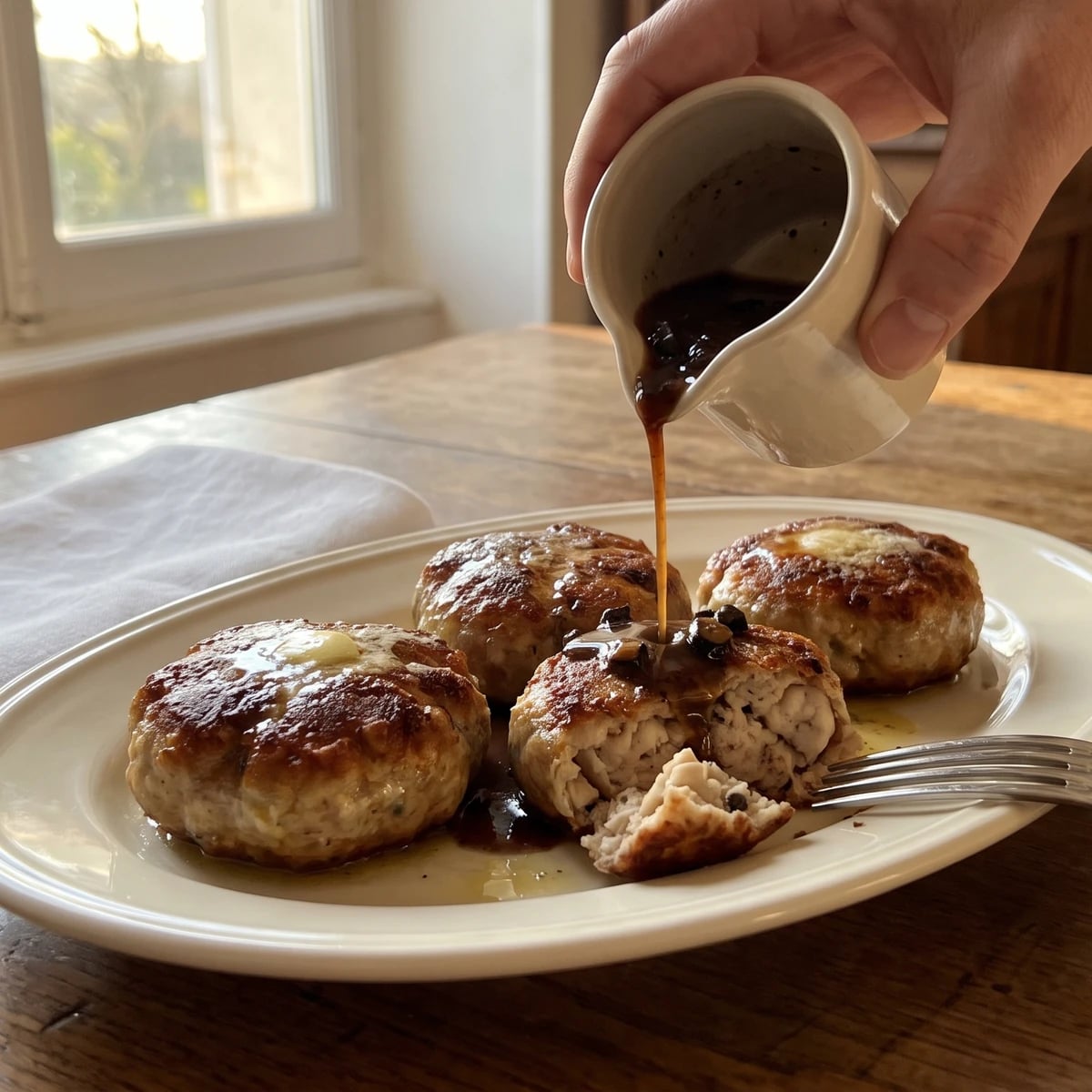
When the crépinettes are right, the crumbs are deeply bronzed, the caul has nearly vanished, and the cut centre is moist, pale, and thick with black truffle. Périgueux sauce supplies the dark, glossy counterpoint. Before you touch the heat, make the mixture cold enough that its fat is firm; that is the step that decides everything after it.

Crépinette de ris de veau belongs to the Parisian grand-kitchen register, though the crépinette form came from French charcuterie, where crépine, pig’s caul, enclosed seasoned mince and basted it as it cooked. Pairing sweetbread with calf’s udder joined delicate offal to a fatty binder, then carried the charcutier’s parcel into formal service with a crown arrangement and a finished sauce. Périgueux sauce invokes Périgord through its black truffles, but this is not a Périgord farmhouse specialty; it is a national classical composition borrowing that region’s most prized ingredient.

The technique, the tradition, and the story behind every dish.

Discover Culinary Explorer

Ingredients

raw veal throat sweetbread

Quantity

1 small lobe (about 6 oz / 170 g), yielding ⅔ cup (160 ml / 109 g) prepared

blanched, pressed, trimmed, chilled, and finely chopped

raw calf’s udder from an inspected butcher

Quantity

⅔ cup (160 ml / 109 g)

well chilled, trimmed, and finely chopped

black truffles, fresh or whole preserved

Quantity

½ cup (120 ml / 68 g)

well drained and finely chopped

beaten whole egg

Quantity

3 tablespoons (45 ml / 48 g), from about 1 large egg

fine salt

Quantity

1⅛ teaspoons (5.5 ml / 6.8 g)

freshly ground black pepper

Quantity

⅛ teaspoon (0.6 ml / 0.3 g)

very soft pig’s caul

Quantity

4 pieces, each about 8 inches / 20 cm square (about 3½ oz / 100 g total)

unsalted butter

Quantity

2 tablespoons (30 ml / 28 g)

melted

fine fresh breadcrumbs

Quantity

½ cup (120 ml / 30 g)

prepared Périgueux sauce

Quantity

1¼ cups (300 ml / 315 g)

kept hot

cold water

Quantity

16 cups (3.8 L / 3.8 kg), divided, plus more as needed

Equipment Needed

  • Digital kitchen scale accurate to 1 gram
  • 2-quart / 2-liter saucepan
  • Two small trays and a 2-pound / 1-kilogram weight
  • Sharp chef’s knife and chilled mixing bowl
  • Rimmed metal broiler tray with a broiler-safe rack
  • Broad metal spatula
  • Instant-read thermometer
  • Small saucepan and warmed sauceboat

Instructions

  1. 1

    Prepare the sweetbread

    Cover the raw sweetbread with cold water and soak it for 30 minutes, changing the water once. Put it in a small saucepan with fresh cold water, bring the water slowly to a bare simmer, and blanch for 5 minutes. Lift it into fresh cold water, then peel away the outer membrane, tubes, and any dark or bloody spots. Set the cleaned sweetbread between two small trays, place a 2-pound / 1-kilogram weight on top, and chill for 30 minutes. Weigh out exactly 109 g of the prepared sweetbread. If the yield is short, do not pad the mixture with extra udder; use equal prepared weights and make slightly smaller crépinettes.

    The blanching firms the delicate tissue enough to trim cleanly, while pressing gives it an even texture for chopping. A hard boil toughens the outside before the centre has set.
  2. 2

    Soften the caul

    While the sweetbread is under its weight, unfold the caul gently in a bowl of fresh cold water. Soak it for 15 minutes, rinse it carefully, and spread it over a clean towel. Pat it dry without pulling. Cut four soft squares about 8 inches / 20 cm across, following the natural web rather than trying to make perfect geometry. Keep the caul cold until wrapping.

  3. 3

    Mix the forcemeat

    Chop the chilled sweetbread and chilled calf’s udder together with a sharp knife until fine but still faintly granular, never puréed. Put them in a cold bowl, season with the salt and pepper, then add the chopped truffles and beaten egg in that order. Mix firmly with a cold spoon until the forcemeat becomes cohesive and slightly tacky. If the bowl turns greasy or the mixture begins smearing, stop immediately and spread it over a chilled tray for 10 minutes before continuing. Ça se rattrape. Warm fat cannot bind properly, but cold restores its structure.

  4. 4

    Shape and wrap

    Divide the forcemeat into four portions of 3 ounces / 85 g, using a scale rather than judging by eye. Shape each into a compact oval about ¾ inch / 2 cm thick. Lay one portion in the centre of each caul square, fold the caul over it snugly, and trim away heavy overlaps. Set each crépinette seam-side down. If the caul tears, overlap a small scrap across the gap; the web fuses as its fat melts.

  5. 5

    Butter and crumb

    Set a broiler-safe rack over a rimmed metal tray and preheat the broiler on low, positioning the rack about 8 inches / 20 cm from the heat. Brush every surface of the crépinettes with melted butter, then shower them with the fine breadcrumbs and press very lightly so the coating adheres without compressing the mince. Chill them on the rack for 10 minutes while the broiler settles. Butter, not margarine. The butter gives the crumbs their even bronze finish while the caul bastes from beneath.

  6. 6

    Grill them gently

    Slide the tray beneath the low broiler and cook for 8 to 10 minutes, until the upper crumbs are evenly golden. Turn the crépinettes carefully with a broad spatula and cook the second side for another 7 to 9 minutes. They are ready when both faces are deep gold, the caul has rendered nearly invisible, and the centre reaches 160°F / 71°C. If the crumbs darken before the centre is ready, move the tray farther from the heat and finish in a 350°F / 180°C oven. Fierce grilling is not bravery here; gentle heat is the technique.

  7. 7

    Sauce and serve

    While the crépinettes cook, warm the prepared Périgueux sauce in a small saucepan at the barest simmer, stirring often. Do not boil it. If it has tightened in the cold, loosen it with a tablespoon (15 ml / 15 g) of hot water and stir until it again coats the back of a spoon with a dark gloss. Rest the crépinettes for 3 minutes, then arrange them in a crown on a heated platter. Bring the Périgueux sauce alongside in a warmed sauceboat and spoon it generously at the table. À table!

Chef Tips

  • Order the throat sweetbread, calf’s udder, and caul together from a butcher who handles inspected veal offal. Calf’s udder is not beef suet. Pork back fat can bind a different crépinette, but it does not preserve this entry’s texture or flavor.
  • Prepared trimmings left after slicing white sweetbreads are entirely proper here and are named in the source itself. Weigh them after trimming, keep them cold, and use exactly the same weight of raw calf’s udder.
  • The truffle proportion is intentionally lavish: five ounces for every pound of the sweetbread-and-udder mince. Whole preserved black truffles, drained and patted dry, are the classical pantry’s honest answer when fresh truffles are out of season. Truffle oil is not.
  • Serve with pommes purée or plainly buttered spinach, something quiet enough to receive the sauce. A supple red Bordeaux has enough earth and structure for the offal and truffle without bullying them.

Advance Preparation

  • The sweetbread can be blanched, trimmed, pressed, and refrigerated one day ahead. Keep it tightly covered and chop it only when you are ready to mix the forcemeat.
  • Prepare the Périgueux sauce from its own recipe up to two days ahead, chill it promptly, and reheat it gently while the crépinettes grill.
  • The wrapped crépinettes may be assembled up to 4 hours ahead and kept covered in the cold. Apply the melted butter and breadcrumbs just before cooking so the crumb stays dry and distinct.

Frequently Asked Questions

Nutrition Information

1 serving (about 190g)

Calories
425 calories
Total Fat
35 g
Saturated Fat
16 g
Trans Fat
0.5 g
Unsaturated Fat
18 g
Cholesterol
190 mg
Sodium
1150 mg
Total Carbohydrates
11 g
Dietary Fiber
1 g
Sugars
2 g
Protein
17 g

Note: Chef personas and recipes are created with AI assistance. Cook with care: follow safe food-handling practices, check doneness with a thermometer when needed, and adapt for allergies and your kitchen.

Where cooking meets culture.

Culinary guides, cultural storytelling, and the editorial depth that makes cooking meaningful.

Discover Culinary Explorer

More from Relevés and Entrées - VEAL

Browse the full collection