
Chef Juliette
John Dory (St. Pierre)
John Dory has the delicacy of sole and the firmness of turbot. A light flouring, a quick butter sauté, and nut-brown beurre noisette show exactly why looks never mattered.
A cooking platform built around craft, culture, and the stories behind what we eat.
Created by Chef Juliette
Based on No. 1217, Grenadins Froids en Bellevue, from Le Guide Culinaire (1907) by Auguste Escoffier
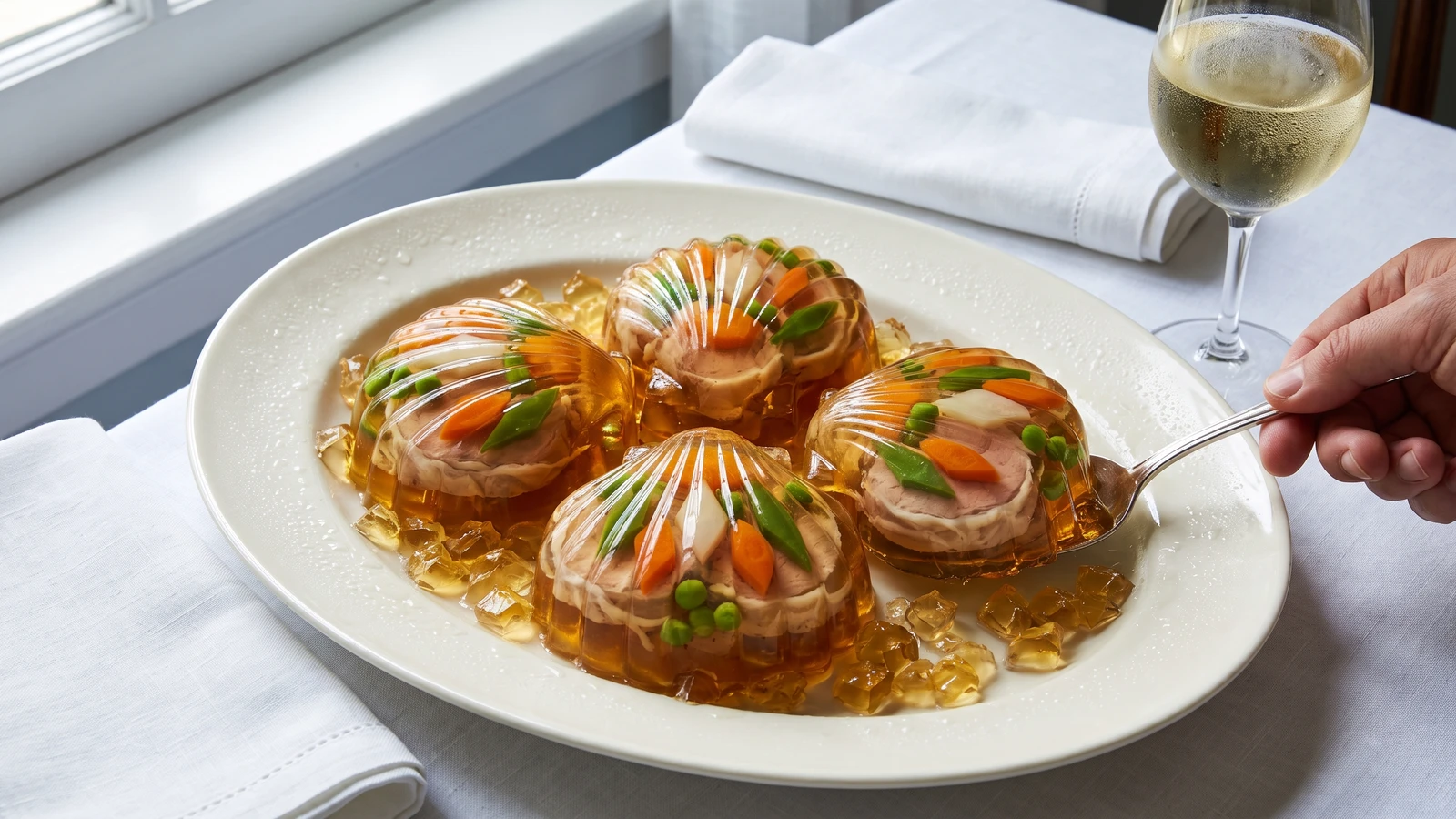
Grenadins en bellevue teach the discipline of aspic: cold veal, exact vegetable trim, and clear jelly layered patiently so the finished crown unmoulds cleanly and holds every bright detail in place.
Grenadins Froids en Bellevue (cold larded veal medallions displayed in aspic) teach one exacting principle: everything that enters the jelly must be cold, dry, and fixed in place before the next layer is poured. Rush that order and the vegetables float, the aspic clouds, and the design wanders. Respect it and four modest medallions emerge under clear, pale-gold jelly, each bright lozenge held precisely where your hand set it.
The source begins with cooked grenadins and melted aspic already waiting, because its kitchen assumed a larding needle, a saucier on staff, clear stock never off the fire, and ranks of shell-shaped dishes. At home, a narrow skewer replaces the larding needle, excellent degreased stock strengthened with measured gelatin replaces a separate consommé operation, and four small moulds replace brigade quantities. That is scaffolding, so it can change. The larded face placed downward, the staged vegetable border, the half-fill of jelly, and the final crown of chopped aspic are the dish itself, so they stay.
This is one cook, one stove, one evening of work, followed by a long rest in the cold. The decisive moment comes when you fix the vegetable border with droplets of aspic: let those drops become tacky before filling the moulds, and nothing will float.
Grenadins en bellevue belong to the Parisian garde-manger, the cold-kitchen branch of the classical table, where clarity, decoration, and careful unmoulding displayed the cook's control. A grenadin is a small, thick medallion of veal traditionally threaded with pork fat, while en bellevue names its visible presentation beneath clear aspic rather than a separate sauce. The source's individual shell dishes bring a grand cold-buffet method down to personal portions, arranged together as a crown only when they reach the table.
Quantity
4, about 5 ounces / 140 g each
cut 1¼ inches / 3 cm thick
Quantity
1½ ounces (40 g)
cut into 12 narrow larding strips
Quantity
2 tablespoons (30 ml / 28 g)
Quantity
1½ teaspoons (7.5 ml / 9 g), plus more if needed
divided
Quantity
⅛ teaspoon (0.6 ml / 0.3 g)
Quantity
4 cups (960 ml / about 960 g)
cold and thoroughly degreased
Quantity
2 tablespoons (30 ml / 18 g), or 1 tablespoon (15 ml / 9 g) if the cold stock already sets firmly
Quantity
½ cup (120 ml / 70 g)
cut into thin lozenges
Quantity
½ cup (120 ml / 75 g)
cut into thin lozenges
Quantity
½ cup (120 ml / 60 g)
cut into small diamonds
Quantity
½ cup (120 ml / 70 g)
| Ingredient | Quantity |
|---|---|
| center-cut veal tenderloin grenadinscut 1¼ inches / 3 cm thick | 4, about 5 ounces / 140 g each |
| chilled unsalted pork fatbackcut into 12 narrow larding strips | 1½ ounces (40 g) |
| unsalted butter | 2 tablespoons (30 ml / 28 g) |
| fine sea saltdivided | 1½ teaspoons (7.5 ml / 9 g), plus more if needed |
| ground white pepper | ⅛ teaspoon (0.6 ml / 0.3 g) |
| very clear, low-sodium veal or beef stockcold and thoroughly degreased | 4 cups (960 ml / about 960 g) |
| unflavored powdered gelatin | 2 tablespoons (30 ml / 18 g), or 1 tablespoon (15 ml / 9 g) if the cold stock already sets firmly |
| peeled carrotcut into thin lozenges | ½ cup (120 ml / 70 g) |
| peeled turnipcut into thin lozenges | ½ cup (120 ml / 75 g) |
| fine green beanscut into small diamonds | ½ cup (120 ml / 60 g) |
| frozen petite peas | ½ cup (120 ml / 70 g) |
Chill the fatback strips until firm enough to handle. Choose one broad face of each grenadin as the larded face, then use a small pointed knife and narrow metal skewer to open three parallel tunnels through the upper third of the meat. Push one fatback strip through each tunnel and trim it level with the sides. If the fat softens or tears, stop and chill it for 10 minutes; cold fat threads cleanly. Tie a loop of kitchen twine around each grenadin so it holds a neat round shape.
Season the grenadins with ¾ teaspoon of the salt and the white pepper. Melt the butter in a heavy skillet over medium-high heat, and when its foam subsides, set the grenadins in larded-side down. Brown for about 2 minutes, turn, brown the second face, then lower the heat and cook gently, turning onto the edges as needed, until the centres reach 145°F / 63°C. Rest for at least 3 minutes, remove the twine, and refrigerate uncovered on a rack until thoroughly cold, about 1 hour. Blot away every trace of surface butter before moulding; grease makes the aspic slide and turn cloudy.
Sprinkle the gelatin evenly over 1 cup of the cold stock and leave it to bloom for 10 minutes. Heat the remaining 3 cups with ½ teaspoon of the salt until just below a simmer, then remove it from the heat and stir in the bloomed gelatin until completely dissolved. Do not boil it. Strain through a dampened fine-mesh sieve without pressing, then taste a spoonful after chilling it briefly on an icy saucer; cold mutes seasoning, so the aspic should taste full but not salty. If it starts setting before you need it, warm the bowl over barely hot water until fluid again. Ça se rattrape.
Bring a saucepan of water to a boil and season it with the remaining salt. Blanch the carrot and turnip separately until just tender, 2 to 3 minutes; blanch the green beans for about 2 minutes and the peas for 30 seconds. Transfer each vegetable directly to ice water to stop the cooking and preserve its colour. Drain everything thoroughly, then spread the pieces on a clean towel and pat them dry. Water trapped on the vegetables dilutes the aspic exactly where it must grip.
Pour 1 cup of the aspic into a shallow dish and refrigerate it for the chopped border. Spoon a thin layer, about ⅛ inch / 3 mm, into the bottom of each shell-shaped mould and chill until firm. Arrange a restrained design of carrot, turnip, green bean, and peas on this layer, remembering that the bottom of the mould will become the top. Touch each piece with a few drops of liquid aspic and chill again until fixed.
Set one thoroughly chilled grenadin into each mould with its larded face undermost, directly against the decoration. Pour cool, still-fluid aspic slowly down the side of each mould until it reaches halfway up the thickness of the meat. Refrigerate until this layer is completely set, about 25 minutes. The aspic must be cool before pouring; warm jelly melts the first layer and releases the design.
Arrange the remaining carrot, turnip, green bean diamonds, and peas around each grenadin, forming a close border on the set aspic. Sprinkle the vegetables with only enough liquid aspic to wet and anchor them, then chill for 10 minutes, until the fixing drops feel tacky and firm. If a piece floats when you test the first mould, lift it back into place and chill longer before continuing. Ça se rattrape; the mistake is pouring the final layer before the border can hold itself.
Fill the moulds to their rims with the remaining cool aspic, pouring slowly against the side so the current cannot disturb the vegetables. Refrigerate on a level shelf for at least 4 hours, preferably overnight, until the jelly is firm from edge to centre. Once set, cover the moulds without letting the covering touch the surface.
Chill a large serving platter until very cold. Dip each mould into hot tap water for 3 to 5 seconds, wipe the outside dry, cover it with your hand, and invert it onto the platter. If it refuses to release, repeat the dip for 2 seconds rather than soaking it; too much heat melts the detail. Arrange the four grenadins in a crown with their decorated larded faces upward. Chop the reserved aspic into clear, irregular pieces and place it around the crown as a generous border. Keep the platter cold and serve immediately. À table!
1 serving (about 420g)
Culinary guides, cultural storytelling, and the editorial depth that makes cooking meaningful.
Discover Culinary ExplorerChef Juliette
John Dory has the delicacy of sole and the firmness of turbot. A light flouring, a quick butter sauté, and nut-brown beurre noisette show exactly why looks never mattered.

Chef Juliette
Fresh haddock proves its delicacy in the meunière pan: a fine flour crust, moist pearly flakes, and beurre noisette sharpened with lemon and parsley, ready from one skillet in half an hour.

Chef Juliette
Éperlans à l’Anglaise turns small fish into a lesson in disciplined coating: boned smelts under a close, crisp crumb, pan-fried in clarified butter and finished with bright, half-melted maître d’hôtel butter.

Chef Juliette
Tiny smelts, shallot, mushrooms, white wine, gratin sauce, and fine bread raspings meet a fierce oven, where the fish must turn tender in the same breath the buttered crust bronzes.