
Chef Juliette
John Dory (St. Pierre)
John Dory has the delicacy of sole and the firmness of turbot. A light flouring, a quick butter sauté, and nut-brown beurre noisette show exactly why looks never mattered.
A cooking platform built around craft, culture, and the stories behind what we eat.
Created by Chef Juliette
Based on No. 1216, Grenadins, from Le Guide Culinaire (1907) by Auguste Escoffier
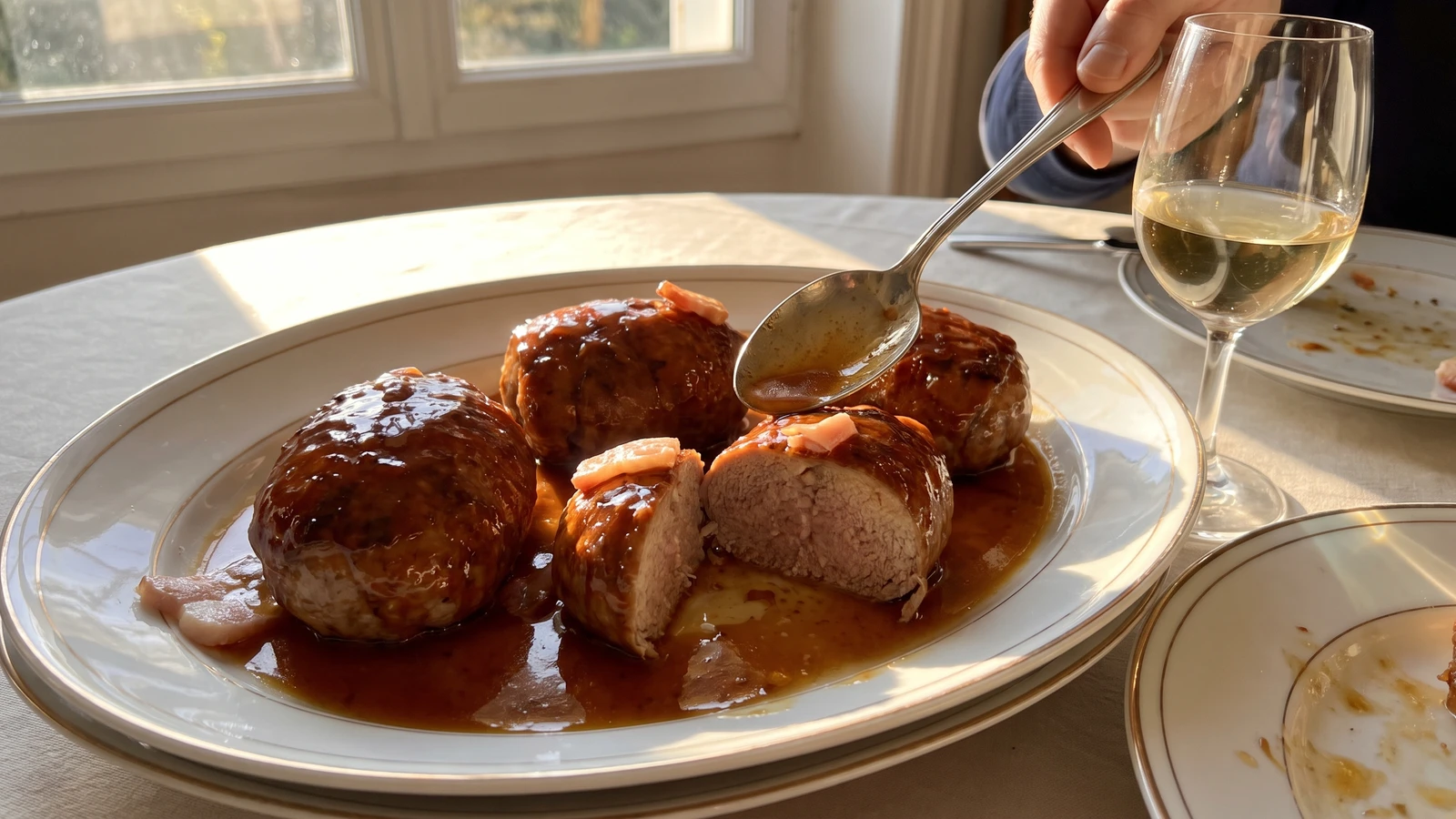
Thick veal collops threaded with fine bacon, braised under a watchful spoon, and glazed until lacquered: grenadins teach that basting is not fussing, but the technique that keeps lean meat generous.
Grenadins de veau (larded, braised veal collops) teach the discipline of basting. The one true thing to know before touching a pan is this: a small, lean cut cannot spend nearly two hours in dry upper heat and remain generous unless you keep returning its braising liquor to its surface. That repeated spooning is not fuss. It is the dish.
The original recipe assumed a larding needle, a saucier free to baste, stock never off the fire, and a salamander waiting to set the glaze. At home, chilled bacon matchsticks, a fine metal skewer, a snug covered pan, rich unsalted stock, and the broiler do the same work. The old entry also sent the meat toward a separate formal garnish assembled elsewhere in the repertoire; here the grenadins return to their own reduced braising glaze, with a plain potato or seasonal vegetable beside them. The separate service pans are brigade scaffolding. Fine larding, frequent basting, and the rapid glaze are the dish, and they stay. One cook, one stove, one evening.
Done properly, each grenadin arrives deep bronze and glossy, with little veins of bacon protecting the fine-grained veal and a clear, concentrated glaze pooling beneath it. Set a timer for the basting. That quarter-hour rhythm matters more than any flourish at the end.
Grenadins belong to the French classical dining-room repertoire codified in Paris, rather than to one regional larder. Cooks made them by dividing the larger fricandeau into thick individual collops, then preserving its fine larding, slow braise, and glaze in miniature. The common habit of calling any veal medallion a grenadin misses the older distinction: here the word promises a small fricandeau, not a quick pan-fry.
Quantity
4 collops, about 1½ pounds (680 g) total
cut about 1½ inches (4 cm) thick
Quantity
2 ounces (55 g)
rind removed and cut into 16 strips about ⅛ inch (3 mm) square
Quantity
1 teaspoon (5 ml / 6 g)
Quantity
½ teaspoon (2.5 ml / 1 g)
Quantity
2 tablespoons (30 ml / 28 g)
Quantity
1 medium, about 1 cup (240 ml / 150 g)
thinly sliced
Quantity
1 medium, about ¾ cup (180 ml / 100 g)
thinly sliced
Quantity
1
Quantity
3 cups (720 ml / 720 g)
divided
Quantity
1 tablespoon (15 ml / 14 g)
diced
| Ingredient | Quantity |
|---|---|
| thick veal collops from the cushion or top roundcut about 1½ inches (4 cm) thick | 4 collops, about 1½ pounds (680 g) total |
| mild unsmoked fatty baconrind removed and cut into 16 strips about ⅛ inch (3 mm) square | 2 ounces (55 g) |
| fine sea salt | 1 teaspoon (5 ml / 6 g) |
| freshly ground white pepper | ½ teaspoon (2.5 ml / 1 g) |
| clarified butter | 2 tablespoons (30 ml / 28 g) |
| medium onionthinly sliced | 1 medium, about 1 cup (240 ml / 150 g) |
| medium carrotthinly sliced | 1 medium, about ¾ cup (180 ml / 100 g) |
| bouquet garni of parsley stems, thyme, and bay leaf | 1 |
| rich unsalted veal or chicken stockdivided | 3 cups (720 ml / 720 g) |
| cold unsalted butterdiced | 1 tablespoon (15 ml / 14 g) |
Chill the bacon strips for 15 minutes, until firm enough to handle without becoming brittle. Pat the veal dry. Push a fine metal skewer across the upper third of each collop to form four evenly spaced, parallel tunnels, then use a narrow chopstick or the blunt end of the skewer to feed one bacon strip through each tunnel. Leave only a tiny end showing on either side and trim away the excess. Tie each collop once around its waist so it keeps a neat round shape. If the bacon softens and buckles, return it to the cold and reopen the tunnel with the skewer. Ça se rattrape; cutting a large trench through the meat does not.
Heat the oven to 325°F (165°C), or 300°F (150°C) with a fan. Season the veal with the salt and white pepper. Heat the clarified butter in a snug, heavy ovenproof sauté pan over medium-high heat, then brown the underside and sides of the grenadins for 2 to 3 minutes per surface. Give the larded face only a brief touch to the pan and keep it uppermost afterward. Transfer the meat to a plate. Lower the heat, add the onion and carrot, and cook for 6 to 8 minutes until golden at their edges. Add ½ cup (120 ml / 120 g) of the stock and scrape up the fond, the browned film on the pan floor. If that film has turned black rather than brown, wipe it away before continuing; burnt fond only grows bitter when reduced.
Spread the vegetables into an even bed and set the grenadins on top, larded faces upward. Add the bouquet garni and enough of the remaining stock to reach halfway up the sides of the meat, keeping at least ½ cup (120 ml / 120 g) in reserve. Bring the liquid just to a simmer. Cover the surface with a cartouche, a round of parchment, then put on the lid and transfer the pan to the oven. The liquid should barely tremble; boiling contracts the veal before the connective tissue has time to soften.
Braise for 1 hour 30 minutes to 1 hour 50 minutes, opening the pan every 15 minutes and spooning the liquor generously over each grenadin before replacing the cartouche and lid. Keep the larded faces upward. If the liquid drops below one-third of the meat's height, add reserved stock a little at a time; if the exposed tops begin darkening too quickly, press the cartouche directly against them. The grenadins are ready when a fine skewer enters with little resistance and the meat yields beneath a spoon without collapsing. Time begins the test, tenderness ends it.
Lift the grenadins onto an ovenproof platter and cover them loosely. Discard the bouquet garni, then strain the braising liquor into a small saucepan without pressing on the vegetables. Skim off excess fat and boil the liquor briskly until about ¾ cup (180 ml / 180 g) remains and it coats the back of a spoon in a clear, glossy film, about 8 to 12 minutes. If it becomes sticky or tight before the flavour is balanced, whisk in hot reserved stock one tablespoon at a time. Ça se rattrape. Do not reach for flour; reduction and the stock's natural gelatin make the lacquer.
Heat the broiler with a rack about 6 inches (15 cm) below it. Snip away the twine and brush the grenadins with a thin coat of reduced liquor. Broil for 30 to 45 seconds, brush again, and repeat until three coats have set into a deep amber lacquer. Watch continuously, because rapid glazing is measured in seconds. If the glaze thickens in the saucepan before the next coat, loosen it with a teaspoon of stock. Whisk the cold butter into the remaining liquor off the heat; if it looks oily, whisk in a teaspoon of cold stock until it comes together. Pool this sauce around the grenadins without covering their lacquer, and serve at once. À table!
1 serving (about 180g)
Culinary guides, cultural storytelling, and the editorial depth that makes cooking meaningful.
Discover Culinary ExplorerChef Juliette
John Dory has the delicacy of sole and the firmness of turbot. A light flouring, a quick butter sauté, and nut-brown beurre noisette show exactly why looks never mattered.

Chef Juliette
Fresh haddock proves its delicacy in the meunière pan: a fine flour crust, moist pearly flakes, and beurre noisette sharpened with lemon and parsley, ready from one skillet in half an hour.

Chef Juliette
Éperlans à l’Anglaise turns small fish into a lesson in disciplined coating: boned smelts under a close, crisp crumb, pan-fried in clarified butter and finished with bright, half-melted maître d’hôtel butter.

Chef Juliette
Tiny smelts, shallot, mushrooms, white wine, gratin sauce, and fine bread raspings meet a fierce oven, where the fish must turn tender in the same breath the buttered crust bronzes.