
Chef Juliette
John Dory (St. Pierre)
John Dory has the delicacy of sole and the firmness of turbot. A light flouring, a quick butter sauté, and nut-brown beurre noisette show exactly why looks never mattered.
A cooking platform built around craft, culture, and the stories behind what we eat.
Created by Chef Juliette
Based on No. 1214, Tête de Veau à la Vinaigrette ou à l’Huile, from Le Guide Culinaire (1907) by Auguste Escoffier
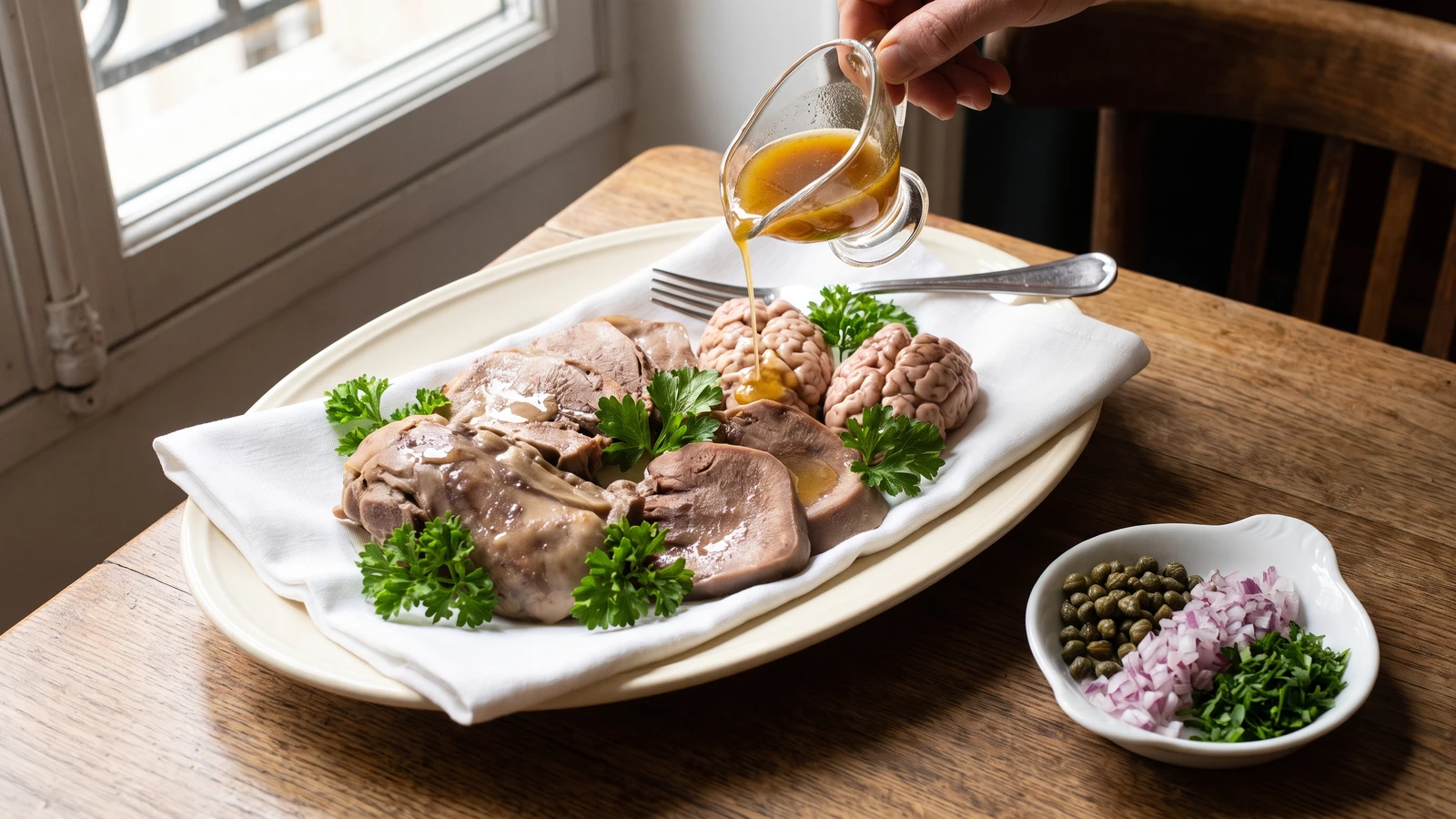
Tête de Veau à la Vinaigrette ou à l’Huile asks for one discipline: poach the head gently, then serve it warm with tongue, brain, green parsley, and the book’s exact one-two-one sauce.
Tête de Veau à la Vinaigrette ou à l’Huile (calf’s head with vinaigrette or oil sauce) teaches the patience of gelatin. A calf’s head doesn’t become tender by boiling harder; it becomes tender by scarcely boiling at all. That is the one true thing to know before touching the pot.
The source entry begins at service, with boiling pieces waiting, the tongue and brain already managed, and a sauceboat arriving from another pair of hands. For four people, a butcher-prepared boned half-head, a heavy pot, and one small saucepan do the same work. The whole skull, muslin wrapping, and brigade staging are scaffolding and can go. The warm napkin service, separate garnishes, and exact ratio of one part vinegar, two parts oil, and one part cooking liquor are the dish and stay. One cook, one stove, one evening.
At the table, the head should be yielding and faintly pearly, the tongue firm enough to slice cleanly, and the brain delicate against cold green parsley. The vinaigrette supplies the necessary bite. Keep the poach at a tremble. That is the step that matters most before you begin.
Tête de veau à la vinaigrette belongs especially to the Parisian bouillon and bistro table, though calf’s-head cookery was practiced wherever French households and charcutiers used the whole animal. Charcutiers handled the skilled boning, while cooks turned one economical cut into a complete service of contrasting textures: gelatinous mask, dense tongue, and delicate brain. Sauce ravigote is a familiar companion, but it is not mandatory; this classical entry keeps capers, onion, and parsley separate and builds its vinaigrette with the head’s own cooking liquor.
Quantity
1, about 2½ pounds (1.1 kg)
butcher-prepared, tied, and packed without the tongue or brain
Quantity
1, about 12 ounces (340 g)
trimmed
Quantity
1, about 10 ounces (280 g)
very fresh
Quantity
16 cups (3.8 L / 3.8 kg)
plus more as needed to cover
Quantity
½ cup (120 ml / 60 g)
Quantity
½ cup (120 ml / 120 g)
Quantity
1, about 5 ounces (150 g)
scrubbed and cut into chunks
Quantity
1, about 7 ounces (200 g)
halved
Quantity
1
Quantity
2 tablespoons (30 ml / 36 g)
Quantity
¼ cup (60 ml / 60 g)
Quantity
½ cup (120 ml / 110 g)
Quantity
¼ cup (60 ml / 60 g)
skimmed, strained, and kept hot
Quantity
½ teaspoon (2.5 ml / 3 g)
or to taste
Quantity
½ teaspoon (2.5 ml / 1 g)
Quantity
¼ cup (60 ml / 45 g)
drained
Quantity
½ cup (120 ml / 75 g)
very finely chopped
Quantity
¼ cup (60 ml / 15 g)
finely chopped
Quantity
12
| Ingredient | Quantity |
|---|---|
| boned and rolled half calf’s headbutcher-prepared, tied, and packed without the tongue or brain | 1, about 2½ pounds (1.1 kg) |
| calf’s tonguetrimmed | 1, about 12 ounces (340 g) |
| calf’s brainvery fresh | 1, about 10 ounces (280 g) |
| cold waterplus more as needed to cover | 16 cups (3.8 L / 3.8 kg) |
| plain flour | ½ cup (120 ml / 60 g) |
| white wine vinegar for the blanc | ½ cup (120 ml / 120 g) |
| large carrotscrubbed and cut into chunks | 1, about 5 ounces (150 g) |
| large yellow onion for the blanchalved | 1, about 7 ounces (200 g) |
| bouquet garni of parsley stems, thyme, and bay | 1 |
| coarse sea salt | 2 tablespoons (30 ml / 36 g) |
| white wine vinegar for the sauce | ¼ cup (60 ml / 60 g) |
| mild olive oil | ½ cup (120 ml / 110 g) |
| calf’s-head cooking liquorskimmed, strained, and kept hot | ¼ cup (60 ml / 60 g) |
| fine sea saltor to taste | ½ teaspoon (2.5 ml / 3 g) |
| freshly ground black pepper | ½ teaspoon (2.5 ml / 1 g) |
| capersdrained | ¼ cup (60 ml / 45 g) |
| yellow onion for servingvery finely chopped | ½ cup (120 ml / 75 g) |
| curly-leaf parsley for servingfinely chopped | ¼ cup (60 ml / 15 g) |
| very green curly-leaf parsley sprigs | 12 |
Check that the calf’s-head roll is firmly tied and keep it and the tongue cold. Submerge the brain in a bowl of very cold water for 1 hour, changing the water twice. Working under the water, gently tease away the thin surface membrane and any visible blood vessels without separating the lobes, then return the cleaned brain to fresh cold water until its poaching liquor is ready.
In a heavy 8-quart pot, whisk the flour with the ½ cup vinegar and about 2 cups of the cold water until perfectly smooth. Add the remaining water, carrot, halved onion, bouquet garni, and coarse salt. This blanc, a lightly floured acidulated cooking liquor, protects the pale colour of the head while its collagen softens. Lower in the head and tongue, adding only enough extra water to cover them by 1 inch. Lay a round of baking parchment directly on the liquid and cover the pot loosely.
Bring the blanc slowly to the barest simmer, skimming away any grey foam as it rises. Hold it between 185 and 194°F (85 and 90°C), where the surface scarcely trembles, for 2½ to 3 hours. Test the tongue after 1½ hours: when a skewer slips easily into its thick end, lift it out, peel away the skin while it is hot, and hold the tongue covered in a ladleful of cooking liquor. Test the head after 2½ hours; it is ready when a skewer passes through its skin and cartilage without springing back. If the pot breaks into a hard boil, pull it from the heat, add ½ cup of cold water, and lower the burner before continuing. Ça se rattrape. A hard boil tightens the skin, but patient cooking will soften it again.
During the final 20 minutes of the head’s cooking, strain 4 cups of the blanc into a 2-quart saucepan and bring it to a bare tremble. Lower in the drained brain and poach it gently for 12 to 15 minutes, turning it once with a slotted spoon, until it is opaque throughout and reaches 160°F (71°C) at the centre. Lift it carefully and let it drain for 5 minutes. Cut it with a damp knife into collops, small neat slices about ½ inch thick. If a lobe begins to crumble, stop cutting and serve it in larger pieces; pressing or reshaping only makes it pasty.
Skim the surface fat from the cooking liquor and strain it through a fine sieve. In a warm sauceboat or bowl, dissolve the fine salt and pepper in the ¼ cup vinegar, whisk in ¼ cup of hot cooking liquor, then whisk in the ½ cup oil. The source ratio stays exact: one part vinegar, two parts oil, one part cooking liquor. This sauce à l’huile is a loose vinaigrette, not a bound mayonnaise, so a few beads of oil are proper. If it separates while waiting, whisk it again just before serving. Nothing is spoiled.
Arrange the drained capers, finely chopped raw onion, and chopped parsley in three distinct piles on a small hors-d’œuvre dish. Do not mix them into the vinaigrette. The separate service lets each person sharpen the rich head, firm tongue, and delicate brain differently. Refresh the parsley sprigs in cold water if they have wilted, then dry them thoroughly.
Lift the calf’s-head roll from its liquor and drain it for a full 2 minutes before removing the ties. Cut it into thick, generous pieces and slice the peeled tongue neatly across the grain. Line a warm oval platter with a freshly laundered, unscented linen or cotton napkin, set the head in the centre, and surround it with alternating slices of tongue and collops of brain. Tuck in the very green parsley sprigs. Bring the platter, the three separate condiments, and the sauceboat of vinaigrette to the table together. The napkin catches excess liquor so the sauce remains bright rather than watery. À table!
1 serving (about 420g)
Culinary guides, cultural storytelling, and the editorial depth that makes cooking meaningful.
Discover Culinary ExplorerChef Juliette
John Dory has the delicacy of sole and the firmness of turbot. A light flouring, a quick butter sauté, and nut-brown beurre noisette show exactly why looks never mattered.

Chef Juliette
Fresh haddock proves its delicacy in the meunière pan: a fine flour crust, moist pearly flakes, and beurre noisette sharpened with lemon and parsley, ready from one skillet in half an hour.

Chef Juliette
Éperlans à l’Anglaise turns small fish into a lesson in disciplined coating: boned smelts under a close, crisp crumb, pan-fried in clarified butter and finished with bright, half-melted maître d’hôtel butter.

Chef Juliette
Tiny smelts, shallot, mushrooms, white wine, gratin sauce, and fine bread raspings meet a fierce oven, where the fish must turn tender in the same breath the buttered crust bronzes.