
Chef Juliette
John Dory (St. Pierre)
John Dory has the delicacy of sole and the firmness of turbot. A light flouring, a quick butter sauté, and nut-brown beurre noisette show exactly why looks never mattered.
A cooking platform built around craft, culture, and the stories behind what we eat.
Created by Chef Juliette
Based on No. 1213, Tête de Veau en Tortue, from Le Guide Culinaire (1907) by Auguste Escoffier
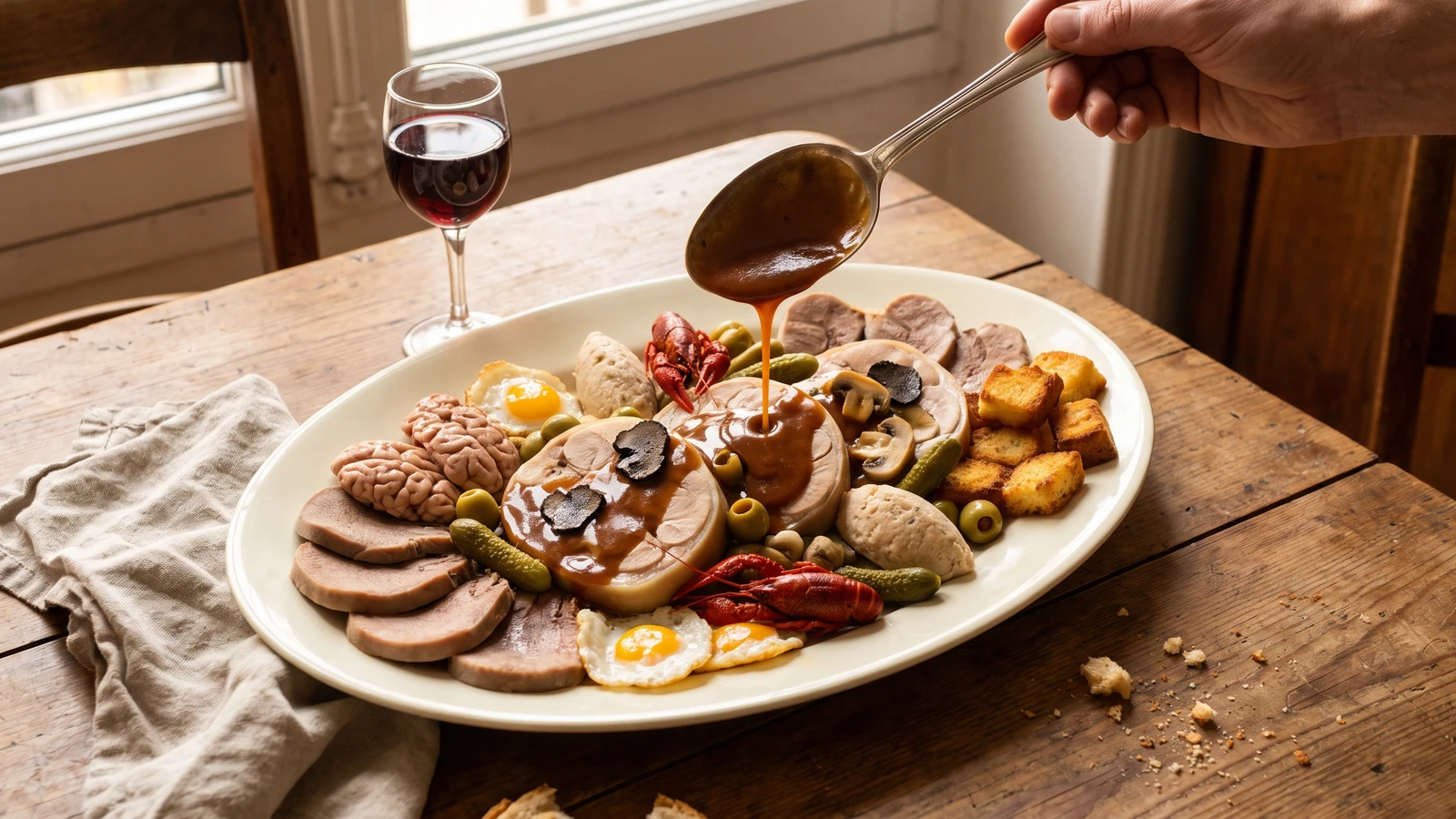
Tête de veau becomes a lesson in grand garnish made manageable: tender skin, herb-dark Sauce Tortue, buttered quenelles, offal, crayfish, olives, truffle, fried eggs, and crisp Croûtons brought together by one cook.
Tête de Veau en Tortue (calf's-head skin under tortue garnish) teaches orchestration. The one true thing to know before touching a pan is this: every garnish must be ready before the sauce is finished. The skin should be meltingly tender, the quenelles light, the crayfish just cooked, and the Sauce Tortue glossy enough to bind the abundance without burying it.
The old formula assumed a saucier on staff, veal stock never off the fire, separate hands for poaching offal and shaping quenelles, and the salamander and hot cupboard of a full brigade. Here, a small roux-bound veal-stock reduction becomes Sauce Tortue in one saucepan, a food processor replaces the mortar and fine sieve, and a low oven replaces the hot cupboard. The salamander goes entirely because nothing in this entry is gratinéed. Multiple poaching pots were brigade scaffolding, so one court-bouillon serves in stages. What stays is the dish itself: skin alone, the complete tortue garnish, gherkins added at the final moment, and Croûtons fried in butter just before serving.
This is a crowded plate, but it needn't be a frantic one. One cook, one stove, one evening. Finish all the poaching and cutting first, then make the sauce and bring the pieces together in their proper order. The decisive step is holding the Sauce Tortue at a bare tremble once the quenelles enter; boil it and they tighten, keep it gentle and the whole grand arrangement remains supple.
Tête de veau belongs broadly to French charcuterie and bourgeois tables, but the en tortue treatment comes from the formal kitchens of Paris, where humble calf's head was dressed with the flavor vocabulary and elaborate garnish associated with turtle dishes. The name is often misunderstood: this preparation contains no turtle, but Sauce Tortue, Madeira, aromatic tortue herbs, quenelles, truffle, olives, offal, crayfish, eggs, and Croûtons. It traveled from the grand kitchen to celebratory private tables precisely because its extravagance could be assembled from many modest pieces.
Quantity
1 (about 2½ lb / 1.2 kg)
scalded, scraped, deboned, and stripped of all attached meat
Quantity
3 qt (2.85 L / 2.85 kg)
Quantity
¼ cup (60 ml / 30 g)
Quantity
½ cup (120 ml / 120 g)
Quantity
1
halved
Quantity
1
peeled and studded with 4 cloves
Quantity
1
thickly sliced
Quantity
1
Quantity
1 tbsp (15 ml / 18 g)
Quantity
4 cockscombs and 8 kidneys (about 7 oz / 200 g total)
Quantity
4 cups (960 ml / 960 g)
Quantity
1 cup (240 ml / 240 g)
Quantity
2 tbsp (30 ml / 30 g)
Quantity
1
sliced
Quantity
1
sliced
Quantity
1
Quantity
1 tsp (5 ml / 3 g)
Quantity
2 tsp (10 ml / 12 g)
Quantity
1 (about 10 oz / 280 g)
soaked and membrane removed
Quantity
8
thawed if frozen
Quantity
1 cup loosely packed (240 ml / 170 g)
Quantity
4 tbsp (60 ml / 56 g)
diced
Quantity
1
chilled
Quantity
2 tbsp (30 ml / 30 g)
Quantity
½ tsp (2.5 ml / 3 g)
Quantity
¼ tsp (1.25 ml / 0.5 g)
Quantity
⅛ tsp (0.6 ml / 0.2 g)
Quantity
12 (about ¾ cup / 180 ml / 120 g)
pitted
Quantity
4 tbsp (60 ml / 56 g)
divided
Quantity
1
finely minced
Quantity
3 tbsp (45 ml / 24 g)
Quantity
2 tbsp (30 ml / 33 g)
Quantity
3 cups (720 ml / 720 g)
Quantity
1
2 basil sprigs, 2 marjoram sprigs, 1 thyme sprig, 1 short rosemary sprig, and 1 small sage leaf
Quantity
½ cup (120 ml / 120 g)
Quantity
⅛ tsp (0.6 ml / 0.2 g)
Quantity
1 tsp (5 ml / 6 g), or as needed
Quantity
12 (about 1 cup / 240 ml / 150 g)
trimmed
Quantity
1 (about 3 tbsp / 45 ml / 25 g)
thinly sliced
Quantity
8 (about ⅓ cup / 80 ml / 60 g)
carved into olive shapes
Quantity
1 cup loosely packed (240 ml / 170 g)
thinly sliced
Quantity
6 tbsp (90 ml / 85 g)
divided
Quantity
4 slices
crusts removed, for Croûtons
Quantity
4
Quantity
¾ cup (180 ml / 165 g)
for frying the eggs
| Ingredient | Quantity |
|---|---|
| prepared calf's head skinscalded, scraped, deboned, and stripped of all attached meat | 1 (about 2½ lb / 1.2 kg) |
| cold water | 3 qt (2.85 L / 2.85 kg) |
| all-purpose flour | ¼ cup (60 ml / 30 g) |
| white wine vinegar | ½ cup (120 ml / 120 g) |
| lemonhalved | 1 |
| large onionpeeled and studded with 4 cloves | 1 |
| large carrotthickly sliced | 1 |
| bouquet garni of parsley stems, thyme, and bay | 1 |
| fine sea salt | 1 tbsp (15 ml / 18 g) |
| cleaned cockscombs and cock's kidneys | 4 cockscombs and 8 kidneys (about 7 oz / 200 g total) |
| cold water for the court-bouillon | 4 cups (960 ml / 960 g) |
| dry white wine | 1 cup (240 ml / 240 g) |
| white wine vinegar for the court-bouillon | 2 tbsp (30 ml / 30 g) |
| small carrotsliced | 1 |
| small onionsliced | 1 |
| bouquet garni for the court-bouillon | 1 |
| black peppercorns | 1 tsp (5 ml / 3 g) |
| fine sea salt for the court-bouillon | 2 tsp (10 ml / 12 g) |
| calf brainsoaked and membrane removed | 1 (about 10 oz / 280 g) |
| small whole raw crayfishthawed if frozen | 8 |
| very cold finely ground lean veal | 1 cup loosely packed (240 ml / 170 g) |
| cold unsalted butterdiced | 4 tbsp (60 ml / 56 g) |
| large eggchilled | 1 |
| cold heavy cream | 2 tbsp (30 ml / 30 g) |
| fine sea salt for the forcemeat | ½ tsp (2.5 ml / 3 g) |
| ground white pepper | ¼ tsp (1.25 ml / 0.5 g) |
| freshly grated nutmeg | ⅛ tsp (0.6 ml / 0.2 g) |
| large green olivespitted | 12 (about ¾ cup / 180 ml / 120 g) |
| unsalted butter for Sauce Tortuedivided | 4 tbsp (60 ml / 56 g) |
| large shallotfinely minced | 1 |
| all-purpose flour for Sauce Tortue | 3 tbsp (45 ml / 24 g) |
| tomato paste | 2 tbsp (30 ml / 33 g) |
| good unsalted veal stock | 3 cups (720 ml / 720 g) |
| tortue-herb bundle2 basil sprigs, 2 marjoram sprigs, 1 thyme sprig, 1 short rosemary sprig, and 1 small sage leaf | 1 |
| Madeira | ½ cup (120 ml / 120 g) |
| cayenne pepper | ⅛ tsp (0.6 ml / 0.2 g) |
| fine sea salt for Sauce Tortue | 1 tsp (5 ml / 6 g), or as needed |
| small button mushroomstrimmed | 12 (about 1 cup / 240 ml / 150 g) |
| small black trufflethinly sliced | 1 (about 3 tbsp / 45 ml / 25 g) |
| small cornichonscarved into olive shapes | 8 (about ⅓ cup / 80 ml / 60 g) |
| cooked calf's tonguethinly sliced | 1 cup loosely packed (240 ml / 170 g) |
| unsalted butter for mushrooms and Croûtonsdivided | 6 tbsp (90 ml / 85 g) |
| firm white sandwich breadcrusts removed, for Croûtons | 4 slices |
| small pasteurized eggs | 4 |
| clarified butterfor frying the eggs | ¾ cup (180 ml / 165 g) |
Put the calf brain in a bowl under a thin stream of cold water for 30 minutes, changing the water whenever it clouds. Lift away the fine outer membrane without tearing the lobes. Inspect the prepared head skin and remove every scrap of attached meat; the source requires skin alone. Keep the veal, egg, cream, diced butter, and food-processor bowl thoroughly cold for the quenelles.
Whisk the ¼ cup flour into about 1 cup of the cold water until perfectly smooth, then add the remaining water, vinegar, lemon, studded onion, carrot, bouquet garni, and 1 tablespoon salt. Lower in the calf's-head skin and cover it with a parchment cartouche so no surface dries. Bring the blanc to 190 to 195°F (88 to 91°C), a bare tremble, and cook for 2¼ to 2¾ hours, until a small knife enters the thickest skin with little resistance. Add the cleaned cockscombs for the final 60 minutes and the cock's kidneys for the final 12 minutes. If the blanc begins boiling, pull the pot from the heat, add a little cold water, and resume gently; boiling tightens the skin before its collagen has softened.
Combine the court-bouillon water, white wine, vinegar, carrot, onion, bouquet garni, peppercorns, and salt. Simmer for 20 minutes, then strain. Hold the liquid at 180 to 185°F (82 to 85°C), lower in the prepared brain, and poach for 15 to 20 minutes, until opaque, set, and at least 160°F (71°C) at the center. Lift it out carefully. Bring the court-bouillon to a lively simmer, tuck each crayfish tail beneath its body with a simple loop of kitchen string, and cook the crayfish for 4 to 5 minutes, until the shells are vivid red and the flesh is opaque. Remove the string after cooking and reserve the strained court-bouillon.
Pulse the very cold veal with the forcemeat salt, white pepper, and nutmeg until fine. Add the chilled egg, then pulse in the diced butter a few pieces at a time. Add the cream last and stop as soon as the forcemeat becomes smooth and tacky. A food processor performs the old mortar-and-sieve work honestly, but warmth is still the enemy. If the mixture turns glossy or loose, stop at once and chill the bowl for 15 minutes before continuing.
Reserve about one-quarter of the forcemeat and use it to stuff the pitted olives. Shape the remainder between two wet teaspoons into 16 small quenelles. Return the court-bouillon to 180 to 185°F (82 to 85°C) and poach one test quenelle for 5 minutes. It should rise, hold its oval shape, and reach 160°F (71°C). If it frays, chill the remaining mixture for another 15 minutes and shape it more firmly. Poach the rest without crowding, then poach the stuffed olives for 4 minutes. Drain both on a cloth-lined tray.
Reserve ½ cup of the veal stock. Melt 3 tablespoons of the sauce butter in a heavy saucepan, soften the shallot without coloring it, then stir in the 3 tablespoons flour. Cook this roux brun (brown roux) for 6 to 8 minutes, stirring, until it smells nutty and reaches the color of hazelnut shells. Stir in the tomato paste for 1 minute. Whisk in the remaining stock gradually, scraping the pan smooth after each addition, then add the tortue-herb bundle. Simmer gently for 25 minutes and strain. Return the sauce to the pan, add the Madeira and cayenne, and reduce until nappé, thick enough to coat the back of a spoon. Season, remove from the heat, and whisk in the final tablespoon of butter. If it is lumpy, strain it; if too thick, use the reserved stock; if the finishing butter releases an oily edge, whisk in a spoonful of cool stock away from the heat. Ça se rattrape.
Lift the tender skin from the blanc and drain it on a tray. While it is warm and pliable, use a 2-inch (5 cm) round cutter to stamp out neat discs, following the source's round-cut presentation. Keep the discs covered with a little strained cooking liquor in a low 200°F (95°C) oven. Drain the cockscombs and kidneys separately.
Melt 2 tablespoons of the garnish butter in a sauté pan and cook the mushrooms briskly until lightly golden and their released moisture has evaporated. Bring the Sauce Tortue to a bare simmer and add the mushrooms, quenelles, stuffed olives, cockscombs, cock's kidneys, and sliced truffle. Warm them gently for 5 minutes without boiling. Fold in the olive-shaped cornichons only at the final moment, exactly as the source directs, so their acidity and crisp bite remain distinct. If holding tightens the sauce, loosen it with reserved veal stock one spoonful at a time.
Cut the cooked calf's tongue and poached brain into neat slices. Arrange them with the crayfish in a covered shallow dish, add 2 tablespoons of reserved court-bouillon, and warm for about 8 minutes in the low oven. These elements remain unsauced in the classical arrangement; warm them gently and keep their separate colors and textures visible.
Cut the bread into small diamonds, crescents, or rounds. Melt the remaining 4 tablespoons garnish butter in a wide skillet and fry the Croûtons in a single layer, turning until crisp and evenly butter-gold. Drain briefly on a cloth. This happens at the last moment because a Croûton softened by waiting has stopped doing its job.
Heat the clarified butter in a small deep skillet to 350°F (175°C). Crack each egg into a cup and spoon away about half of its loose raw white, reserving that white for another use. Slide in one egg at a time and use a spoon to fold the bubbling white around the yolk, frying for 40 to 60 seconds until the white is crisp-edged and set while the yolk remains yielding. If the white spreads flat, the butter has cooled; lift out the egg, restore the temperature, and continue with the next.
Arrange the hot calf's-head skin discs in the center of a warmed deep serving platter. Spoon the Sauce Tortue and its sauced garnish generously over them. Set the unsauced slices of tongue and brain, the whole crayfish, and the fried eggs around the edge, then tuck the butter-fried Croûtons between them. Bring the platter directly to the table while the sauce still gleams and the Croûtons still answer the teeth. À table!
1 serving (about 850g)
Culinary guides, cultural storytelling, and the editorial depth that makes cooking meaningful.
Discover Culinary ExplorerChef Juliette
John Dory has the delicacy of sole and the firmness of turbot. A light flouring, a quick butter sauté, and nut-brown beurre noisette show exactly why looks never mattered.

Chef Juliette
Fresh haddock proves its delicacy in the meunière pan: a fine flour crust, moist pearly flakes, and beurre noisette sharpened with lemon and parsley, ready from one skillet in half an hour.

Chef Juliette
Éperlans à l’Anglaise turns small fish into a lesson in disciplined coating: boned smelts under a close, crisp crumb, pan-fried in clarified butter and finished with bright, half-melted maître d’hôtel butter.

Chef Juliette
Tiny smelts, shallot, mushrooms, white wine, gratin sauce, and fine bread raspings meet a fierce oven, where the fish must turn tender in the same breath the buttered crust bronzes.