
Chef Juliette
John Dory (St. Pierre)
John Dory has the delicacy of sole and the firmness of turbot. A light flouring, a quick butter sauté, and nut-brown beurre noisette show exactly why looks never mattered.
A cooking platform built around craft, culture, and the stories behind what we eat.
Created by Chef Juliette
Based on No. 1211, Tête de Veau à la Financière, from Le Guide Culinaire (1907) by Auguste Escoffier
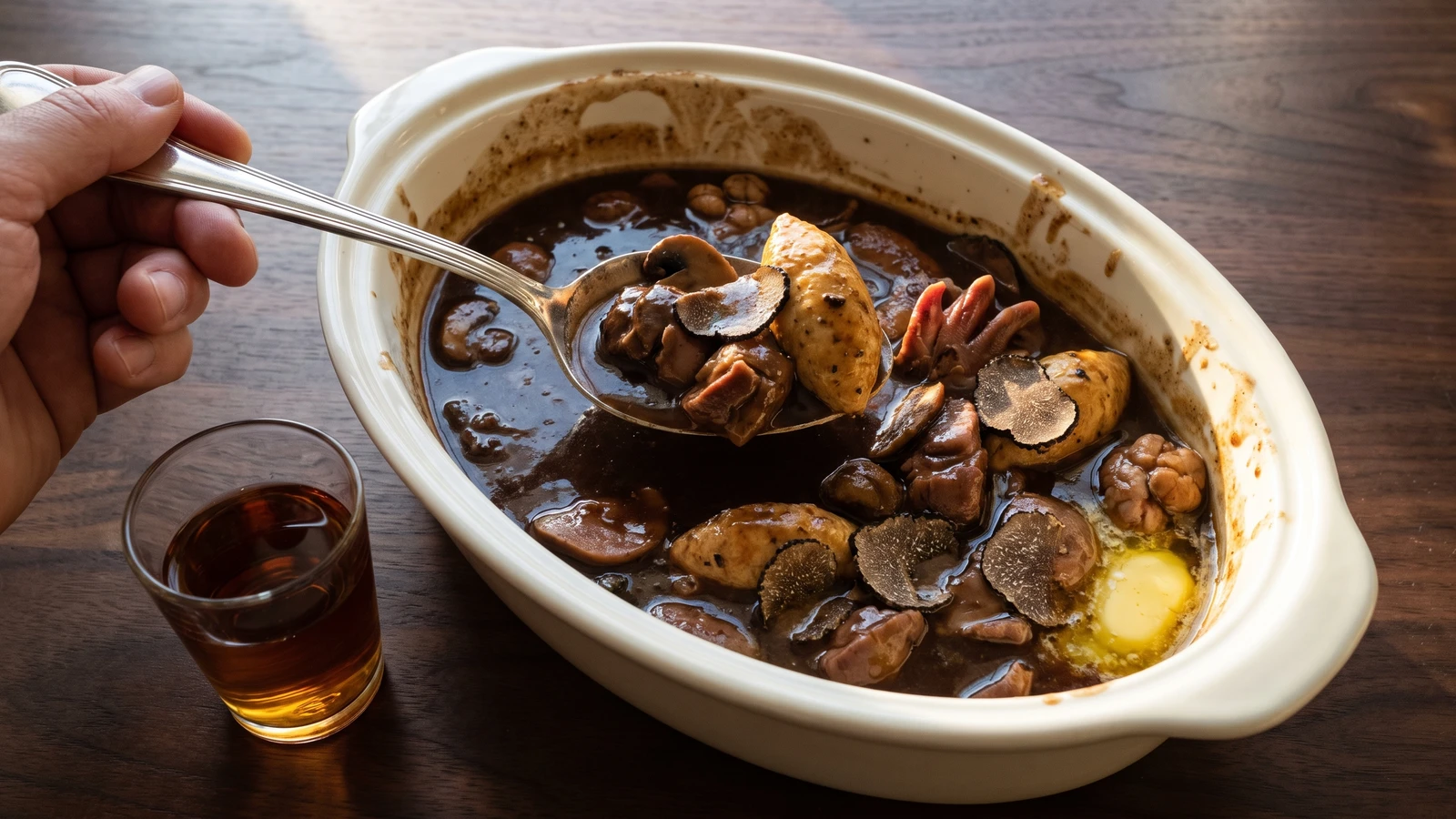
Tête de veau à la financière turns humble offal into a generous centerpiece: tender calf's head, tongue, and brain beneath glossy Madeira sauce crowded with quenelles, cockscombs, mushrooms, sweetbreads, and truffle.
Tête de Veau à la Financière (calf's head with a financière garnish) teaches the grand principle of offal cookery: tenderness comes from controlled moisture, then luxury comes from the sauce. Before you touch a pan, know the one true thing. The head must cook beneath a barely trembling blanc, fully protected from the air. Boil it or let it rise above the liquid and the skin tightens and darkens; coddle it, and it becomes supple enough to cut into gleaming squares.
The original entry assumes the head already cooked, a saucier with brown sauce ready, a stock never off the fire, and separate hands tending quenelles, cockscombs, tongue, brain, and sweetbreads. A salamander has nothing to do here. At home, gelatin-rich veal stock reduced with Madeira, a parchment cartouche, preserved cockscombs and kidneys, and one small batch of poultry quenelles perform those jobs for four. We build them sequentially because separate stations are brigade scaffolding; the blanc, the mixed offal garnish, the truffle, and the order of assembly are the dish and must stay. One cook, one stove, one evening.
Financière is not merely brown sauce. The word carries a defined garnish, lavish by intention, in which quenelles and truffle meet the parts timid cooks too often discard. Keep the blanc at a lazy tremble and pressed beneath its parchment. That is the step that decides everything.
Tête de veau belongs to the triperie and bourgeois tables of Paris and Lyon, though its more familiar companions are gribiche and ravigote. The financière treatment comes from the Parisian grand-kitchen repertoire, carrying the thrifty boiled head into a Madeira-bound garnish of quenelles, cockscombs, cock's kidneys, sweetbreads, mushrooms, and truffle. Its contrast is deliberate: one of the humblest cuts meets one of the canon's richest garnishes, and generations of cooks have preserved both sides of that argument.
Quantity
1 (3 to 3½ lb / 1.35 to 1.6 kg)
rolled and tied
Quantity
1 (1 to 1½ lb / 450 to 680 g)
scrubbed
Quantity
1 (10 to 12 oz / 280 to 340 g)
Quantity
8 oz (225 g)
Quantity
16 cups (3.8 L / 3.8 kg), plus more as needed
Quantity
1 cup (240 ml / 240 g)
divided
Quantity
½ cup (120 ml / 60 g)
Quantity
2 tablespoons (30 ml / 36 g)
Quantity
2 medium (10 oz / 280 g)
thickly sliced
Quantity
1 large (8 oz / 225 g)
quartered
Quantity
1 (4 oz / 115 g)
halved
Quantity
1
Quantity
1 teaspoon (5 ml / 3 g)
Quantity
6 oz (170 g)
diced and thoroughly chilled
Quantity
1
Quantity
½ cup (120 ml / 120 g)
thoroughly chilled
Quantity
½ teaspoon (2.5 ml / 3 g)
Quantity
1 small pinch (less than ⅛ teaspoon / less than 0.5 g)
Quantity
4 cups (960 ml / 960 g)
Quantity
¾ cup (180 ml / 180 g)
Quantity
6 tablespoons (90 ml / 85 g)
divided
Quantity
2 tablespoons (30 ml / 16 g)
Quantity
8 oz (225 g)
trimmed
Quantity
1 jar (7 oz / 200 g)
drained and rinsed
Quantity
1 jar: 1 oz (28 g) truffle plus about 2 tablespoons (30 ml / 30 g) liquor
truffle thinly sliced and liquor reserved
Quantity
to taste
| Ingredient | Quantity |
|---|---|
| cleaned, boned half calf's headrolled and tied | 1 (3 to 3½ lb / 1.35 to 1.6 kg) |
| small calf's tonguescrubbed | 1 (1 to 1½ lb / 450 to 680 g) |
| calf's brain | 1 (10 to 12 oz / 280 to 340 g) |
| lamb sweetbreads | 8 oz (225 g) |
| cold water | 16 cups (3.8 L / 3.8 kg), plus more as needed |
| white wine vinegardivided | 1 cup (240 ml / 240 g) |
| all-purpose flour for the blanc | ½ cup (120 ml / 60 g) |
| fine salt for the blanc | 2 tablespoons (30 ml / 36 g) |
| carrotsthickly sliced | 2 medium (10 oz / 280 g) |
| onionquartered | 1 large (8 oz / 225 g) |
| lemonhalved | 1 (4 oz / 115 g) |
| bouquet garni of parsley stems, thyme, and bay | 1 |
| black peppercorns | 1 teaspoon (5 ml / 3 g) |
| skinless chicken breastdiced and thoroughly chilled | 6 oz (170 g) |
| large egg white | 1 |
| heavy creamthoroughly chilled | ½ cup (120 ml / 120 g) |
| fine salt for the quenelles | ½ teaspoon (2.5 ml / 3 g) |
| grated nutmeg | 1 small pinch (less than ⅛ teaspoon / less than 0.5 g) |
| strong, unsalted, gelatin-rich veal stock | 4 cups (960 ml / 960 g) |
| dry Madeira | ¾ cup (180 ml / 180 g) |
| unsalted butterdivided | 6 tablespoons (90 ml / 85 g) |
| all-purpose flour for the sauce | 2 tablespoons (30 ml / 16 g) |
| small button mushroomstrimmed | 8 oz (225 g) |
| preserved cockscombs and cock's kidneysdrained and rinsed | 1 jar (7 oz / 200 g) |
| preserved black truffle with its liquortruffle thinly sliced and liquor reserved | 1 jar: 1 oz (28 g) truffle plus about 2 tablespoons (30 ml / 30 g) liquor |
| fine salt and freshly ground white pepper | to taste |
Put the tied calf's head and tongue in a large stockpot, cover generously with fresh cold water, and bring to a boil. Blanch for 5 minutes, then drain and rinse the offal and pot thoroughly, rubbing away any grey scum. This first blanching is not the blanc; it clears blood and impurities so the true poaching liquid stays clean. Meanwhile, place the brain in a bowl of cold water with ¼ cup (60 ml / 60 g) of the vinegar and refrigerate it for 30 minutes.
Whisk the ½ cup (120 ml / 60 g) flour with about 2 cups (480 ml / 480 g) of the measured cold water until perfectly smooth, then add the remaining measured water, the remaining ¾ cup (180 ml / 180 g) vinegar, salt, carrots, onion, juice and shells of the lemon, bouquet garni, and peppercorns. Return the head and tongue to the pot and bring the blanc slowly to the barest simmer. Press a parchment cartouche directly against the liquid, cover the pot partially, and cook for 2½ to 3 hours, turning the head once, until a skewer passes through the skin and underlying tissue without resistance. Never let the pot gallop. If it boils hard, add a cup of cold water, lower the heat, and reset the cartouche; ça se rattrape. Replace evaporation with hot water so the head remains fully covered.
While the head cooks, soak the sweetbreads in several changes of cold water for 30 minutes. Blanch them in fresh gently simmering water for 5 minutes, cool them in cold water, and pull away the coarse membrane without tearing the lobes. Set them between two plates with a small pan on top and press for 30 minutes, then cut into ¾-inch (2 cm) pieces. Drain the brain, ease away its surface membrane and any visible blood vessels with your fingertips, and keep it refrigerated until its poach.
Chill the food-processor bowl and blade if the kitchen is warm. Process the cold chicken breast with the egg white, salt, nutmeg, and a pinch of white pepper until smooth, scraping the bowl as needed. Add the cold cream in three additions, pulsing only until the farce becomes glossy and cohesive. Fry or poach a teaspoonful and taste it for seasoning. If the mixture becomes loose or greasy, stop and set the bowl over ice for 15 minutes before pulsing it briefly again. Cold is the structure here.
Bring a wide pan of salted water to a bare tremble. Using two wet teaspoons, shape the chicken farce into 12 small oval quenelles and lower them into the water as you work. Poach without boiling for 6 to 8 minutes, turning once, until gently springy and cooked to 165°F (74°C) at the centre. Lift them into a shallow dish and moisten with a little poaching water. If the first quenelle feathers at the edges, chill the farce for another 10 minutes before shaping the rest.
Melt 2 tablespoons (30 ml / 28 g) of the butter in a medium saucepan, stir in the 2 tablespoons (30 ml / 16 g) flour, and cook this roux brun, a brown roux, over medium-low heat until it smells nutty and reaches the colour of a hazelnut. Whisk in the veal stock a little at a time, keeping each addition smooth before adding the next. Simmer gently for 30 to 40 minutes, skimming the surface, until the sauce naps the back of a spoon. Add the Madeira and reserved truffle liquor, then simmer for another 6 to 8 minutes. If the sauce is thin, reduce it; if too tight, loosen it with a spoonful of stock or water. If the roux has left lumps, strain the sauce and whisk it again. Ça se rattrape.
Melt 2 tablespoons (30 ml / 28 g) butter in a wide sauté pan. Brown the pressed sweetbread pieces over medium heat, turning until golden on every face, then add the mushrooms and cook until their moisture evaporates and their edges colour. Season lightly. Transfer both to the financière sauce, add the rinsed cockscombs and cock's kidneys, and hold everything at a bare simmer for 6 to 8 minutes, until the sweetbreads reach 160°F (71°C). Add the quenelles and most of the truffle slices for the final 3 minutes. These garnishes are delicate now, so turn them with a spoon rather than stirring vigorously.
When the head is tender, strain 4 cups (960 ml / 960 g) of its blanc through a fine sieve into a small saucepan. Thin it with a little water if it has become pasty, then bring it to a bare simmer. Lower in the brain, cover its surface with a small parchment cartouche, and poach gently for 12 to 15 minutes, until opaque, lightly firm, and 160°F (71°C) at the centre. Lift it with a slotted spoon, rest it for 5 minutes, and cut it into small slices. If a lobe cracks, don't discard it. Keep the pieces together and place them on top at assembly rather than stirring them through the sauce.
Lift out the tongue while warm and peel away its coarse outer skin, trimming the root before cutting several small, neat slices. Untie the calf's head and lay it skin-side down. Following the source entry, shave away the thick pillows of meat beneath it so only a thin layer, about ¼ inch (6 mm), remains attached to the skin. Reserve those trimmings for croquettes or a mustardy hash. Cut the skin and its thin meat lining into squares of 1, 2, or 3 inches (2.5, 5, or 7.5 cm), choosing the size according to the natural curves. If the pieces stiffen as they cool, dip them back into hot strained blanc for 2 minutes.
Warm a deep 2-quart (1.9 L) timbale or serving dish. Arrange the hot squares of calf's head in it, skin-side visible where possible. Take the financière sauce off the heat and swirl in the final 2 tablespoons (30 ml / 28 g) cold butter until the sauce gleams, then taste for salt and white pepper. If the butter separates, whisk in a teaspoon of cold stock away from the heat. Cover the head generously with the financière garnish, then add the small slices of tongue and brain and the reserved truffle slices, spooning just enough sauce over them to make them shine. The final butter is not decoration; it gives the sauce its finish. We don't apologize for butter. À table!
1 serving (about 850g)
Culinary guides, cultural storytelling, and the editorial depth that makes cooking meaningful.
Discover Culinary ExplorerChef Juliette
John Dory has the delicacy of sole and the firmness of turbot. A light flouring, a quick butter sauté, and nut-brown beurre noisette show exactly why looks never mattered.

Chef Juliette
Fresh haddock proves its delicacy in the meunière pan: a fine flour crust, moist pearly flakes, and beurre noisette sharpened with lemon and parsley, ready from one skillet in half an hour.

Chef Juliette
Éperlans à l’Anglaise turns small fish into a lesson in disciplined coating: boned smelts under a close, crisp crumb, pan-fried in clarified butter and finished with bright, half-melted maître d’hôtel butter.

Chef Juliette
Tiny smelts, shallot, mushrooms, white wine, gratin sauce, and fine bread raspings meet a fierce oven, where the fish must turn tender in the same breath the buttered crust bronzes.