
Chef Juliette
John Dory (St. Pierre)
John Dory has the delicacy of sole and the firmness of turbot. A light flouring, a quick butter sauté, and nut-brown beurre noisette show exactly why looks never mattered.
A cooking platform built around craft, culture, and the stories behind what we eat.
Created by Chef Juliette
Based on No. 1204, Noix de Veau Froide à la Suédoise, from Le Guide Culinaire (1907) by Auguste Escoffier
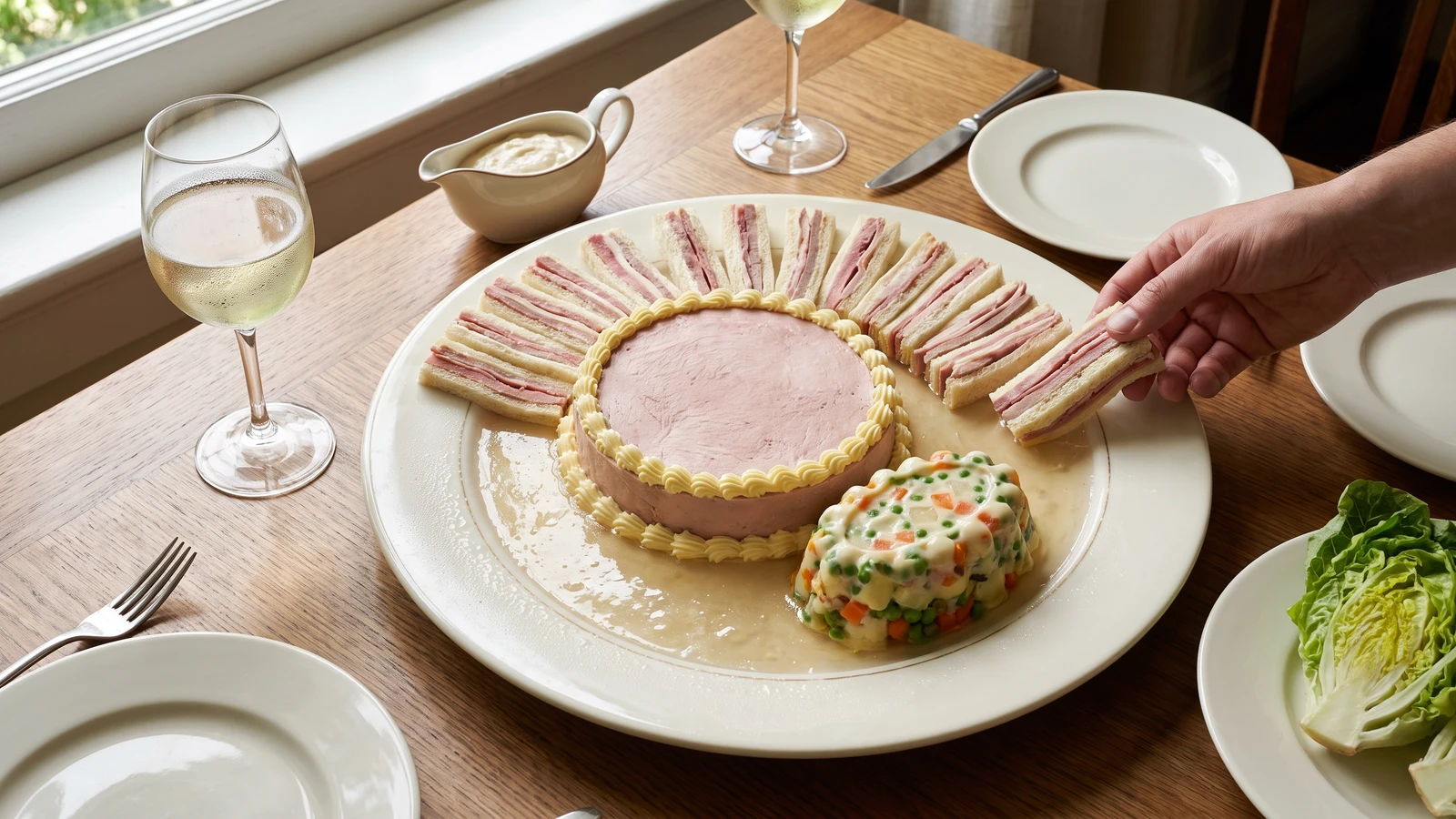
A grand cold buffet translated for one table: tender veal, salted tongue, and horseradish butter circling a jewel-like vegetable salad, all held with aspic and served with a sharp, silken mayonnaise.
Noix de Veau Froide à la Suédoise (cold cushion of veal in the Swedish manner) teaches the architecture of a composed cold dish: every slice must hold its shape, every emulsion must remain supple, and every seasoning must still speak after the chill. The one true thing to know before touching a pan is that cold quiets flavour. Season each component a little more boldly than you would serve it warm.
The original begins with a cold cooked cushion of veal and assumes a garde-manger, a saucier on staff, clear aspic drawn from stock never off the fire, a bombe mould, and meat enough for a buffet. At home, we roast one compact noix, strengthen good clear stock with gelatin, make one mayonnaise and divide it, and use a small smooth bowl for the mould. The brigade quantity and separate stations were scaffolding, so they go; the aspic bed, moulded salad, exact tongue-and-veal sandwiches, and fluted cord of butter are the dish, so they stay. One cook, one stove, one evening of work, then the refrigerator keeps watch overnight.
The one step that decides the composition is drying the cooked vegetables completely before they meet the mayonnaise collée, mayonnaise lightly set with aspic. Water loosens the emulsion and makes the mould slump. Dry them with patience and the salad will turn out cleanly, firm enough to crown the veal yet tender under the fork.
The real home of Noix de Veau Froide à la Suédoise is the French garde-manger and the formal cold buffet, where cooked roasts were recut and rebuilt into generous centrepieces. The title à la Suédoise does not make it a Swedish household recipe; in the French classical naming system, the Swedish association signals horseradish more reliably than geographic origin. From banquet kitchens the composition passed to bourgeois special-occasion tables, with salted tongue, clear aspic, and moulded salad preserving the grand kitchen's sense of abundance.
Quantity
2 lb (900 g)
kept in one compact piece and tied
Quantity
1 tablespoon plus 1/2 teaspoon (17.5 ml / 21 g)
divided
Quantity
1/2 teaspoon (2.5 ml / 1 g)
Quantity
2 tablespoons (30 ml / 28 g)
Quantity
1 1/2 cups (360 ml / 360 g)
Quantity
2 1/2 teaspoons (12.5 ml / 7 g)
Quantity
1
Quantity
2 teaspoons (10 ml / 10 g)
Quantity
1 tablespoon (15 ml / 15 g)
Quantity
3/4 cup (180 ml / 165 g)
Quantity
1/3 cup (80 ml / 50 g)
cut into 1/4-inch dice
Quantity
1/3 cup (80 ml / 55 g)
cut into 1/4-inch dice
Quantity
1/3 cup (80 ml / 40 g)
cut into 1/4-inch pieces
Quantity
1/3 cup (80 ml / 45 g)
Quantity
1 teaspoon (5 ml / 5 g)
Quantity
6 oz (170 g)
chilled
Quantity
3 tablespoons (45 ml / 42 g)
softened
Quantity
2 tablespoons plus 1 teaspoon (35 ml / 35 g)
well drained and divided
Quantity
2 tablespoons (30 ml / 28 g)
softened
Quantity
1
| Ingredient | Quantity |
|---|---|
| boneless veal top round or noixkept in one compact piece and tied | 2 lb (900 g) |
| fine sea saltdivided | 1 tablespoon plus 1/2 teaspoon (17.5 ml / 21 g) |
| ground white pepper | 1/2 teaspoon (2.5 ml / 1 g) |
| unsalted butter for roasting | 2 tablespoons (30 ml / 28 g) |
| clear, fat-free white veal or chicken stock | 1 1/2 cups (360 ml / 360 g) |
| unflavoured powdered gelatin | 2 1/2 teaspoons (12.5 ml / 7 g) |
| pasteurized large egg yolk | 1 |
| Dijon mustard | 2 teaspoons (10 ml / 10 g) |
| white wine vinegar | 1 tablespoon (15 ml / 15 g) |
| neutral oil for mayonnaise | 3/4 cup (180 ml / 165 g) |
| carrotscut into 1/4-inch dice | 1/3 cup (80 ml / 50 g) |
| waxy potatocut into 1/4-inch dice | 1/3 cup (80 ml / 55 g) |
| green beanscut into 1/4-inch pieces | 1/3 cup (80 ml / 40 g) |
| frozen peas | 1/3 cup (80 ml / 45 g) |
| neutral oil for the mould | 1 teaspoon (5 ml / 5 g) |
| cooked salted beef tonguechilled | 6 oz (170 g) |
| unsalted butter for the sandwichessoftened | 3 tablespoons (45 ml / 42 g) |
| prepared horseradishwell drained and divided | 2 tablespoons plus 1 teaspoon (35 ml / 35 g) |
| unsalted butter for pipingsoftened | 2 tablespoons (30 ml / 28 g) |
| small lettuce heart | 1 |
Heat the oven to 325°F (165°C). Dry the veal thoroughly, season it with 1 teaspoon of the salt and the white pepper, and retie it if necessary so it forms an even cylinder. Melt the roasting butter in a heavy ovenproof skillet over medium heat and brown the veal patiently on every side. Roast until the centre reaches 145°F (63°C), about 35 to 50 minutes depending on its shape. Rest for 15 minutes, cool uncovered, then wrap and chill for at least 4 hours, preferably overnight. The even shape matters because the cold meat must later yield one broad pedestal and neat, thin rectangles.
Reserve 1 tablespoon of the plain stock for the final sauce. Put 1/4 cup of the remaining cold stock in a small bowl and sprinkle the gelatin evenly over it; leave it for 5 minutes until swollen. Warm the rest of the stock just below a simmer, season with a small pinch of the measured salt, and stir it into the gelatin until completely dissolved. Never boil it, which weakens the set and muddies the clarity. Strain through a damp fine cloth or coffee filter and cool until fluid but no longer warm. If it sets before you need it, warm it very gently until liquid again.
Whisk the yolk, Dijon mustard, vinegar, and a pinch of the measured salt in a stable bowl. Add the neutral oil drop by drop at first, whisking continuously; once a thick emulsion forms, pour in a fine steady thread until the mayonnaise is glossy and holds soft peaks. If it splits, stop. Ça se rattrape: put 1 teaspoon of cold water in a clean bowl, whisk in a spoonful of the broken mayonnaise until smooth, then rebuild the rest gradually. Cover and keep cold.
Bring a saucepan of water to a boil and season it with 1 tablespoon of the measured salt. Cook the potato until tender but still square at the edges, 5 to 7 minutes; cook the carrots for about 3 minutes, the beans for 2 minutes, and the peas for 30 seconds. Cool each vegetable promptly, drain very well, then spread everything over clean towels until completely dry. Mix 1/2 cup of the mayonnaise with 3 tablespoons of the cool liquid aspic to make the mayonnaise collée, then fold in the vegetables without crushing them. Lightly oil a 1 1/2-cup narrow bowl or smooth mould, pack in the salad, level the top, and chill for at least 2 hours. If the mixture looks loose, chill it in the bowl for 10 minutes and stir again; if necessary, fold in another tablespoon of aspic before moulding.
Set a 12-inch round shallow platter in the refrigerator until cold. Pour about 1/2 cup of the fluid aspic over its bottom in a thin, even layer and chill until completely firm. From the widest part of the cold veal, cut one lateral slice exactly 1 1/3 inches (3.3 cm) thick and trim it into a handsome round. Lay it carefully at the centre of the firm aspic. This is the pedestal for the salad, so keep its upper surface level.
Cut the remaining veal across the grain into 8 to 10 rectangles, each about 2 inches long, 1 1/2 inches wide, and 1/8 inch thick (5 by 4 by 0.3 cm). Cut the same number of salted-tongue rectangles to matching dimensions, making them slightly thinner than the veal. Beat the 3 tablespoons of softened butter with 2 tablespoons of the drained horseradish until smooth. Spread a thin, complete coating over each veal rectangle, set a tongue rectangle on top, and round all four corners with a sharp knife. Cover and keep cold.
Work the remaining 2 tablespoons of butter into beurre pommade, butter softened to the consistency of an ointment. Transfer it to a piping bag fitted with a small fluted tip and pipe a continuous cord around the upper edge of the thick veal pedestal. If the butter slumps instead of holding the grooves, scrape it back into the bag and chill it for 5 minutes before trying again. Soft enough to pipe, cool enough to stand, that is the balance.
Dip the outside of the vegetable mould in warm water for no more than 2 seconds, dry it, and invert it onto the centre of the veal pedestal. Lift the mould straight upward. If the salad refuses to release, wrap the outside briefly with a warm towel rather than shaking it apart. Open the lettuce heart gently so its leaves form a small cup and place it on top. Arrange the veal-and-tongue sandwiches in an overlapping ring around the pedestal, tongue side upward, following the round of the platter.
Stir the reserved teaspoon of horseradish into the remaining mayonnaise, then loosen it with the tablespoon of reserved plain stock until it falls from the spoon in a soft ribbon. This mayonnaise au raifort, horseradish mayonnaise, is the cold derived sauce served apart. Taste it from the cold and correct the salt if necessary. Keep the composed platter chilled until 10 minutes before serving, then bring it to the table with the sauce in a small bowl or sauceboat. À table!
1 serving (about 465g)
Culinary guides, cultural storytelling, and the editorial depth that makes cooking meaningful.
Discover Culinary ExplorerChef Juliette
John Dory has the delicacy of sole and the firmness of turbot. A light flouring, a quick butter sauté, and nut-brown beurre noisette show exactly why looks never mattered.

Chef Juliette
Fresh haddock proves its delicacy in the meunière pan: a fine flour crust, moist pearly flakes, and beurre noisette sharpened with lemon and parsley, ready from one skillet in half an hour.

Chef Juliette
Éperlans à l’Anglaise turns small fish into a lesson in disciplined coating: boned smelts under a close, crisp crumb, pan-fried in clarified butter and finished with bright, half-melted maître d’hôtel butter.

Chef Juliette
Tiny smelts, shallot, mushrooms, white wine, gratin sauce, and fine bread raspings meet a fierce oven, where the fish must turn tender in the same breath the buttered crust bronzes.