
Chef Juliette
John Dory (St. Pierre)
John Dory has the delicacy of sole and the firmness of turbot. A light flouring, a quick butter sauté, and nut-brown beurre noisette show exactly why looks never mattered.
A cooking platform built around craft, culture, and the stories behind what we eat.
Created by Chef Juliette
Based on No. 1202, Noix de Veau en Surprise à la Toulousaine, from Le Guide Culinaire (1907) by Auguste Escoffier
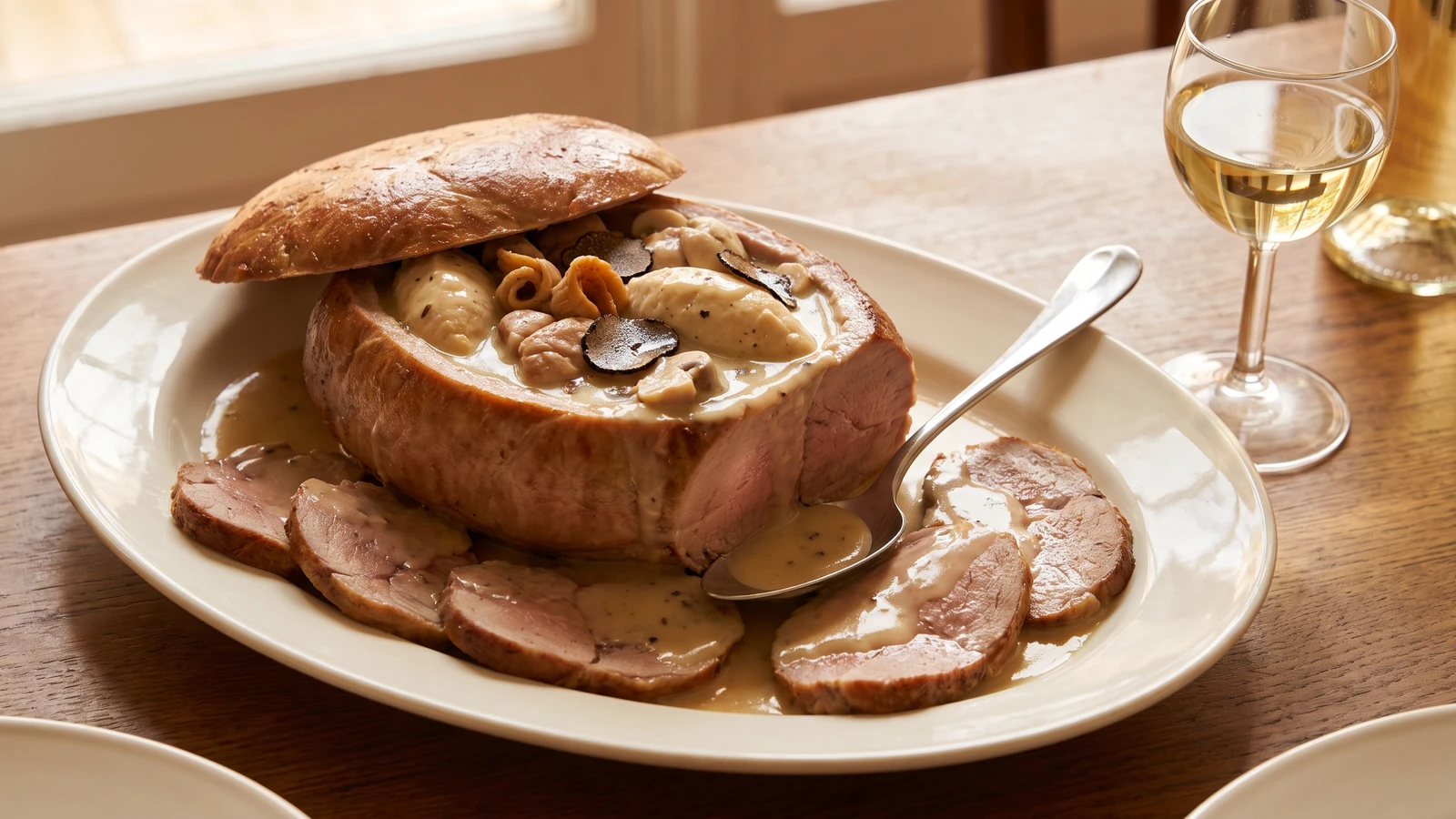
A braised veal cushion becomes its own serving case, holding pale chicken quenelles, tender sweetbreads, cocks’ combs, mushrooms, and truffle in glossy sauce Allemande, a grand construction disciplined by simplicity.
Noix de Veau en Surprise à la Toulousaine (braised veal cushion filled with the Toulousaine garnish) teaches the difference between construction and mere complication. The veal replaces the pastry case of a vol-au-vent or timbale, holding quenelles, sweetbreads, cocks’ combs, white mushrooms, and truffle in sauce Allemande. One truth decides everything before you touch the pan: the noix must become tender without collapsing, because you still have to hollow it and return its lid.
The original service assumed a saucier on staff, a stock never off the fire, and a salamander available for neighboring dishes, although this veal is closed rather than gratinéed. At home, a compact three-pound noix serves four, its braising liquor becomes the foundation of the sauce, a food processor replaces the mortar and sieve, prepared cocks’ combs spare you a brigade’s trimming work, and preserved truffle answers honestly when fresh truffle is out of season. Decorative carving and separate stations are scaffolding, so they go. The hollow case, pale sweetbread braise, quenelles, mushrooms, truffle, and sauce Allemande stay because they are the dish. One cook, one stove, one evening.
When it reaches the table, the veal should be softly bronzed outside, ivory and sliceable within, with the glossy filling revealed beneath its fitted lid. The source itself warns that simplicity is the better rule, and it is right; this grand curiosity earns its place by teaching control, not pomp. Judge the braise with a skewer rather than the clock, stopping while the meat remains firm enough to hold a clean wall.
À la Toulousaine names a classical garnish rather than a single household roast from Toulouse: poultry quenelles, sweetbreads, cocks’ combs, mushrooms, and truffle held in sauce Allemande. Its abundance draws on the poultry and offal larder around Toulouse, then traveled into grand-kitchen service as a filling for vol-au-vent and timbales. In this entry the hollowed noix de veau deliberately replaces pastry, while the author’s own warning that simplicity should rule keeps the spectacle in its proper place.
Quantity
1 compact piece, about 3 lb (1.36 kg)
tied into an oval
Quantity
1 tablespoon plus 1 teaspoon (20 ml / 24 g)
divided
Quantity
1 teaspoon (5 ml / 2 g)
divided
Quantity
7 tablespoons (105 ml / 100 g)
divided
Quantity
1 cup (240 ml / 150 g)
sliced
Quantity
3/4 cup (180 ml / 90 g)
sliced
Quantity
1/2 cup (120 ml / 60 g)
sliced
Quantity
1 cup (240 ml / 240 g)
Quantity
4 cups (960 ml / 960 g)
divided
Quantity
1
Quantity
8 oz (225 g)
Quantity
2 cups (480 ml / 150 g)
trimmed
Quantity
5 cups (1.2 L / 1.2 kg)
divided
Quantity
2 tablespoons (30 ml / 30 g)
divided
Quantity
4 oz (115 g)
diced and thoroughly chilled
Quantity
1
thoroughly chilled
Quantity
1 cup (240 ml / 240 g)
thoroughly chilled and divided
Quantity
1 pinch
Quantity
6 small, about 3/4 cup (180 ml / 75 g)
rinsed and patted dry
Quantity
1 small, about 3 tablespoons (45 ml / 20 g)
drained and thinly sliced
Quantity
1/3 cup (80 ml / 42 g)
Quantity
2
| Ingredient | Quantity |
|---|---|
| boneless veal top round or noixtied into an oval | 1 compact piece, about 3 lb (1.36 kg) |
| fine sea saltdivided | 1 tablespoon plus 1 teaspoon (20 ml / 24 g) |
| ground white pepperdivided | 1 teaspoon (5 ml / 2 g) |
| unsalted butterdivided | 7 tablespoons (105 ml / 100 g) |
| yellow onionsliced | 1 cup (240 ml / 150 g) |
| carrotsliced | 3/4 cup (180 ml / 90 g) |
| celerysliced | 1/2 cup (120 ml / 60 g) |
| dry white wine | 1 cup (240 ml / 240 g) |
| unsalted pale veal stock or chicken stockdivided | 4 cups (960 ml / 960 g) |
| bouquet garni of parsley stems, thyme, and bay leaf | 1 |
| veal sweetbreads | 8 oz (225 g) |
| small white button mushroomstrimmed | 2 cups (480 ml / 150 g) |
| cold waterdivided | 5 cups (1.2 L / 1.2 kg) |
| fresh lemon juicedivided | 2 tablespoons (30 ml / 30 g) |
| skinless chicken breastdiced and thoroughly chilled | 4 oz (115 g) |
| large egg whitethoroughly chilled | 1 |
| heavy creamthoroughly chilled and divided | 1 cup (240 ml / 240 g) |
| freshly grated nutmeg | 1 pinch |
| prepared cooked cocks’ combsrinsed and patted dry | 6 small, about 3/4 cup (180 ml / 75 g) |
| preserved black truffledrained and thinly sliced | 1 small, about 3 tablespoons (45 ml / 20 g) |
| all-purpose flour | 1/3 cup (80 ml / 42 g) |
| large egg yolks | 2 |
Put the sweetbreads in a bowl, cover generously with additional cold water, and refrigerate for 1 1/2 hours, changing the water twice. Begin the veal while they soak. When the sweetbreads look pale, cover them with fresh cold water in a saucepan, bring just to a simmer, and blanch for 3 minutes. Transfer them to cold water, peel away the outer membrane and any coarse tubes, then press between two trays with a 2 lb (900 g) weight for 20 minutes. Pressing gives you neat collops rather than ragged pieces.
Heat the oven to 325°F (165°C). Dry the tied veal, then season it with 2 teaspoons of the salt and 1/2 teaspoon of the white pepper. Melt 2 tablespoons of the butter in a heavy casserole over medium heat and color the veal evenly to a quiet butter-gold, not a dark crust. Lift it out, add the onion, carrot, and celery, and cook for 5 minutes without browning. Pour in the wine, scrape up the fond, and reduce by half. Return the veal with 2 1/2 cups of the stock and the bouquet garni; the liquid should reach roughly halfway up the meat. Cover with a round of parchment and the lid, then braise for 1 hour 45 minutes to 2 hours 15 minutes, turning once. It is ready when a skewer enters with gentle resistance and the center reaches at least 165°F (74°C), while the piece still holds its oval shape. Transfer it to a board and rest it for 20 minutes. If it begins to feel fragile, stop the cooking immediately and let it firm as it rests; ça se rattrape.
Melt 1 tablespoon of the butter in a small saucepan over low heat. Add the pressed sweetbreads and turn them in the butter without allowing them to color. Add 1 cup of the stock, cover with parchment, and hold at the barest simmer for 15 to 20 minutes, until they feel firm and reach 160°F (71°C). Lift them out and cut them into 1/2-inch (1.25 cm) collops. Strain and reserve their cooking liquid for the sauce.
Put the mushrooms in a wide saucepan with 1 cup of the measured water, 1 tablespoon of the butter, 1 tablespoon of the lemon juice, and a pinch of salt. Cover and simmer briskly for 5 to 7 minutes, just until tender and still white. Drain them at once and reserve every drop of liquid. Boil that liquid uncovered until only 1/3 cup (80 ml) remains; this concentrated cuisson is the mushroom essence that gives the sauce its proper flavor.
Chill the food processor bowl and blade for 10 minutes. Process the cold chicken with the egg white, 1/2 teaspoon of salt, a pinch of white pepper, and the nutmeg until completely smooth. With the motor running, add 1/3 cup of the cold cream in a thin stream, stopping as soon as the forcemeat looks glossy and cohesive. Bring the remaining 4 cups of measured water to 175°F to 180°F (80°C to 82°C) and season it lightly. Poach a teaspoon of forcemeat as a test: if it feels rubbery, fold another teaspoon of cream into the mixture; if it frays in the water, chill the forcemeat for 15 minutes before continuing. Shape 10 small oval quenelles between two wet teaspoons and poach without boiling for 5 to 7 minutes, until firm and 165°F (74°C) at the center. Drain on a cloth.
Strain the veal braising liquor, pressing the vegetables gently, then skim off the fat. Combine it with the sweetbread cooking liquid and reduce, or add the remaining stock, until you have 2 1/2 cups (600 ml). Melt the remaining 3 tablespoons of butter in a saucepan, stir in the flour, and cook this roux for 2 minutes without coloration. Whisk in the hot cooking liquid gradually, then simmer gently for 15 minutes, skimming as needed. Add the mushroom essence. The sauce should nappe, coating the back of a spoon in a smooth ivory layer. Whisk the egg yolks with 1/2 cup of the cream, temper them with two ladlefuls of hot sauce, then return the mixture to the pan. Stir over low heat until it reaches 170°F to 175°F (77°C to 79°C), but never let it boil. Finish with the remaining tablespoon of lemon juice, then taste for salt and white pepper. If the liaison turns grainy, remove it from the heat immediately, whisk in 1 to 2 tablespoons of cold cream, and pass it through a fine sieve. Ça se rattrape.
Remove the strings from the rested veal. Cut a horizontal lid about 3/4 inch (2 cm) thick from the top and set it aside in the same orientation. With a small knife and spoon, hollow the noix carefully, leaving a wall and base about 3/4 inch (2 cm) thick. Cut the withdrawn meat into neat 1/4-inch (6 mm) slices and keep them warm under foil. If a wall tears, line the weak place from inside with one of the veal slices and a spoonful of sauce. It will disappear beneath the filling, and the case will hold.
Reserve about 3/4 cup (180 ml) of sauce Allemande for the platter. Put the remaining sauce over the lowest heat and add the quenelles, sweetbread collops, white mushrooms, cocks’ combs, and truffle slices. Turn everything with a spoon until evenly coated and hot, keeping the sauce below a simmer so the liaison remains smooth. Cohered means bound together, not drowned; if the garnish looks loose, lift the solids into the case with a slotted spoon and add only enough sauce to fill the spaces.
Set the hollowed veal on a warm oval platter. Spoon in the Toulousaine garnish, letting it mound slightly, then return the veal lid to its original position. Arrange the slices removed from the center around the case and coat them lightly with the reserved sauce Allemande. Carry the platter straight to the table and lift the lid only as you begin serving. Cooking well is not cooking fancy, even when supper arrives wearing a lid. À table!
1 serving (about 550g)
Culinary guides, cultural storytelling, and the editorial depth that makes cooking meaningful.
Discover Culinary ExplorerChef Juliette
John Dory has the delicacy of sole and the firmness of turbot. A light flouring, a quick butter sauté, and nut-brown beurre noisette show exactly why looks never mattered.

Chef Juliette
Fresh haddock proves its delicacy in the meunière pan: a fine flour crust, moist pearly flakes, and beurre noisette sharpened with lemon and parsley, ready from one skillet in half an hour.

Chef Juliette
Éperlans à l’Anglaise turns small fish into a lesson in disciplined coating: boned smelts under a close, crisp crumb, pan-fried in clarified butter and finished with bright, half-melted maître d’hôtel butter.

Chef Juliette
Tiny smelts, shallot, mushrooms, white wine, gratin sauce, and fine bread raspings meet a fierce oven, where the fish must turn tender in the same breath the buttered crust bronzes.