
Chef Juliette
John Dory (St. Pierre)
John Dory has the delicacy of sole and the firmness of turbot. A light flouring, a quick butter sauté, and nut-brown beurre noisette show exactly why looks never mattered.
A cooking platform built around craft, culture, and the stories behind what we eat.
Created by Chef Juliette
Based on No. 1200, Noix de Veau en Surprise à la Macédoine, from Le Guide Culinaire (1907) by Auguste Escoffier
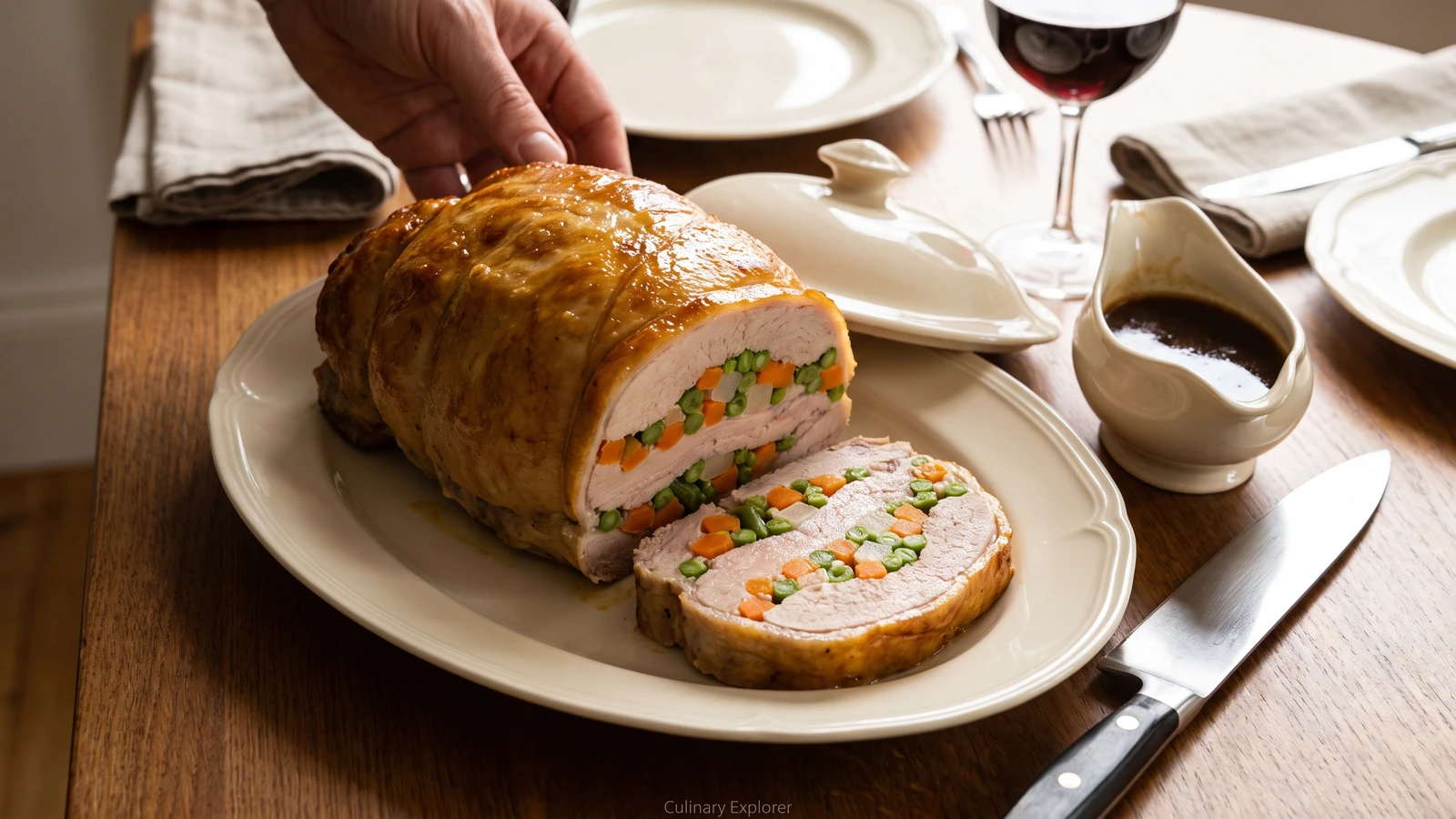
A braised veal cushion becomes its own serving case, layered with buttered macédoine and neat slices from the hollowed centre, then warmed whole and served with its glossy liquor.
Noix de Veau en Surprise à la Macédoine (braised veal cushion filled with mixed vegetables) teaches a lovely classical economy: the meat withdrawn to make the case becomes its filling. Know one thing before touching the pan. The veal must become tender while remaining firm enough to hollow and slice. Braise it until it collapses and the surprise becomes a heap.
The original formula assumed a saucier on staff, a stockpot never off the fire, and several hands preparing the macédoine while the veal braised. For four, a compact 3-pound noix, measured unsalted stock, one cocotte, and a saucepan do the work honestly. The vegetables cook while the meat is in the oven, and the liquor reduces while it rests. Parallel labor is brigade scaffolding and can go; the hollow case, alternating layers, and liquor served separately are the dish and must stay. No salamander has work here, because the filled cushion needs gentle warming, not another browning. One cook, one stove, one evening.
At the table, the bronzed cushion appears whole. Then the lid lifts and shows the small, bright dice between neat layers of veal, every piece of the joint accounted for. Hollow patiently, leaving an even ⅝-inch wall and base. That is the step that decides whether the cushion stands proudly when it reaches the platter.
Noix de veau was prized on the Parisian classical table because its compact, fine-grained shape could be braised, carved, and presented whole. Preparations en surprise turned a roast into its own covered case, while macédoine named a disciplined mixture of evenly diced early vegetables, not any casual vegetable medley. The method passed naturally to bourgeois dinner tables because one joint supplied both the case and its layered filling, with nothing from the centre discarded.
Quantity
1 roast, 3 lb (1.35 kg)
trimmed and tied
Quantity
1 tablespoon (15 ml / 18 g)
divided
Quantity
¾ teaspoon (3.75 ml / 1.5 g)
divided
Quantity
2 tablespoons (30 ml / 28 g)
Quantity
1 cup (240 ml / 150 g)
sliced
Quantity
⅔ cup (160 ml / 100 g)
sliced
Quantity
1
Quantity
3 cups (720 ml / 720 g)
Quantity
⅓ cup (80 ml / 45 g)
cut into ¼-inch dice
Quantity
⅓ cup (80 ml / 50 g)
cut into ¼-inch dice
Quantity
⅓ cup (80 ml / 40 g)
cut into ¼-inch pieces
Quantity
⅓ cup (80 ml / 50 g)
Quantity
2 tablespoons (30 ml / 28 g)
Quantity
1 tablespoon (15 ml / 14 g)
| Ingredient | Quantity |
|---|---|
| compact boneless veal top round (noix)trimmed and tied | 1 roast, 3 lb (1.35 kg) |
| fine sea saltdivided | 1 tablespoon (15 ml / 18 g) |
| ground white pepperdivided | ¾ teaspoon (3.75 ml / 1.5 g) |
| clarified unsalted butter | 2 tablespoons (30 ml / 28 g) |
| yellow onionsliced | 1 cup (240 ml / 150 g) |
| carrot for the braisesliced | ⅔ cup (160 ml / 100 g) |
| bouquet garni of parsley stems, thyme, and bay leaf | 1 |
| unsalted light veal stock, or unsalted chicken stock | 3 cups (720 ml / 720 g) |
| carrot for the macédoinecut into ¼-inch dice | ⅓ cup (80 ml / 45 g) |
| turnip for the macédoinecut into ¼-inch dice | ⅓ cup (80 ml / 50 g) |
| green beans for the macédoinecut into ¼-inch pieces | ⅓ cup (80 ml / 40 g) |
| frozen peas | ⅓ cup (80 ml / 50 g) |
| unsalted butter for the macédoine | 2 tablespoons (30 ml / 28 g) |
| cold unsalted butter for the braising liquor | 1 tablespoon (15 ml / 14 g) |
Heat the oven to 325°F (165°C). Take the veal from the cold for 30 minutes, then dry it thoroughly. Season every surface with 2 teaspoons of the salt and ½ teaspoon of the white pepper. Keep the roast tied into a compact cushion; a loose or flattened joint cannot support the hollow case.
Heat the clarified butter in a snug 5 to 6-quart cocotte over medium-high heat. Brown the veal patiently on every surface, including both ends, until it wears a deep hazelnut crust, about 10 minutes. Lift it out. If the fond on the pot floor turns black rather than brown, wipe away the burnt patches and add a little fresh butter before continuing. Burnt fond cannot build a good liquor, but the dish is still entirely recoverable.
Lower the heat to medium. Add the sliced onion and braising carrot, cooking for 6 to 8 minutes until softened and lightly colored. Return the veal and add the bouquet garni. Reserve ¼ cup of the stock for the macédoine and later adjustments, then pour the remainder around the meat, scraping every brown trace from the pot floor. The liquid should reach about halfway up the cushion. Bring it only to a bare tremble, cover, and transfer the cocotte to the oven.
While the veal braises, bring a saucepan of water to a boil and season it with the remaining salt. Add the diced carrot and turnip. After 3 minutes add the green beans, then add the peas 2 minutes later and cook everything for 1 final minute. The dice should be tender but still hold their square edges. Drain very well and spread them briefly on a clean towel; wet vegetables would flood the case. Melt the macédoine butter in a skillet with 2 tablespoons of the reserved stock. Swirl until the butter and stock form a glossy emulsion, then add the vegetables and toss over medium heat until every dice glistens and no liquid remains in the pan. Season with the remaining white pepper. If the butter separates into an oily pool, pull the skillet from the heat and swirl in a teaspoon of cold reserved stock. The emulsion will gather again.
Baste the veal every 30 minutes and keep the braise at the faintest tremble. Begin checking after 75 minutes. It is ready when a thin skewer enters with light resistance and the centre registers 155 to 158°F (68 to 70°C), usually after 85 to 100 minutes. Do not wait for fork-tender collapse. This cushion must eat tenderly while retaining enough structure to become its own case. Transfer it to a board and rest it for 20 minutes.
While the veal rests, strain the braising liquor into a saucepan, pressing the vegetables lightly, then skim away excess fat. Boil steadily until reduced to about 1¼ cups (300 ml), glossy and just thick enough to leave a light film on a spoon. It should remain a liquor, not become gravy. Take it from the heat and whisk in the cold butter. If it tightens too far, loosen it with the reserved stock; if the butter beads on the surface, whisk in a teaspoon of cold stock off the heat until the emulsion returns. Keep the liquor warm for the sauceboat.
Remove the string and place the rested veal broad side down. Cut a horizontal lid about ½ inch (1.25 cm) thick from the top, keeping it intact and noting its position. With a small sharp knife, outline a cavity while leaving an even ⅝-inch (1.5 cm) wall and base. Crosscut the centre into large blocks and lift them out carefully with a sturdy spoon. Cut all the withdrawn meat across the grain into thin rectangles about 2 by 1 inch (5 by 2.5 cm) and ¼ inch (6 mm) thick, using smaller pieces to complete the ends of each layer. If a wall cracks, don't discard the case. Ça se rattrape: set the cushion snugly in its ovenproof serving dish and loop kitchen string gently around the outside. The string will hold the shape during warming and can be slipped away before serving.
Spread a thin layer of macédoine over the bottom of the cavity. Cover it with a close layer of veal rectangles, then repeat the macédoine and meat layers until every piece of withdrawn veal has returned to the case. Finish with macédoine and replace the lid. Spread each vegetable layer thinly and never ram the filling down; the lid may sit slightly proud, which is exactly right. Set the filled cushion in an ovenproof oval serving dish and cover it loosely with parchment and foil. Warm it in the 325°F (165°C) oven for 10 to 15 minutes, only until the centre is hot. Further cooking would dry the shell. Remove any supporting string, carry the cushion whole to the table, and send the warm braising liquor separately in a sauceboat. Lift the lid to show the layers, then cut the cushion crosswise into four generous portions. À table!
1 serving (about 360g)
Culinary guides, cultural storytelling, and the editorial depth that makes cooking meaningful.
Discover Culinary ExplorerChef Juliette
John Dory has the delicacy of sole and the firmness of turbot. A light flouring, a quick butter sauté, and nut-brown beurre noisette show exactly why looks never mattered.

Chef Juliette
Fresh haddock proves its delicacy in the meunière pan: a fine flour crust, moist pearly flakes, and beurre noisette sharpened with lemon and parsley, ready from one skillet in half an hour.

Chef Juliette
Éperlans à l’Anglaise turns small fish into a lesson in disciplined coating: boned smelts under a close, crisp crumb, pan-fried in clarified butter and finished with bright, half-melted maître d’hôtel butter.

Chef Juliette
Tiny smelts, shallot, mushrooms, white wine, gratin sauce, and fine bread raspings meet a fierce oven, where the fish must turn tender in the same breath the buttered crust bronzes.