
Chef Juliette
John Dory (St. Pierre)
John Dory has the delicacy of sole and the firmness of turbot. A light flouring, a quick butter sauté, and nut-brown beurre noisette show exactly why looks never mattered.
A cooking platform built around craft, culture, and the stories behind what we eat.
Created by Chef Juliette
Based on No. 1199, Noix de Veau en Surprise, from Le Guide Culinaire (1907) by Auguste Escoffier
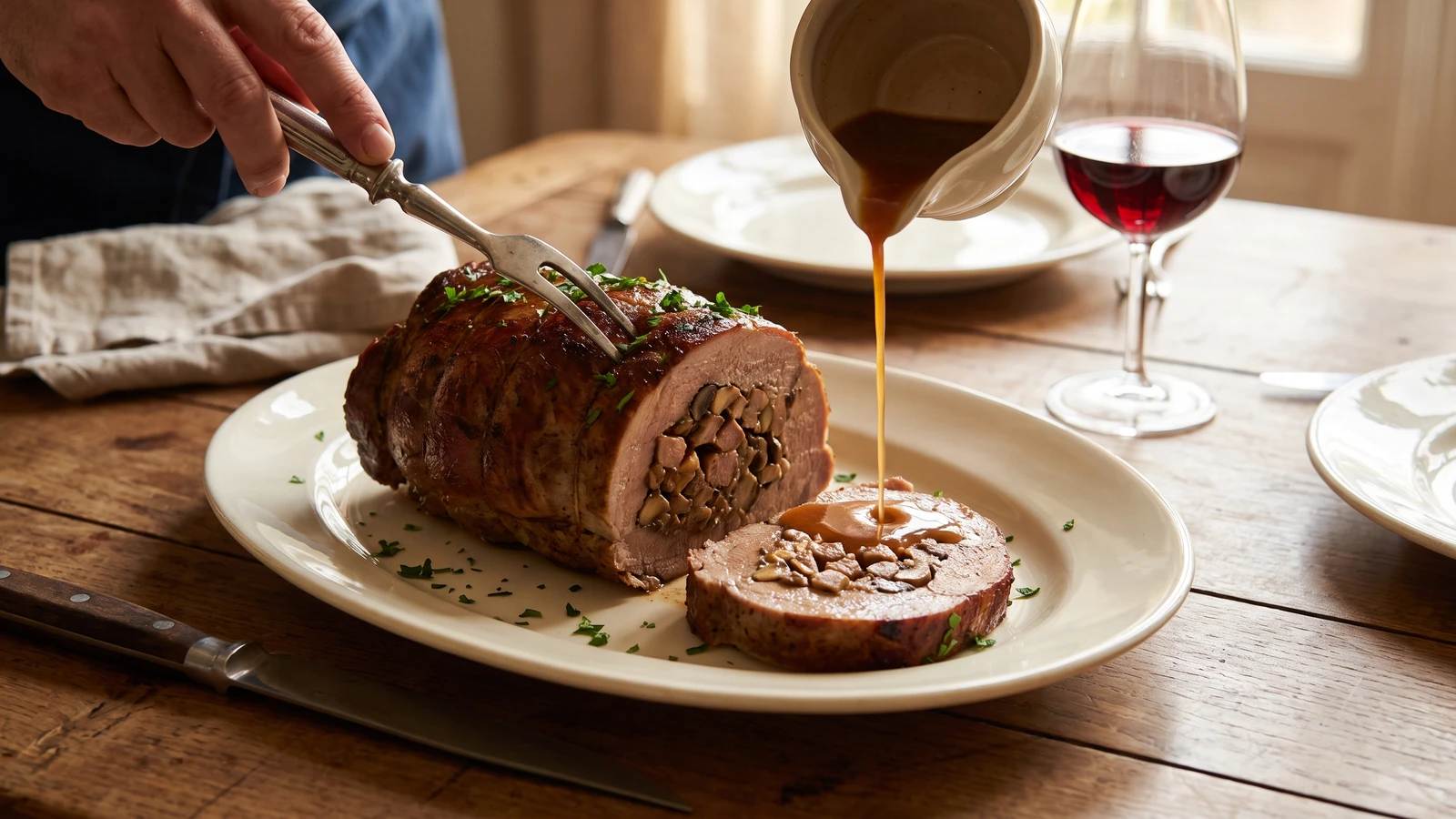
A bronzed veal cushion conceals a glossy mushroom salpicon beneath its fitted lid, then arrives whole so the first generous slice reveals the careful work hidden inside.
Noix de Veau en Surprise (braised veal cushion with a hidden filling) teaches control. The veal must emerge from its braise cooked but still firm, because tenderness pushed too far leaves you nothing strong enough to hollow. This is not a falling-apart pot roast. The walls are the architecture, and the surprise depends upon them.
The original working kitchen assumed a saucier tending the braising liquor, stock never off the fire, and enough hands to carve and fill the joint while it cooled. It calls for a gentle oven finish, not the fierce heat of a salamander, and that distinction matters. At home, one cocotte builds the fond and braise, a saucepan reduces the same liquor, and a covered oven reheats the filled case without drying its thin walls. Unsalted chicken stock is the honest equivalent when veal stock is not waiting in your kitchen. One cook, one stove, one evening.
Separate garnish cooks and holding pans are brigade scaffolding, so they go. The firm braise, the half-inch walls, the veal-and-mushroom salpicon, meaning small dice bound with jus, the replaced lid, and the braising liquor served separately are the dish itself, so they stay. Before the knife ever begins its circular cut, judge the veal correctly: it should yield to a skewer but retain a quiet resistance.
Noix de veau names the compact cushion cut from the veal leg, a joint prized at the Parisian grand-service table because its rounded shape could be presented whole and carved ceremoniously. Preparations en surprise concealed a garnish beneath an apparently untouched exterior, moving the cook's finest work from the kitchen into the moment of carving. Here the surprise is not a raw stuffing baked inside the meat, but a cooked joint fashioned into a case, refilled, closed, and returned to the table under its own lid.
Quantity
1 roast, 2¾ pounds (1.25 kg)
at least 4 inches (10 cm) deep and tied into a compact oval
Quantity
2½ teaspoons (12.5 ml / 15 g)
Quantity
1 teaspoon (5 ml / 2 g)
Quantity
6 tablespoons (90 ml / 85 g)
divided
Quantity
1 tablespoon (15 ml / 14 g)
Quantity
1 medium, 1 cup (240 ml / 150 g)
diced
Quantity
1 medium, ½ cup (120 ml / 75 g)
diced
Quantity
1 stalk, ½ cup (120 ml / 60 g)
diced
Quantity
1 tablespoon (15 ml / 16 g)
Quantity
1 cup (240 ml / 240 g)
Quantity
3 cups (720 ml / 720 g)
Quantity
1
Quantity
2½ cups (600 ml / 250 g)
cut into small dice
Quantity
2, ⅓ cup (80 ml / 70 g)
finely minced
Quantity
2 tablespoons (30 ml / 8 g)
finely chopped
| Ingredient | Quantity |
|---|---|
| compact boneless veal top round or noixat least 4 inches (10 cm) deep and tied into a compact oval | 1 roast, 2¾ pounds (1.25 kg) |
| fine sea salt | 2½ teaspoons (12.5 ml / 15 g) |
| freshly ground black pepper | 1 teaspoon (5 ml / 2 g) |
| unsalted butterdivided | 6 tablespoons (90 ml / 85 g) |
| neutral oil | 1 tablespoon (15 ml / 14 g) |
| yellow oniondiced | 1 medium, 1 cup (240 ml / 150 g) |
| carrotdiced | 1 medium, ½ cup (120 ml / 75 g) |
| celerydiced | 1 stalk, ½ cup (120 ml / 60 g) |
| tomato paste | 1 tablespoon (15 ml / 16 g) |
| dry white wine | 1 cup (240 ml / 240 g) |
| unsalted veal or chicken stock | 3 cups (720 ml / 720 g) |
| bouquet garni of parsley stems, thyme, and bay leaf | 1 |
| white button mushroomscut into small dice | 2½ cups (600 ml / 250 g) |
| shallotsfinely minced | 2, ⅓ cup (80 ml / 70 g) |
| flat-leaf parsleyfinely chopped | 2 tablespoons (30 ml / 8 g) |
Heat the oven to 325°F (165°C). Tie the veal at 1-inch (2.5 cm) intervals so it forms a compact oval with a level top and bottom; the shape must be deep enough to become a case later. Dry it thoroughly, then season all over with 2 teaspoons of the salt and ½ teaspoon of the pepper.
Heat 2 tablespoons of the butter with the oil in a heavy cocotte over medium-high heat. When the butter stops foaming, brown the veal patiently on every surface, including both ends, until it wears an even chestnut crust. Lift it out. Keep the browned film in the pot; that fond is the foundation of the braising liquor.
Lower the heat to medium. Add the onion, carrot, and celery with a pinch of the remaining salt, then cook until softened and well colored, about 8 minutes. Stir in the tomato paste and cook until it darkens slightly. Pour in the wine, scrape every trace of fond from the pot floor, and reduce by half. Add the stock and bouquet garni, then return the veal. The liquid should rise between one-third and halfway up its sides; add a little more stock only if the pot is unusually wide.
Bring the liquor just to a simmer, cover the cocotte, and transfer it to the oven. Braise for 70 to 90 minutes, turning the veal once, until a skewer enters with slight resistance and an instant-read thermometer at the center registers about 140°F (60°C); carryover heat should bring it to 145°F (63°C). Do not wait for fork-tender meat. If it has softened farther than intended, chill it completely and leave ¾-inch (2 cm) walls when hollowing. The case will hold less filling, but ça se rattrape.
Transfer the veal to a rimmed dish and remove the twine. Let it rest for 25 to 30 minutes, until almost cool but still supple. Strain the braising liquor into a saucepan without pressing on the vegetables, skim off the grease, and boil steadily until reduced to about 1½ cups (360 ml). It should lightly coat a spoon but remain pourable. If it becomes salty before it gains body, stop reducing and add a little unsalted stock; a glossy light jus is better than a thick, harsh one.
Place the veal level on the board. With a long sharp knife, cut off a horizontal lid ⅓ inch (8 mm) below the top, preserving its orientation. Set the lid aside. Score an oval inside the veal, keeping exactly ½ inch (1.25 cm) from every outer edge, then cut downward while leaving the same ½-inch thickness across the bottom. Withdraw the center in the largest pieces possible, using a small spoon only to tidy the cavity. If the knife pierces a wall, line the damaged spot from inside with a broad, thin slice of the removed veal. The filling will support the patch and the lid will hide the repair.
Cut about 10 ounces (285 g) of the removed veal into ⅜-inch (1 cm) dice. Reserve any remainder to slice around the finished case. Melt 2 tablespoons of the butter in a wide skillet over medium-high heat, add the mushrooms, and cook until they release their water, the water evaporates, and their edges brown. Add the shallots and cook for 2 minutes. Fold in the diced veal, ½ cup (120 ml) of the reduced braising liquor, the parsley, and the remaining salt and pepper. Toss until the salpicon is glossy and moist but no loose liquid remains. If it looks soupy, remove the veal and reduce the liquid before folding it back in. A wet filling softens the walls.
Spoon the salpicon into the veal case, settling it into the corners without packing so hard that the walls split. Replace the lid in its original position and align the browned exterior so the joint appears untouched. Set the filled veal in a shallow covered baking dish, add ¼ cup (60 ml) of the remaining braising liquor around it, and brush the top with 1 tablespoon of the butter.
Cover and return the veal to the 325°F (165°C) oven for 12 to 18 minutes, just until the salpicon and case are hot through. The lid should remain fitted and the thin walls should stay succulent. If the case was prepared in advance and chilled, allow 30 to 40 minutes and confirm that the center reaches 165°F (74°C). Lift the whole piece carefully onto a warm oval platter, arranging any reserved slices around it.
Warm the remaining braising liquor and taste for seasoning. Off the heat, montez au beurre, meaning finish with butter, by whisking in the final tablespoon a little at a time until the sauce gleams. If the butter separates, whisk in 1 teaspoon of cold stock and it will gather again. Ça se rattrape. Pour the sauce into a warm sauceboat rather than over the veal, preserving the untouched appearance until it is carved at the table. À table!
1 serving (about 360g)
Culinary guides, cultural storytelling, and the editorial depth that makes cooking meaningful.
Discover Culinary ExplorerChef Juliette
John Dory has the delicacy of sole and the firmness of turbot. A light flouring, a quick butter sauté, and nut-brown beurre noisette show exactly why looks never mattered.

Chef Juliette
Fresh haddock proves its delicacy in the meunière pan: a fine flour crust, moist pearly flakes, and beurre noisette sharpened with lemon and parsley, ready from one skillet in half an hour.

Chef Juliette
Éperlans à l’Anglaise turns small fish into a lesson in disciplined coating: boned smelts under a close, crisp crumb, pan-fried in clarified butter and finished with bright, half-melted maître d’hôtel butter.

Chef Juliette
Tiny smelts, shallot, mushrooms, white wine, gratin sauce, and fine bread raspings meet a fierce oven, where the fish must turn tender in the same breath the buttered crust bronzes.