
Chef Juliette
John Dory (St. Pierre)
John Dory has the delicacy of sole and the firmness of turbot. A light flouring, a quick butter sauté, and nut-brown beurre noisette show exactly why looks never mattered.
A cooking platform built around craft, culture, and the stories behind what we eat.
Created by Chef Juliette
Based on No. 1196, Chump of Veal or Quasi, from Le Guide Culinaire (1907) by Auguste Escoffier
The quasi teaches the quiet discipline of a white-meat braise: gentle browning, patient basting, and a final reduction that turns humble stock and pan fond into a butter-glossed jus.
Quasi de veau braisé (braised chump of veal) teaches the one true thing about a large veal joint: basting is not decoration. The quasi is lean enough to dry at its exposed surface and rich enough in connective tissue to reward a slow braise, so the cooking liquor must barely tremble below while you repeatedly carry its butter and juices over the meat. That rhythm is the dish.
The source entry assumed a whole pelvis-and-haunch joint for a large table, a stockpot never off the fire, a saucier to reduce the gravy, and a salamander to set the final glaze. Here the whole joint becomes a tied 3¼-pound boneless section, good unsalted stock gains body from gelatin only when it needs it, and a close-fitting cocotte and home broiler do the remaining work. Larding, formal carving service, and a separate garnish crew are brigade scaffolding and can go. The retained fat cap, aromatic fond, shallow braise, constant basting, strained reduction, and glossy glaze must stay. One cook, one stove, one evening.
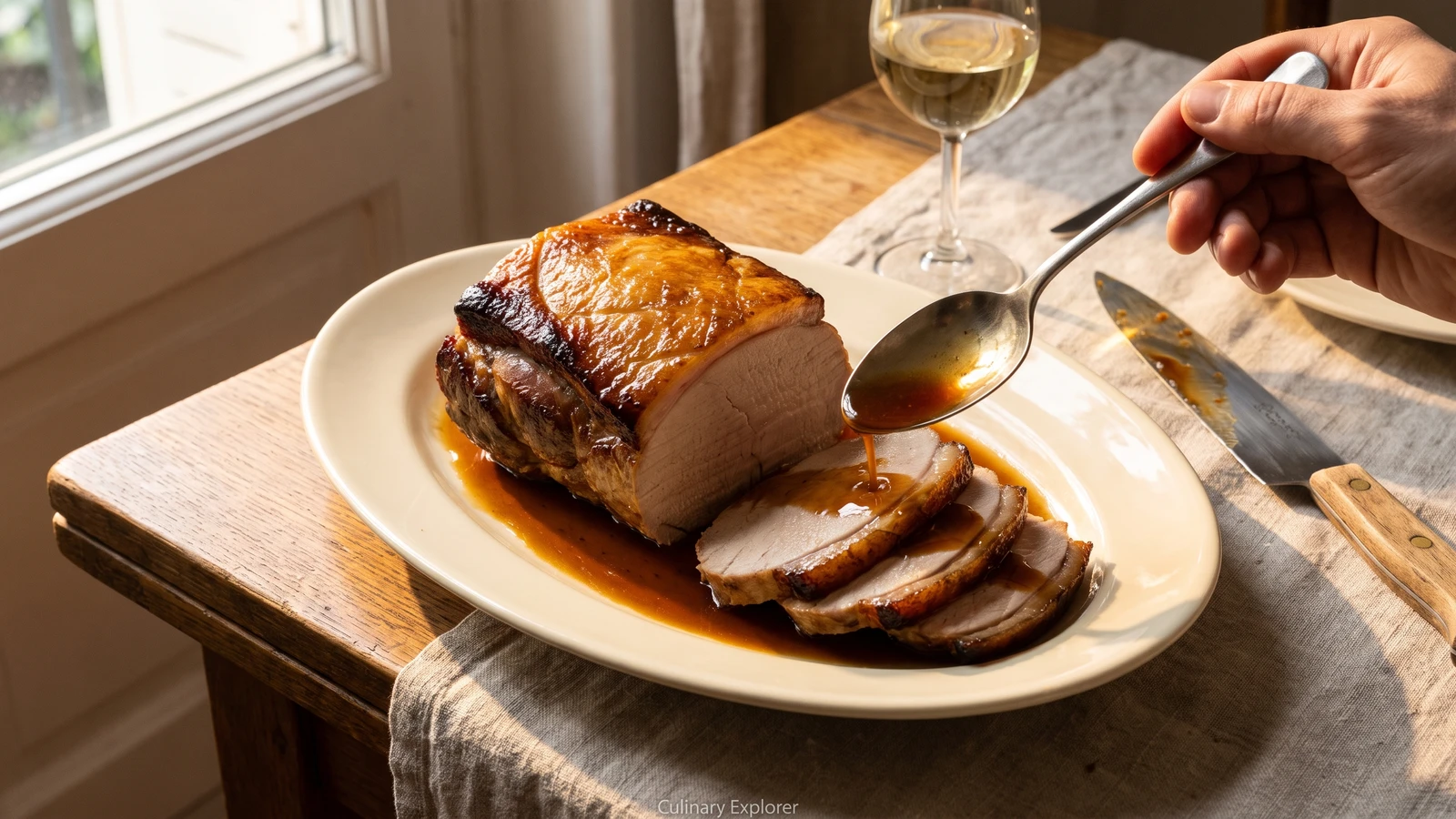
Done properly, the quasi arrives butter-gold and burnished, still neat enough to carve, with an amber jus that tastes more deeply of veal than the modest ingredient list suggests. Keep the heat gentle and the liquor alive beneath the joint. The step that decides everything is the basting: return to the pot every twenty minutes and wet every exposed surface.
Quasi is the French butcher's name for the caudal end of the loin, the section wrapping the pelvis and upper haunch, and its home is the French boucherie and bourgeois Sunday table rather than one particular province. Classical Parisian service carried it into the relevé course, where the large joint was braised, glazed, carved, and presented with changing garnishes. The English name chump can make it sound secondary, but French butchers prize the cut because its close grain and connective tissue give a more succulent braise and finer gravy than straightforward roasting.
Quantity
1 roast, 3¼ pounds (1.5 kg)
tied into an even roast with the fat cap retained
Quantity
2½ teaspoons (12.5 ml / 15 g)
divided
Quantity
¾ teaspoon (3.75 ml / 1.5 g)
Quantity
3 tablespoons (45 ml / 42 g), or the clear butterfat from 4 tablespoons (60 ml / 56 g) melted unsalted butter
divided
Quantity
2, about 1¼ cups (300 ml / 180 g)
cut into ½-inch (1 cm) dice
Quantity
1, about 1½ cups (360 ml / 220 g)
cut into ½-inch (1 cm) dice
Quantity
1, about 1 cup (240 ml / 110 g)
sliced and thoroughly washed
Quantity
2 cloves
lightly crushed
Quantity
1
Quantity
3 cups (720 ml / 720 g)
Quantity
1 teaspoon (5 ml / 3 g)
Quantity
1 tablespoon (15 ml / 14 g)
diced
| Ingredient | Quantity |
|---|---|
| boneless veal quasi or chump-end rumptied into an even roast with the fat cap retained | 1 roast, 3¼ pounds (1.5 kg) |
| fine sea saltdivided | 2½ teaspoons (12.5 ml / 15 g) |
| finely ground white pepper | ¾ teaspoon (3.75 ml / 1.5 g) |
| clarified butterdivided | 3 tablespoons (45 ml / 42 g), or the clear butterfat from 4 tablespoons (60 ml / 56 g) melted unsalted butter |
| medium carrotscut into ½-inch (1 cm) dice | 2, about 1¼ cups (300 ml / 180 g) |
| large yellow onioncut into ½-inch (1 cm) dice | 1, about 1½ cups (360 ml / 220 g) |
| small leek, white and pale green partssliced and thoroughly washed | 1, about 1 cup (240 ml / 110 g) |
| garliclightly crushed | 2 cloves |
| bouquet garni of parsley stems, thyme, and bay leaf | 1 |
| hot unsalted veal or chicken stock | 3 cups (720 ml / 720 g) |
| unflavored powdered gelatin (optional) | 1 teaspoon (5 ml / 3 g) |
| cold unsalted butterdiced | 1 tablespoon (15 ml / 14 g) |
Take the veal from the cold 45 minutes before cooking. Keep its fat cap, trim only tough silver skin, and tighten the string if the roast is uneven. Pat it thoroughly dry, then season with 2 teaspoons of the salt and all the white pepper. Heat the oven to 325°F (160°C), with a rack in the lower third. If using gelatin, sprinkle it over 2 tablespoons (30 ml) of the measured cold stock, leave it for 5 minutes, then whisk it into the remaining stock as that stock heats.
Heat 2 tablespoons of the clarified butter in a heavy cocotte over medium heat. Brown the quasi on every side, beginning with the fat cap, until it is an even hazelnut gold, about 10 to 12 minutes. Veal wants thorough but gentle color, not the dark crust of beef. If the butter or the fond turns black, lift out the meat, wipe away the bitter specks, and continue with the reserved clarified butter. Ça se rattrape. Transfer the browned veal to a plate.
Add the remaining clarified butter if the cocotte looks dry, then add the carrots, onion, leek, and reserved ½ teaspoon salt. Cook over medium-low heat for 8 to 10 minutes, stirring, until the vegetables soften and their edges begin to color. Add the garlic and bouquet garni for 1 minute. Pour in 1 cup (240 ml) of the hot stock and scrape the pot floor carefully. The fond, the browned film clinging there, is the foundation of the jus, so leave none of it behind.
Return the quasi to the cocotte fat-side up and settle it on the aromatic bed. Add enough of the remaining hot stock to rise one-third to halfway up the meat, reserving any excess for basting adjustments. Bring the liquid only to a bare simmer. Lay a cartouche, a round of parchment paper, directly over the meat and liquid, then cover with the lid and transfer the cocotte to the oven.
Braise for 2 to 2¼ hours. Every 20 minutes, open the cocotte, spoon the liquor generously over the exposed veal, and turn the joint a quarter turn while keeping the fat cap generally uppermost. The liquid should barely tremble. If it boils, lower the oven to 300°F (150°C); if it falls below one-quarter of the meat's height, add reserved hot stock. Ça se rattrape, but do not let the surface remain dry. The quasi is ready when a thin skewer enters with gentle resistance and the center registers about 176 to 185°F (80 to 85°C). It should be tender but still sliceable.
Lift the quasi onto a rimmed tray and tent it loosely. Rest it for 20 minutes while you make the jus. Strain the braising liquor through a fine sieve into a saucepan without pressing the spent vegetables, which would cloud the sauce. Skim off the surface fat, leaving only enough to give the liquor a quiet sheen.
Boil the strained liquor briskly until reduced to about 1¼ cups (300 ml) and glossy enough to coat the back of a spoon lightly, about 12 to 18 minutes. If it becomes too salty or syrupy, loosen it with hot stock a tablespoon at a time. Set an oven rack about 6 inches (15 cm) below the broiler. Spoon a little reduced jus over the veal and broil for 1 to 2 minutes, watching continuously, then glaze once more. This is the honest home equivalent of the salamander. If the glaze catches at an edge, remove the joint immediately and brush that spot with fresh jus.
Take the remaining jus off the heat. Monter au beurre, whisking in cold butter to finish, one piece at a time until the sauce gleams. Do not boil it afterward. If the butter separates into an oily film, whisk 1 teaspoon of cold water in a clean warm saucepan, then add the sauce gradually while whisking. Carve the quasi across the grain into ½-inch (1 cm) slices, spoon over enough jus to gloss them, and send the rest to the table in a warm sauceboat. À table!
1 serving (about 440g)
Culinary guides, cultural storytelling, and the editorial depth that makes cooking meaningful.
Discover Culinary ExplorerChef Juliette
John Dory has the delicacy of sole and the firmness of turbot. A light flouring, a quick butter sauté, and nut-brown beurre noisette show exactly why looks never mattered.

Chef Juliette
Fresh haddock proves its delicacy in the meunière pan: a fine flour crust, moist pearly flakes, and beurre noisette sharpened with lemon and parsley, ready from one skillet in half an hour.

Chef Juliette
Éperlans à l’Anglaise turns small fish into a lesson in disciplined coating: boned smelts under a close, crisp crumb, pan-fried in clarified butter and finished with bright, half-melted maître d’hôtel butter.

Chef Juliette
Tiny smelts, shallot, mushrooms, white wine, gratin sauce, and fine bread raspings meet a fierce oven, where the fish must turn tender in the same breath the buttered crust bronzes.