
Chef Juliette
John Dory (St. Pierre)
John Dory has the delicacy of sole and the firmness of turbot. A light flouring, a quick butter sauté, and nut-brown beurre noisette show exactly why looks never mattered.
A cooking platform built around craft, culture, and the stories behind what we eat.
Created by Chef Juliette
Based on No. 1195, Short Loin of Veal, from Le Guide Culinaire (1907) by Auguste Escoffier
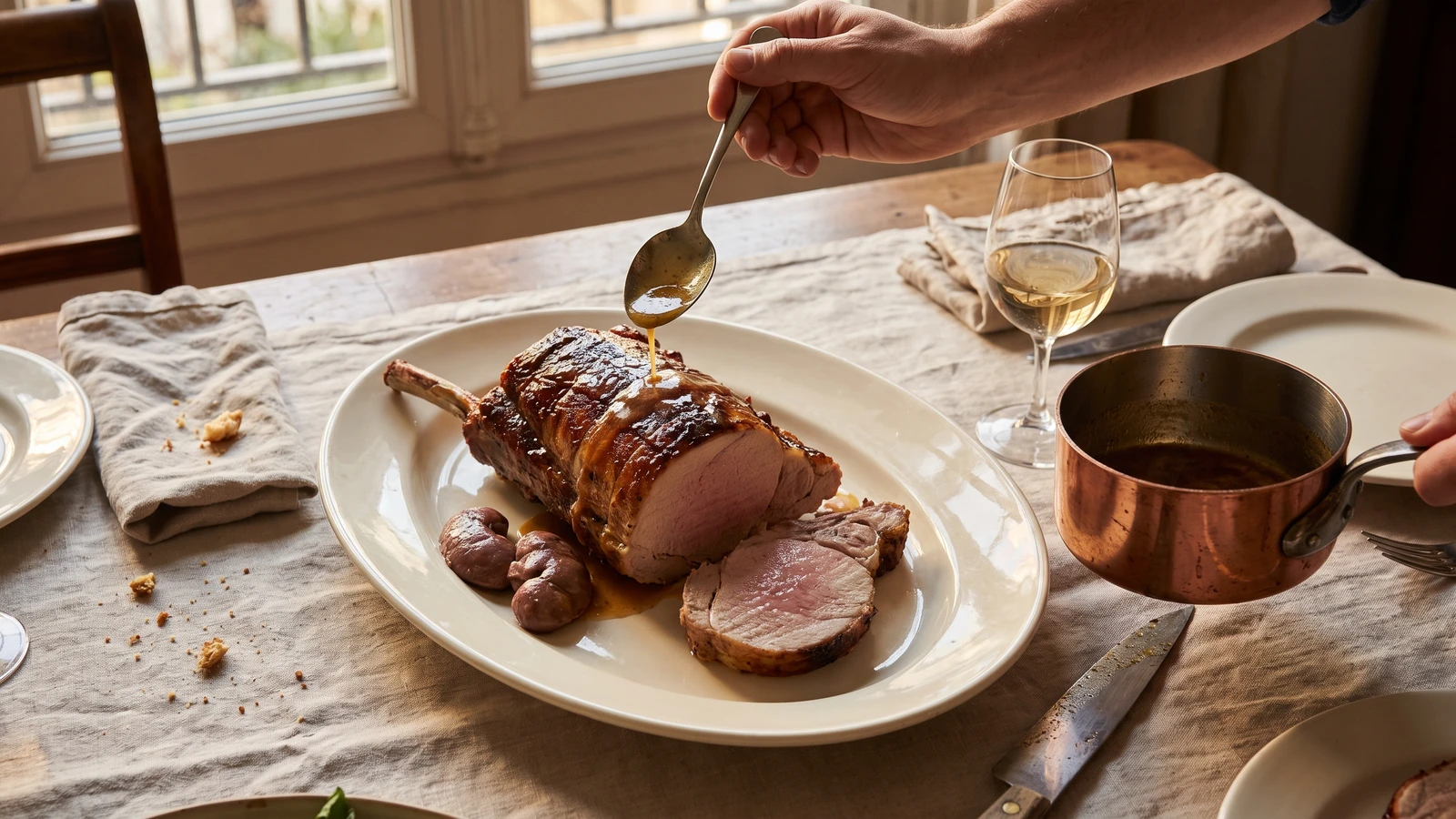
A bone-in veal loin braised as white meat should be, lightly browned, basted often, and pulled at the first tender blush, with its own reduced juices polished into a butter-glossed sauce.
Longe de veau braisée (braised short loin of veal) teaches the discipline of braising a tender white meat: moisture for succulence, roast timing for restraint. The one true thing is this: braising does not grant permission to overcook the loin. Baste it often, begin checking early, and stop while the centre still holds a tender blush. Every minute after steals what the covered pot was meant to protect.
The original preparation assumed a large relevé, a braisière broad enough to hold it, stock never off the fire, a saucier to reduce the gravy, and a salamander, a fierce overhead grill, for the final glaze. Tonight the joint feeds four, a snug cocotte replaces the braisière, gelatin-rich unsalted stock provides the body of the perpetual stockpot, the braising pot becomes the sauce pan, and your broiler supplies the glazing heat. I have cut the brigade portions and discarded the larding needle, which is scaffolding this tender, naturally protected cut does not need. The light browning, aromatic bed, frequent basting, reduction, and glaze remain. They are the dish. One cook, one stove, one evening.
At the table, the loin should wear a thin bronze lacquer over pearl-pale meat, with its fillet and kidney offered as the choice morsels and a glossy jus pooling beneath each slice. Trust the thermometer before the clock. That is the step that matters most.
Longe de veau braisée belongs to the national classical table, but this whole-joint presentation is especially tied to the Parisian service of the relevé, the substantial course that carried a grand cut and its gravy to the table. The short loin is the veal counterpart of beef sirloin, running from the haunch toward the floating ribs and enclosing both fillet and upper fillet; the kidney was commonly left attached after its surplus fat was pared away. Bourgeois home cooks kept the braise after formal service loosened its grip, because covered cooking and frequent basting make this prized but delicate cut more succulent than an exposed roast without turning it into a stew.
Quantity
1 joint (about 4 lb / 1.8 kg)
chine loosened for carving, excess kidney fat trimmed, and joint tied
Quantity
2 teaspoons (10 ml / 12 g)
Quantity
1/2 teaspoon (2.5 ml / 1 g)
Quantity
4 tablespoons (60 ml / 56 g)
divided
Quantity
1 medium (about 1 cup / 150 g)
cut into 1/2-inch dice
Quantity
1 large (about 3/4 cup / 100 g)
cut into 1/2-inch dice
Quantity
1 small bundle
Quantity
3 cups (720 ml / 720 g)
warmed
Quantity
1 teaspoon (5 ml / 3 g)
use only if the chilled stock remains liquid
| Ingredient | Quantity |
|---|---|
| bone-in short loin of veal with fillet and kidney attached if availablechine loosened for carving, excess kidney fat trimmed, and joint tied | 1 joint (about 4 lb / 1.8 kg) |
| fine salt | 2 teaspoons (10 ml / 12 g) |
| ground white pepper | 1/2 teaspoon (2.5 ml / 1 g) |
| unsalted butterdivided | 4 tablespoons (60 ml / 56 g) |
| yellow onioncut into 1/2-inch dice | 1 medium (about 1 cup / 150 g) |
| carrotcut into 1/2-inch dice | 1 large (about 3/4 cup / 100 g) |
| bouquet garni containing thyme, parsley stems, and bay leaf | 1 small bundle |
| unsalted gelatin-rich veal or chicken stockwarmed | 3 cups (720 ml / 720 g) |
| unflavoured powdered gelatin (optional)use only if the chilled stock remains liquid | 1 teaspoon (5 ml / 3 g) |
Heat the oven to 325°F (165°C). Ask the butcher to loosen or crack the chine so the cooked loin can be carved without a struggle, but keep the fillet and kidney attached when available. Remove only hard, excessive clumps of kidney fat; a thin veil protects the meat. Pat the joint thoroughly dry, tie it into an even shape, and season it all over with the salt and white pepper. If the stock does not set softly when cold, sprinkle the optional gelatin over it, wait five minutes, then warm gently until dissolved. This replaces the natural body of the stockpot, not the flavour.
Melt 2 tablespoons (30 ml / 28 g) of the butter in a snug, heavy cocotte over medium heat. When the foam subsides, brown the veal on every meaty surface for 8 to 10 minutes, turning carefully and stopping at an even golden bronze. White-meat braising wants a blond fond, the amber film left on the pot floor, not the bitter darkness of a beef braise. If the butter blackens, lift out the joint, wipe away the burnt fat, add fresh butter from the measured amount, and continue. Ça se rattrape.
Lift the veal onto a plate and lower the heat. Add 1 tablespoon (15 ml / 14 g) of butter with the onion and carrot. Cook for 6 to 8 minutes, stirring, until the mirepoix, the diced aromatic vegetables, softens and takes a little gold without scorching. Add the bouquet garni, return the joint bone-side down and fat-side up, and pour the warm stock around it until the liquid reaches roughly one-third of the way up the meat. Reserve any extra stock. Bring the liquid just to a tremble, lay a cartouche, a round of parchment, directly over the joint, and cover with the lid.
Transfer the covered cocotte to the oven. Baste the veal generously with the braising liquid every 15 minutes, replacing the parchment and lid promptly each time. Begin checking the centre after 55 minutes; a 4 lb (1.8 kg) bone-in joint commonly needs 70 to 85 minutes, but the thermometer governs. Lift it out when the thickest part of the loin reaches 138 to 140°F (59 to 60°C). The rest and glaze must bring it to at least 145°F (63°C) for three minutes. Do not wait for the meat to soften like a pot roast. This is a tender loin receiving the protection of a braise, and roast timing still rules.
Move the joint to a warm board and tent it loosely for 15 minutes. If the kidney is attached, check it separately; it should reach 160°F (71°C). If the loin is ready first, cut the kidney free and return it to the braising liquid until it reaches that temperature, rather than sacrificing the entire joint. Discard the bouquet garni, strain the liquid into a bowl, and let the fat rise for a minute before skimming it. The onion and carrot have given their flavour and are not the garnish, so leave them in the sieve.
Return the strained liquid to the cocotte and bring it to a lively simmer. Skim the surface and reduce to about 1 cup (240 ml / 240 g), until the jus, the concentrated braising juices, becomes nappant, thick enough to coat the back of a spoon in a translucent film. It should remain a flowing jus, never a flour-thickened gravy. If it is thin, keep reducing. If it becomes too salty before it coats the spoon, add a little unsalted stock or water and reduce more gently. Reserve about 1/4 cup (60 ml / 60 g) for glazing.
Heat the broiler and place the oven rack 6 to 8 inches beneath it. Return the rested joint to the dry cocotte, brush it with a thin layer of the reserved jus, and broil until the surface gleams. Repeat with one or two more thin coats, allowing 30 to 45 seconds between them. This is the home salamander, and the thin repeated layers are what make a lacquer instead of a wet coating. Watch without wandering; if one patch darkens too quickly, lower the rack and continue. Confirm that the centre has reached at least 145°F (63°C) and held there for three minutes. If not, finish it gently in the 325°F (165°C) oven.
Rest the glazed joint for five minutes. Meanwhile, warm the remaining jus, remove it from the heat, and whisk in the final 1 tablespoon (15 ml / 14 g) of cold butter until the sauce shines. If the butter floats in greasy beads, whisk in 1 teaspoon (5 ml / 5 g) of cold water away from the heat, then continue. Ça se rattrape. Remove the strings, lift the loin and fillet away from the loosened bones, and slice across the grain. Cut the kidney into small pieces and share it among those who want it. Spoon a little jus over the meat and pass the rest at the table. À table!
1 serving (about 330g)
Culinary guides, cultural storytelling, and the editorial depth that makes cooking meaningful.
Discover Culinary ExplorerChef Juliette
John Dory has the delicacy of sole and the firmness of turbot. A light flouring, a quick butter sauté, and nut-brown beurre noisette show exactly why looks never mattered.

Chef Juliette
Fresh haddock proves its delicacy in the meunière pan: a fine flour crust, moist pearly flakes, and beurre noisette sharpened with lemon and parsley, ready from one skillet in half an hour.

Chef Juliette
Éperlans à l’Anglaise turns small fish into a lesson in disciplined coating: boned smelts under a close, crisp crumb, pan-fried in clarified butter and finished with bright, half-melted maître d’hôtel butter.

Chef Juliette
Tiny smelts, shallot, mushrooms, white wine, gratin sauce, and fine bread raspings meet a fierce oven, where the fish must turn tender in the same breath the buttered crust bronzes.