
Chef Juliette
John Dory (St. Pierre)
John Dory has the delicacy of sole and the firmness of turbot. A light flouring, a quick butter sauté, and nut-brown beurre noisette show exactly why looks never mattered.
A cooking platform built around craft, culture, and the stories behind what we eat.
Created by Chef Juliette
Based on No. 1192, Selle de Veau Froide, from Le Guide Culinaire (1907) by Auguste Escoffier
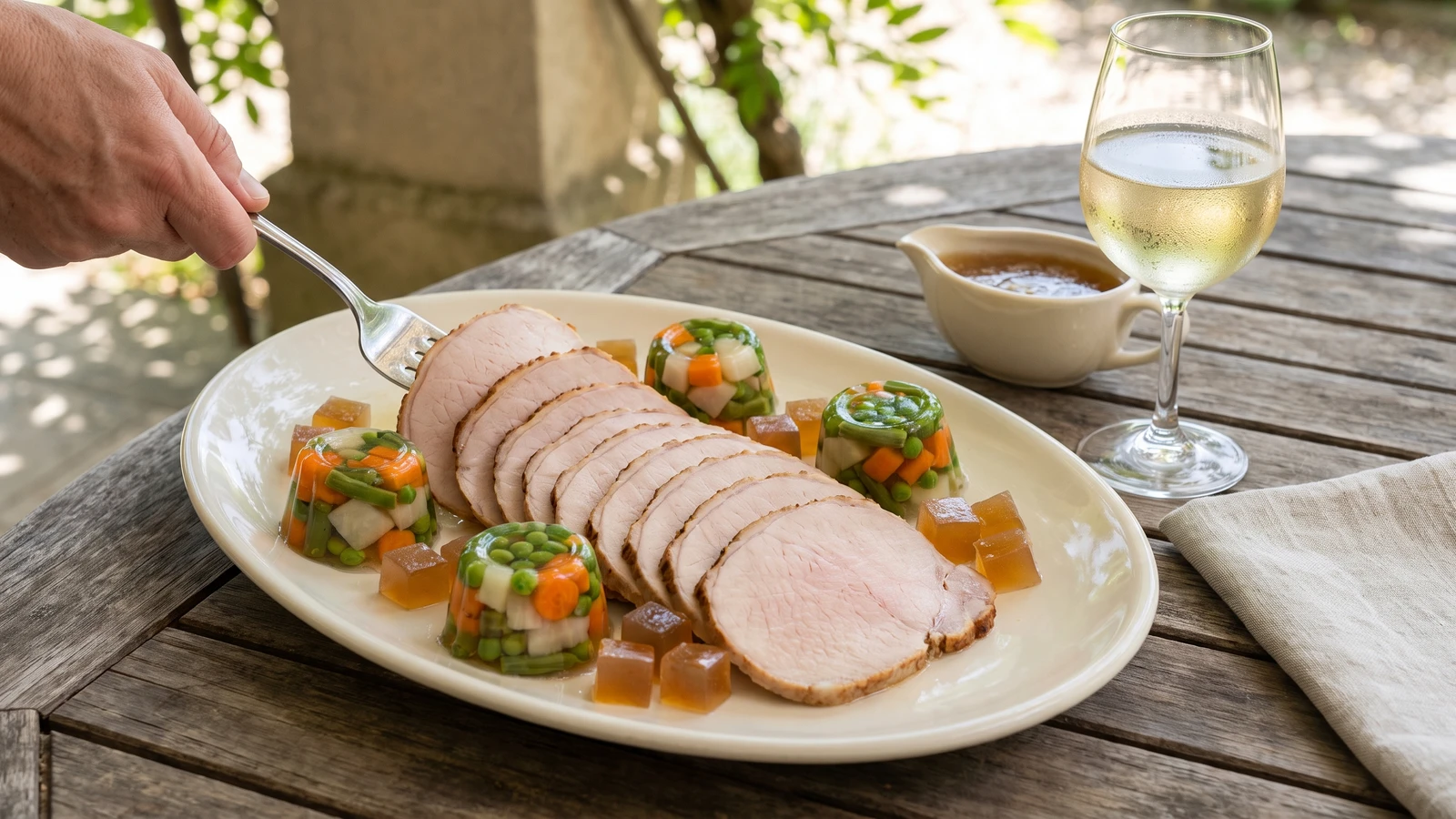
Selle de Veau Froide turns one careful braise into an entire cold supper: tender veal, bright vegetable macédoine, precise jelly dice, and the reduced, degreased cooking liquor served as its own sauce.
Selle de Veau Froide (cold braised saddle of veal) teaches the discipline of cold cookery: flavor must be built hot with enough depth to survive the chill. The one true thing to know before touching the pan is that the braising liquor is not left behind. It becomes the sauce, so careless browning, weak reduction, and a film of grease will all announce themselves once cold.
The original preparation assumed a whole saddle large enough for a relevé, a stockpot never off the fire, a saucier to tend the liquor, and larder hands to mold the garnish. For four, I use a boned, rolled saddle or center-cut veal loin in a snug cocotte, then add a precisely weighed little measure of gelatin because young veal and modern stock do not always set reliably. The imposing whole joint and separate clarified aspic were brigade scaffolding, so they can go. The gentle braise, the Macédoine (a mixture of small-cut vegetables), the regular jelly dice, and the veal's own unclarified, thoroughly degreased liquor are the dish and must stay. One cook, one stove, one evening of work, then the cold does its patient share.
On the platter, the veal should be pale, moist, and cleanly sliced, with bright vegetable molds and amber jelly catching the light around it. Reduce the liquor until it tastes complete before adding gelatin. Gelatin can make weak stock stand upright, but it cannot make it taste of veal. That reduction is the step that decides the dish.
Selle de veau froide belongs to the Parisian grand kitchen and the bourgeois cold sideboard, where a relevé, the substantial joint course, could return chilled and garnished for a summer meal. Its defining economy is exact: the liquor that braised the veal is thoroughly degreased but served without egg-white clarification, so the meat supplies its own sauce rather than borrowing another. Macédoine molds and fine jelly dice carried the preparation from the working larder to the formal buffet without changing its practical heart.
Quantity
1 roast (2¼ lb / 1 kg)
Quantity
2 teaspoons (10 ml / 12 g)
divided
Quantity
1 teaspoon (5 ml / 2 g)
Quantity
2 tablespoons (30 ml / 28 g)
Quantity
1 medium (about 1 cup / 150 g)
cut into ½-inch dice
Quantity
1 large (about 1 cup / 130 g)
cut into ½-inch dice
Quantity
1 stalk (about ½ cup / 60 g)
cut into ½-inch pieces
Quantity
1 clove
lightly crushed
Quantity
1
Quantity
1 cup (240 ml / 240 g)
Quantity
3 cups (720 ml / 720 g)
Quantity
1 small (about ½ cup / 70 g)
cut into ¼-inch dice
Quantity
1 small (about ½ cup / 70 g)
cut into ¼-inch dice
Quantity
½ cup (120 ml / 60 g)
cut into ¼-inch pieces
Quantity
½ cup (120 ml / 70 g)
Quantity
1 tablespoon (15 ml / 18 g)
Quantity
2 teaspoons (10 ml / 6 g)
Quantity
2 tablespoons (30 ml / 30 g)
Quantity
¾ teaspoon (4 ml / 2 g)
Quantity
1 tablespoon (15 ml / 15 g)
| Ingredient | Quantity |
|---|---|
| boned and rolled veal saddle or center-cut veal loin roast | 1 roast (2¼ lb / 1 kg) |
| fine sea saltdivided | 2 teaspoons (10 ml / 12 g) |
| freshly ground white pepper | 1 teaspoon (5 ml / 2 g) |
| unsalted butter | 2 tablespoons (30 ml / 28 g) |
| onioncut into ½-inch dice | 1 medium (about 1 cup / 150 g) |
| carrot for the braisecut into ½-inch dice | 1 large (about 1 cup / 130 g) |
| celerycut into ½-inch pieces | 1 stalk (about ½ cup / 60 g) |
| garliclightly crushed | 1 clove |
| bouquet garni (parsley stems, thyme, and bay leaf) | 1 |
| dry white wine | 1 cup (240 ml / 240 g) |
| unsalted veal stock or light chicken stock | 3 cups (720 ml / 720 g) |
| carrot for the Macédoinecut into ¼-inch dice | 1 small (about ½ cup / 70 g) |
| turnip for the Macédoinecut into ¼-inch dice | 1 small (about ½ cup / 70 g) |
| green beans for the Macédoinecut into ¼-inch pieces | ½ cup (120 ml / 60 g) |
| frozen peas for the Macédoine | ½ cup (120 ml / 70 g) |
| fine sea salt for blanching | 1 tablespoon (15 ml / 18 g) |
| unflavored powdered gelatin for the Macédoine and jelly dice | 2 teaspoons (10 ml / 6 g) |
| cold water for blooming the firm jelly | 2 tablespoons (30 ml / 30 g) |
| unflavored powdered gelatin for the sauce | ¾ teaspoon (4 ml / 2 g) |
| cold water for blooming the sauce gelatin | 1 tablespoon (15 ml / 15 g) |
Tie the veal at 1½-inch intervals if the butcher has not already done it, keeping the roast evenly cylindrical so every slice will be the same size. Pat it thoroughly dry, then season all over with 1½ teaspoons of the salt and the white pepper. Leave it at cool room temperature for 30 minutes while you prepare the braising vegetables. A wet, refrigerator-cold roast browns poorly, and the fond on the pot floor must carry the eventual sauce.
Heat the butter in a snug, heavy cocotte over medium-high heat until its foam subsides. Add the veal and brown every surface patiently, turning only when each side has taken a deep hazelnut color, about 10 to 12 minutes altogether. Lift the roast out. If the butter threatens to blacken before the meat is properly browned, pull the pot from the heat for 30 seconds and lower the flame; burnt specks make a bitter jelly, while dark brown ones make the sauce.
Add the onion, braising carrot, and celery to the same pot. Cook over medium heat for 6 to 8 minutes, stirring and scraping, until the vegetables soften and pick up the fond. Add the garlic for the final minute. Pour in the wine and scrape the pot floor clean, then boil until the wine has reduced by about two-thirds and smells rounded rather than raw. Add the stock, bouquet garni, and remaining ½ teaspoon salt. Return the veal to the pot; the liquid should come roughly halfway up its sides.
Bring the liquid only to a bare simmer, cover the cocotte, and place it in a 325°F (165°C) oven. Braise for 60 to 90 minutes, turning the veal once, until an instant-read thermometer reaches 145°F (63°C) at the center. The liquor should tremble, never gallop. If you find it boiling hard, lower the oven by 25°F (15°C) and uncover the pot for a minute before continuing. Ça se rattrape, but don't leave lean veal fighting a boil.
Lift the veal onto a rack set over a tray and rest it for 20 minutes, then refrigerate it uncovered until the surface is cold. Cover and continue chilling for at least 5 hours. Strain the braising liquor through a fine sieve into a shallow bowl without pressing the vegetables, but do not clarify it. Chill until the fat hardens on top, then lift away every trace. This is nonnegotiable because warm fat tastes generous and cold fat tastes waxy. If boiling has broken the fat into small droplets, chill the liquor completely, lift off the firm layer, then draw the corner of a clean paper towel lightly across the surface. Ça se rattrape.
Return the degreased liquor to a clean saucepan and simmer until exactly 2 cups (480 ml / 480 g) remain. Taste as it reduces. It should be savory enough to serve as a sauce but not aggressively salty, since the cold will sharpen its concentration. If it becomes salty too soon, stop reducing and add a little unsalted stock or water to return it to 2 cups. Gelatin supplies the final set, so there is no prize for reducing the sauce into brine.
Bring a saucepan of water to a boil and add the blanching salt. Cook the diced carrot and turnip until tender but still distinct, about 3 to 4 minutes, then lift them into ice water. Blanch the green beans for about 2 minutes and the peas for 1 minute, chilling each in turn. Drain every vegetable thoroughly and spread them on a clean towel to dry. Water clinging to the Macédoine weakens the jelly and makes the colors bleed.
Sprinkle the 2 teaspoons gelatin over 2 tablespoons cold water and leave it for 5 minutes to swell. Stir it into 1¼ cups (300 ml / 300 g) of the hot reduced liquor until perfectly clear. Pack the Macédoine loosely into four 4-ounce molds and pour in just enough jelly to fill the spaces and cohere the vegetables. Pour the remainder into a shallow metal dish in a layer about ¼ inch thick for the jelly dice. If the gelatin forms threads instead of dissolving, set the bowl over hot water and stir gently until clear. Do not boil it.
Sprinkle the remaining ¾ teaspoon gelatin over 1 tablespoon cold water and leave it for 5 minutes. Stir it into the remaining ¾ cup (180 ml / 180 g) hot braising liquor, then pour the sauce into a small sauceboat or covered bowl. Chill the sauce, the vegetable molds, and the shallow tray until fully set, at least 4 hours. The sauce should form a tender, spoonable jelly rather than a rubbery block.
Remove the string from the cold veal and cut it across the grain into clean ¼-inch slices. Overlap the slices generously on a chilled oval platter. Dip each Macédoine mold in warm water for 3 seconds, invert it beside the veal, and repeat briefly if it resists rather than attacking it with a knife. Cut the firm jelly into fine, regular ¼-inch dice and scatter them around the meat. Let the sauceboat stand for 10 minutes so its jelly softens to a tremble, then serve it beside the platter. Keep the dish cold until the table is ready. À table!
1 serving (about 320g)
Culinary guides, cultural storytelling, and the editorial depth that makes cooking meaningful.
Discover Culinary ExplorerChef Juliette
John Dory has the delicacy of sole and the firmness of turbot. A light flouring, a quick butter sauté, and nut-brown beurre noisette show exactly why looks never mattered.

Chef Juliette
Fresh haddock proves its delicacy in the meunière pan: a fine flour crust, moist pearly flakes, and beurre noisette sharpened with lemon and parsley, ready from one skillet in half an hour.

Chef Juliette
Éperlans à l’Anglaise turns small fish into a lesson in disciplined coating: boned smelts under a close, crisp crumb, pan-fried in clarified butter and finished with bright, half-melted maître d’hôtel butter.

Chef Juliette
Tiny smelts, shallot, mushrooms, white wine, gratin sauce, and fine bread raspings meet a fierce oven, where the fish must turn tender in the same breath the buttered crust bronzes.