
Chef Juliette
John Dory (St. Pierre)
John Dory has the delicacy of sole and the firmness of turbot. A light flouring, a quick butter sauté, and nut-brown beurre noisette show exactly why looks never mattered.
A cooking platform built around craft, culture, and the stories behind what we eat.
Created by Chef Juliette
Based on No. 1185, Selle de Veau à l’Orientale, from Le Guide Culinaire (1907) by Auguste Escoffier
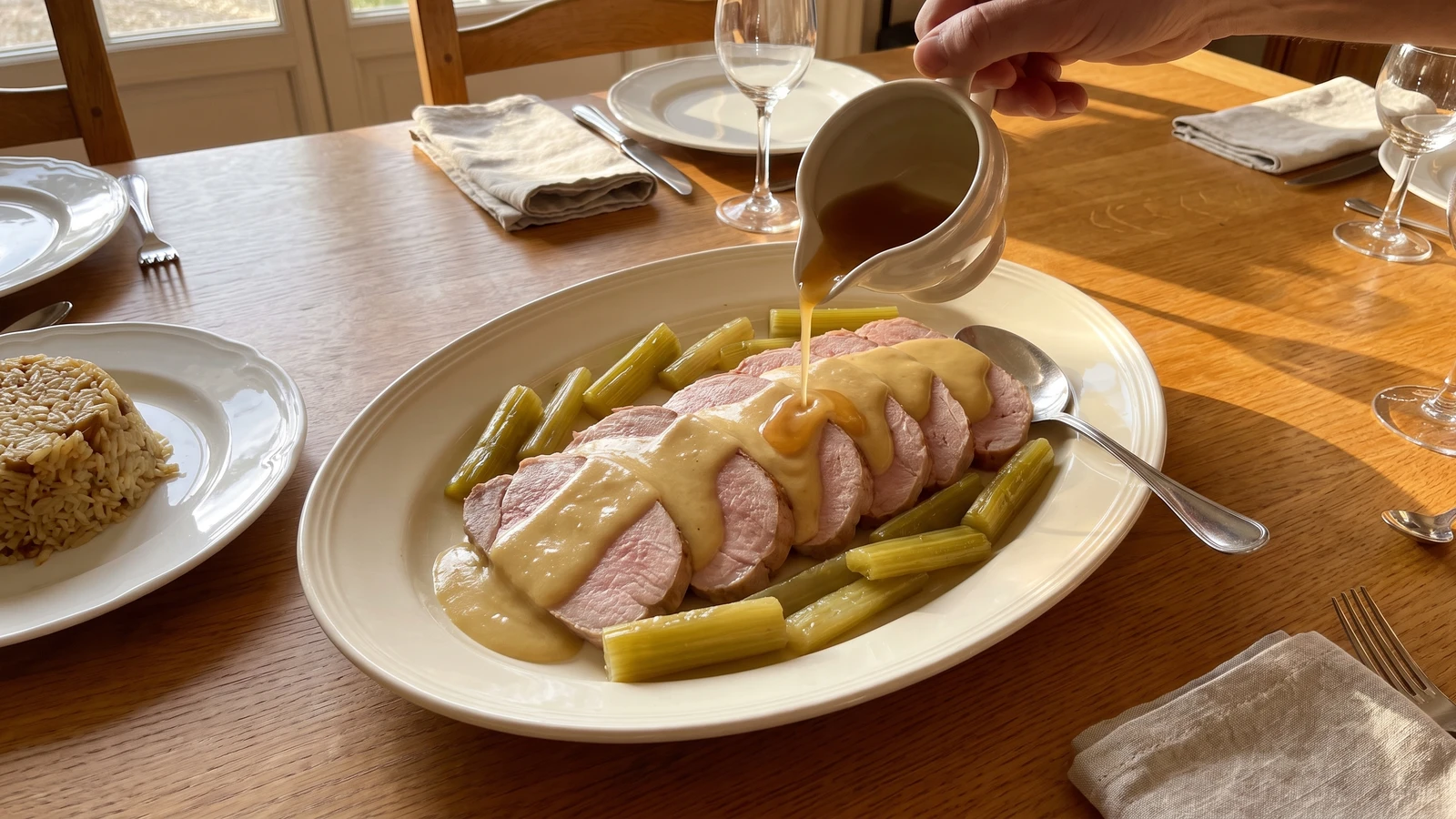
Selle de Veau à l’Orientale brings a whole braised saddle to the table in collops, layered with onion-sweet curried Soubise, encircled by tender celery, with pilaff and clear veal jus alongside.
Selle de Veau à l’Orientale (braised saddle of veal with curried Soubise) teaches a precise kind of abundance: mild, tender meat, an onion-rich sauce, and two composed garnishes, each kept distinct until the platter brings them together. The one true thing to know before touching a pan is that the veal must remain juicy enough to be cut into collops after braising. Cook it to collapse and the reconstruction that defines the dish is gone.
The brigade formula assumes a saucier at the ready, stock never off the fire, a salamander available for last-minute gloss, and separate hands tending the Soubise, celery, and pilaff. Your kitchen needs a small butcher-prepared saddle, a heavy braiser, two saucepans, and an ordinary oven. The salamander can go because warm Soubise supplies the finish without scorching the veal. A full service joint becomes a small saddle for four, its collops overlapped on a warmed platter so the original architecture remains intact. One cook, one stove, one evening.
Separate stations and prolonged holding are scaffolding for a brigade. The gentle braise, Soubise au currie (onion sauce warmed with curry), reconstruction of the collops, celery ring, and pilaff served apart are the dish and must stay. Curry gives warmth here, never heat. Watch the thermometer during the braise, because pulling the veal at the proper temperature is the step that decides everything afterward.
Selle de veau à l’Orientale belongs to the Parisian grand-kitchen repertory, where a braised joint was carved, rebuilt, sauced, and surrounded with composed garnishes before reaching the formal table. Its à l’Orientale title is not a claim to one region or cuisine: in French menu language it marked the selective use of curry and pilaff, flavors absorbed through trade and empire and disciplined within the French sauce system. Here Soubise remains an onion sauce made round with butter and cream, while curry supplies gentle warmth and the separate pilaff completes the service.
Quantity
1 small saddle, 3½ to 4 pounds (1.6 to 1.8 kg)
chine bone cracked by the butcher, outer fat trimmed to ¼ inch (6 mm), and tied
Quantity
10 tablespoons (150 ml / 142 g)
divided, with 1 tablespoon kept cold
Quantity
3 teaspoons (15 ml / 18 g)
divided
Quantity
¾ teaspoon (3.75 ml / 1.5 g)
divided
Quantity
1 medium carrot (4 ounces / 115 g)
diced
Quantity
1 medium onion (6 ounces / 170 g)
coarsely chopped
Quantity
1 rib (2 ounces / 55 g)
coarsely chopped
Quantity
1
Quantity
¾ cup (180 ml / 180 g)
Quantity
5½ cups (1.3 liters / 1.3 kilograms)
kept hot and divided
Quantity
2 large onions (1 pound / 450 g)
thinly sliced
Quantity
2 teaspoons (10 ml / 5 g)
Quantity
2 tablespoons (30 ml / 16 g)
Quantity
1 cup (240 ml / 245 g)
Quantity
¾ cup (180 ml / 180 g)
with 2 tablespoons reserved cold
Quantity
2 hearts (about 1½ pounds / 680 g total)
trimmed, strings removed, and quartered lengthwise
Quantity
1 cup (240 ml / 190 g)
Quantity
1 small shallot (1 ounce / 30 g)
finely minced
Quantity
1
| Ingredient | Quantity |
|---|---|
| bone-in saddle of vealchine bone cracked by the butcher, outer fat trimmed to ¼ inch (6 mm), and tied | 1 small saddle, 3½ to 4 pounds (1.6 to 1.8 kg) |
| unsalted butterdivided, with 1 tablespoon kept cold | 10 tablespoons (150 ml / 142 g) |
| fine sea saltdivided | 3 teaspoons (15 ml / 18 g) |
| freshly ground white pepperdivided | ¾ teaspoon (3.75 ml / 1.5 g) |
| carrotdiced | 1 medium carrot (4 ounces / 115 g) |
| yellow onion for the braisecoarsely chopped | 1 medium onion (6 ounces / 170 g) |
| celery ribcoarsely chopped | 1 rib (2 ounces / 55 g) |
| bouquet garni of parsley stems, thyme, and bay leaf | 1 |
| dry white wine | ¾ cup (180 ml / 180 g) |
| unsalted veal stockkept hot and divided | 5½ cups (1.3 liters / 1.3 kilograms) |
| yellow onions for the Soubisethinly sliced | 2 large onions (1 pound / 450 g) |
| mild curry powder | 2 teaspoons (10 ml / 5 g) |
| all-purpose flour | 2 tablespoons (30 ml / 16 g) |
| whole milk | 1 cup (240 ml / 245 g) |
| heavy creamwith 2 tablespoons reserved cold | ¾ cup (180 ml / 180 g) |
| celery heartstrimmed, strings removed, and quartered lengthwise | 2 hearts (about 1½ pounds / 680 g total) |
| long-grain white rice | 1 cup (240 ml / 190 g) |
| shallotfinely minced | 1 small shallot (1 ounce / 30 g) |
| bay leaf | 1 |
Heat the oven to 325°F (165°C). Pat the saddle completely dry, then season it all over with 1½ teaspoons of the salt and ½ teaspoon of the white pepper. Keep the veal stock hot in a covered saucepan. Choose an oven-safe oval platter large enough to hold the reconstructed saddle and its ring of celery, then set it aside for warming near the end.
Melt 2 tablespoons of the butter in a heavy oval braiser over medium heat. Brown the saddle evenly for 8 to 10 minutes, turning it only when each surface has taken a clear hazelnut color, then lift it out. Add the carrot, chopped onion, and celery rib; cook for 6 minutes without letting them burn. Add the bouquet garni and wine, scrape up the fond, and reduce the wine by half. Pour in 2¼ cups of the hot veal stock and return the saddle fat-side up. The liquid should reach roughly 1 inch (2.5 cm) up the meat. Cover and braise in the oven, basting every 20 minutes, until the center reaches 140°F (60°C), usually 75 to 95 minutes. Transfer the veal to a board and rest it loosely covered for 15 minutes; verify that carryover cooking brings it to at least 145°F (63°C). If it has not, return it to the oven briefly before carving.
While the veal braises, melt 3 tablespoons of butter in a saucepan over medium-low heat. Add the sliced onions with ½ teaspoon salt and ⅛ teaspoon white pepper. Cover and sweat them for 20 to 25 minutes, stirring often, until completely soft but still pale. Stir in the curry powder for 30 seconds, then add the flour and cook for 2 minutes. Whisk in the milk and ½ cup of hot veal stock a little at a time, followed by all but the reserved 2 tablespoons of cream. Simmer gently for 12 to 15 minutes. Blend until perfectly smooth, then pass through a fine sieve if any onion fibers remain. The Soubise sauce au currie should coat a spoon thickly while remaining soft enough to settle between the collops. If it is too tight, blend in hot stock by the tablespoon; if it is thin, simmer it uncovered. If it turns greasy, remove it from the heat and blend in the reserved cold cream. Ça se rattrape.
Arrange the celery-heart quarters in a wide saucepan with 2 tablespoons of butter. Season them with ½ teaspoon salt and ⅛ teaspoon white pepper, then add 1 cup of hot veal stock. Cover with a lid and braise over low heat for 25 to 35 minutes, turning once, until a knife enters the thickest portion without resistance but the pieces remain intact. If the celery finishes before its liquid becomes glossy, lift it out and reduce the liquid separately, then return the pieces and roll them gently in the glaze.
Reserve ½ tablespoon of butter for the mold, then melt 1½ tablespoons in a medium saucepan. Add the shallot and cook without coloring for 2 minutes. Add the rice and nacrer it, coating the grains in butter until their edges look pearly, for another 2 minutes. Pour in 1½ cups of hot veal stock, add the bay leaf and the remaining ½ teaspoon salt, and bring to a bare simmer. Cover tightly and cook over the lowest heat for 16 to 18 minutes. Remove from the heat and rest, still covered, for 10 minutes. If the rice is wet, uncover and return it to low heat for 1 or 2 minutes; if the center remains hard, sprinkle over 2 tablespoons of hot stock, cover, and rest another 5 minutes. Butter a 4-cup mold or heatproof bowl and pack in the rice gently without crushing it.
Strain the saddle’s braising liquor through a fine-mesh sieve into a clean saucepan without pressing the vegetables, then skim away the surface fat. Boil steadily until reduced to about 1¼ cups and concentrated enough to lightly coat a spoon. Taste before adding salt. If it has become too strong or salty, dilute it with reserved hot stock; if it is weak, continue reducing. Take it off the heat and monter au beurre, finishing it by whisking in the remaining 1 tablespoon of cold butter. If the butter separates, whisk in a teaspoon of cold water and the gloss will return.
Lower the oven to 250°F (120°C) and warm the oval platter. Remove the strings from the rested saddle. Run a sharp slicing knife close along the bones to lift off the two long loin fillets, keeping each one oriented so it can be returned to its original side. Cut the fillets crosswise into ⅜-inch (1 cm) collops, as for Selle à la Metternich. Spoon a layer of Soubise sauce au currie into the two cavities. Reconstruct each fillet with its collops in order, overlapping them slightly and placing a little Soubise between the slices, then coat the surface with the remaining sauce. If the assembly has cooled, place the oven-safe platter in the low oven for no more than 5 minutes. Do not broil it; fierce top heat skins the Soubise and overcooks the collops.
Arrange the glazed celery around the reconstructed saddle in an even ring. Invert the pilaff onto a separate warmed plate and lift away the mold. Pour the veal cooking liquor into a warm sauceboat and serve it separately, exactly as the dish requires. Bring everything to the table at once so each guest receives veal, Soubise, celery, pilaff, and a spoonful of the clear buttered jus. À table!
1 serving (about 720g)
Culinary guides, cultural storytelling, and the editorial depth that makes cooking meaningful.
Discover Culinary ExplorerChef Juliette
John Dory has the delicacy of sole and the firmness of turbot. A light flouring, a quick butter sauté, and nut-brown beurre noisette show exactly why looks never mattered.

Chef Juliette
Fresh haddock proves its delicacy in the meunière pan: a fine flour crust, moist pearly flakes, and beurre noisette sharpened with lemon and parsley, ready from one skillet in half an hour.

Chef Juliette
Éperlans à l’Anglaise turns small fish into a lesson in disciplined coating: boned smelts under a close, crisp crumb, pan-fried in clarified butter and finished with bright, half-melted maître d’hôtel butter.

Chef Juliette
Tiny smelts, shallot, mushrooms, white wine, gratin sauce, and fine bread raspings meet a fierce oven, where the fish must turn tender in the same breath the buttered crust bronzes.