
Chef Juliette
John Dory (St. Pierre)
John Dory has the delicacy of sole and the firmness of turbot. A light flouring, a quick butter sauté, and nut-brown beurre noisette show exactly why looks never mattered.
A cooking platform built around craft, culture, and the stories behind what we eat.
Created by Chef Juliette
Based on No. 1182, Selle de Veau à la Chartreuse, from Le Guide Culinaire (1907) by Auguste Escoffier
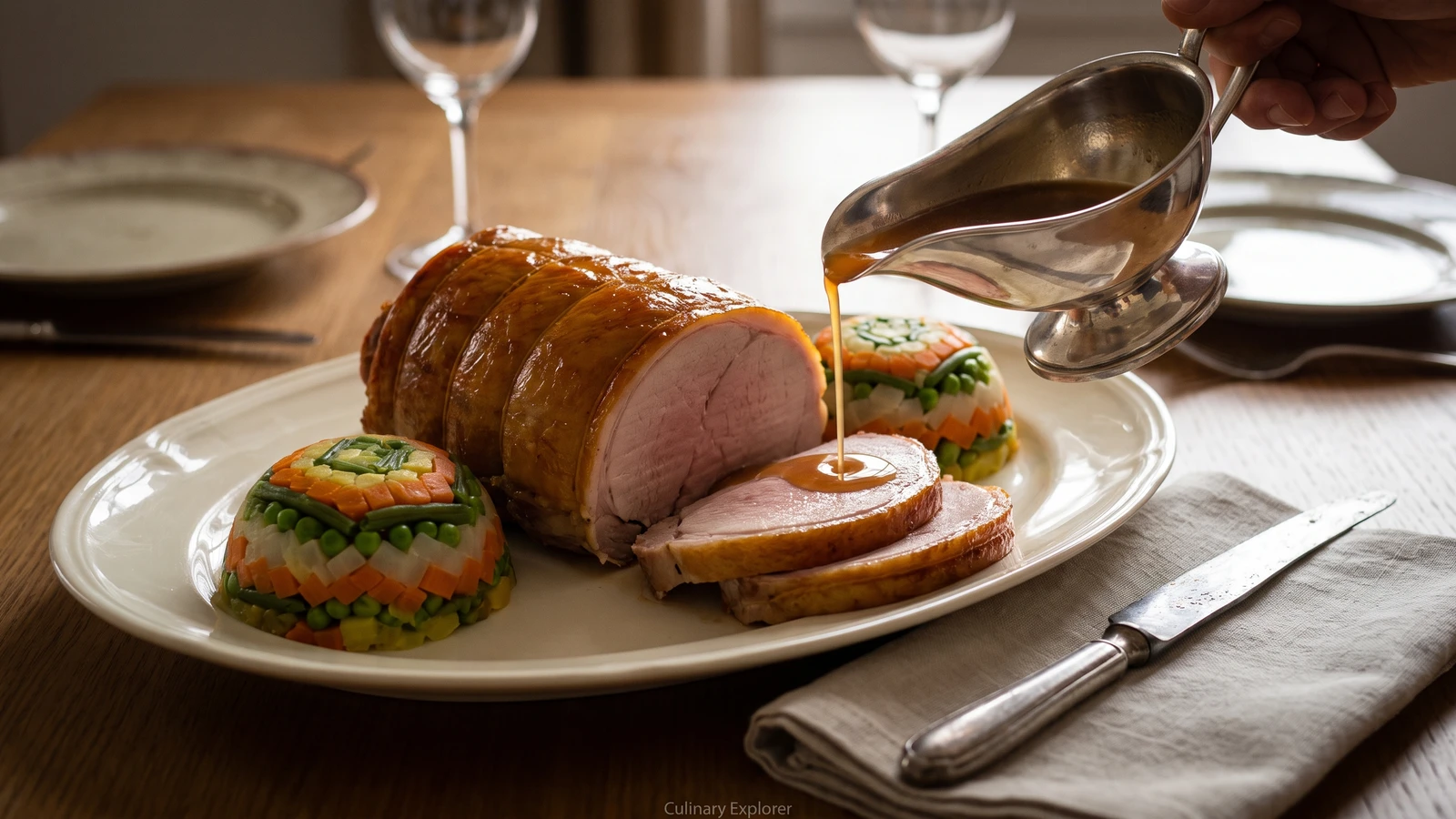
A bronzed saddle of veal between two patterned vegetable domes, with clear, glossy braising jus passed at the table: classical structure translated for four, patient enough for a celebration and possible on one stove.
Selle de Veau à la Chartreuse (braised saddle of veal with patterned vegetable domes) teaches a hard, useful truth: decoration survives only when it is built as structure. Before you touch a pan, know that the carrots, turnips, peas, and French beans aren't simply pressed into a mould. A thin forcemeat lining is poached behind them first, then the mould is filled with a macédoine, small mixed dice of vegetables bound with stiff Béchamel. Skip that first setting and the lovely pattern stays behind when you unmould it.
The classical formula assumed a banquet saddle, a vegetable station with pans to spare, a saucier on staff, stock never off the fire, and a salamander waiting to glaze the meat. Here, a rolled boneless half-saddle feeds four, two small pudding basins replace large Charlotte moulds, one blanching pot cooks the vegetables in succession, good unsalted stock reduces in the braising pot, and the home broiler supplies the final heat. The spare hands and array of pans were brigade scaffolding, so they can go. The patterned lining, its first poach, the cream-bound macédoine, the bacon barding, the clear reduction, and the last-minute glaze are the dish, so they stay. One cook, one stove, one evening.
When it is right, the saddle arrives burnished and juicy, the clear veal jus gathers in a glossy pool, and each chartreuse turns out as a bright little dome of carrot orange, turnip ivory, and fresh green. The step that decides everything is the eight-minute pre-poach of the forcemeat lining: dry the vegetables thoroughly, press the pattern firmly into place, and set that backing before the filling goes anywhere near it.
Selle de Veau à la Chartreuse belongs to the Parisian classical table, where a braised joint was presented whole and its vegetables were organized into separate moulded garnishes rather than scattered around the platter. Chartreuse here names the patterned dome, built from individually cooked vegetables, forcemeat, and a bound macédoine, not an instruction to season the veal with the herbal liqueur. The presentation traveled from grand kitchens to festive bourgeois dining rooms, where a long platter, two domes, and a sauceboat made one roast the undisputed center of the table.
Quantity
1 roast (2¾ to 3 pounds / 1.25 to 1.35 kg)
Quantity
1½ tablespoons (22 ml / 27 g)
divided
Quantity
¾ teaspoon (3.75 ml / 1.5 g)
divided
Quantity
8 thin slices (about 7 ounces / 200 g)
Quantity
8 tablespoons (120 ml / 113 g)
divided
Quantity
1 tablespoon (15 ml / 14 g)
Quantity
1 medium (about 1 cup / 240 ml / 150 g)
chopped
Quantity
1 stalk (about ½ cup / 120 ml / 60 g)
chopped
Quantity
3 medium (about 2½ cups / 600 ml / 360 g)
peeled; one reserved for the braise
Quantity
2 medium (about 2 cups / 480 ml / 300 g)
peeled
Quantity
2 cups (480 ml / 480 g)
Quantity
1 cup (240 ml / 145 g)
fresh or frozen
Quantity
6 ounces (about 1½ cups / 360 ml / 170 g)
trimmed
Quantity
8 ounces (about 1 cup / 240 ml / 225 g)
very cold
Quantity
1 large (2 tablespoons / 30 ml / 30 g)
lightly beaten
Quantity
½ cup (120 ml / 120 g)
very cold and divided
Quantity
3 tablespoons (45 ml / 24 g)
Quantity
½ cup (120 ml / 124 g)
Quantity
¼ teaspoon (1.25 ml / 0.6 g)
| Ingredient | Quantity |
|---|---|
| boneless rolled veal saddle or veal loin roast | 1 roast (2¾ to 3 pounds / 1.25 to 1.35 kg) |
| fine sea saltdivided | 1½ tablespoons (22 ml / 27 g) |
| freshly ground black pepperdivided | ¾ teaspoon (3.75 ml / 1.5 g) |
| unsmoked streaky bacon | 8 thin slices (about 7 ounces / 200 g) |
| unsalted butterdivided | 8 tablespoons (120 ml / 113 g) |
| neutral oil | 1 tablespoon (15 ml / 14 g) |
| yellow onionchopped | 1 medium (about 1 cup / 240 ml / 150 g) |
| celerychopped | 1 stalk (about ½ cup / 120 ml / 60 g) |
| carrotspeeled; one reserved for the braise | 3 medium (about 2½ cups / 600 ml / 360 g) |
| white turnipspeeled | 2 medium (about 2 cups / 480 ml / 300 g) |
| unsalted light veal stock or unsalted chicken stock | 2 cups (480 ml / 480 g) |
| shelled peasfresh or frozen | 1 cup (240 ml / 145 g) |
| French beanstrimmed | 6 ounces (about 1½ cups / 360 ml / 170 g) |
| lean ground vealvery cold | 8 ounces (about 1 cup / 240 ml / 225 g) |
| egg whitelightly beaten | 1 large (2 tablespoons / 30 ml / 30 g) |
| heavy creamvery cold and divided | ½ cup (120 ml / 120 g) |
| all-purpose flour | 3 tablespoons (45 ml / 24 g) |
| whole milk | ½ cup (120 ml / 124 g) |
| ground white pepper | ¼ teaspoon (1.25 ml / 0.6 g) |
Heat the oven to 325°F (165°C). Chop one carrot for the braise and hold it with the onion and celery. Slice part of the remaining carrots and turnips about ⅛ inch (3 mm) thick, then cut or stamp enough small rounds or squares to pattern the two moulds. Cut twelve French beans into neat lengths for bands along the sides. Dice every trimming and all the remaining carrot, turnip, and beans into a macédoine of even ¼-inch (6 mm) pieces. Reserve several spoonfuls of peas for the pattern and keep the rest for the filling.
Bring one large saucepan of water to a boil and season it with 1½ teaspoons of the salt. Cook each vegetable separately in the same water, lifting it out before the next goes in: carrots for 5 to 7 minutes, turnips for 4 to 5 minutes, French beans for about 3 minutes, and peas for 45 to 60 seconds. Each should be tender enough to bend without breaking but still hold its shape. Cool them promptly in cold water, drain, and spread them on towels until completely dry. Melt 1 tablespoon of the butter and coat the decorative pieces and diced vegetables lightly, keeping them in separate bowls.
Melt 2 tablespoons of the butter in a small saucepan, stir in the flour, and cook this pale roux for 2 minutes without letting it colour. Whisk in the milk gradually, then cook until the Béchamel, the milk sauce thickened by the roux, becomes thick enough to stand in a mound on the spoon. Whisk in ¼ cup (60 ml / 60 g) of the cream, ¼ teaspoon of salt, and the white pepper. Fold the sauce through the diced vegetables and the peas not reserved for decorating. The macédoine must cohere when spooned, not swim. If it is loose, return it to gentle heat and stir until the excess moisture cooks away; if it becomes pasty, loosen it with one spoonful of milk. Ça se rattrape. Spread it on a tray to cool.
Put the cold ground veal, ½ teaspoon of salt, and ¼ teaspoon of black pepper in a food processor. Process just until the mixture becomes smooth and sticky, then add the remaining ¼ cup (60 ml / 60 g) cream in a thin stream. Fold or pulse in the lightly beaten egg white, which softens the forcemeat while giving it the structure needed to hold the vegetables. Keep it cold. If it turns grainy or begins smearing fat around the bowl, stop immediately, chill the bowl for 10 minutes, and process again only until it comes together.
Use 3 tablespoons of the butter to coat two 2-cup (475 ml) dome or pudding moulds liberally. Line each with a parchment circle on the bottom and overlapping parchment strips around the sides, then butter the paper as well. Arrange carrots, turnips, peas, and French beans over the bottom and sides in a checkerboard or alternating coloured rows, pressing every piece firmly against the paper. With a damp spoon, spread about two-thirds of the forcemeat over the pattern in an even layer about ¼ inch (5 mm) thick. Reserve the rest for the lids. This patterned lining is patient work, but it is the chartreuse, not decoration added afterward.
Stand the moulds in a deep roasting pan and pour in hot water to reach halfway up their sides, making a bain-marie, or water bath. Cover the pan loosely with foil and poach the empty lined shells in the oven for 8 minutes, just until the forcemeat turns opaque and holds the vegetable pattern. Lift the moulds out. If a piece has shifted, reposition it while the lining is warm and patch behind it with a little reserved forcemeat. Fill each mould with the cooled macédoine to within ⅓ inch (8 mm) of the rim, pressing gently to remove air pockets, then seal the top with the remaining forcemeat. Cover with buttered parchment and set aside while the veal begins braising.
Dry the saddle thoroughly and season it with 2 teaspoons of salt and ½ teaspoon of black pepper. Heat 2 tablespoons of the butter with the oil in a snug, heavy casserole. Brown the veal on every side until the surface is deep gold, taking 10 to 12 minutes and turning only when each face releases cleanly. Lift it out. Add the chopped onion, celery, and reserved carrot to the same pot and cook for 5 minutes. Pour in the stock and scrape the fond, the browned glaze on the pot floor, into the liquid. Return the saddle and drape the bacon slices across its top, overlapping them so the lean veal is completely barded.
Cover the casserole tightly and place it in the oven. The liquid should reach roughly one-third of the way up the meat and barely tremble, never boil hard. Begin checking after 45 minutes. If the liquid is racing, lower the oven to 300°F (150°C) and add a small splash of hot water; fierce heat tightens the loin before the braise can protect it. Continue until the center registers 136 to 140°F (58 to 60°C), usually 80 to 95 minutes in total. The final glaze will carry it to its serving temperature.
About 35 minutes before the veal is expected to finish, return the covered chartreuse moulds to their bain-marie and place the pan in the oven beside the casserole. Poach for 35 minutes. The filling should feel firm at the center and the forcemeat should reach 160°F (71°C); if it has not, give it another 5 minutes. Remove the moulds from the water and let them rest for at least 5 minutes before unmoulding. That pause lets the structure settle.
Lift the veal from its casserole as soon as it reaches temperature, remove every bacon slice, and set the saddle on a rack over a small roasting tray. Strain the braising liquor through a fine sieve without crushing the vegetables, because hard pressing clouds the jus. Remove every trace of surface fat with a separator or a shallow spoon, then boil the clear liquor in a wide saucepan until about 1¼ cups (300 ml / 300 g) remain and it coats a spoon with a light gloss. If it becomes sticky or too salty, loosen it with hot water; if a sheen of grease returns, skim again. Taste and use the final reserved salt only if the sauce needs it.
Raise the oven to 450°F (230°C) or heat the broiler. Brush the bare saddle with a thin coat of reduced braising liquor and expose it to the high heat for 1 to 2 minutes. Brush and repeat twice, watching closely, until the surface is burnished and glossy and the center reaches at least 145°F (63°C). If one patch darkens too quickly, lower the tray and cover that spot with a scrap of foil while the rest catches up. Rest the glazed veal for 8 minutes.
Run a thin knife only around the unlined top edge of each mould, place a small plate over it, and invert with confidence. If a chartreuse refuses to release, wrap the mould in a hot towel for 20 seconds and try again; if one vegetable remains behind, lift it out and press it gently into its place. Set the glazed saddle lengthwise on a warm platter and place one chartreuse at each end. Spoon only a few tablespoons of the clear reduced liquor around the veal so the pattern remains visible, and pass everything else in a warm sauceboat. Carve the saddle into thick slices at the table. À table!
1 serving (about 700g)
Culinary guides, cultural storytelling, and the editorial depth that makes cooking meaningful.
Discover Culinary ExplorerChef Juliette
John Dory has the delicacy of sole and the firmness of turbot. A light flouring, a quick butter sauté, and nut-brown beurre noisette show exactly why looks never mattered.

Chef Juliette
Fresh haddock proves its delicacy in the meunière pan: a fine flour crust, moist pearly flakes, and beurre noisette sharpened with lemon and parsley, ready from one skillet in half an hour.

Chef Juliette
Éperlans à l’Anglaise turns small fish into a lesson in disciplined coating: boned smelts under a close, crisp crumb, pan-fried in clarified butter and finished with bright, half-melted maître d’hôtel butter.

Chef Juliette
Tiny smelts, shallot, mushrooms, white wine, gratin sauce, and fine bread raspings meet a fierce oven, where the fish must turn tender in the same breath the buttered crust bronzes.