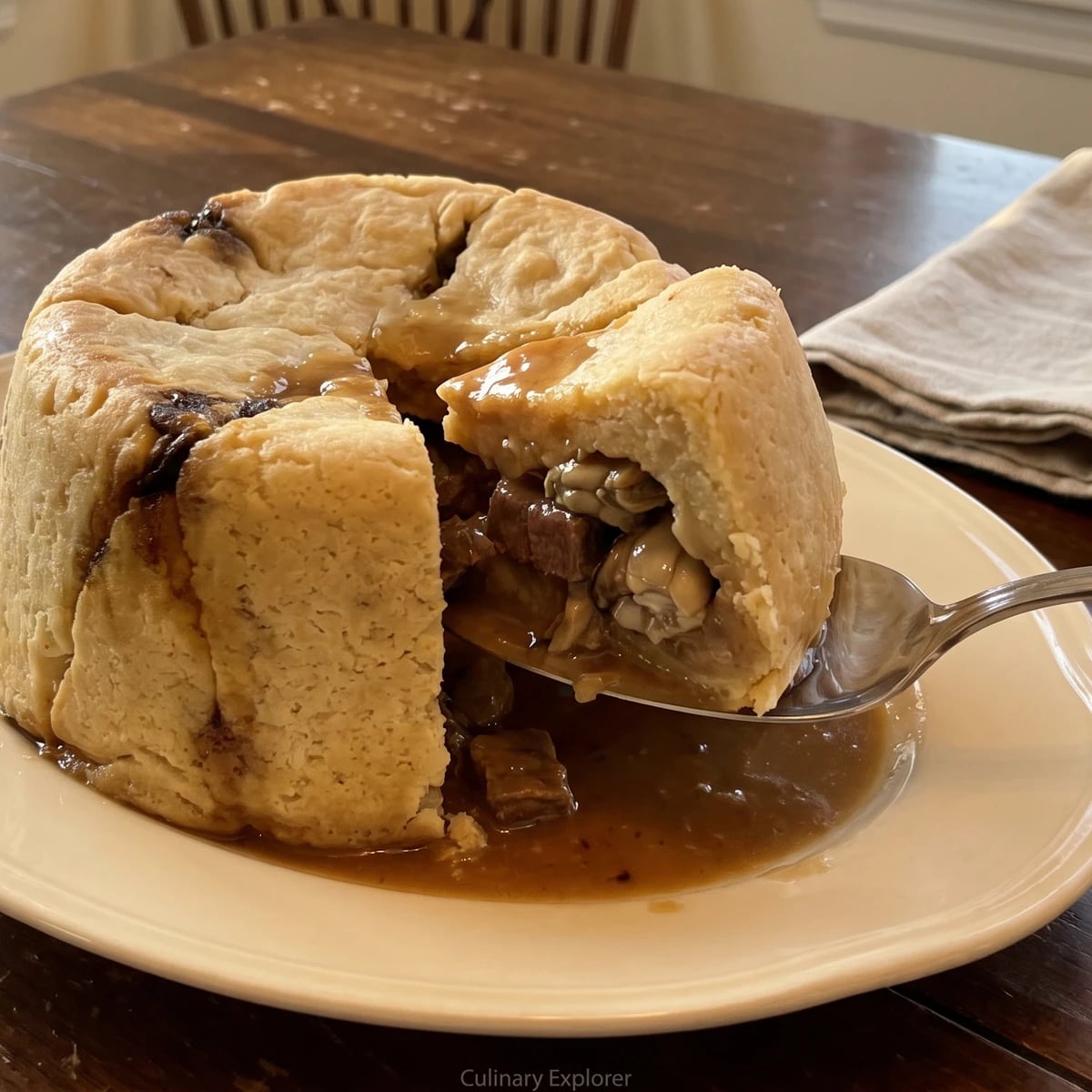
A sealed suet crust turns beef, oysters, and their liquor into its own gravy: an English pudding kept in the French canon, scaled for four and cooked in one home pot.
Main Dishes
French
Comfort Food
Make Ahead
Special Occasion
45 min
Active Time
3 hr 30 min cook•4 hr 15 min total
Yield4 servings
Pouding de bœuf aux huîtres (steak and oyster pudding) teaches the sealed-basin principle: the crust is not decoration, it is the cooking vessel. Close it completely and the beef, oysters, their liquor, and a little flour make their own gravy while the suet paste turns tender but holds. Leave a weak seam and the whole construction drinks the boiler water.
The source entered a professional repertoire, but this pouding never needed a saucier on staff, a stock never off the fire, or a salamander. It assumed something plainer: a large pudding boiler kept going and a quantity meant for more hands at table. For four, its two pounds of beef and forty oysters are cut exactly in half, keeping both the ratio and the raw, layered sequence. A deep lidded pot, a trivet, and a kettle are the honest home equivalents. One cook, one stove, one evening.
A separate sauce would be brigade scaffolding and can go. The sealed suet crust, raw filling, oyster liquor, and long gentle cooking are the dish and must stay; the oysters are meant to soften almost into the gravy, not sit plump like a garnish. Before you touch the pan, remember the one step that decides everything: seal the pastry lid to the lining without a gap.
This preparation belongs to the English boiled-pudding table, with a strong place in London cookery, where oysters went into beef pies and puddings as seasoning and substance rather than luxury garnish. Generations of cooks sealed the pairing beneath suet crust so the oyster liquor became part of the gravy while the oysters themselves nearly disappeared. Its place in the French classical repertoire is as an adopted English preparation recorded by French professional kitchens, not as a specialty of Lyon, Burgundy, Normandy, or any other French region.
The technique, the tradition, and the story behind every dish.
⅔ cup (160 ml / 160 g), plus up to 2 tablespoons (30 ml / 30 g) if needed
beef chuck
Quantity
2¾ cups (650 ml / 454 g)
cut into 1-inch pieces
all-purpose flour for the filling
Quantity
3 tablespoons (45 ml / 24 g)
fine sea salt for the filling
Quantity
½ teaspoon (2.5 ml / 3 g)
freshly ground black pepper
Quantity
1 teaspoon (5 ml / 2 g)
fine oysters
Quantity
20, about 1¼ cups (300 ml / 300 g) shucked
shucked and kept cold, liquor reserved
oyster liquor and cold water
Quantity
¾ cup (180 ml / 180 g) total
reserved oyster liquor topped up with cold water as needed
Ingredient
Quantity
unsalted buttersoftened, for greasing the basin
1 tablespoon (15 ml / 14 g)
all-purpose flour for the crustplus more for rolling
2¾ cups (650 ml / 350 g)
beef suetfinely shredded and kept very cold
1⅔ cups loosely packed (395 ml / 175 g)
fine sea salt for the crust
1 teaspoon (5 ml / 6 g)
ice-cold water
⅔ cup (160 ml / 160 g), plus up to 2 tablespoons (30 ml / 30 g) if needed
beef chuckcut into 1-inch pieces
2¾ cups (650 ml / 454 g)
all-purpose flour for the filling
3 tablespoons (45 ml / 24 g)
fine sea salt for the filling
½ teaspoon (2.5 ml / 3 g)
freshly ground black pepper
1 teaspoon (5 ml / 2 g)
fine oystersshucked and kept cold, liquor reserved
20, about 1¼ cups (300 ml / 300 g) shucked
oyster liquor and cold waterreserved oyster liquor topped up with cold water as needed
¾ cup (180 ml / 180 g) total
Equipment Needed
•1½-quart (1.4-liter) pudding basin
•7 to 8-quart (6.5 to 7.5-liter) deep pot with a tight lid
•Heatproof trivet or upturned saucer
•Rolling pin
•Fine-mesh sieve
•Parchment paper, foil, and kitchen twine
•Instant-read thermometer
Instructions
1
Prepare the boiler
Butter a 1½-quart pudding basin generously, reaching all the way to the rim. Set a heatproof trivet or an upturned saucer in a deep lidded pot, place the empty basin on it, and note where water will reach halfway up the basin. Remove the basin, fill the pot to that level, and bring the water to a gentle simmer. Cut a sheet each of parchment and foil large enough to cover the basin, making a broad pleat through the centre so the pouding can expand.
2
Make the suet crust
Mix the 2¾ cups flour and crust salt, then stir through the cold shredded suet until every piece is dusted. Add about ½ cup of the ice-cold water and mix with a table knife, adding the remainder little by little until the dough gathers into a soft, firm mass. Press rather than knead. If it crumbles when squeezed, add cold water one teaspoon at a time; if it turns sticky, dust it lightly with flour and rest it for ten minutes. Ça se rattrape.
3
Line the basin
Reserve one quarter of the dough for the lid. Roll the larger piece on a lightly floured surface into a round about ¼ inch thick, then ease it into the buttered basin without stretching it. Press it neatly against the base and sides, leaving about 1 inch hanging over the rim. The lining must be continuous. If it tears, dampen the edges of the tear, press on a thin scrap of dough, and smooth the join firmly.
A patched crust cooks perfectly well. A hole left from pride does not.
4
Layer the filling
Shuck the oysters over a bowl and pass their liquor through a fine sieve to remove shell fragments. Add enough cold water to make ¾ cup liquid. Toss the raw beef with the filling flour, salt, and pepper, coating every piece lightly. Put half the beef into the lined basin, distribute half the oysters among it, and repeat. Pour the oyster liquor mixture slowly around the edge, leaving at least ¾ inch of headroom. Do not brown the beef. Browning would create a fond, but it would change this entry's sequence; here the oyster liquor is the gravy's foundation, and the flour thickens it gradually inside the sealed crust.
5
Seal the pouding
Roll the reserved dough into a lid slightly wider than the basin. Brush the overhanging lining with cold water, lay the lid over the filling, and pinch the two pieces together firmly all around. Trim the excess, fold the joined edge inward, and press it once more. Cover with the pleated parchment and foil, foil uppermost, then tie securely beneath the basin's rim with kitchen twine. Make a twine handle across the top for lifting.
6
Cook at a tremble
Lower the covered basin onto the trivet. The simmering water should reach halfway up its sides without touching the pastry seal. Cover the pot and cook for 3 hours 15 minutes at a steady, gentle simmer, checking every 30 to 40 minutes and replenishing only with boiling water. A rolling boil knocks the basin about; a lazy pot cooks unevenly. If the pot runs dry, restore it immediately with boiling water and add 20 minutes to the cooking time. Ça se rattrape.
Keep a filled kettle nearby. Cold refill water stops the cooking and can leave the beef firm when the crust appears done.
7
Rest and turn out
Lift the basin from the pot and rest it for ten minutes before removing the wrapping. A skewer pushed through the centre should meet tender beef and emerge thoroughly hot; an instant-read thermometer should show at least 190°F (88°C), the range where chuck becomes tender rather than merely cooked. Loosen the edge with a thin knife, place a warm serving platter over the basin, and invert them together. If it sticks, wrap the basin in a hot damp towel for two minutes and try again.
8
Correct the gravy
Cut the first generous wedge and let the gravy pool onto the platter. If it is thinner than you want, spoon it into a small saucepan and boil it for 2 to 4 minutes until it lightly coats a spoon, then pour it back over the cut face. If it is too thick, loosen it with a tablespoon of hot water. The oysters will have softened deeply into the sauce, which is exactly their work here. Serve at once. À table!
Chef Tips
•Choose twenty small or medium oysters, not a few enormous ones. The source makes count part of the ratio, and evenly distributed oysters season the pouding more completely. Ask the fishmonger to shuck them over a container and save every drop of liquor.
•Chuck is the honest home cut. It has enough connective tissue to soften during the long cooking, while fillet would surrender its texture and give the gravy very little. Technique first, always.
•Use real beef suet, freshly shredded or a good packaged version. Butter melts too quickly to build the same porous crust, vegetable shortening tastes flat, and margarine has no business here.
•Expect the oysters to become very soft and some to disappear almost entirely. They stand in for the kidney as the source directs, giving salinity, body, and liquor to the gravy; preserving them as plump garnish would make another dish.
•Serve with plainly boiled potatoes or sharp mustard-dressed greens. If pouring wine, choose a cool, lightly tannic Beaujolais-Villages, which has enough fruit for the beef without trampling the oysters.
Advance Preparation
•The suet crust can be mixed up to 6 hours ahead, wrapped, and kept cold. Let it stand at room temperature for ten minutes before rolling so it bends without cracking.
•The filled and sealed basin may wait in the refrigerator for up to 4 hours before cooking. Keep it at 40°F (4°C) or colder because the oysters and beef are raw.
•For a fully make-ahead pouding, cook it one day before serving, cool it promptly, cover the basin, and refrigerate within 2 hours. Reheat it over gently simmering water for 60 to 75 minutes, until the centre reaches at least 165°F (74°C), then rest and turn it out as directed.
Frequently Asked Questions
Nutrition Information
1 serving (about 400g)
Calories
1035 calories
Total Fat
64 g
Saturated Fat
32 g
Trans Fat
3 g
Unsaturated Fat
29 g
Cholesterol
155 mg
Sodium
1250 mg
Total Carbohydrates
74 g
Dietary Fiber
3 g
Sugars
1 g
Protein
37 g
Where cooking meets culture.
Culinary guides, cultural storytelling, and the editorial depth that makes cooking meaningful.