
Chef Juliette
John Dory (St. Pierre)
John Dory has the delicacy of sole and the firmness of turbot. A light flouring, a quick butter sauté, and nut-brown beurre noisette show exactly why looks never mattered.
A cooking platform built around craft, culture, and the stories behind what we eat.
Created by Chef Juliette
Based on No. 1169, Steak and Kidney Pudding, from Le Guide Culinaire (1907) by Auguste Escoffier
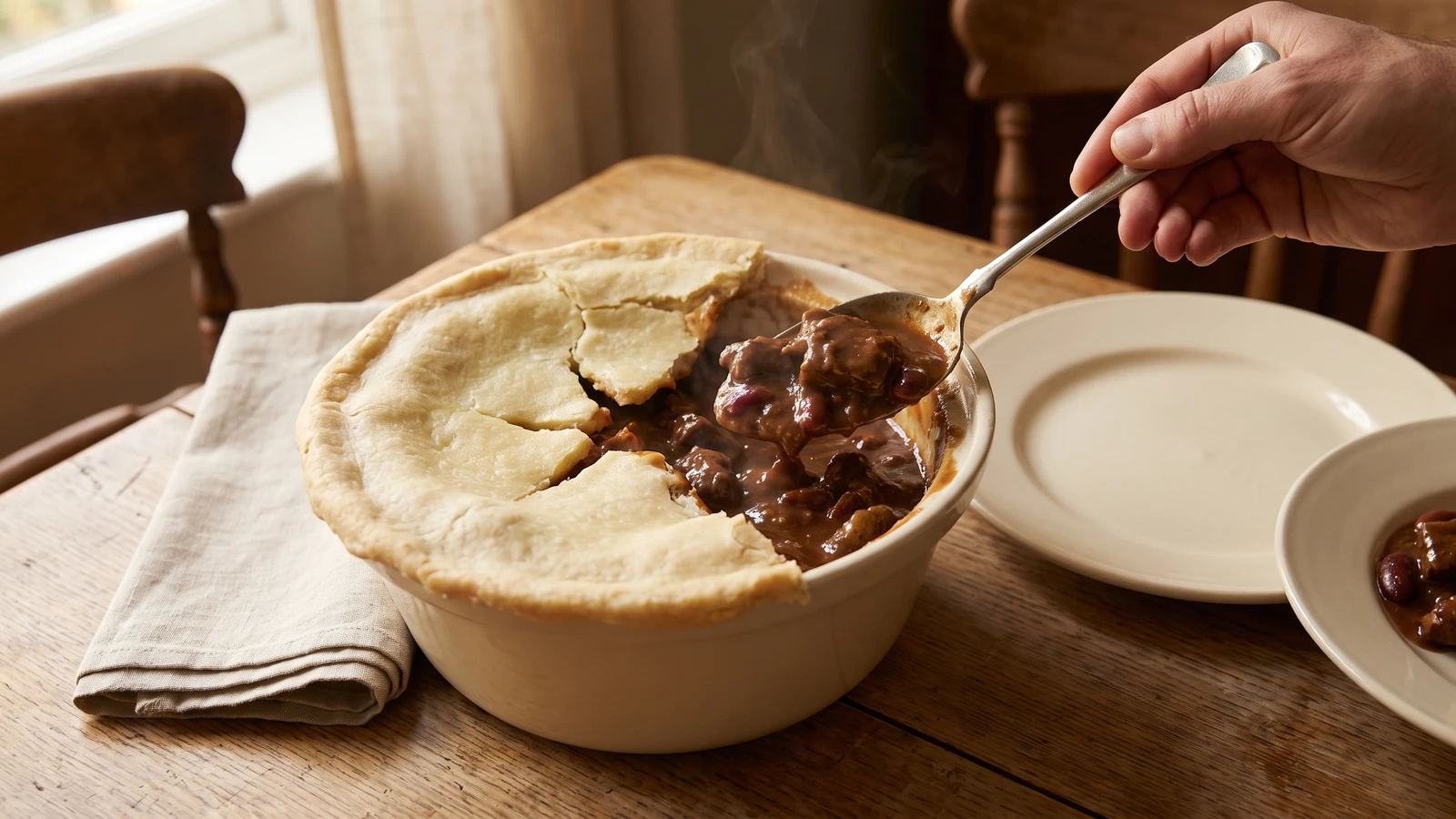
Beef and kidney cook inside a firm suet crust for five patient hours, making their own dark gravy. The dampened seam decides everything: close it well, then let the pouding work.
Pouding de bœuf et rognons (steak and kidney pudding) teaches containment. Raw beef, kidney, onion, parsley, nutmeg, and water become their own rich gravy because the suet crust holds every drop through five hours of cooking. Brown nothing and add no stock. The one true thing to know before touching a pan is this: a sealed pouding bastes itself, while a careless seam empties its promise into the cooking water.
The original preparation assumed three pounds of beef, a pound of kidney, a great basin, a boiler kept going for half the day, and a buttered, floured napkin tied beneath the rim. For four people, I have halved the meat exactly and given you a two-quart basin, a covered stockpot, and a pleated parchment-and-foil cap. The napkin was useful scaffolding and can go. The five-hour cook, the firm suet paste, the raw filling, and the dampened pastry seam are the dish itself, so all four stay. One cook, one stove, one evening.
When it is ready, the crust is tender and substantial, the beef yields beneath the spoon, and dark gravy gathers wherever the lid is cut. Seal the two layers of paste with wet fingers and a thorough pinch before the basin goes near the water. That seam matters more than elegance ever will.
Steak and kidney pudding belongs to the English household table and public-house supper, where suet pastry made a practical enclosure for long-cooked beef and offal. The basin form grew through generations of boiled puddings, catching the meat juices inside rather than requiring a separate sauce. French professional manuals adopted it under its English identity, which is why it appears in the classical French record without becoming a French regional dish.
Quantity
About 3 cups (710 ml / 700 g)
prepared through the firm-dough stage and kept as one piece for the lining and lid
Quantity
About 3⅓ cups (790 ml / 680 g)
sliced ⅓ inch (8 mm) thick
Quantity
About 1½ cups (355 ml / 225 g)
trimmed and cut into 1-inch (2.5 cm) pieces
Quantity
¼ cup (60 ml / 40 g)
finely chopped
Quantity
2 tablespoons (30 ml / 8 g)
finely chopped
Quantity
2 teaspoons (10 ml / 12 g)
Quantity
1 teaspoon (5 ml / 2 g)
Quantity
¼ teaspoon (1.25 ml / 0.5 g)
Quantity
1 to 1½ cups (240 to 355 ml / 240 to 355 g)
or just enough to cover the filling
Quantity
1 tablespoon (15 ml / 14 g)
softened, for the parchment
| Ingredient | Quantity |
|---|---|
| Suet Dumpling (No. 1166)prepared through the firm-dough stage and kept as one piece for the lining and lid | About 3 cups (710 ml / 700 g) |
| very lean beefsliced ⅓ inch (8 mm) thick | About 3⅓ cups (790 ml / 680 g) |
| beef, veal, or mutton kidneytrimmed and cut into 1-inch (2.5 cm) pieces | About 1½ cups (355 ml / 225 g) |
| onionfinely chopped | ¼ cup (60 ml / 40 g) |
| flat-leaf parsleyfinely chopped | 2 tablespoons (30 ml / 8 g) |
| fine salt | 2 teaspoons (10 ml / 12 g) |
| freshly ground black pepper | 1 teaspoon (5 ml / 2 g) |
| freshly grated nutmeg | ¼ teaspoon (1.25 ml / 0.5 g) |
| wateror just enough to cover the filling | 1 to 1½ cups (240 to 355 ml / 240 to 355 g) |
| unsalted buttersoftened, for the parchment | 1 tablespoon (15 ml / 14 g) |
Set a heatproof trivet or an inverted saucer in the bottom of a deep, heavy stockpot. Place the empty 2-quart (2-liter) pudding basin on it and add enough water to reach halfway up the basin, then remove the basin and bring the water to a boil under a tight lid. Keep a kettle of water ready for replenishing the pot during the long cook.
Trim every hard white core and membrane from the kidney, then cut it into 1-inch (2.5 cm) pieces. Combine the salt, pepper, and nutmeg. Season the beef and kidney evenly with this mixture, then toss each separately with the chopped onion and parsley. Keep the meats separate for the source preparation's layered filling.
Reserve one quarter of the prepared Suet Dumpling (No. 1166) for the lid. Roll the remainder into a round about ¼ inch (6 mm) thick, lower it into the basin, and press it evenly across the bottom and sides, leaving a small overhang at the rim. If the paste tears, don't start again. Ça se rattrape: press a thin scrap over the hole with damp fingers until no seam remains. A firm, unbroken lining matters more than a perfectly smooth one.
Arrange a layer of seasoned beef across the bottom and continue the slices up the sides, overlapping them slightly. Put the seasoned kidney in the middle, then cover it with the remaining beef. Pour in only enough water to cover the meat, usually 1 to 1½ cups (240 to 355 ml / 240 to 355 g), while leaving at least ¾ inch (2 cm) of headroom beneath the rim. The water is deliberate: enclosed with the meat juices and seasoning, it becomes the gravy.
Roll the reserved Suet Dumpling (No. 1166) into a lid slightly wider than the basin. Moisten both pastry edges with water, lay on the lid, and pinch it firmly to the lining all the way around. Trim any heavy excess and fold the seam inward. If one section refuses to adhere, lift it, wet both surfaces again, and repinch until the join becomes one piece. Don't pierce the lid. The seam is the dish. Butter a sheet of parchment, pleat it across the middle to allow for expansion, and place it buttered-side down over the basin. Cover with pleated foil and tie kitchen string securely beneath the basin's lip. This replaces the original buttered, floured napkin because it excludes splashing water more reliably in a home stockpot.
Lower the covered basin onto the trivet in the boiling water. The water should come halfway up its sides without reaching the tied cover. Cover the stockpot and maintain a steady, contained boil for five full hours. Check the level every forty-five minutes and replenish only with boiling water, because cold water stops the cooking and a dry pot can crack the basin. If the level has fallen too far, refill it at once and allow the water to return to the boil before resuming the timing.
Lift out the basin carefully and let it stand for ten minutes. Remove the string, foil, and parchment, then wipe the outside of the basin dry. Serve the pouding as it stands, just as the source directs: cut through the suet lid at the table and spoon out beef, kidney, crust, and the gravy gathered beneath. Never apologize at your own table. À table!
1 serving (about 495g)
Culinary guides, cultural storytelling, and the editorial depth that makes cooking meaningful.
Discover Culinary ExplorerChef Juliette
John Dory has the delicacy of sole and the firmness of turbot. A light flouring, a quick butter sauté, and nut-brown beurre noisette show exactly why looks never mattered.

Chef Juliette
Fresh haddock proves its delicacy in the meunière pan: a fine flour crust, moist pearly flakes, and beurre noisette sharpened with lemon and parsley, ready from one skillet in half an hour.

Chef Juliette
Éperlans à l’Anglaise turns small fish into a lesson in disciplined coating: boned smelts under a close, crisp crumb, pan-fried in clarified butter and finished with bright, half-melted maître d’hôtel butter.

Chef Juliette
Tiny smelts, shallot, mushrooms, white wine, gratin sauce, and fine bread raspings meet a fierce oven, where the fish must turn tender in the same breath the buttered crust bronzes.