Culinary Explorer

A cooking platform built around craft, culture, and the stories behind what we eat.
Discover Culinary Explorer
Stewed Steaks and Onions

Stewed Steaks and Onions

Created by Chef Juliette

Based on No. 1164, Stewed Steaks and Onions, from Le Guide Culinaire (1907) by Auguste Escoffier

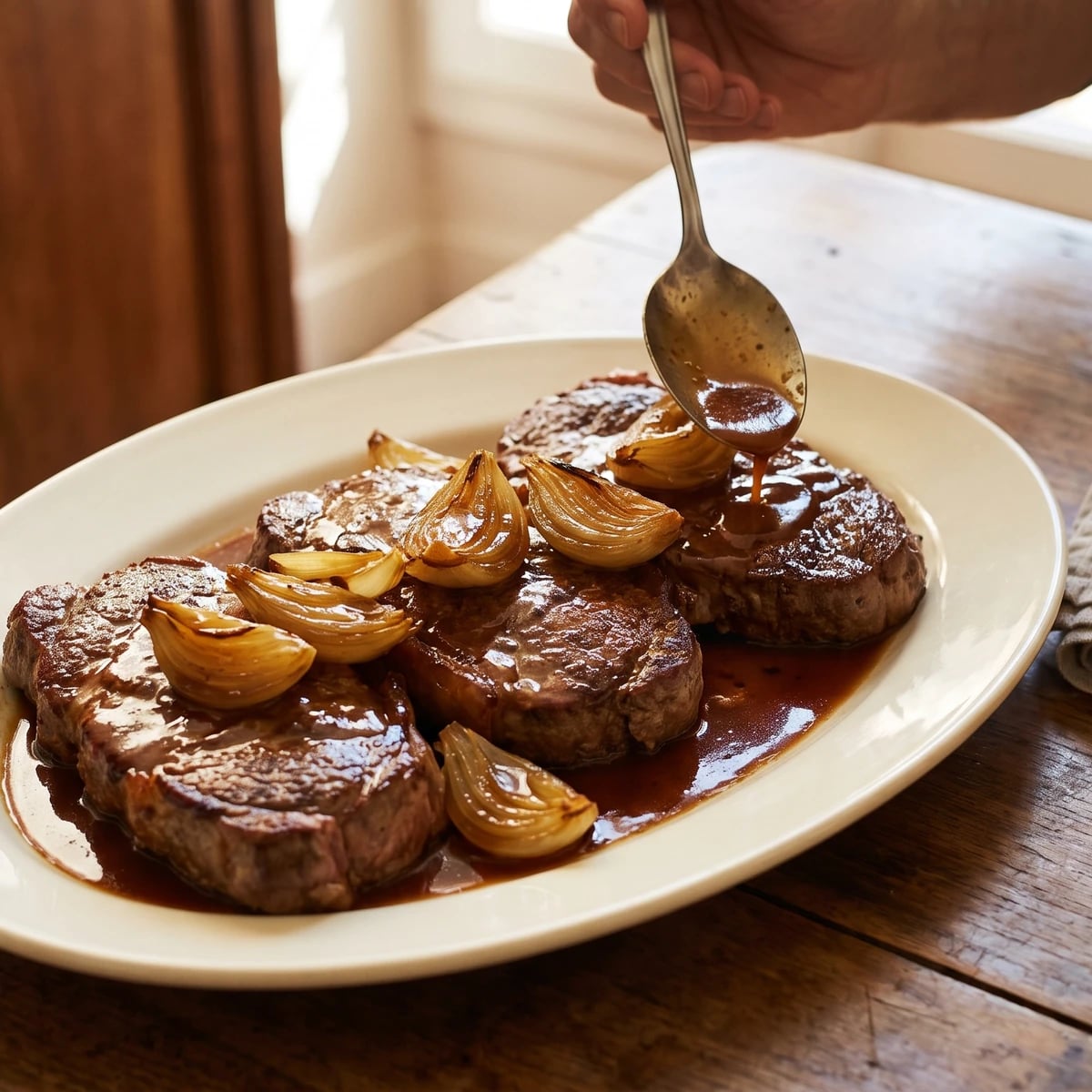
Biftecks braisés aux oignons teaches the honest braise: brown thick steaks in butter, settle them beneath abundant gilded onions, then give gentle heat three hours to make its own rich gravy.

Main Dishes
French
Comfort Food
Make Ahead
Budget Friendly
20 min
Active Time
3 hr 45 min cook4 hr 5 min total
Yield4 servings

Biftecks braisés aux oignons (stewed steaks and onions) teaches the first law of a long braise: choose meat that needs time, then give it all the time it asks. These are thick chuck steaks, not tender grilling steaks, and the three hours are the dish. They soften the beef while a heap of browned onions surrenders itself to the gravy.

The old entry assumed a stock never off the fire, brigade judgment for every unnamed quantity, and a saucier ready to clear the grease and reduce the liquor at service. At home, four steaks, gelatin-rich unsalted stock, one heavy cocotte, and a wide spoon do the same work. Those are scaffolding changes, made because one cook has no station behind them; butter-browning, abundant quartered onions, short moistening, three gentle hours, defatting, and reduction all stay, because they are the dish. One cook, one stove, one evening.

Keep the braise at a bare tremble. A hard boil drives the meat tight and batters the onions apart before they can melt gracefully; if the liquid bubbles hard, lower the heat at once. Patience, not complication, makes this pot magnificent.

These steaks belong first to the English domestic table, where thick economical beef and onions shared a covered stewing pan until both yielded; French classical kitchens kept the dish's English character while codifying its browning, short moistening, and reduced finish. The word bifteck entered French from the English beefsteak, a small reminder that the classical canon has always absorbed useful dishes from across the Channel. This is not a quickly seared tender steak buried under fried onions: its identity lies in a braising cut, abundant onion quarters, and the full gentle cooking that turns their liquor into gravy.

The technique, the tradition, and the story behind every dish.

Discover Culinary Explorer

Ingredients

boneless beef chuck steaks

Quantity

4 steaks, each about 8 oz (225 g), 2 lb (900 g) total

cut 1⅓ inches (3.5 cm) thick

medium yellow onions

Quantity

8, about 2½ lb (1.1 kg)

peeled and quartered through the root

unsalted butter

Quantity

5 tablespoons (75 ml / 71 g)

divided

unsalted gelatin-rich beef stock

Quantity

2 cups (475 ml / 475 g)

kept hot and divided

fine sea salt

Quantity

2 teaspoons (10 ml / 12 g)

divided

freshly ground black pepper

Quantity

1 teaspoon (5 ml / 2 g)

Equipment Needed

  • Heavy lidded cocotte or Dutch oven, 5 to 6 quarts (4.7 to 5.7 liters)
  • Tongs or a broad turning spatula
  • Wide shallow spoon or gravy separator
  • Warm oval serving platter

Instructions

  1. 1

    Prepare the steaks

    Heat the oven to 285°F (140°C). Pat the steaks completely dry, then season both sides with three-quarters of the salt and all the pepper. A wet surface stews in the pan before it browns, and this dish needs a deep fond beneath its gravy.

  2. 2

    Brown the steaks

    Melt 2 tablespoons (30 ml / 28 g) of the butter in the cocotte over medium-high heat. When the foam subsides, brown the steaks in two batches, about 3 to 4 minutes per side, until they carry a dark bronze crust. Move them only when they release willingly, then set them aside. If the milk solids turn black, stop and pour away the burnt fat, wiping out only the loose black specks before adding fresh butter. Ça se rattrape. Keep any mahogany fond attached to the pot, because that is the beginning of the gravy.

    Crowding traps moisture and leaves the steaks grey. Two at a time gives each one enough hot metal to brown properly.
  3. 3

    Gild the onions

    Add the remaining 3 tablespoons (45 ml / 43 g) butter as needed and brown the onion quarters in two batches, placing their cut faces against the pot. Give them 8 to 10 minutes per batch, turning once, until their broad sides are butter-gold with bronze edges. They need colour, not complete tenderness. If the fond threatens to scorch before the onions brown, lower the heat and add a tablespoon of the measured stock; let it evaporate before continuing.

  4. 4

    Set the braise

    Pour ½ cup (120 ml / 120 g) of the hot stock into the empty pot and scrape up every browned deposit. Return the steaks in one snug layer, overlapping slightly only if necessary, then mound the browned onions over and around them. Add enough of the remaining stock to rise between one-third and halfway up the meat, reserving any excess. This is the mouillement court, a shallow braising liquid: the steaks must braise, not float. Bring it only to the first quiet tremble, cover tightly, and place the cocotte in the oven.

  5. 5

    Braise three hours

    Cook gently for 3 hours, turning the steaks once halfway through and checking that a little liquid remains on the pot floor. Add reserved hot stock only if the pot looks nearly dry. The liquor should barely quiver; if it bubbles actively, lower the oven by 25°F (15°C). At three hours, a fork should enter the beef with almost no resistance. If the meat remains firm, it isn't ruined, it simply needs more time. Ça se rattrape: cover it again and cook for another 20 to 30 minutes.

  6. 6

    Dish and defat

    Lift the steaks carefully onto a warm serving platter, then arrange the onion quarters abundantly around them. Cover loosely while you finish the liquor. Tilt the cocotte and skim every visible pool of fat with a wide shallow spoon, or pour the liquor through a gravy separator and return it to the pot. Clear away the grease, not the browned flavor beneath it.

  7. 7

    Reduce and serve

    Bring the cleared braising liquor to a brisk simmer and reduce it for 5 to 10 minutes, until glossy and substantial enough to coat the back of a spoon. Taste and add the remaining salt only if needed. If the liquor tightens too far, loosen it with a spoonful of hot stock; if it tastes salty before it has enough body, stop reducing and add unsalted stock for a lighter jus. Spoon the finished gravy over the steaks and onions, letting it pool generously on the platter. À table!

Chef Tips

  • Ask for chuck steaks cut to the full 1⅓ inches (3.5 cm). Ribeye, strip, and tenderloin are made for quick heat and become dry after three hours; chuck has the connective tissue this braise needs.
  • Plain yellow onions are correct here. Quarter them through the root so they hold their shape while browning, then soften slowly into the gravy during the braise.
  • Use unsalted, gelatin-rich beef stock. Reduction concentrates salt, while natural gelatin gives the finished liquor body without flour. The original calls for no roux, wine, garlic, or herbs, and none are needed.
  • Serve with mashed potatoes, boiled potatoes, or thick bread, something honest enough to collect the onion gravy. A fresh, medium-bodied red with good acidity suits the sweetness of the onions.

Advance Preparation

  • The braise can be cooked up to two days ahead. Transfer the steaks, onions, and unreduced liquor to a shallow covered vessel and refrigerate within two hours; the fat will solidify on top and lift away cleanly.
  • To serve, reheat the steaks and onions gently in their liquor until thoroughly hot, then dish them and perform the final reduction. Add a spoonful of unsalted stock if the chilled gravy has set too firmly.

Frequently Asked Questions

Nutrition Information

1 serving (about 435g)

Calories
735 calories
Total Fat
48 g
Saturated Fat
22 g
Trans Fat
3 g
Unsaturated Fat
22 g
Cholesterol
195 mg
Sodium
1350 mg
Total Carbohydrates
26 g
Dietary Fiber
5 g
Sugars
12 g
Protein
50 g

Note: Chef personas and recipes are created with AI assistance. Cook with care: follow safe food-handling practices, check doneness with a thermometer when needed, and adapt for allergies and your kitchen.

Where cooking meets culture.

Culinary guides, cultural storytelling, and the editorial depth that makes cooking meaningful.

Discover Culinary Explorer

More from Relevés and Entrées - Ox Tails

Browse the full collection