
Chef Juliette
John Dory (St. Pierre)
John Dory has the delicacy of sole and the firmness of turbot. A light flouring, a quick butter sauté, and nut-brown beurre noisette show exactly why looks never mattered.
A cooking platform built around craft, culture, and the stories behind what we eat.
Created by Chef Juliette
Based on No. 1161, Queue de Bœuf Farcie, from Le Guide Culinaire (1907) by Auguste Escoffier
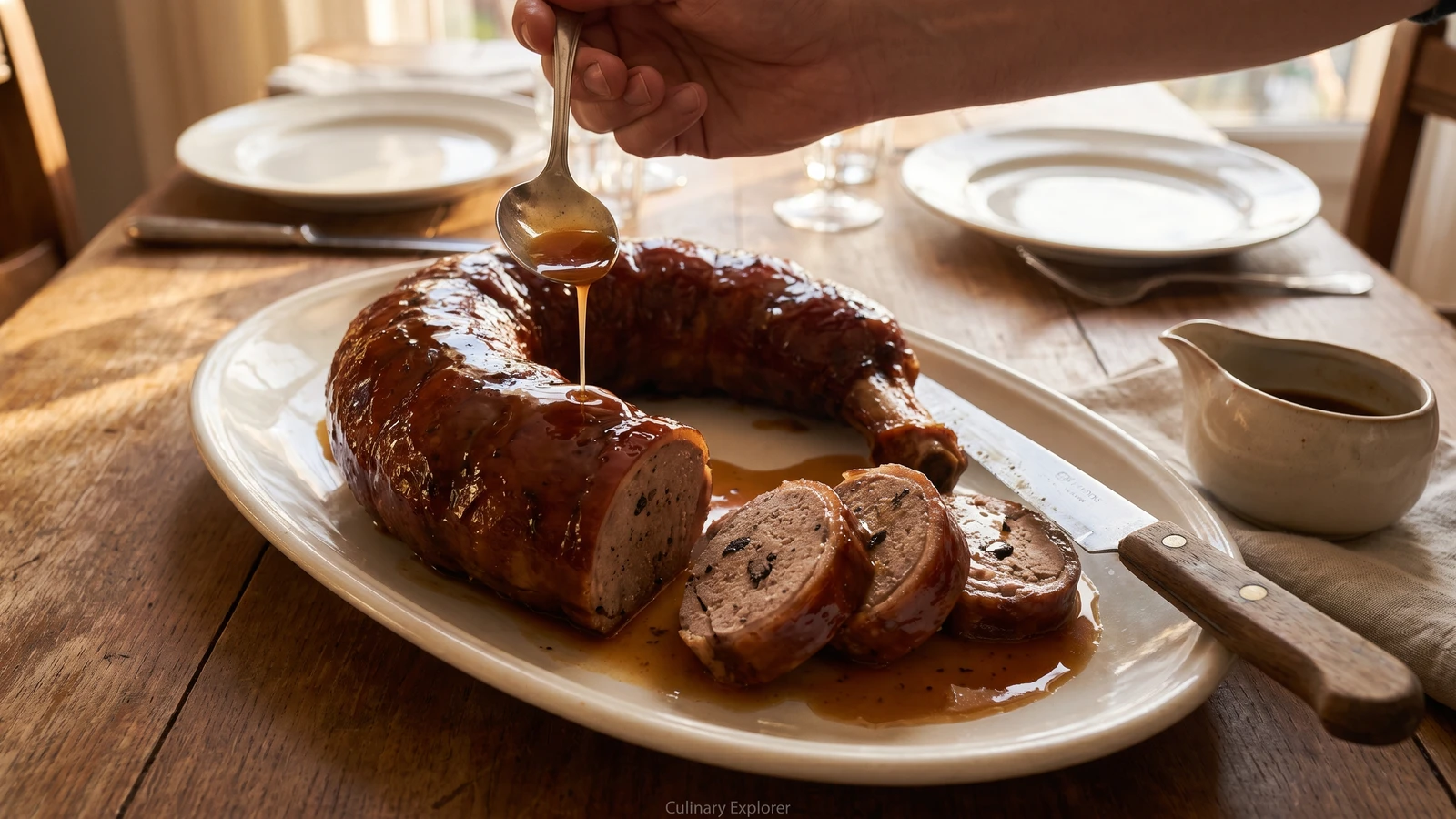
Queue de Bœuf Farcie turns patient boning, truffled forcemeat, and gentle poaching into a burnished centerpiece. The final basting is the dish: each spoonful builds the lacquer that makes the tail magnificent.
Queue de Bœuf Farcie (whole oxtail stuffed with truffled beef forcemeat) teaches glazing by accumulation. The one true thing to know before touching a pan is that its deep chestnut lacquer is not applied at the end; it is built, spoonful by spoonful, as the cooking liquor concentrates over the meat. Rush those last bastings and you will have a cooked tail, but not this dish.
The original instructions assumed a stock never off the fire, a saucier reducing liquor while another hand basted, linen for the galantine, a cloth-bound stuffed piece, and a long sauté pan that fit the tail. They had no need of a salamander; the shine came from repeated basting, and it still should. Here, good unsalted stock diluted to a light broth, cotton muslin, an oval cocotte, and a household oven take their places. The book's forcemeat is halved for four while preserving its exact 3:2:1 ratio of lean beef, fat bacon, and pressed crumbs. The perpetual stockpot and spare hands were brigade scaffolding, so they go. The intact boning, gentle three-hour poach, and final glazing are the dish, so they stay. One cook, one stove, one evening.
Bone from the thick end, one vertebra at a time, and keep the blade facing bone, never skin. A small nick can be stitched and supported by the muslin, so don't lose your nerve. Once the tail is poached and unwrapped, the finish asks for attention rather than force: baste more and more often as the liquor turns syrupy. That is the step that matters most.
Queue de bœuf farcie belongs to the Parisian classical table, where the charcutier's galantine method of boning, stuffing, wrapping, and poaching passed into the hot kitchen. Its ingenuity is practical: a highly jointed, economical cut becomes a sliceable centerpiece without losing the tail's curved form. It is sometimes mistaken for a braised roast, but the canon treats it first as a poached galantine and only then as a glazed piece, with its own cooking liquor reduced into the sauce.
Quantity
1 tail, 3 to 3½ lb (1.35 to 1.6 kg)
skin intact and kept in one piece
Quantity
6 oz (170 g)
trimmed, diced, and very cold
Quantity
4 oz (113 g)
rind removed, diced, and very cold
Quantity
About 1 packed cup (2 oz / 57 g)
Quantity
1 cup (240 ml / 245 g)
for soaking the breadcrumbs
Quantity
1
Quantity
About ⅓ cup (1½ oz / 42 g)
fresh or preserved, drained and finely chopped
Quantity
1¼ teaspoons (¼ oz / 7 g)
Quantity
¼ teaspoon (0.6 g)
Quantity
Scant 1/16 teaspoon (0.1 g)
Quantity
8 cups (1.9 L / about 1.9 kg)
Quantity
4 cups (960 ml / 960 g), plus more if needed
Quantity
1 large, about 9 oz (255 g)
halved
Quantity
2 medium, about 8 oz (225 g)
cut into large pieces
Quantity
2 medium, about 9 oz (255 g)
cleaned and cut into large pieces
Quantity
2 large stalks, about 4 oz (115 g)
cut into large pieces
Quantity
1 small, about 5 oz (140 g)
quartered
Quantity
2
Quantity
1
4 parsley stems, 2 thyme sprigs, and 1 bay leaf
Quantity
¾ teaspoon (4 g)
reserve a little for final adjustment
Quantity
1 medium, about 7 oz (200 g)
thinly sliced
Quantity
1 medium, about 4 oz (115 g)
thinly sliced
Quantity
1 stalk, about 2 oz (55 g)
thinly sliced
Quantity
1 tablespoon (0.3 oz / 8 g)
Quantity
2 tablespoons (30 ml / 30 g)
| Ingredient | Quantity |
|---|---|
| whole, uncut oxtailskin intact and kept in one piece | 1 tail, 3 to 3½ lb (1.35 to 1.6 kg) |
| very lean beeftrimmed, diced, and very cold | 6 oz (170 g) |
| fatty unsmoked slab baconrind removed, diced, and very cold | 4 oz (113 g) |
| fresh white breadcrumbs | About 1 packed cup (2 oz / 57 g) |
| whole milkfor soaking the breadcrumbs | 1 cup (240 ml / 245 g) |
| large egg | 1 |
| black truffle peelingsfresh or preserved, drained and finely chopped | About ⅓ cup (1½ oz / 42 g) |
| fine sea salt for the forcemeat | 1¼ teaspoons (¼ oz / 7 g) |
| freshly ground black pepper | ¼ teaspoon (0.6 g) |
| ground quatre-épices | Scant 1/16 teaspoon (0.1 g) |
| unsalted light beef stock | 8 cups (1.9 L / about 1.9 kg) |
| water | 4 cups (960 ml / 960 g), plus more if needed |
| yellow onion for poachinghalved | 1 large, about 9 oz (255 g) |
| carrots for poachingcut into large pieces | 2 medium, about 8 oz (225 g) |
| leeks for poachingcleaned and cut into large pieces | 2 medium, about 9 oz (255 g) |
| celery for poachingcut into large pieces | 2 large stalks, about 4 oz (115 g) |
| turnipquartered | 1 small, about 5 oz (140 g) |
| whole cloves | 2 |
| bouquet garni4 parsley stems, 2 thyme sprigs, and 1 bay leaf | 1 |
| fine sea salt for the poaching liquorreserve a little for final adjustment | ¾ teaspoon (4 g) |
| yellow onion for the braising bedthinly sliced | 1 medium, about 7 oz (200 g) |
| carrot for the braising bedthinly sliced | 1 medium, about 4 oz (115 g) |
| celery for the braising bedthinly sliced | 1 stalk, about 2 oz (55 g) |
| arrowroot | 1 tablespoon (0.3 oz / 8 g) |
| cold water for the arrowroot slurry | 2 tablespoons (30 ml / 30 g) |
Soak the breadcrumbs in the milk for 10 minutes, then squeeze them very firmly until no milk runs between your fingers. Pulse the cold beef and bacon in a chilled food processor until finely chopped and tacky, stopping before the fat turns greasy. Add the pressed crumbs, egg, truffle peelings, 1¼ teaspoons salt, pepper, and quatre-épices; pulse only until the mixture becomes cohesive. If the fat begins to smear, stop and spread the mixture in a shallow dish, chill it for 15 minutes, then continue briefly. Keep the finished forcemeat cold while you bone the tail.
Lay the oxtail on a stable board with its thick end toward you. Working through the exposed base, circle the first vertebra with the tip of a narrow boning knife, scraping connective tissue away while keeping the blade flat against the bone. Flex the tail to expose the joint, cut through its cartilage, and withdraw that vertebra. Turn back only enough of the loosened meat to expose the next bone, then repeat, one joint at a time, all the way to the narrow tip. Never saw toward the skin, and keep your free hand behind the knife. If you make a small nick, stop. Ça se rattrape: close it at once with two or three stitches of butcher's twine; the muslin will support the repair during poaching.
Turn the boned tail right side out and check the cavity for bone fragments. Feed the cold forcemeat down toward the pointed end with a spoon handle and your fingers, pressing out air pockets but never stretching the skin taut. The filling expands as it cooks. When the tail is naturally rounded, fold the thick opening neatly inward and close it with firm overcast stitches using a poultry trussing needle and butcher's twine. If the edges won't meet, remove a spoonful of filling rather than forcing them; an overfilled tail splits before it reaches the table.
Dampen the cotton muslin and wring it nearly dry. Lay the stuffed tail along one edge, roll it snugly in the cloth, and twist and tie both ends. Add loops of twine every 2 inches (5 cm), close enough to hold the curved form but not so tight that they cut into the meat. The bundle should feel supported, not strangled.
Put the stock, water, halved onion, poaching carrots, leeks, celery, turnip, cloves, bouquet garni, and most of the remaining salt into the oval cocotte. Bring the liquid to a bare tremble, then lower in the wrapped tail and add enough water to cover it. Hold the liquor between 180 and 190°F (82 and 88°C) for 3 hours, turning the bundle every 30 minutes if it isn't fully submerged. A rolling boil drives out fat and can burst the wrapping; if the pot boils, lift it off the heat for 2 minutes and return it over a lower flame. After the full 3 hours, test through the sewn thick end: the forcemeat must reach at least 160°F (71°C), and the tail should yield when pressed with tongs. Continue for 15 minutes if either test is not met.
Heat the oven to 425°F (220°C). Lift the bundle onto a tray and let it drain for 10 minutes. Strain the cooking liquor, discard the spent vegetables, and skim off excess fat. Measure 2 cups (480 ml) for braising, 3 cups (720 ml) for the sauce, and keep another cup nearby for loosening either one. Remove the outer ties and muslin while leaving the closure stitches intact. Spread the sliced onion, carrot, and celery in a heavy shallow roasting pan as a mirepoix, an aromatic vegetable bed. Set the tail on top and pour the 2 cups of liquor around it.
Roast the tail uncovered for 35 to 45 minutes. Baste it generously with the pan liquor every 7 or 8 minutes for the first half hour, rotating the pan if the colour develops unevenly. During the final 10 minutes, baste every 2 or 3 minutes as the liquor concentrates and clings. This increasing rhythm is the dish. If the pan dries before the tail is deep chestnut and glossy, add reserved cooking liquor ¼ cup (60 ml) at a time. If the surface remains pale while the meat is already hot, reduce a ladle of the pan liquor in a small saucepan until syrupy, brush it over the tail, and return it to the oven for 5 minutes.
Move the glazed tail to a carving board and rest it uncovered for 10 minutes so the lacquer stays firm. Strain the braising liquor into a saucepan with the reserved 3 cups of poaching liquor, skim it carefully, and reduce briskly to about 2¼ cups (540 ml). Mix the arrowroot with the cold water until perfectly smooth. Lower the sauce to a gentle simmer and whisk in half the slurry; wait 30 seconds before adding only enough of the remainder to make the sauce lightly coat a spoon. Do not boil it hard after thickening. If it becomes too tight, whisk in reserved cooking liquor a spoonful at a time; if it forms lumps, pass it through the fine sieve again.
Spoon a light veil of sauce over the bottom of a warmed oval platter. Remove every closure thread and any repair stitches from the tail, then arrange it in its natural curve. Leave most of it whole and carve several ¾-inch (2 cm) rounds from the thick end to show the truffled forcemeat. Send the remaining cooking-liquor sauce in a warmed sauceboat, with a smooth purée or braised root vegetables served separately. À table!
1 serving (about 320g)
Culinary guides, cultural storytelling, and the editorial depth that makes cooking meaningful.
Discover Culinary ExplorerChef Juliette
John Dory has the delicacy of sole and the firmness of turbot. A light flouring, a quick butter sauté, and nut-brown beurre noisette show exactly why looks never mattered.

Chef Juliette
Fresh haddock proves its delicacy in the meunière pan: a fine flour crust, moist pearly flakes, and beurre noisette sharpened with lemon and parsley, ready from one skillet in half an hour.

Chef Juliette
Éperlans à l’Anglaise turns small fish into a lesson in disciplined coating: boned smelts under a close, crisp crumb, pan-fried in clarified butter and finished with bright, half-melted maître d’hôtel butter.

Chef Juliette
Tiny smelts, shallot, mushrooms, white wine, gratin sauce, and fine bread raspings meet a fierce oven, where the fish must turn tender in the same breath the buttered crust bronzes.